Castlepook’s Carnivore Cave30325 BCE
Around 30,325 BCE, Ireland lay in later Marine Isotope Stage 3, amid unstable cold conditions and growing ice sheets. Derryvree in Fermanagh preserves an ice-free wetland interval, with tundra vegetation, shallow pools and open ground. Castlepook Cave in Cork contains remains of mammoth, reindeer, giant deer and carnivores, demonstrating changing connections with north-west Europe. A cut-marked reindeer femur may indicate early human carcass processing, but cannot establish settlement. Later glaciation destroyed or disturbed much evidence, leaving deposits and bones as fragmentary records of a landscape approaching major glacial transformation. Evidence cannot support an exact annual historical account for this period.
Dateline
A date expressed as 30,325 BCE suggests a precision that the evidence cannot bear. No Irish event, community or individual can be assigned to this particular calendar year. At this depth in time, archaeologists and Quaternary scientists work with radiocarbon determinations, calibrated ranges, sediment layers, animal remains and changing landforms; their uncertainties commonly extend across centuries or millennia. The most responsible view is therefore of Ireland during the later part of Marine Isotope Stage 3, perhaps around 32,000–33,000 calendar years before present, as climates deteriorated towards the main expansion of the last British–Irish Ice Sheet.
The island was not the familiar green, wooded Ireland of later prehistory. Nor should it be imagined as uniformly entombed beneath ice at every moment. The fullest Last Glacial Maximum lay later, although ice sheets were growing, climates were exceptionally unstable, sea level was much lower, and the outlines of coasts, river valleys and exposed shelves differed profoundly from those of today. The direct Irish record for this era is sparse, unevenly dated and vulnerable to the destruction or disturbance caused by later glaciation. Its value lies precisely in its fragments: a buried wetland in Fermanagh, and animal-rich limestone caves in Cork, preserve different aspects of a vanished world.
Open Ground Before the Great Ice
At Derryvree near Maguiresbridge in County Fermanagh, roadworks exposed organic silts and fine sands lying between two tills: deposits of glacial debris laid down at different times. The organic layer produced the important radiocarbon determination BIRM-166, 30,500 radiocarbon years before present, with a substantial uncertainty. This conventional radiocarbon age must not be treated as an exact calendar equivalent, but it identifies an ice-free interval in the broad later-MIS-3 landscape of Ireland. Its position below a later till is equally important: whatever open terrain and water lay here were eventually overridden or sealed by renewed ice advance.
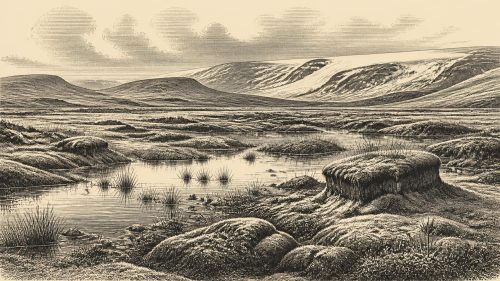
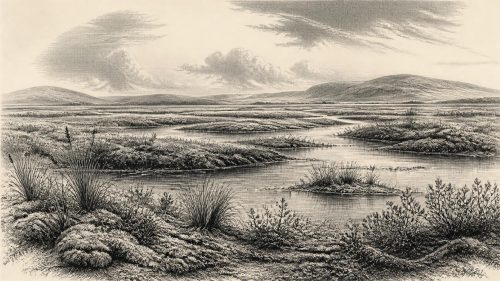
The Derryvree fossils evoke a severe but living environment. Plant macrofossils and pollen include sedges, grasses, dwarf willow, juniper, mountain avens, bogbean and water-milfoil; mosses and insect evidence point to wet ground with shallow pools and plant-rich margins. This was not dense forest. It was a treeless, periglacial mosaic of open tundra, muskeg-like wetland, damp hollows and exposed mineral ground. Short growing seasons could nevertheless support a specialised flora, while sheltered freshwater habitats created local ecological variety. The evidence speaks most securely for conditions at the site and for a broad climatic phase, not for a continuous, unchanging landscape across every part of Ireland.
For people, had they been present, such a landscape would have offered difficult opportunities rather than easy abundance. Watercourses, lake margins and seasonal vegetation would concentrate animals and fuel, while the surrounding open country exposed travellers to wind, frost and rapidly changing weather. There were no known fields, houses, monuments, pottery or cemeteries. There is no basis for describing kingdoms, chiefs, diplomacy, formal warfare, trade routes or religious institutions in Ireland at this date. Those categories belong to much later archaeological records. The political history of this year is therefore not hidden: it is simply beyond the reach of the surviving evidence.
The Cave at Castlepook
The richer animal evidence comes from Castlepook Cave, also called Mammoth Cave, near Doneraile in north County Cork. Excavated principally in the early twentieth century, and investigated again in recent decades, the cave is Ireland’s most significant known archive of vertebrate life before the Last Glacial Maximum. Its old collections are complicated by antiquarian excavation, uncertain original contexts and natural bone movement within a cave system. That means the assemblage cannot be treated as the refuse from one hunt, one season or one human camp. Yet the bones establish that an impressive large-mammal and carnivore community reached Ireland during colder phases of the Late Pleistocene.
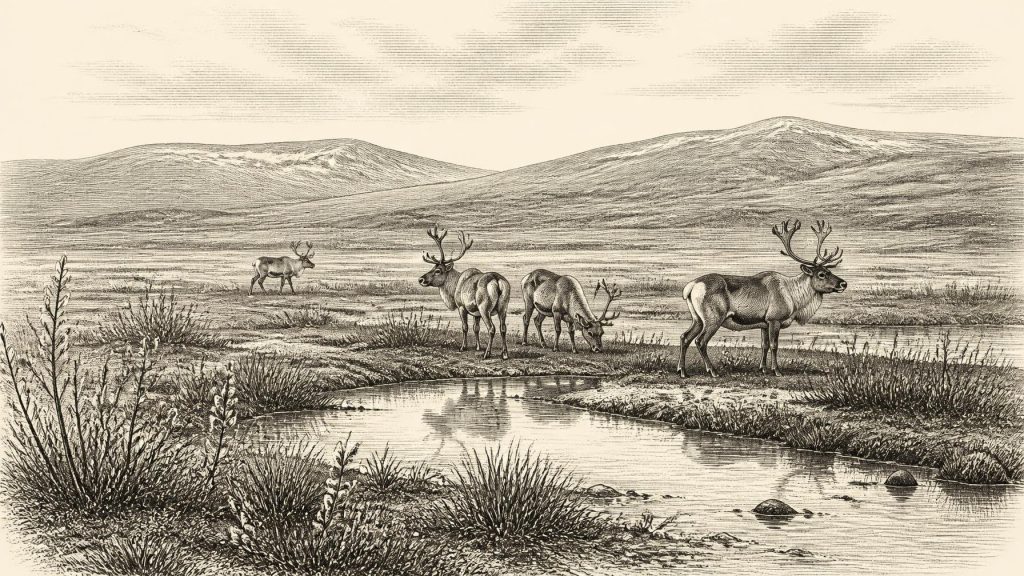
Castlepook’s fauna includes woolly mammoth, reindeer, giant deer, brown bear, wolf, foxes, hare, stoat, lemmings and spotted hyena. This combination is powerful environmental evidence. Reindeer, lemmings, Arctic fox and woolly mammoth are especially consistent with cold, open habitats and with Ireland’s intermittent biological connection to the wider north-west European world. Giant deer, despite its later popular association with a lush Irish past, was also part of this Pleistocene fauna. The cave was not necessarily a peaceful animal sanctuary. Hyenas and other carnivores could have dragged prey or scavenged carcasses into its chambers; water, slope processes and later excavation then mixed the record further.
The fauna also reminds us that Ireland’s insularity was changing. Lower global sea levels exposed broad areas now beneath the Irish Sea and Atlantic margins, but exposed land did not automatically mean a simple, dry land bridge usable at all times or in every direction. Glaciers, meltwater, sea incursions, cold-steppe vegetation and shifting coastlines formed a moving set of barriers and corridors. Mammals demonstrably reached the island during parts of this long period. The precise routes, timing and frequency of their movements remain debated, and should not be simplified into a single migration pathway.
A Possible Human Trace
The most arresting evidence is a reindeer femur from Castlepook bearing a deep linear mark. Ruth Carden and colleagues have interpreted the modification as a cut made by a stone tool while fresh bone was being processed. The bone has been publicly reported as about 33,000 years old, making it potentially much earlier than the long-accepted evidence for human presence in Ireland. If the mark is confirmed as anthropogenic, it indicates a brief encounter in which a person or group handled a reindeer carcass. It does not demonstrate permanent settlement, a village, a population spanning the island, or activity in 30,325 BCE itself.
This distinction matters. Cave bones can be damaged by teeth, trampling, sediment movement, excavation tools and weathering. A convincing cut mark must be assessed through its position, shape, microscopic characteristics and relation to the bone’s preservation. Moreover, dating the bone dates the animal’s death, not necessarily every action associated with it. The Castlepook femur is thus best regarded as important but limited evidence: a serious hypothesis of very early human activity in Ireland, rather than a complete Palaeolithic settlement record. Recent cave research is valuable because it can seek intact deposits and test old interpretations with modern excavation, dating, microscopy and biomolecular methods.
If people did visit, their everyday life would have been mobile and highly dependent on knowledge rather than built infrastructure. They would have required clothing, fire-making, stone-working skills, cooperation and familiarity with animal behaviour. A reindeer carcass could yield meat, marrow, hide, sinew and bone, but no securely associated hearth, stone-tool assemblage or camp floor from Castlepook currently permits a fuller reconstruction. Nor can language, kinship, ritual or learning be recovered directly. It is reasonable to infer that survival in this climate depended on shared practical knowledge, but the content of that knowledge is unknown.
Ice, Loss and Survival
The broad trajectory was towards a more extensive and dynamic ice sheet. Modern reconstructions show that the British–Irish Ice Sheet grew and changed markedly after about 31,000 years ago, with different sectors reaching their maxima at different times. Ireland’s later glacial landforms—drumlins, streamlined bedrock, tills, moraines and meltwater channels—testify to powerful ice movement, but they cannot provide a neat island-wide map for one numbered year in the early phase of growth. The Derryvree sequence itself demonstrates the larger pattern: an ice-free wetland could be preserved between deposits left by separate glaciations.
That later ice helps explain the poverty of Ireland’s early archaeological record. Advancing glaciers eroded surfaces, redeposited sediments and obscured ancient places where people might once have paused. Caves, protected fissures and buried organic horizons have a better chance of retaining evidence, although each has its own taphonomic problems. Absence of camps therefore cannot prove that no person ever entered Ireland in this period; equally, one modified bone cannot prove enduring occupation. The proper historical conclusion is a narrow but consequential one: later-MIS-3 Ireland sustained cold-adapted animals in open and locally wet landscapes, and Castlepook may preserve a fleeting human interaction with that world.
For Ireland around 30,325 BCE, then, the central story is environmental rather than political. Seasonal pools lay amid tundra vegetation in Fermanagh; reindeer, mammoth, giant deer and predators moved through other parts of the island; and changing ice, sea and climate repeatedly altered the conditions of access and survival. The evidence does not yield an annual chronicle. It offers something older and more fragile: a handful of deposits and bones from a landscape on the threshold of glacial transformation.
Primary Sources
- A Middle Midlandian Freshwater Series at Derryvree, Maguiresbridge, County Fermanagh, Northern Ireland
- Irish Pleistocene Biostratigraphy
- The Irish Quaternary Fauna Project
- Castlepook Cave, County Geological Site Report
- The Archaeological Heritage of County Cork
- UCD School of Archaeology Research Day 2022
- New Insights on the Fauna of Ireland's Younger Dryas and Early Holocene from Alice & Gwendoline Cave
- Deglaciation Chronology of the Donegal Ice Centre, North-West Ireland
- Growth and Retreat of the Last British-Irish Ice Sheet, 31,000 to 15,000 Years Ago: the BRITICE-CHRONO Reconstruction
- The Timing and Magnitude of the British-Irish Ice Sheet Between Marine Isotope Stages 5d and 2
- Timing and Pace of Ice-Sheet Withdrawal Across the Marine-Terrestrial Transition West of Ireland During the Last Glaciation
- Exploring Controls of the Early and Stepped Deglaciation on the Western Margin of the British Irish Ice Sheet
- Britain and Ireland: Glacial Landforms from the Last Glacial Maximum
- Trimlines, Blockfields and the Vertical Extent of the Last Ice Sheet in Southern Ireland
- Radiocarbon Constraints on the Age of the Maximum Advance of the British-Irish Ice Sheet in the Celtic Sea
- The Irish Brown Bear: a Review of Its History and Status
- Landscapes and Environments of the Last Glacial-Interglacial Transition: a Time of Amazingly Rapid Change in Ireland
- Ireland's Palaeolithic Archaeology – Fleeting Footprints in a Frozen Land
- The Irish Biogeographical Society: Postglacial Colonisation of Ireland
- IQUA Newsletter No. 58