Maguiresbridge’s Mossland Interval30321 BCE
30,321 BCE is a modern label within an uncertain Late Pleistocene interval, not a date recoverable as annual history. At Derryvree, County Fermanagh, organic freshwater sediments between glacial tills indicate a temporary ice-free tundra wetland episode, broadly dated to 34,950–29,750 BCE. Mosses, sedges, grasses and cold-adapted plants grew beside shallow water before returning ice buried the site. Castlepook Cave fauna, including reindeer, horse, mammoth and hyaena, demonstrate changing cold-open habitats. A possibly cut-marked reindeer bone may indicate human carcass processing, but proves neither settlement nor occupation. Low seas altered access, but routes remained uncertain; Ireland was ecologically dynamic, archaeologically sparse.
Dateline
30,321 BCE is a modern calendar label, not a date at which Ireland’s deep past can be observed year by year. No written record, settlement sequence or archaeological horizon can be assigned to that precise year. The responsible approach is to place it within a much wider Late Pleistocene setting: roughly 32,270 years before AD 1950, during Marine Isotope Stage 3 (MIS 3), as the climate was unstable and the British–Irish Ice Sheet was growing. Evidence relevant to Ireland comes chiefly from buried sediments, cave fauna, landforms and radiocarbon measurements with broad uncertainties. It can illuminate landscapes and possibilities, but not provide an annual chronicle.
A Date Within Broad Ranges
The closest important Irish chronological anchor is Derryvree townland, near Maguiresbridge in County Fermanagh. Roadworks in 1969 cut through a drumlin and exposed a remarkable sequence: an older glacial till below, freshwater silts and fine sands with organic material in the middle, and a younger till above. In plain terms, ice had occupied the site, then retreated or ceased to cover that locality long enough for water, sediment and plants to accumulate, before ice-related deposition returned and sealed the record.
The organic deposit produced radiocarbon determination BIRM-166, conventionally reported as 30,500 radiocarbon years before present, with a large uncertainty of +1,170 and −1,030 years. A radiocarbon age is not a calendar age: atmospheric carbon-14 levels have varied, so results must be calibrated. Using modern calibration, the determination is best treated as a broad range, approximately 36,900–31,700 calibrated years before present, or about 34,950–29,750 BCE. Thus 30,321 BCE falls within the general chronological span relevant to Derryvree, but cannot be attached to a particular sediment layer, season, animal or human action there.
This distinction matters. The evidence establishes an ice-free freshwater episode at one Fermanagh locality during the wider Middle Midlandian cold stage. It does not prove that every part of Ireland was simultaneously open, habitable or connected by a single uniform landscape. Dating uncertainty, local environmental variation and the fragmentary survival of deposits rule out that degree of confidence.
A Treeless Wetland World
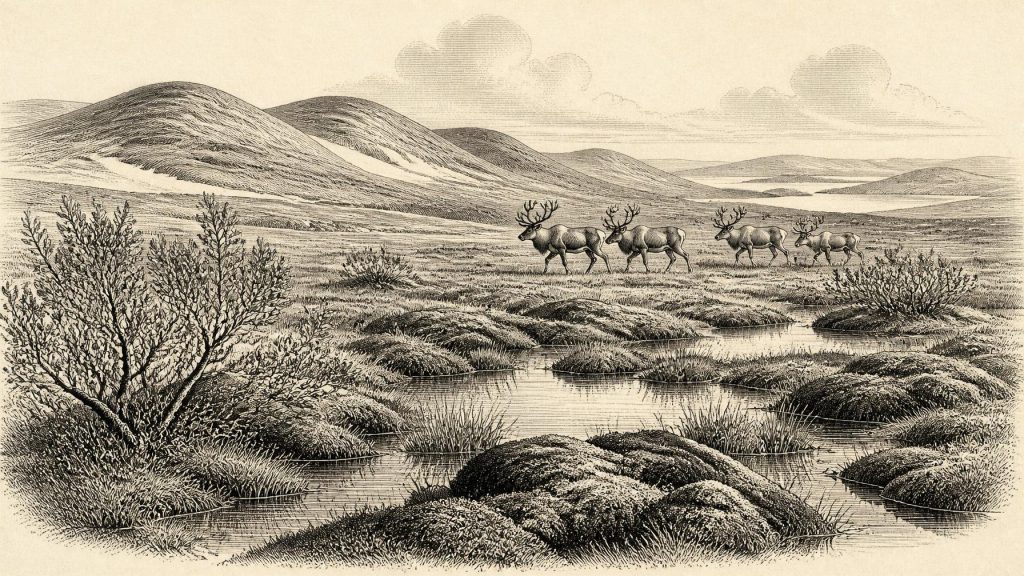
Derryvree is nevertheless unusually vivid. Its fossil flora and fauna indicated open tundra vegetation and a periglacial regime: a cold landscape shaped by frost, seasonal thaw and ground processes near an ice margin rather than by dense forest. Mosses, sedges, grasses and hardy herbs grew around freshwater. Finds included plants adapted to cold, exposed conditions, among them mountain-avens, dwarf willow and bogbean, while aquatic or wet-ground species show that standing or sluggish fresh water existed within the basin.
The scene should not be pictured as an unbroken white wilderness. In the short growing season, wet hollows, shallow pools, sedge margins and mossy ground could support patches of vegetation. Yet this was no later Irish countryside: there were no oak woods, fields, hedges or peat-cuttings. Winter cold, wind, frozen ground and limited woody cover would have made the terrain austere. The upper till records the larger fact governing all local life: the return or advance of glacier ice eventually overwhelmed and preserved the wetland.
Recent reconstructions of the British–Irish Ice Sheet reinforce the need for caution. They identify significant ice growth across Ireland and Britain from about 31,000 to 26,000 years ago, but reconstructing the exact position of every margin remains impossible. Around the nominal date considered here, parts of Ireland may have held expanding upland ice masses while some lower ground retained periglacial or ice-free environments. Derryvree is evidence for such a local window, not a licence to draw a sharp national coastline or a single map of the island for 30,321 BCE.
Animals, Caves and Mobility
Irish cave deposits offer another, different form of evidence. Castlepook Cave, near Doneraile in north County Cork, has yielded Late Pleistocene remains of animals associated with cold, open habitats: reindeer, horse, hare, fox, lemming, brown bear, spotted hyaena and woolly mammoth among them. These species did not necessarily live together at one instant, and cave assemblages are not straightforward snapshots. Carnivores could drag prey into caves; water, disturbance and early excavation methods could mix material of different ages. Still, the assemblage demonstrates that Ice Age animal communities repeatedly used, or ranged through, parts of Ireland during the wider period.
Reindeer are particularly significant. They were suited to open, cold country and could move over great distances in seasonal or longer-term migrations. Their presence makes a resource landscape conceivable for mobile human visitors, but it does not establish a resident human population. Mammoth and hyaena remains are equally important reminders that Ireland’s ecological past cannot be reduced to modern native fauna. Predators, scavengers and herbivores formed overlapping food webs in a changing world where access to forage, shelter and unfrozen water varied sharply across the year.
The Castlepook Human Question
A reindeer femur from Castlepook has been reported as bearing a deep mark interpreted as damage made by a sharp stone tool during carcass processing. Public accounts have associated the specimen with an age of about 33,000 years ago. If the mark is correctly identified as anthropogenic and securely related to the dated animal, it would be exceptionally early evidence for human activity in Ireland: not an Irish “first settlement”, but an episode in which a person or very small party processed a reindeer carcass.
The qualification is essential. The bone derived from older cave collections rather than a modernly excavated living floor containing tools, hearths and refitting debris. No securely associated lithic assemblage, dwelling, burial, human skeleton or art of this age has been published from Ireland. Modern work at Castlepook has sought intact Pleistocene deposits and better contextual evidence, but it has not transformed the site into a demonstrated Upper Palaeolithic camp. The femur should therefore be treated as important and suggestive evidence, not as proof of permanent colonisation.
No Polities, No Proven Trade
There were no political affairs to narrate in the historical sense. Archaeology provides no basis for identifying peoples, territories, leaders, alliances, diplomacy or organised warfare in Ireland at this time. Nor is there evidence for agriculture, stock keeping, villages, domestic architecture, cemeteries, metalwork, pottery or exchange networks. Terms such as tribe, nation, Gaelic, Celtic or kingdom would be anachronistic by tens of millennia.
If humans did reach Ireland during this phase, the strongest inference is that they were highly mobile hunter-gatherers familiar with the wider north-west European Upper Palaeolithic world. They may have followed animal movements or made short exploratory visits when geography and weather allowed. That inference derives from comparison with better-documented continental societies, however; it is not directly demonstrated by an excavated Irish camp. We cannot responsibly reconstruct their language, kinship, beliefs, clothing, boats, routes or numbers.
Culture and Belief Beyond Recovery
Religion, learning and artistic culture are similarly beyond the present Irish evidence. A cave is not automatically a ritual site, nor does an animal bone with a possible cut mark prove ceremony. The peoples of Upper Palaeolithic Europe elsewhere made sophisticated stone and bone tools, ornaments, images and formal burials, but no comparable securely dated cultural assemblage has yet been recovered in Ireland for this interval. Absence of evidence is not evidence that visitors lacked culture; it means that Irish archaeology cannot specify it.
What can be said is that practical knowledge would have mattered enormously if people were present. Reading snow, ice, animal tracks, shelter opportunities and the timing of seasonal change was knowledge on which survival depended. But this is a general human reality, not recoverable proof of particular practices at Derryvree or Castlepook.
An Island in Transformation
Sea level was far lower than it is today because so much water was stored in global ice sheets, but low sea level did not automatically create an easy land bridge to Ireland. The Irish Sea basin, changing coastlines, glacier positions and hazardous weather all shaped possible movement. Whether a particular route was open, passable or used at any given moment remains unresolved. Ireland may have been more geographically accessible than in the modern era, yet still difficult to enter and harder to occupy continuously.
The most important development around this notional year was therefore environmental, not political: an unstable cold-stage landscape in which local freshwater tundra could exist between episodes of glaciation, while animal communities ranged through an island being reshaped by ice. Derryvree’s buried wetland and Castlepook’s bones are precious precisely because they preserve small traces from a period otherwise repeatedly scoured, covered and altered by glaciers. They offer a responsible picture of Ice Age Ireland: ecologically real, archaeologically sparse and resistant to the false precision of a calendar-year story.
Primary Sources
- Middle Midlandian Freshwater Series at Derryvree, Maguiresbridge, County Fermanagh, Northern Ireland
- A Middle Midlandian Freshwater Series at Derryvree, Maguiresbridge, County Fermanagh, Northern Ireland
- The Geology of Ireland: Cenozoic—Tertiary and Quaternary
- Pleistocene Glaciations in Ireland
- Exploring Controls of the Early and Stepped Deglaciation on the Western Margin of the British Irish Ice Sheet
- Growth and Retreat of the Last British–Irish Ice Sheet, 31,000 to 15,000 Years Ago: the BRITICE-CHRONO Reconstruction
- The Timing and Magnitude of the British–Irish Ice Sheet Between Marine Isotope Stages 5d and 2
- Timing and Pace of Ice-Sheet Withdrawal Across the Marine–Terrestrial Transition West of Ireland During the Last Glaciation
- Trimlines, Blockfields and the Vertical Extent of the Last Ice Sheet in Southern Ireland
- Radiocarbon Constraints on the Age of the Maximum Advance of the British–Irish Ice Sheet in the Celtic Sea
- Quaternary
- Geology of Ireland
- The Subdivision of the Quaternary Period in Ireland
- References and Recommended Reading
- The IntCal20 Northern Hemisphere Radiocarbon Age Calibration Curve (0–55 cal kBP)
- IntCal Publications
- The Irish Quaternary Fauna Project
- Archaeology Research Excavation Grant 2022: Castlepook Caves Project Final Report
- 2022:564 – Castlepook Cave, Castlepook South, Cork
- Archaeological Heritage of County Cork
- New Insights on the Fauna of Ireland’s Younger Dryas and Early Holocene from Alice & Gwendoline Cave