Derryvree’s Moss Carbon30322 BCE
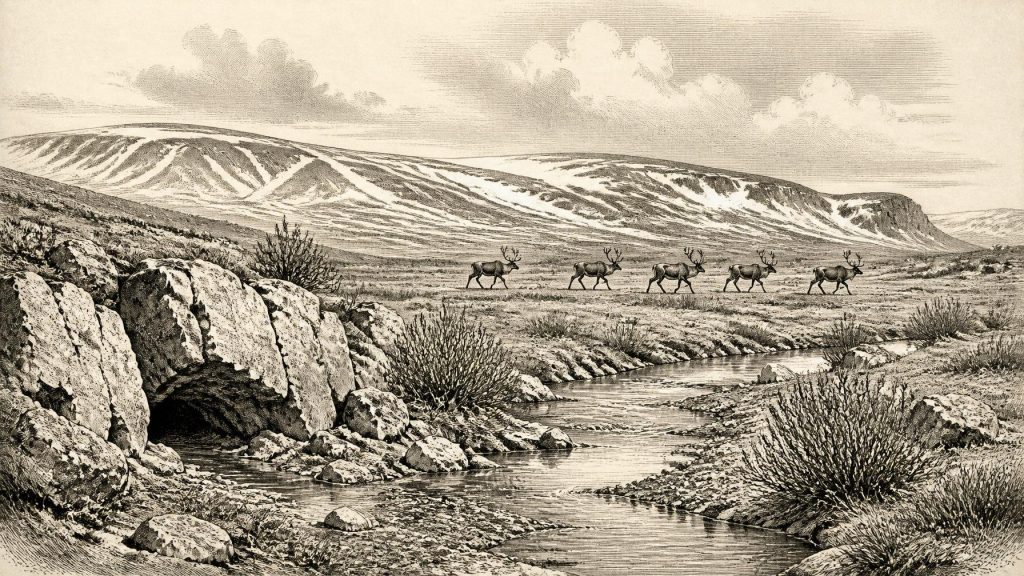
Around 30,322 BCE, Ireland lay in the Late Pleistocene, before the British–Irish Ice Sheet reached its maximum extent. Climate and landscapes changed repeatedly, producing mosaics of ice, exposed ground, tundra, wetlands and meltwater. Organic deposits at Derryvree, Fermanagh, suggest cold freshwater habitats, although their radiocarbon date is imprecise and low-confidence. Castlepook Cave’s fauna, including mammoth, reindeer, lemmings, predators and giant deer, demonstrates varied cold-environment ecosystems over long periods. A possibly cut-marked reindeer bone may indicate Upper Palaeolithic butchery, but cannot prove permanent human settlement. No evidence identifies polities, conflict, trade, religion or calendar-year events; interpretation depends on uncertain surviving traces.
Dateline
A label such as 30,322 BCE gives a useful point on a modern timeline, but it cannot describe a known Irish “year”. There was no written calendar in Ireland, no named community and no year-specific event that archaeology can securely assign to this date. In conventional arithmetic it falls roughly 32,270 years before AD 1950, but that conversion is not a radiocarbon determination. The responsible chronology is therefore broad: Ireland at this point belonged to the Late Pleistocene, during the last glacial cycle, and lay within a changing world that was moving towards the maximum expansion of the British–Irish Ice Sheet several millennia later.
The evidence is not a continuous historical record. It consists of cave bones, sediments trapped beneath later glacial deposits, landforms, dates with substantial uncertainties and comparisons with Greenland ice cores and North Atlantic marine records. These materials can illuminate climate, animals and landscape. They cannot establish an Irish government, a battle, a religion, an organised trade network or a settled population in 30,322 BCE. The most compelling human clue from this deep period is a potentially cut-marked reindeer bone from Castlepook Cave in north Cork, but even that is an important research question rather than a licence to write a narrative of permanent occupation.
A Date Within a Long Cold Age
By about 32,000 years ago, the island’s terrain was part of the Late Midlandian glacial episode, the Irish expression of the last major cold stage in north-west Europe. “Cold stage”, however, does not mean one uniform frozen scene. Ice cores show that the North Atlantic climate repeatedly shifted between colder stadials and comparatively milder interstadials on a millennial scale. A date expressed as a single BCE year is far too fine-grained to be matched confidently to one of those shifts in Ireland. Calibrated ranges, rather than a single year, are the proper language for this evidence.
At the broadest scale, ice was building in the mountains and across marine basins around Ireland. Research on the British–Irish Ice Sheet indicates major growth after about 32,000 years ago, while its later maximum extent on the western and southern shelves is generally placed nearer 26,000–23,000 calibrated years BP, with regional variation. Thus 30,322 BCE belongs to the approach to, not the culmination of, the Last Glacial Maximum. The island was not simply a modern outline buried beneath a static white cap. Ice margins advanced and reorganised; exposed ground, periglacial terrain, waterways and coasts changed as climate and sea level changed.
That distinction matters. Many of the drumlins, moraines, striae, meltwater routes and sheets of till now familiar in Ireland were shaped or reworked during later phases of the glaciation. They are durable evidence that ice profoundly altered the country, but they cannot be treated as a map of one moment in 30,322 BCE. Geological Survey Ireland’s Quaternary mapping makes clear both the richness of this physical record and its limitations: landforms and sediments preserve processes, not a diary.
Open Ground and Cold-Water Patches
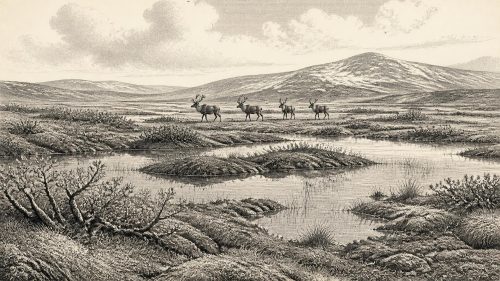
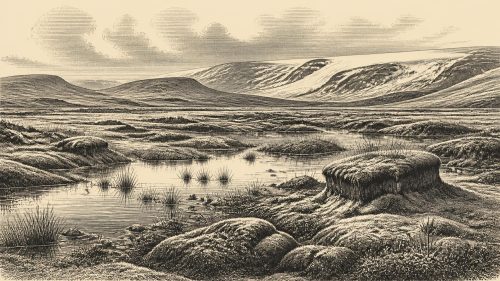
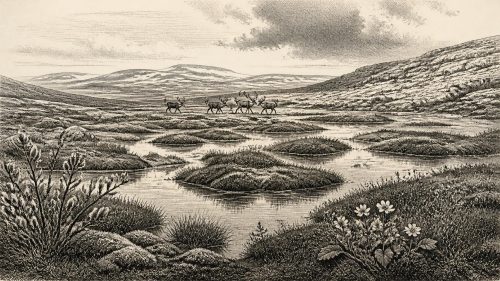
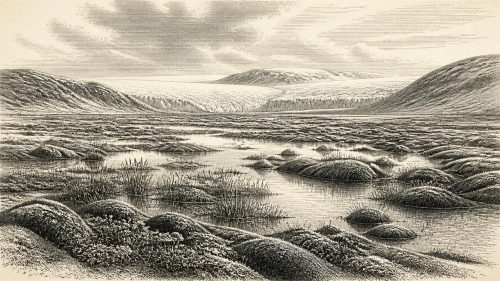
In Fermanagh, a much-discussed road-cut sequence at Derryvree near Maguiresbridge preserves organic-rich mud between glacial deposits. Its plant macrofossils include sedges, mosses and aquatic or wet-ground plants such as bogbean, water-milfoil, dwarf willow, mountain avens and other cold-tolerant species. Taken together, they indicate that, before the deposits were overridden and sealed by later ice, there had been shallow freshwater, marshy margins and treeless or sparsely vegetated tundra-like ground.
This is valuable environmental evidence, but its dating must be handled with unusual caution. The legacy determination BIRM-166, obtained from total organic carbon in the moss-rich mud, was reported as 30,500 ± 1,100 radiocarbon years BP. Later ice-sheet chronology assessments flag it as a low-confidence, pre-Last-Glacial-Maximum date. Total organic carbon can contain mixed material of different ages, and the very wide uncertainty becomes broader still when calibration is considered. It cannot securely prove that a particular sedge pool or bogbean plant was alive in 30,322 BCE. It does, nevertheless, show that parts of Ireland could contain cold freshwater habitats between episodes of glacial deposition.
The careful interpretation is therefore a mosaic rather than a panorama. During suitable intervals, low-lying basins could support summer meltwater, shallow ponds, wet sedge ground and patches of hardy herbs and shrubs. Frost action, sparse cover and short growing seasons would have restricted soils and woodland. These environments were not empty wastes, but neither do they justify imagining a uniform carpet of vegetation over the island. Local altitude, drainage, proximity to ice and the timing of climatic oscillations all mattered.
The Castlepook Fauna
Castlepook Cave, also known as Mammoth Cave or Doneraile Cave, lies in the limestone country north of Doneraile, County Cork. Excavations and collecting there from the nineteenth and early twentieth centuries produced one of Ireland’s most important Pleistocene animal assemblages. Among the identified remains are woolly mammoth, reindeer, giant deer, brown bear, wolf, Arctic fox, stoat, mountain hare, collared lemming, Norwegian lemming and spotted hyaena. A selection of these animals evokes the range of cold-open-country conditions that existed in Ireland at different times during the last glacial cycle.
Yet the cave is not a photograph of a single herd crossing Cork in a single season. Its deposits accumulated over long spans. Carnivores could drag prey or carrion into passages; animals could die naturally; water could move bones; later excavation disturbed their original positions; and old collections often lack the precise context expected of modern archaeology. A mammoth bone, hyaena tooth and reindeer femur from Castlepook may all be relevant to the Late Pleistocene, without belonging to the same generation or even the same climatic phase.
The fauna nevertheless permits some sound inferences. Reindeer point to open environments with vegetation adequate for grazing and browsing. Lemmings and Arctic fox indicate severe, treeless conditions at least during some episodes. Mammoth and giant deer demonstrate that large herbivores reached Ireland before the ice sheet achieved its later maximum, while hyaenas and wolves attest to predators and scavengers within the wider food web. Such animals needed extensive territories and changing seasonal resources. Their presence makes Ireland a north-western ecological frontier connected, at intervals and by routes still debated, to the wider European Pleistocene world.
A Reindeer Bone and a Human Question
The most consequential archaeological issue is a reindeer femur from Castlepook bearing a deep surface mark interpreted by Ruth Carden as damage made on fresh bone with a stone implement during butchery. Public heritage accounts have associated it broadly with about 31,000 BCE or roughly 33,000 years ago. If that diagnosis and age are sustained by further work, the bone would be evidence that a person, or people, handled a reindeer in Ireland during the Upper Palaeolithic—far earlier than the once conventional picture in which Irish human history began only after the last ice sheet retreated.
For 30,322 BCE, however, the proper conclusion is deliberately restrained. The reported age is broad and its relationship to this modern calendar label is not exact. The bone is not a house floor, camp, hearth, grave, tool-kit or human skeleton. No securely dated settlement surface from this period has yet supplied the social detail needed to identify a group, language, kinship system, route of arrival or length of stay. Ongoing work at Castlepook has specifically sought better stratigraphy, new radiocarbon dates, ancient DNA, lithics, charcoal and additional modified bone because the older excavations left major questions unresolved.
It is possible that highly mobile foragers entered Ireland briefly when climate, animals and geography allowed. That is an interpretation supported by the possible butchered bone, not an established history of continuous colonisation. Equally, the absence of a large excavated assemblage is not proof that nobody came: ice, erosion, rising seas, thin archaeological deposits and the limited investigation of suitable caves all reduce what survives. The distinction between “possible visit” and “demonstrated settlement” is especially important at this date.
No Polities, No Recorded Conflict
There is no evidence for political affairs in the later historical sense. No chiefdoms, territorial states, assemblies, diplomatic ties, formal warfare or named peoples can be identified in Ireland around 30,322 BCE. The animal record does reveal ecological conflict—predators competing for prey and scavengers exploiting carcasses—but it cannot be converted into human warfare. Similarly, caves have no demonstrated ritual meaning for this particular period. Later Irish cave use can be archaeological and culturally rich, but it must not be projected backwards across tens of thousands of years.
Nor can economy and trade be described in their usual historical meanings. If the Castlepook modification represents butchery, it implies practical knowledge of carcass processing and the use of a sharp stone edge. It does not demonstrate exchange, regular hunting territories, a local lithic industry or seasonal commerce. There is no securely attributable evidence for farming, metalworking, pottery, textiles, seafaring, writing or formal learning. Any knowledge was embodied in skills: reading weather, moving through difficult ground, finding fuel and shelter, locating animals and making or carrying suitable cutting tools.
An Island of Evidence, Not Certainty
The most important development around this point is thus environmental and methodological. Ireland stood in a volatile northern landscape as ice expanded towards its later maximum. Wetlands preserved beneath tills in Fermanagh indicate that cold freshwater habitats could exist between glacial advances. Castlepook’s bone deposits show that a striking Pleistocene fauna occupied, visited or was transported through parts of the island over a long interval. One marked reindeer bone raises the possibility of human presence, but does not yet reveal a settled society.
That is not a thin story; it is the beginning of a more truthful one. Around 30,322 BCE, Ireland’s past must be reconstructed from ice, silt, plant fragments and animal bone. The evidence establishes a changing cold-world ecology and an unresolved human possibility. It does not yield an event for a calendar year. Future excavation, direct dating and biomolecular work may sharpen the picture, but the responsible history of this date remains a history of calibrated ranges, surviving traces and carefully stated uncertainty.
Primary Sources
- Deglaciation chronology of the Donegal Ice Centre, north-west Ireland
- The deglaciation of the western sector of the Irish Ice Sheet from the inner continental shelf to its terrestrial margin
- Dimensions and chronology of the last ice sheet in Western Ireland
- Radiocarbon constraints on the age of the maximum advance of the British–Irish Ice Sheet in the Celtic Sea
- Oscillating retreat of the last British-Irish Ice Sheet on the continental shelf offshore Galway Bay, western Ireland
- The timing and magnitude of the British–Irish Ice Sheet between Marine Isotope Stages 5d and 2
- Quaternary deposits and glacial stratigraphy in Ireland
- A stratigraphic framework for abrupt climatic changes during the Last Glacial period based on three synchronized Greenland ice-core records
- Data – Ice Samples – Software
- Radiocarbon chronology and environmental context of last glacial and deglacial events in the British-Irish Ice Sheet
- On the Cave of Castlepook, Near Doneraile, Co. Cork
- Castlepook Cave, Castlepook South, Cork: 2022 Excavation Report
- Archaeology Research Excavation Grant 2022: Final Report
- Heritage Artefacts of County Cork
- Archaeological Heritage of County Cork
- New Insights on the Fauna of Ireland’s Younger Dryas
- The Irish Quaternary Fauna Project
- Mammoth Cave
- Quaternary
- Geology of Ireland
- Ireland Through Geological Time
- An All-Ireland Quaternary Map
- Field Guides
- The Mesolithic in Ireland: When Was It?
- TOPDOWN: Examining the Vertical Expression of the Last Glaciation of Ireland