Derryvree’s Tundra Herbarium30270 BCE
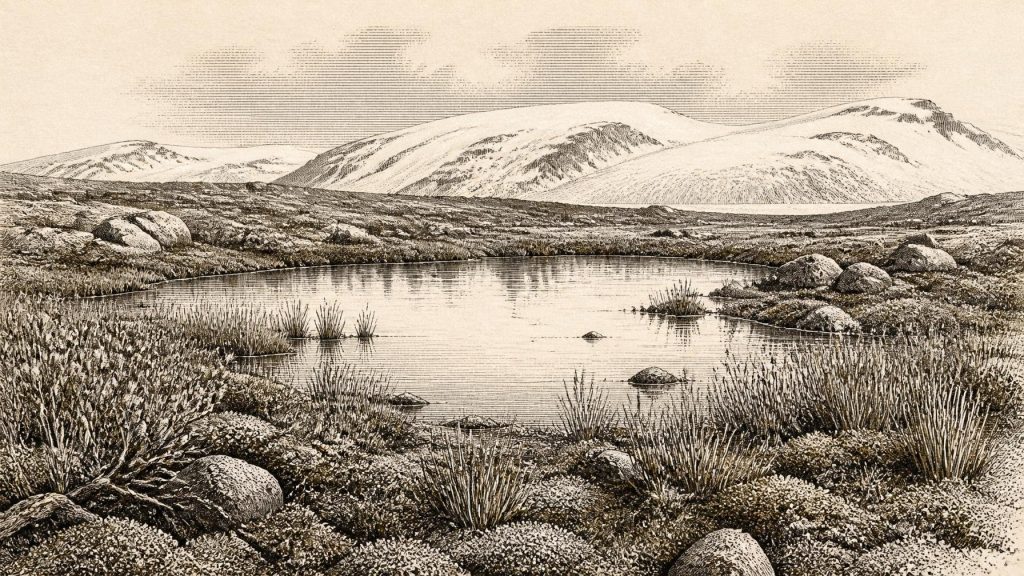
Around 30,270 BCE, Ireland’s past is reconstructed from fragmentary environmental evidence rather than historical events. At Derryvree, County Fermanagh, freshwater silts and organic deposits, preserved between glacial tills, indicate an ice-free interval within a cold, treeless periglacial landscape. Mosses, sedges, herbs and aquatic plants marked wetland and tundra-like habitats, although conditions cannot be extrapolated across Ireland. Dynamic ice growth and retreat reshaped land, drainage and preservation. Castlepook Cave, County Cork, produced MIS 3 fauna including mammoth, reindeer and hyaena, and a possibly tool-marked reindeer bone, suggesting but not proving brief human activity. No permanent population or specific event is demonstrated.
Dateline
“30,270 BCE” cannot be treated as a date in the modern historical sense. No written record, settlement sequence or event can be assigned to that individual calendar year in Ireland. At this depth of time, evidence is dated chiefly through radiocarbon measurements and geological relationships, then converted into broad calibrated ranges. The nominal year falls about 32,220 years before AD 1950, within the later part of the Late Pleistocene and Marine Isotope Stage 3. The responsible subject is therefore not an Irish year of kings, wars or migrations, but a changing Ice Age landscape whose surviving evidence is fragmentary, local and often difficult to date precisely.
A Date Within a Wide Window
The closest Irish evidence comes from Derryvree, near Maguiresbridge in County Fermanagh. Roadworks in 1969 cut through a drumlin and revealed a remarkable sequence: a freshwater bed of silts and fine sands lay between two thick deposits of glacial till. The lower till recorded an earlier passage of glacier ice. Then, for a time, freshwater sediments and organic material accumulated. Later glacial action buried and preserved the deposit beneath an upper till. The discovery offered an unusually clear reminder that glaciation was not one uninterrupted frozen state, but a sequence of advances, pauses, altered drainage and renewed ice growth.
Organic matter from the Derryvree bed produced radiocarbon determination BIRM-166: 30,500 radiocarbon years before present, with a substantial uncertainty of +1,170/−1,030 years. Radiocarbon years are not calendar years. Using modern calibration curves, the result corresponds to a broad range of calendar possibilities, approximately 36,900–31,700 calibrated years before present, or roughly 34,950–29,750 BCE. The named year lies within that range, but cannot be identified with a particular layer, season, pool edge or generation. Indeed, a date taken from bulk organic sediment may represent material accumulated over an interval rather than a single instant.
This distinction is more than technical caution. The Derryvree sediments are strong evidence that this part of Fermanagh was ice-free when they formed. They do not prove that every part of Ireland was open ground at the same moment, nor do they provide a map precise enough to trace the margins of every glacier in 30,270 BCE. The British–Irish Ice Sheet was dynamic and its chronology before the later Last Glacial Maximum remains debated in detail. Major reconstructions place the decisive build-up of the final ice sheet after about 35,000–32,000 years ago, while its widest later expansion is generally associated with roughly 27,000–21,000 years ago. Around the date in question, Ireland was entering a colder and increasingly unstable phase, not yet a simple, uniformly ice-covered island.
Freshwater Between the Tills
Derryvree’s value lies in its palaeoecology: the recovery of evidence for plants and small organisms from a landscape long removed by erosion or sealed beneath later deposits. The organic silts contained poorly preserved pollen, plant macrofossils and mosses. Together they indicate an open, treeless, periglacial environment. Periglacial does not mean permanently buried under glacier ice. It describes ground subjected to severe cold, freeze–thaw processes and a short growing season on or near the margins of ice.
The flora included plants associated with cold, exposed ground and wet places. Mosses, sedges and herbs formed a low vegetation cover; records include dwarf willow, mountain-avens, lesser clubmoss, bogbean and water-milfoil. Some species point to shallow freshwater or marshy margins, others to sparse tundra-like ground nearby. This was not a modern Irish bog, woodland or pasture. It was a patchwork of water, wet silt, gravelly ground and low vegetation, with vegetation responding quickly to meltwater, sediment movement and changes in temperature.
The evidence also corrects an easy but misleading picture of an entirely lifeless Ice Age. Derryvree was harsh, but it supported freshwater plants and a wetland ecosystem. Yet its record is local. A small basin can preserve plants that do not represent the whole island, while pollen may travel far and survive unevenly. The safest conclusion is that southern Fermanagh possessed at least one cold freshwater refuge during the interval represented by the deposits. Wider regional conditions must be reconstructed by comparing it with cave faunas, marine cores, ice-sheet landforms and records from Britain and the Atlantic shelf.
The Island’s Moving Ice Frontier
Ireland’s geography was also different from that of today. Global sea level was lower because immense volumes of water were stored in northern ice sheets. Coastlines lay farther out on parts of the continental shelf, but this does not license a simple image of a permanent, walkable land bridge from continental Europe into Ireland. Glaciers, proglacial lakes, marine channels, sea ice and changing coastlines complicated movement. The routes by which animals may have reached Ireland varied through time, and the evidence does not permit a confident reconstruction for one named year.
What can be said is that the island lay within a wider north-west European zone of environmental change. Ice centres in Ireland, Scotland and elsewhere in the British–Irish region expanded and contracted asynchronously. Upland and coastal sectors could have differed sharply: one landscape might be frozen beneath ice, another exposed as cold open ground, and another receiving meltwater into a pond or wetland. Such regional variation helps explain why Derryvree’s freshwater deposits are so important. Later ice could both destroy older surfaces and protect occasional remnants beneath till.
There were no political affairs in the historical sense. No evidence identifies a polity, leader, border, alliance, battle or diplomatic contact in Ireland at this time. Nor is there evidence for settlements, houses, fields, cultivated crops, livestock, exchange networks, monuments, burials, religious practice, language or art. These absences are not proof that no person ever entered Ireland during the broader period; they are limits on what the present record can demonstrate. The overwhelming historical force shaping the island was environmental: advancing and retreating ice altered land, drainage, habitats and the chances that any human traces might survive.
Castlepook and the Question of People
County Cork’s Castlepook Cave, also known as Mammoth Cave, gives the period its most arresting but most uncertain human question. Excavations from the early twentieth century recovered a rich Pleistocene animal assemblage. Later dating, including improved laboratory pretreatment of bone collagen, has shown that parts of the fauna belong to Marine Isotope Stage 3, well before the Last Glacial Maximum. The cave has produced remains of woolly mammoth, reindeer, giant deer, brown bear, wolf, Arctic fox, lemmings and spotted hyaena. These animals establish that, in episodes before the final maximum ice expansion, Ireland supported or was reached by a much richer cold-stage mammal community than the modern island.
A reindeer femur from Castlepook has been reported as bearing a deep mark interpreted by zooarchaeologist Ruth Carden as an incision made by a sharp stone tool while the bone was fresh. If this interpretation is upheld, it would be evidence that a person processed an animal in Ireland during the broad MIS 3 period. It would be a discovery of profound importance, pushing possible human activity far earlier than Ireland’s formerly accepted terminal-Pleistocene evidence.
Its limitations are equally important. The bone came from an old cave collection, not a recently excavated and securely sealed occupation floor. There is no associated hearth, dwelling, stone-tool assemblage, burial, repeated kill site or unmistakable living surface of comparable age. A radiocarbon date establishes when the animal lived and died, not automatically when every mark was made; recognising a tool cut also requires careful taphonomic comparison with damage caused by carnivores, sediment movement, breakage and weathering. Castlepook therefore supports a possibility of brief human presence or carcass processing, not a claim that Ireland had a permanent population in 30,270 BCE.
If people did reach the island intermittently, their daily lives remain unknown. The wider European Upper Palaeolithic demonstrates that mobile groups could make sophisticated stone tools, exploit animal and plant resources, use hides and bone, and maintain long-distance social ties. None of those activities can responsibly be projected into Ireland without direct finds. Reindeer, if encountered, could potentially have supplied meat, fat, hide, sinew, bone and antler; that is a statement about practical possibilities, not evidence that a particular Irish group used every resource. Nor can any visitor be assigned securely to a named archaeological culture or connected genealogically to later inhabitants of Ireland.
Animals, Predators and Seasonal Ground
The Castlepook fauna nevertheless makes Derryvree’s open vegetation easier to imagine within a broader ecological setting. Reindeer and lemmings are well suited to severe northern environments. Mammoth and giant deer indicate that, at some points in the wider MIS 3 interval, Ireland contained or was accessible to substantial open-country habitats capable of supporting large herbivores. Spotted hyaena adds another crucial dimension: caves may have served as dens or traps, while bone deposits could have been accumulated, gnawed, moved and mixed by animals rather than by people.
That is why cave bones must not be read as a simple census of a single moment. The fauna at Castlepook accumulated through different processes and may represent multiple episodes separated by long periods. It is sound evidence for the presence of species in the region over broad spans, but weak evidence for exact animal populations in one year. Similarly, the Derryvree wetland tells of conditions at a particular locality, rather than a uniform Irish climate.
Even so, the combined records transform the oldest Irish past from a blank white space into a scientifically legible, if incomplete, landscape. Around the wide chronological horizon represented by 30,270 BCE, Fermanagh could contain cold freshwater and tundra vegetation between episodes of ice cover. Other parts of Ireland had, during the broader period, habitats used by large herbivores and formidable carnivores. Glacial growth was reshaping the island and would later erase much of the evidence of any open ground or passing visitors.
What This Year Can Mean
The most accurate annual overview is therefore one of limits as well as discoveries. There was no Ireland of tribes, rulers or recorded traditions. There is no demonstrated diplomacy, warfare, religion, trade or learned culture to narrate. The material record does, however, preserve an older history: wetland plants embedded between tills at Derryvree, bones in the limestone caves of Cork, and the physical imprint of ice across land and shelf. These sources show a country repeatedly made and unmade by cold.
For 30,270 BCE, Derryvree’s tundra herbarium is the clearest guide. Its plants grew during an ice-free interval, perhaps beside shallow water in a severe but viable landscape. Its later burial beneath glacial deposits foreshadows the climatic deterioration that would profoundly reorganise Ireland. In the deep past, that environmental transformation—not an identifiable human event—is the central development.
Primary Sources
- A Middle Midlandian Freshwater Series at Derryvree, Maguiresbridge, County Fermanagh, Northern Ireland
- A Reconsideration of the Radiocarbon Dating of the Marine Isotope Stage 3 Fauna from Southern Ireland
- New Insights on the Fauna of Ireland's Younger Dryas and Early Holocene from Alice & Gwendoline Cave
- The Irish Quaternary Fauna Project
- Extent and Timing of the Last Glacial Maximum (LGM) in Britain and Ireland: A Review
- Growth and Retreat of the Last British–Irish Ice Sheet, 31,000 to 15,000 Years Ago: The BRITICE-CHRONO Reconstruction
- The Timing and Magnitude of the British–Irish Ice Sheet Between Marine Isotope Stages 5d and 2
- Sedimentology and Chronology of the Advance and Retreat of the Last British-Irish Ice Sheet on the Continental Shelf West of Ireland
- Maximum Extent and Dynamic Behaviour of the Last British–Irish Ice Sheet West of Ireland
- Stratigraphic and Palaeo-Geomorphological Evidence for the Glacial-Deglacial History of the Last British-Irish Ice Sheet in the North-Western Irish Sea
- Investigating Seasonal Mobility in Irish Giant Deer Megaloceros giganteus Through Strontium Isotope Analysis
- The Exploration of Castlepook Cave, County Cork, Being the Third Report from the Committee Appointed to Explore Irish Caves
- 2022:564 – Castlepook Cave, Castlepook South, Cork
- Archaeology Research Excavation Grant 2022: Final Report
- Archaeological Heritage of County Cork
- Heritage Artefacts of County Cork
- Palaeoecology: Irish Quaternary Association Field Guide
- Our Ancient Landscapes: Hunter-Gatherers in Ireland
- The IntCal20 Northern Hemisphere Radiocarbon Age Calibration Curve (0–55 cal kBP)
- OxCal: Radiocarbon Calibration
- Radiocarbon Calibration
- Occurrence of Mammalia Relicts at Site Castlepook Cave
- Exploring Controls of the Early and Stepped Deglaciation on the Western Margin of the British–Irish Ice Sheet
- Pattern and Timing of Retreat of the Last British-Irish Ice Sheet