Derryvree’s Bogbean and Milfoil30269 BCE
30,269 BCE cannot identify a discrete Irish event, but falls within Marine Isotope Stage 3, before maximum expansion of the British-Irish Ice Sheet. Derryvree, County Fermanagh, preserves freshwater sediments between glacial tills, dated broadly to 34,950–29,750 BCE, indicating treeless periglacial wetlands with bogbean, milfoil, mosses, insects and tundra vegetation. Later ice sealed this local archive. Castlepook Cave, County Cork, yielded reindeer, mammoth, giant deer and hyaena remains, showing varied cold-stage fauna. A cut-marked reindeer femur may indicate Upper Palaeolithic butchery, but proves neither settlement nor continuous occupation. Evidence depicts a changing, fragmented landscape, requiring caution about human presence at all.
Dateline
30,269 BCE is not a recoverable Irish historical year. It is a modern calendar label imposed on a far older stretch of the Late Pleistocene. Nothing in Ireland can identify an event, person, journey or season in that particular year. The responsible approach is therefore to place the date within a wider archaeological and environmental horizon: Marine Isotope Stage 3, several millennia before the fullest expansion of the last British–Irish Ice Sheet. The evidence is sparse, unevenly preserved and often difficult to date, but it does offer a striking picture of an island of cold open country, wetlands, mobile animals and perhaps very occasional human visitors.
A Date Range, Not a Diary Entry
At this depth in time, calendar precision is impossible. The closest major environmental record is at Derryvree, near Maguiresbridge in County Fermanagh. Roadworks there in 1969 cut through a drumlin and revealed freshwater silts and fine sands, rich in organic matter, trapped between two separate sheets of glacial till. The sequence provides a secure relative history: ice had first crossed the locality; an ice-free or ice-marginal interval then allowed a wetland to form; and ice later returned, burying the deposits beneath fresh till.
Organic material from the Derryvree sediments produced the conventional radiocarbon determination BIRM-166: 30,500 radiocarbon years before present, with a substantial uncertainty of +1,170 and −1,030 years. “Before present” means before AD 1950, and a radiocarbon age is not a calendar age. When assessed with modern calibration curves, the measurement corresponds to a broad range rather than a single point, commonly expressed at roughly 36,900–31,700 calibrated years before present, or approximately 34,950–29,750 BCE. The notional year 30,269 BCE lies close to the younger end of that broad range, but it cannot be assigned to a particular layer, plant, animal or episode in the Derryvree basin.
This distinction matters. The Derryvree record does not show that all Ireland looked alike in any one year. Nor does it demonstrate an uninterrupted ice-free island. It establishes that this particular Fermanagh locality supported freshwater and wetland life during a cold stage before later ice overran it. Its value lies in revealing a vanished landscape, not in providing an annual chronicle.
Fermanagh Between the Tills
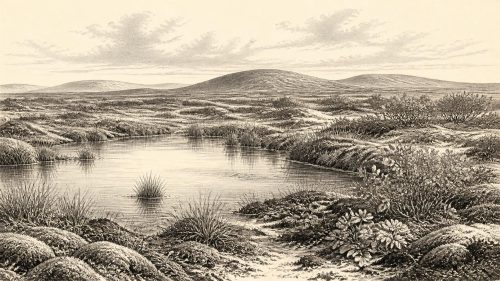
The silts at Derryvree preserve an environmental assemblage of remarkable richness. Mosses, seeds, pollen and insect remains point to a treeless, periglacial setting: a landscape shaped by prolonged cold, seasonal freezing and thawing, saturated ground and shallow water. The published flora includes aquatic and wetland plants alongside cold-adapted species such as bogbean, water-milfoil, dwarf willow, mountain-avens and lesser clubmoss. Sedges, grasses and mosses would have formed low cover around pools and watercourses, while sparse herbs and dwarf shrubs occupied better-drained ground.
“Tundra” is a useful shorthand, provided it is not made into a uniform wilderness. The evidence suggests a mosaic rather than an empty plain: open ground, wet hollows, freshwater margins and patches of vegetation responding to soil moisture, exposure and the brief growing season. Pools could sustain aquatic plants even where the wider climate was severe. Insects are particularly valuable because their climatic tolerances help confirm a cold, open environment. Yet individual species may have shifted as conditions altered during the accumulation of the deposit. The list of fossils is evidence for the wider interval, not a census from 30,269 BCE.
There were no forests, fields or farm animals. Ireland’s familiar green, wooded and pastoral appearance belongs to a vastly later world. At Derryvree, the economy of the landscape was ecological rather than human: plants captured a short season’s light; insects and small animals fed within wetland food chains; and larger herbivores could exploit the surrounding open country. Frost action, meltwater and changing ice margins mattered more than any human intervention.
Before the Maximum Ice
This was not yet the Last Glacial Maximum, the phase when the British–Irish Ice Sheet reached its greatest Late Pleistocene extent. Reconstructions differ in detail, but major ice growth and maximum conditions came later, broadly during the interval from about 27,000 to 20,000 years ago, with many studies placing maximum Irish and Irish Sea ice limits around 26,000–21,000 years ago. Around the nominal date considered here, Ireland was entering a period of increasing climatic instability and, ultimately, more extensive glaciation.
That larger sequence helps explain both the survival and the scarcity of evidence. Glaciers are efficient destroyers and recyclers of landscapes: advancing ice erodes surfaces, transports debris and lays down till. Older soils, campsites and riverbanks can be removed entirely. At Derryvree, however, the later till also sealed an older freshwater deposit, protecting a fragment of the preceding landscape. Elsewhere, caves became another kind of archive, preserving animal bone in places where open-air evidence has almost certainly been lost.
Regional variation must remain central. A freshwater wetland near Maguiresbridge cannot be projected uncritically onto every coast, upland or lowland of Ireland. Ice, sea, terrain and local climate did not operate uniformly. Nor can modern shorelines be used as a guide to the geography of the time. Sea level was much lower during the wider glacial period, and the Irish Sea basin and surrounding shelf were exposed or transformed in ways difficult to visualise from the present map. Ireland was nevertheless a north-western peninsula or island margin facing significant ecological barriers and fluctuating routes, not an assured extension of continental hunting territory.
Castlepook’s Animal Archive
In north County Cork, Castlepook Cave near Doneraile—also known as Mammoth Cave—provides the most important faunal counterpart to the Fermanagh wetland. Its old excavations recovered remains of animals associated with cold-stage north-west Europe, including reindeer, woolly mammoth, giant deer and spotted hyaena. Modern re-dating has shown that some cave bones are substantially older than earlier measurements suggested, strengthening the case that a diverse fauna occupied or reached southern Ireland during Marine Isotope Stage 3.
The cave should not be imagined as a simple snapshot. Carnivores could drag carcass parts into a den; water, scavenging, excavation and the long history of cave use could mix material from different episodes. A mammoth bone proves that mammoths occurred in Ireland or close enough for their remains to enter the cave system, but it does not establish a resident herd in the Doneraile district in 30,269 BCE. Likewise, reindeer remains indicate the presence of suitable cold-open habitats at some point in the relevant period, not a precisely dated migration passing a particular cave mouth.
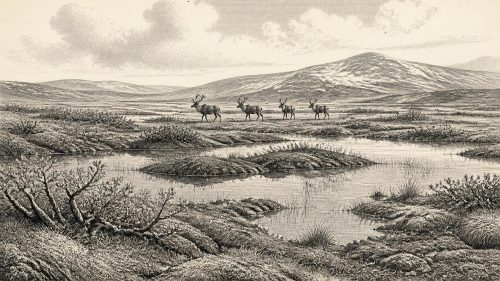
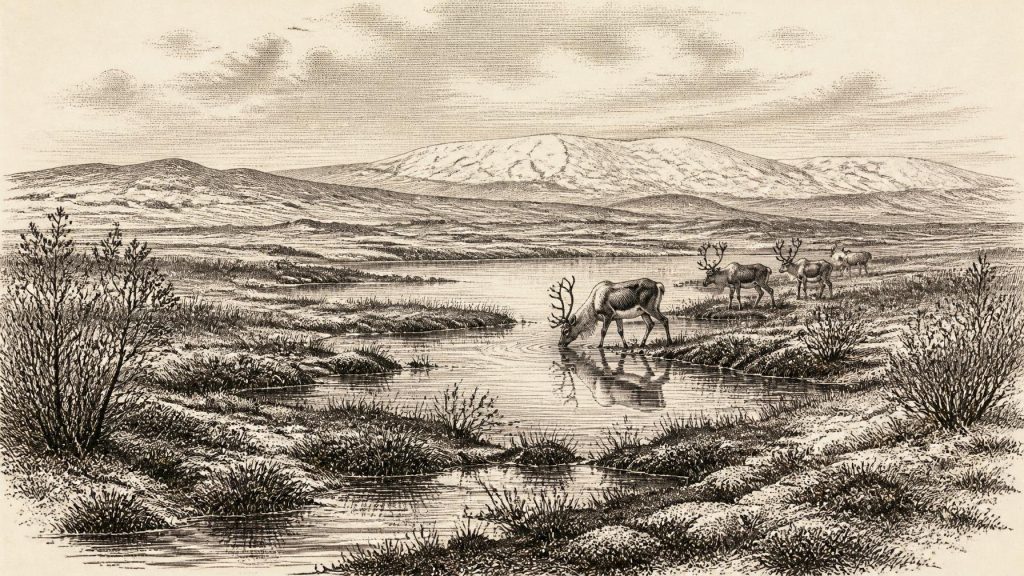
Even so, the animals are historically important. Reindeer are well suited to seasonal, open environments and could have moved through extensive grass-, herb- and shrub-rich landscapes. Spotted hyaena, now long absent from Ireland, signals a food web that included large carrion and predators as well as herbivores. The assemblage rebukes the old image of an utterly lifeless, permanently ice-covered island. Parts of Ireland could at times sustain sizeable mammals, although the scale, duration and geographic distribution of those populations remain uncertain.
The Reindeer Femur and Human Possibility
Castlepook has also raised Ireland’s most provocative question for this era. A reindeer femur from the cave bears a deep incision which zooarchaeologist Ruth Carden has interpreted as a cut made by a sharp stone tool while fresh meat was being processed. County Cork’s heritage publication assigns the specimen broadly to about 31,000 BCE. If that interpretation and broad dating are sustained, the bone would be evidence that a person, or people, handled a reindeer in Ireland during the Upper Palaeolithic—far earlier than the island’s long-established post-glacial settlement record.
The claim is important precisely because it must be kept narrow. The bone is not a house, a hearth, a stone-tool assemblage, a burial, a settlement floor or a named community. No securely associated Palaeolithic camp has been excavated at Castlepook. The mark cannot tell us whether the animal was hunted, scavenged elsewhere, butchered near the cave, or carried there by carnivores after people had processed it. It cannot establish the size, language, beliefs, kinship arrangements or duration of a visiting group. The date of the bone is also not the exact moment of cutting.
The most responsible conclusion is therefore one of possibility rather than certainty. Ireland may have been visited intermittently by Upper Palaeolithic hunter-gatherers moving through the wider north-west European world, perhaps following or exploiting reindeer. But there is no basis for describing a settled population, regular occupation or continuous colonisation in 30,269 BCE. The physical risks of cold, changing sea routes, unstable habitats and advancing ice would have made any presence precarious.
Society Beyond the Evidence
Political affairs, diplomacy and warfare leave no evidence in Ireland for this period. There were no states, kingdoms, monuments, written records or known territorial institutions. It would be misleading to fill that silence with imagined tribes or chiefs. If people entered the island, they belonged to mobile foraging societies whose social worlds can only be discussed by broad comparison with Upper Palaeolithic Europe, not recovered directly from Irish finds. Such comparison may suggest small groups, practical knowledge of animal behaviour and sophisticated use of perishable materials, but it cannot convert inference into Irish evidence.
The same restraint applies to religion, art and learning. No securely dated Irish cave art, ritual site, grave, ornament or symbolic object belongs to this horizon. The absence of finds does not prove an absence of thought, language, custom or belief; it reflects the destructive force of glaciation and the frailty of organic materials. What can be said is simpler and firmer: knowledge of weather, terrain, water, animal movements and seasonal resources would have been essential to any human survival in such a landscape.
An Island of Fragments
The best history for around 30,269 BCE is therefore environmental and evidential. Derryvree preserves a cold freshwater world caught between advances of ice. Castlepook preserves traces of an Ice Age animal community and a single, debated clue to human carcass processing. Together they show that Ireland was neither a familiar pastoral island nor a blank white void. It was a changing northern landscape in which wetlands, tundra vegetation and large mammals persisted in some places before the greatest ice expansion of the last glacial cycle.
Its human story remains unresolved. Future excavation, direct dating and re-examination of museum collections may clarify whether Castlepook’s marked reindeer bone records a fleeting visit or the first known chapter of a deeper Palaeolithic presence. For now, the evidence supports humility: not a year of kings, battles or settlements, but a broad and difficult interval whose witnesses are mud beneath a Fermanagh drumlin and bone in a Cork cave.
Primary Sources
- Middle Midlandian Freshwater Series at Derryvree, Maguiresbridge, County Fermanagh, Northern Ireland
- A Reconsideration of the Radiocarbon Dating of the Marine Isotope Stage 3 Fauna from Southern Ireland
- The Irish Quaternary Fauna Project
- Heritage Artefacts of County Cork
- Archaeology Research Excavation Grant 2022: Final Report
- Growth and Retreat of the Last British–Irish Ice Sheet, 31,000 to 15,000 Years Ago: the BRITICE-CHRONO Reconstruction
- Pattern and Timing of Retreat of the Last British-Irish Ice Sheet
- Last Glacial Maximum Cirque Glaciation in Ireland and Implications for Reconstructions of the Irish Ice Sheet
- New Data for the Last Glacial Maximum in Great Britain and Ireland
- Stratigraphic and Palaeo-Geomorphological Evidence for the Glacial-Deglacial History of the Last British-Irish Ice Sheet in the North-Western Irish Sea
- Early Deglaciation of the British-Irish Ice Sheet on the Atlantic Margin of North-West Ireland
- Ireland Under the Ice
- Aghnadarragh
- The IntCal20 Northern Hemisphere Radiocarbon Age Calibration Curve (0–55 cal kBP)
- IntCal Publications
- IntCal Data
- Irish Quaternary Association: Publications
- Irish Quaternary Association: Field Guides
- Irish Quaternary Association: Outreach Links, Events and Exhibitions
- Ireland’s Palaeolithic Archaeology – Fleeting Footprints in a Frozen Land