Maguirebridge’s Tundra Interval30267 BCE
30,267 BCE is not a recoverable Irish year but falls within a broad Marine Isotope Stage 3 interval. At Derryvree, County Fermanagh, freshwater organic sediments between glacial tills, radiocarbon dated to about 30,500 BP, record an ice-free tundra basin with sedges, mosses, aquatic plants and sparse arctic-alpine vegetation. Later ice advance reshaped the region, though Ireland was not uniformly glaciated. Southern cave assemblages, notably Castlepook, attest cold-adapted mammals, including reindeer and mammoth, across a wider timespan. A possibly tool-marked reindeer bone suggests an unconfirmed human visit, but no evidence supports settlement, polities, or sustained occupation. The period’s history is environmental.
Dateline
“30,267 BCE” is a modern chronological label, not a year that can be recovered from Ireland’s Late Pleistocene record. No event, person, settlement or season can responsibly be assigned to that calendar year. The appropriate scale is a broad environmental interval during Marine Isotope Stage 3, before the fullest expansion of the last British–Irish Ice Sheet. The most informative Irish evidence comes from a buried freshwater deposit at Derryvree, near Maguiresbridge in County Fermanagh, and from cave-fauna collections in the south. Together they show that parts of Ireland could sustain cold-adapted plants and animals during an unstable Ice Age world, even as major ice expansion approached.
A Date With A Wide Margin
The date is best treated as falling within a range rather than as a pinpoint. At Derryvree, roadworks in 1969 cut through a drumlin and exposed organic silts and fine sands trapped between two thick sheets of glacial till. The organic layer produced the conventional radiocarbon determination BIRM-166: 30,500 radiocarbon years before present, with a large uncertainty of +1,170 and −1,030 years. Radiocarbon years are not calendar years. Atmospheric carbon-14 has varied over time, so such results must be calibrated against independently dated records. Under modern calibration approaches, the Derryvree result represents a very broad interval, approximately 36,900–31,700 calibrated years BP, or roughly 34,950–29,750 BCE.
30,267 BCE therefore lies within the broad chronological reach of this evidence, but not within a recoverable annual history. The dated material accumulated over time; the measurement has statistical uncertainty; and calibration produces ranges rather than an exact historical timestamp. What can be said is that, during part of this interval, the Derryvree hollow held freshwater sediment and organic matter before later ice deposited the upper till across it. That sequence is powerful evidence for changing conditions, but it is not a diary of a particular year.
The Derryvree Window
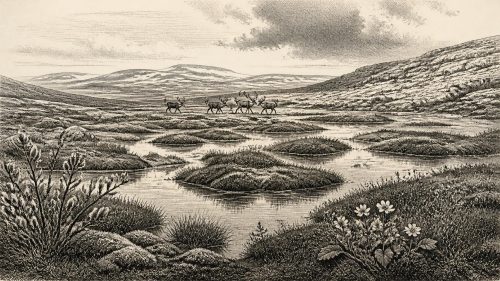
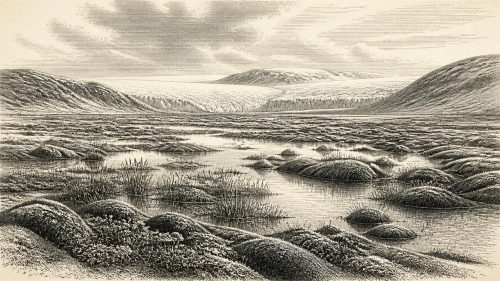
Derryvree is significant because the sediments preserve a living landscape that was later sealed beneath glacial deposits. The original investigators identified a flora and fauna characteristic of open tundra and a periglacial climatic regime. The term periglacial does not mean glacier-covered: it describes intensely cold conditions on or near the margins of ice, where frost action, seasonal thaw and sparse vegetation shaped the ground. A freshwater basin could exist in such a landscape, fed by local water while surrounded by exposed mineral soils, wet ground and cold-climate vegetation.
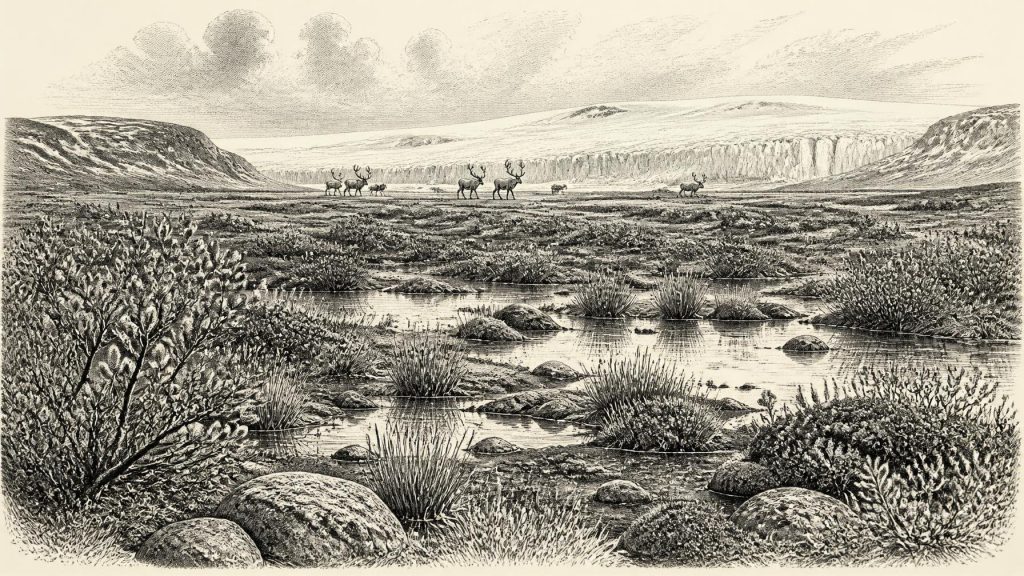
Macrofossils from the deposit include plants suited to cold, open and often waterlogged conditions. Mosses, sedges and aquatic or waterside plants such as bogbean (Menyanthes trifoliata) and water-milfoil indicate that water lay in or beside the basin. Mountain avens, dwarf willow, juniper and other arctic-alpine or tundra-associated elements contribute to a picture of low, discontinuous vegetation rather than closed forest. This was not modern Fermanagh transported unchanged into the past. There is no evidence here for woodland, fields or a settled rural landscape. Instead, the record suggests a treeless mosaic: shallow freshwater, sedge-rich margins, mossy wet ground, herbaceous tundra and patches of bare or frost-disturbed sediment.
Such evidence supports environmental reconstruction, not a precise weather forecast. It cannot tell us whether 30,267 BCE brought a hard winter, a short growing season or a single flood. Nor can it establish that every part of Ireland looked alike. Ireland’s relief, distance from ice margins, exposure to Atlantic weather and local drainage would have produced regional variation. The strength of Derryvree is its direct testimony to one northern inland locality; its limitation is that one locality cannot stand for the entire island.
Ice On The Horizon
The freshwater layer lies between tills, making its wider significance unmistakable: ice affected the area before the organic sediments formed, and ice later overrode or surrounded the landscape again. Modern reconstructions of the British–Irish Ice Sheet identify this period as one of rapid, uneven growth and changing ice margins. The full local maximum in Irish waters and across much of the island came later, broadly around 27,000–23,000 years ago in many reconstructions, within the global Last Glacial Maximum interval of about 26,500–19,000 years ago.
For the time represented at Derryvree, the safest conclusion is not that Ireland was wholly ice-free, nor that it was already buried beneath a single uniform ice sheet. Rather, the island was part of a shifting north-west European ice-age zone. Derryvree provides firm evidence that its locality was ice-free long enough for freshwater and tundra communities to establish. Bayesian modelling of the wider ice-sheet record uses the deposit as a maximum constraint on later ice build-up into the Donegal Bay sector. Ice dynamics, however, were geographically complex: advances, lobes, marine margins and local topography mattered. The later sweep of glacier ice would alter the landscape profoundly, depositing tills, moulding drumlins and obscuring much of what came before.
Animals In A Cold Mosaic
The cave record of southern Ireland offers a different kind of evidence. Castlepook Cave, near Doneraile in north Cork, has produced remains of an Ice Age fauna including reindeer, brown bear, wolf, hare, Arctic fox, spotted hyaena, giant deer and woolly mammoth in its broader assemblage. Improved radiocarbon pretreatment and re-dating have shown that some specimens from Castlepook are substantially older than earlier measurements suggested. The cave is consequently one of Ireland’s most important archives for mammals living before the Last Glacial Maximum.
These animal remains establish that suitable habitats and ecological corridors existed in Ireland during portions of the wider period. They do not demonstrate that all these species were contemporaries, nor that they occupied every Irish region at once. Cave deposits are especially difficult archives: carnivores may carry bones inside, animals can die in shelters, water and sediment can move material, and antiquarian excavations often removed deposits without the modern standards of stratigraphic recording. A faunal list is therefore a record of presence across time, not a photograph of one herd moving through one valley in 30,267 BCE.
Even so, reindeer and other cold-adapted mammals fit the Derryvree evidence for open country. Their movements would have followed food, terrain and season. Carnivores, scavengers and denning animals belonged to the same ecological system. This was a landscape in which survival depended on mobility and on access to scattered patches of forage, water and shelter.
The Human Question
Ireland has one provocative possible indication of a much earlier human visit. A reindeer femur from the old Castlepook collection has been reported as around 33,000 years old and bears a deep mark interpreted by zooarchaeologist Ruth Carden as damage made by a sharp stone tool during fresh-bone processing. If that interpretation is confirmed and the mark is contemporary with the bone’s final handling, it would indicate that one or more Upper Palaeolithic people processed a reindeer carcass in Ireland during the wider pre-maximum glacial period.
This is important, but it must not be inflated into a settled population or a national origin story. The bone has no securely associated hearth, stone-tool assemblage, built shelter, burial, human remains, art or occupation surface of the same age. It cannot establish whether people killed the animal, found it already dead, processed it within the cave, stayed for a night, or returned repeatedly. The better-established butchered brown-bear bone from Alice and Gwendoline Cave in County Clare is far later, dating to about 12,800–12,600 calibrated years BP. Thus, for the period around 30,267 BCE, human activity in Ireland remains possible and consequential, but very limited as evidence.
No Recoverable Polities
There is no basis for describing political affairs, diplomacy, territorial rule or organised conflict in Ireland at this date. No communities can be named; no boundaries, leaders, weapons caches or settlements have been identified. Likewise, there is no direct Irish evidence for formal religion, monuments, ritual deposits, literacy, teaching institutions or visual art from this interval. Upper Palaeolithic people elsewhere in Europe created complex technologies and remarkable art, but those achievements cannot simply be imported into the Irish record.
The same restraint applies to economy and trade. If people did process a reindeer at Castlepook, meat, marrow, hide, sinew, antler and bone would have been valuable resources; that is a reasonable inference from the animal, not evidence for a durable Irish hunting economy. Lower sea levels changed the outlines of the Irish and Celtic seas, but they do not prove an easy land bridge, a regular migration route or trade across water at this particular time. Ice, channels, marshes, rivers and coastlines changed repeatedly.
The history of Ireland around this date is therefore principally environmental. In a Fermanagh basin, freshwater supported a sparse but resilient cold-climate community. In southern caves, bones preserve traces of large mammals from a wider Ice Age ecosystem. Across the island, advancing ice and changing sea levels continually altered what ground, water and routes were available. That is not an absence of history. It is the deep precondition from which Ireland’s much later human histories would eventually emerge.
Primary Sources
- Middle Midlandian Freshwater Series at Derryvree, Maguiresbridge, County Fermanagh, Northern Ireland
- The IntCal20 Northern Hemisphere Radiocarbon Age Calibration Curve (0–55 cal kBP)
- Growth and Retreat of the Last British–Irish Ice Sheet, 31,000 to 15,000 Years Ago: The BRITICE-CHRONO Reconstruction
- Timing and Pace of Ice-Sheet Withdrawal Across the Marine–Terrestrial Transition West of Ireland During the Last Glaciation
- Stratigraphic and Palaeo-Geomorphological Evidence for the Glacial-Deglacial History of the Last British-Irish Ice Sheet in the North-Western Irish Sea
- Dimensions and Chronology of the Last Ice Sheet in Western Ireland
- Trimlines, Blockfields and the Vertical Extent of the Last Ice Sheet in Southern Ireland
- Deglaciation Chronology of the Donegal Ice Centre, North-West Ireland
- A Reconsideration of the Radiocarbon Dating of the Marine Isotope Stage 3 Fauna from Southern Ireland
- The Irish Quaternary Fauna Project
- First Evidence of a Late Upper Palaeolithic Human Presence in Ireland
- New Insights on the Fauna of Ireland’s Younger Dryas and Early Holocene from Alice & Gwendoline Cave
- The Archaeology of Caves in Ireland
- Irish Quaternary Association Guide: The Quaternary of Fermanagh
- Irish Quaternary Association Guide: The Quaternary History of Ireland
- Menyanthes trifoliata in Fermanagh: Fossil Record
- Dryas octopetala in Fermanagh: Fossil Record
- A Stratigraphic Framework for Abrupt Climatic Changes During the Last Glacial Period Based on Three Synchronized Greenland Ice-Core Records
- The Castlepook Cave Project, County Cork: Excavation Report 2022
- Heritage Artefacts of County Cork