
Waterford’s Pre-Ice Red Deer30266 BCE
Around 32,215 years ago, Ireland lay in the climatically unstable Late Pleistocene, before the Last Glacial Maximum. Evidence from bones, sediments, plants, insects and cave deposits provides ranges rather than precise annual events. Waterford caves contain pre-maximum red-deer remains, while Derryvree, County Fermanagh, preserves a cold, treeless wetland between glacial advances. Southern caves record diverse mammals, though deposits are mixed and imperfectly dated. Castlepook Cave’s marked reindeer femur may indicate brief human handling, but cannot prove settlement. Lower sea levels altered coasts without establishing a land bridge. Ireland supported life amid advancing and retreating ice, but human presence remains uncertain.
Dateline
30,266 BCE cannot responsibly be treated as a year in the historical sense. No written chronology, settlement sequence or event can be fixed to this point in Ireland’s past. In relation to the radiocarbon convention of AD 1950, it lies about 32,215 calendar years ago, within the Late Pleistocene and Marine Isotope Stage 3 (MIS 3), a climatically unstable portion of the last Ice Age. The appropriate evidence comes not from annals or monuments but from dated animal remains, buried sediments, fossil plants and insects, cave deposits, and the landforms later made or altered by ice. These materials offer calibrated ranges and environmental sequences, not calendar-year precision.
The most useful conclusion for this date is therefore deliberately modest. Ireland was entering the later part of an Ice Age world, but it was not yet the uniformly ice-covered landscape of the Last Glacial Maximum. The British-Irish Ice Sheet expanded and contracted through several phases, and its extent before about 30,000 years ago remains an active research problem. Later maximum ice expansion, generally placed after this broad interval, destroyed, buried or reworked much earlier evidence. What survives is fragmentary and unevenly distributed: a few exceptional cave assemblages in the south, isolated bones from other localities, and rare organic layers preserved beneath glacial deposits.
A Calendar Date Without a Calendar
Modern BCE notation can give a false impression of exactness. Archaeologists normally express this era as thousands of years before present, with “present” fixed at AD 1950. Radiocarbon ages are not identical to calendar ages because atmospheric carbon-14 levels changed through time; they must be calibrated against long reference records. At around 32,000 calendar years ago, a determination can translate into a broad and sometimes irregular calibrated interval rather than a single point. Consequently, it is unsound to say what happened in Ireland on a particular day, season or year in 30,266 BCE. It is safer to discuss a horizon around 32.2 thousand calibrated years before present and to state how closely each specimen or sediment sequence approaches it.
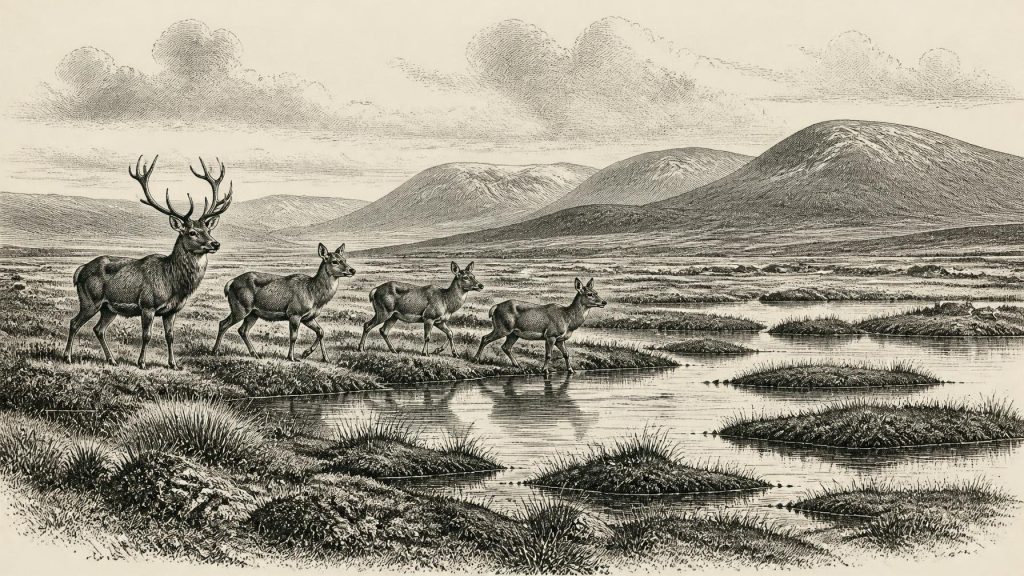
One especially pertinent body of evidence comes from south-east Ireland. A study of ancient red-deer remains identified two pre-Last Glacial Maximum specimens from County Waterford caves. Their calibrated ranges were reported as about 32,930–31,280 and 30,297–29,594 cal. BP. The earlier range overlaps the broad chronological neighbourhood of 30,266 BCE. This does not prove that a particular deer stood in Waterford in that numbered year, nor does it demonstrate a continuous Irish population. It does show that red deer, or at least red-deer bone deposited in cave contexts, belong to the Irish record of this pre-maximum cold-stage interval. It also warns against imagining the island as either lifeless or permanently frozen.
Open Ground, Wet Hollows and Changing Ice
The closest Irish environmental archive for the wider Middle Midlandian phase lies at Derryvree near Maguiresbridge in County Fermanagh. There, organic sediments occur between two tills: deposits laid down by, or in association with, ice. A conventional radiocarbon measurement of around 30,500 radiocarbon years BP, with substantial uncertainty and requiring calibration, has long made the layer important to discussions of Ireland during MIS 3. It is not an annual record and should not be equated precisely with 30,266 BCE. Its great value is stratigraphic: the wetland existed after one phase of glaciation and before a later advance sealed it beneath till.
Plant macrofossils, pollen, mosses and insect remains from the Derryvree deposits have been interpreted as evidence for a cold, open and treeless environment, including sedges, grasses, herbs, juniper and aquatic or wetland plants. Inference from this assemblage suggests a muskeg-like mosaic of waterlogged ground, mossy margins and shallow pools, not a forested countryside. Such a landscape could support seasonal plant growth and animal grazing while remaining harsh, with long winters and limited shelter. Yet Derryvree was a local basin, not a complete map of Ireland. Uplands, limestone districts, exposed coasts and areas near ice margins may have differed markedly. Its evidence is strongest for local conditions and for the fact that non-glacial environments existed in at least some Irish settings between ice advances.
At the scale of the island, regional change mattered more than any imagined political boundary. Sea level was lower than today because enormous volumes of water were locked in northern ice sheets, exposing more of the continental shelf. But lower seas do not automatically demonstrate a dry, walkable route from Ireland to Britain or continental Europe at this particular time. The palaeogeography of the Irish Sea was affected by changing relative sea level, crustal movements, marine basins and ice. Humans and animals may have encountered changing coastlines, islands, ice margins and shallow-water crossings, but the available Irish evidence cannot establish a specific route in 30,266 BCE.
Caves as Imperfect Archives
Southern Irish caves, particularly Castlepook Cave near Doneraile in County Cork, supply much of the period’s animal evidence. Their deposits have yielded remains attributed to woolly mammoth, reindeer, giant deer, red deer, brown bear, wolf, fox, Arctic fox, mountain hare, lemmings and spotted hyaena. This is not a single, neatly contemporary community. Cave deposits accumulated over long periods; bones may have been carried in by carnivores, water, gravity or people, while old excavations did not record contexts to modern standards. New radiocarbon work has also shown that some earlier dates on southern Irish cave fauna were too young, reinforcing the need to date individual, identified specimens and to separate distinct episodes of deposition.
Nevertheless, the faunal record establishes the character of the wider ecological world. Large herbivores and carnivores could reach Ireland during parts of the Late Pleistocene, and the island formed part of a north-west European zone of cold-adapted and adaptable mammals. A hyaena den, a mammoth bone or a reindeer limb is not evidence for a stable population of every species across the whole island. It is evidence that animal movements, predation and carcass accumulation occurred in landscapes whose precise extent has since been transformed by ice and sea. The apparent scarcity of fossils should not be mistaken for simple absence: glaciation is itself an efficient destroyer of exposed deposits.
The Castlepook Human Question
The most consequential, and most limited, possible human evidence for the broad period is a reindeer femur from Castlepook. It has been publicly reported as roughly 33,000 years old and as carrying a deep mark interpreted by zooarchaeologist Ruth Carden as a cut or chop made by a sharp stone tool while fresh bone was processed. If future research confirms both the anthropogenic origin of the mark and its association with the animal’s death, it would indicate human handling of a reindeer in Ireland well before the Last Glacial Maximum. It would be a major addition to the Irish Upper Palaeolithic record.
It does not, however, demonstrate a settled population in 30,266 BCE. A date on bone dates the animal, not necessarily the exact moment or agent of surface modification. The specimen derives from an older cave collection rather than a modernly excavated living floor with a securely associated hearth, stone-tool assemblage, dwelling, burial or repeated camp sequence. Carnivore damage, trampling, sediment abrasion and excavation damage must always be distinguished from tool marks. Until a larger body of securely stratified evidence is published, the responsible description is possible brief human activity, not a named hunting band, a permanent colony or an established Irish society.
What Cannot Yet Be Written
There is no evidence from this horizon for political affairs, diplomacy, organised warfare, chiefs, territories, religious institutions, trade networks, farming, villages, language or formal learning in Ireland. Even the familiar term “hunter-gatherer” must be used cautiously here, because it describes a plausible Upper Palaeolithic lifeway in neighbouring regions rather than a fully demonstrated Irish settlement system. No Irish house, hearth, workshop, grave, artwork or stone-tool industry can presently be tied securely to this exact date. Nor can the movement of mammals be converted into evidence of regular commerce or human migration.
The human story of 30,266 BCE is thus a threshold rather than a narrative. The evidence supports an Ireland of fluctuating cold, open ground and wetland refuges; of large mammals and carnivores represented in rare cave assemblages; and of ice that had not yet reached its later maximum but would profoundly reshape the island. Waterford’s dated red deer and Fermanagh’s buried wetland demonstrate that life persisted in parts of this changing world. Castlepook offers an intriguing, still unresolved possibility that people entered it too. Their exact movements, identities and duration of stay remain beyond the present evidence, and that uncertainty is not a gap to fill with invention but the central historical fact of the period.
Primary Sources
- A reconsideration of the radiocarbon dating of the Marine Isotope Stage 3 fauna from southern Ireland
- Phylogeographic, ancient DNA, fossil and morphometric analyses reveal ancient and modern introductions of a large mammal: The complex case of red deer (Cervus elaphus) in Ireland
- The Irish Quaternary Fauna Project
- New insights on the fauna of Ireland's Younger Dryas and Early Holocene from Alice & Gwendoline Cave
- Archaeology Research Excavation Grant 2022
- Archaeology Research Excavation Grant Report
- Castlepook Cave, County Cork, 2022
- Pleistocene glaciations in Ireland
- Quaternary deposits and glacial stratigraphy in Ireland
- Irish Pleistocene biostratigraphy
- Trimlines, blockfields and the vertical extent of the last ice sheet in southern Ireland
- Dimensions and chronology of the last ice sheet in Western Ireland
- Deglaciation chronology of the Donegal Ice Centre, north-west Ireland
- The timing and magnitude of the British-Irish Ice Sheet between Marine Isotope Stages 5d and 2
- Pattern and timing of retreat of the last British-Irish Ice Sheet
- Radiocarbon constraints on the age of the maximum advance of the British-Irish Ice Sheet in the Celtic Sea
- Outreach and Education Resources
- Figure 6.— The subdivision of the Quaternary Period in Ireland
- The IntCal20 Northern Hemisphere radiocarbon age calibration curve (0-55 cal kBP)
- IntCal Publications
- The problem of a late quaternary landbridge between Britain and Ireland
- Guide to the National Museum of Ireland