Fermanagh Under Two Tills30238 BCE
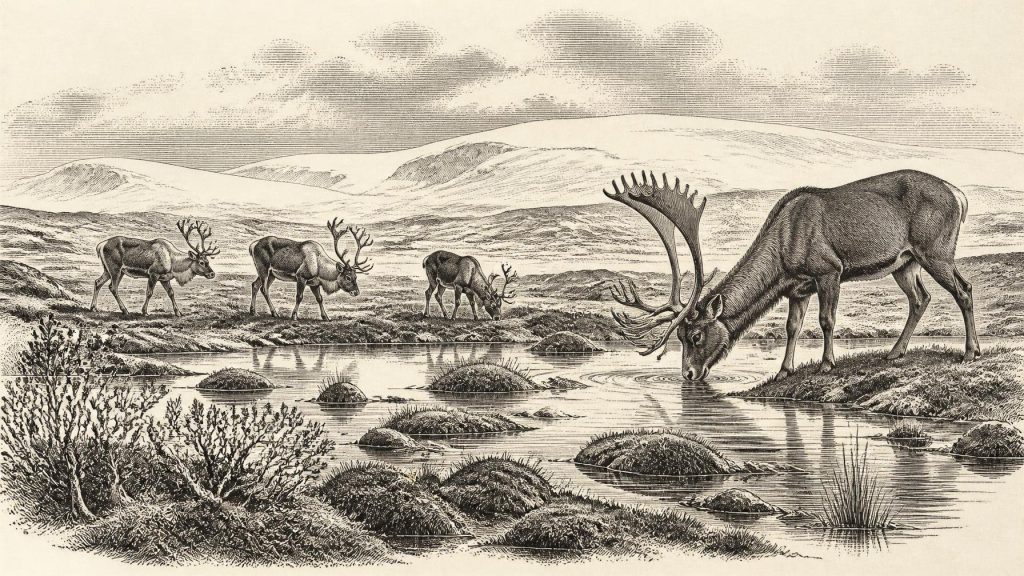
Around 30,238 BCE, Ireland has no annual human history, only fragmentary Late Pleistocene evidence. At Derryvree, County Fermanagh, freshwater sediments between two glacial tills show that ice retreated or margins shifted long enough for wetlands, vegetation and animals to flourish before renewed glaciation. Radiocarbon dating places this interval broadly around the nominal date, but cannot identify a specific year. Fossils indicate open tundra, saturated ground, pools and harsh seasonal conditions. Cave faunas show reindeer, mammoth and other cold-adapted animals. A modified Castlepook bone suggests fleeting visits, not settlement. Ireland remained environmentally dynamic with changing ice and habitats across the island.
Dateline
30,238 BCE is not a year for which Ireland can be given an event, ruler, battle or settlement history. It is a modern calendar label applied to a far deeper prehistoric interval: roughly 32,187 years before AD 1950, the conventional reference point for “before present” dating. No annual chronology exists at this depth. The evidence is instead stratified, scattered and often difficult to date: sediments beneath later ice, fossil plants and insects, animal remains from caves, landforms, and radiocarbon measurements with substantial margins of uncertainty.
The most responsible way to illuminate Ireland around this nominal date is through the Late Pleistocene environment of Marine Isotope Stage 3, a climatically variable part of the last Ice Age. It was not yet the fullest extent of the later Last Glacial Maximum, but neither was it a stable interlude. Cold phases, brief ameliorations, changing ice margins and shifting habitats governed what could live on the island and whether people could reach or use it. The result is not a lost Irish society waiting to be named; it is a changing northern landscape, only partly preserved beneath the effects of later glaciation.
Dating a Landscape, Not a Day
The key Irish record for this broad horizon lies at Derryvree near Maguiresbridge in County Fermanagh. Road construction in 1969 exposed a drumlin section with two thick deposits of glacial till — unsorted material laid down directly by ice — separated by freshwater sands, silts and organic sediments. The order of the layers is decisive evidence. Ice had once occupied the locality; afterwards, water and vegetation accumulated there; then ice returned and sealed the deposit beneath another till.
Organic material from the intervening freshwater series yielded the radiocarbon determination BIRM-166, reported as 30,500 radiocarbon years BP, with an uncertainty of +1,170/−1,030 years. Radiocarbon years cannot simply be converted by subtraction into calendar years, because atmospheric carbon-14 has varied through time. Modern calibration places the determination broadly at about 36,900–31,700 calibrated years BP, approximately 34,950–29,750 BCE. The notional year 30,238 BCE falls inside that very broad range, but it cannot be attached to a particular season, pond, generation or event.
This limitation matters. The Derryvree sediments accumulated over time, and a single sample dates the carbon within a deposit rather than every organism or moment represented by it. Subsequent work also treats old radiocarbon results cautiously, especially where samples were collected before modern pretreatment and calibration methods. Yet the stratigraphy remains powerful: at some point during this interval, the Derryvree locality was ice-free or ice-marginal long enough for freshwater sediment, plants and animals to leave a record before later glacier ice overrode it.
Open Ground and Cold Water
Derryvree does not provide a weather report for the whole island, but it offers an unusually detailed local picture. The fossil assemblage indicates open tundra vegetation and a periglacial regime. Mosses, sedges and cold-adapted flowering plants grew around shallow water and saturated ground. Finds including bogbean, water-milfoil, dwarf willow, mountain avens and other tundra or wetland plants point to a mosaic rather than a barren, featureless plain: sedge margins, mossy ground, pools and channels, with sparse low vegetation across exposed terrain.
Insect evidence adds further texture. The assemblage has been interpreted as compatible with a muskeg-like wetland — waterlogged, peaty ground with open pools and abundant plant detritus — under harsh seasonal conditions. Such evidence records ecological tolerances, not an exact temperature for 30,238 BCE. Nevertheless, it strongly supports an environment with severe winters, a short growing season and little or no woodland at this site. There is no basis for imagining familiar Irish oak woods, enclosed fields or a settled pastoral landscape. The ecological rhythms were those of cold water, frost, wind, snow cover and brief summer productivity.
Other Irish evidence reinforces the point that the island’s climate changed sharply over millennia. Speleothems in Crag Cave, County Kerry, formed only during episodes when liquid water could circulate through the cave system, providing a separate indication that warmer interstadial conditions interrupted the broader glacial regime. These cave records and the Fermanagh deposits need not represent identical years or identical local climates. Together, however, they show that Ice Age Ireland was environmentally dynamic rather than uniformly frozen.
Animals in a Fragmentary Archive
Caves in southern Ireland preserve an equally incomplete but important faunal archive. Castlepook Cave near Doneraile, County Cork, has yielded remains of reindeer, woolly mammoth, giant deer, brown bear, spotted hyaena, Arctic fox, wolf, stoat and lemmings. Not every specimen belongs to the same moment, and old cave excavations rarely preserved the precise spatial and stratigraphic information expected today. It would therefore be wrong to turn the list into a single, contemporaneous animal community roaming every district of Ireland in 30,238 BCE.
Even so, revised direct dating has confirmed that several Castlepook animals belong to Marine Isotope Stage 3, well before the Last Glacial Maximum. Reindeer and lemmings are consistent with cold, open environments; hyaena, mammoth and giant deer demonstrate that Ireland was at times connected to wider north-west European ecological networks. The giant deer, often misleadingly called the “Irish elk”, was neither restricted to Ireland nor an elk. Its later Irish fossil abundance owes much to conditions favourable for bone and antler preservation, not to an exclusively Irish origin.
The animal evidence also explains why a local wetland could matter. Pools and sedge-rich ground would have concentrated food and water in an otherwise exposed landscape. Yet fossils can reveal presence without revealing behaviour in detail. A bone in a cave may record an animal dying nearby, a carnivore carrying part of a carcass inside, water moving material, or later disturbance of deposits. In a period with so few sites, careful taphonomy — the study of how remains accumulated and altered — is as important as identification.
Ice, Coasts and Regional Change
Around this nominal year, Ireland’s geography cannot be reconstructed as a neat modern outline surrounded by a familiar sea. Global sea levels were lower than today, but local coastlines, exposed shelves, ice margins and routes between Ireland, Britain and continental Europe changed repeatedly. Ice-sheet reconstructions show major growth and expansion later in the glacial cycle, with the Irish sector of the British–Irish Ice Sheet reaching extensive offshore limits around 27,000–26,000 calibrated years BP. That was thousands of years after the older portion of the Derryvree freshwater interval, though the transition towards large-scale glaciation was regionally complex.
The two tills at Derryvree embody that complexity. They disprove any simple assumption that this Fermanagh locality was continuously covered by ice throughout the late Ice Age, but they do not demonstrate that all Ireland was simultaneously habitable or ice-free. Conditions could differ greatly between uplands, lowlands, coasts and the Irish Sea basin. Later ice also eroded and buried many older land surfaces, helping to explain why the evidence is so sparse.
People: A Question, Not a Settlement History
There is no securely identified settlement, hearth, tool assemblage, burial, house or human skeleton from Ireland that can be assigned to 30,238 BCE. Accordingly, there is no responsible basis for describing clans, political authority, warfare, diplomacy, trade routes, languages or religious practice. Such categories require evidence of people and social relationships; the Irish record at this date mainly preserves environmental traces.
Castlepook has nonetheless made the question of human presence more interesting. A reindeer femur from the cave has been interpreted as bearing a fresh-bone incision consistent with human modification, and its date has been presented as suggesting a very early Upper Palaeolithic visit to Ireland. This is potentially significant, but it is not a substitute for a settlement record. The bone came from an antiquarian cave collection, not from a modern excavation with intact contextual documentation, while the cave’s chronology has been repeatedly revised as dating methods improved. The evidence may indicate a fleeting encounter between people and an animal; it cannot establish a resident community, much less a continuous population.
The better-established Irish evidence for human activity is far later, in the terminal Pleistocene and early Holocene. Around 30,238 BCE, any human movement to the island remains difficult to demonstrate and would, if it occurred, have been constrained by cold, changing terrain and the availability of animal resources. Archaeology must leave open the possibility of short-lived visits while distinguishing that possibility from proof.
What Cannot Be Recovered
For this date, political affairs, conflict and diplomacy are unknown rather than merely undocumented. There is likewise no direct evidence for domestic life, clothing, food preparation, exchange, ritual, art or formal learning in Ireland. No artefact provides grounds for inferring trade. No monument or burial supports a claim about belief. Absence of evidence is not proof that no person ever crossed the landscape, but it is a firm reason not to invent a human world around an isolated bone mark or an environmental deposit.
The most important development illuminated by 30,238 BCE is therefore environmental: Ireland was part of a volatile Ice Age world in which water, vegetation, animals and ice margins repeatedly remade the possibilities for life. Fermanagh’s freshwater sediments, sealed beneath later glacial debris, preserve a brief but invaluable witness to that world. They tell of tundra wetlands and cold-adapted organisms before renewed ice altered the ground again — not of one dated year, but of a landscape whose history can only be read in broad calibrated ranges.
Primary Sources
- A Middle Midlandian Freshwater Series at Derryvree, Maguiresbridge, County Fermanagh, Northern Ireland
- A Reconsideration of the Radiocarbon Dating of the Marine Isotope Stage 3 Fauna from Southern Ireland
- The Irish Quaternary Fauna Project
- Growth and Retreat of the Last British–Irish Ice Sheet, 31,000 to 15,000 Years Ago: the BRITICE-CHRONO Reconstruction
- Timing and Pace of Ice-Sheet Withdrawal Across the Marine–Terrestrial Transition West of Ireland During the Last Glaciation
- Episodic Speleothem Deposition Tracks the Terrestrial Impact of Millennial-Scale Last Glacial Climate Variability in SW Ireland
- The IntCal20 Northern Hemisphere Radiocarbon Age Calibration Curve (0–55 cal kBP)
- The Colonization of Ireland: A Human Ecology Perspective
- First Evidence of a Late Upper Palaeolithic Human Presence in Ireland
- New Insights on the Fauna of Ireland's Younger Dryas and Early Holocene from Alice & Gwendoline Cave
- Geology of Ireland
- Figure 6—The Subdivision of the Quaternary Period in Ireland
- Guide to the National Museum of Ireland
- Heritage Artefacts of County Cork
- 2022:564 – Castlepook Cave, Castlepook South, Cork
- Last Glacial Maximum Cirque Glaciation in Ireland and Implications for Reconstructions of the Irish Ice Sheet
- New Data for the Last Glacial Maximum in Great Britain and Ireland
- Ireland: Submerged Prehistoric Sites and Landscapes
- The Quaternary of Western Ireland
- Irish Quaternary Association Publications
- The Irish Elk: When and Why Did This Giant Deer Go Extinct and What Did It Look Like?