
Castlepook’s Pre-Ice Passage30192 BCE
Around 30,192 BCE, Ireland was a cold, variable Late Pleistocene frontier, not a documented human society. Derryvree sediments in Fermanagh record ice-free freshwater wetlands with sedges, mosses, aquatic plants and dwarf willow before later glaciation. Castlepook Cave in Cork preserved remains of reindeer, giant deer, bear, Arctic fox, lemming and other animals, demonstrating intermittent access from north-west Europe. A possibly cut-marked reindeer bone may indicate brief human activity, but cannot prove settlement or sustained occupation. Lower sea levels may have created movement opportunities, although routes remained uncertain. Later ice buried much evidence, leaving an incomplete environmental archive open to reassessment.
Dateline
The label 30,192 BCE cannot denote a recoverable year in Irish history. No calendar, written record, ruler, settlement sequence or human lifetime in Ireland can be fixed to so precise a point in the Late Pleistocene. In archaeological convention it lies roughly 32,000 years before AD 1950, but the evidence is dated in broad radiocarbon and calibrated ranges, often with uncertainties of centuries or millennia. The responsible historical setting is therefore the later part of Marine Isotope Stage 3, before the Last Glacial Maximum, when Ireland lay at the western edge of a cold, changeable north-west European world.
The most important point is also the most limiting: Ireland at this time has no securely identified inhabited village, cemetery, hearth, tool-making floor or named population. Its history must be assembled from cave bone, buried mud, plant remains, insects, glacial deposits and the wider geography of the British–Irish Ice Sheet. These sources can illuminate animals, climate, water and land access. They cannot responsibly supply kings, tribes, diplomacy, religious systems, languages or an organised Irish society.
A Date Within a Wide Window
Modern year numbering is particularly misleading here. Radiocarbon ages are expressed as years ‘before present’, where present means AD 1950, and must be calibrated against independently dated records because atmospheric carbon levels have varied. Calibration does not turn an Ice Age measurement into an exact historical anniversary; it produces a probability range. A nominal date of 30,192 BCE should thus be treated as a filing point within a much longer environmental interval, not as the date of a particular occurrence.
One key Irish reference point is Derryvree, near Maguiresbridge in County Fermanagh. There, roadworks exposed organic freshwater sediments between two glacial tills. The BIRM-166 radiocarbon determination from the deposit was reported as 30,500 radiocarbon years BP, with a large asymmetric uncertainty. Later synthesis has expressed the evidence for the ice-free freshwater interval at approximately 35.1 ± 3.2 thousand calibrated years BP. That broad span is more useful than an artificially exact conversion: it indicates that, before renewed ice cover, at least part of northern Ireland supported a cold freshwater landscape. It does not establish conditions across every part of the island in any one year.
Water, Moss and Open Ground
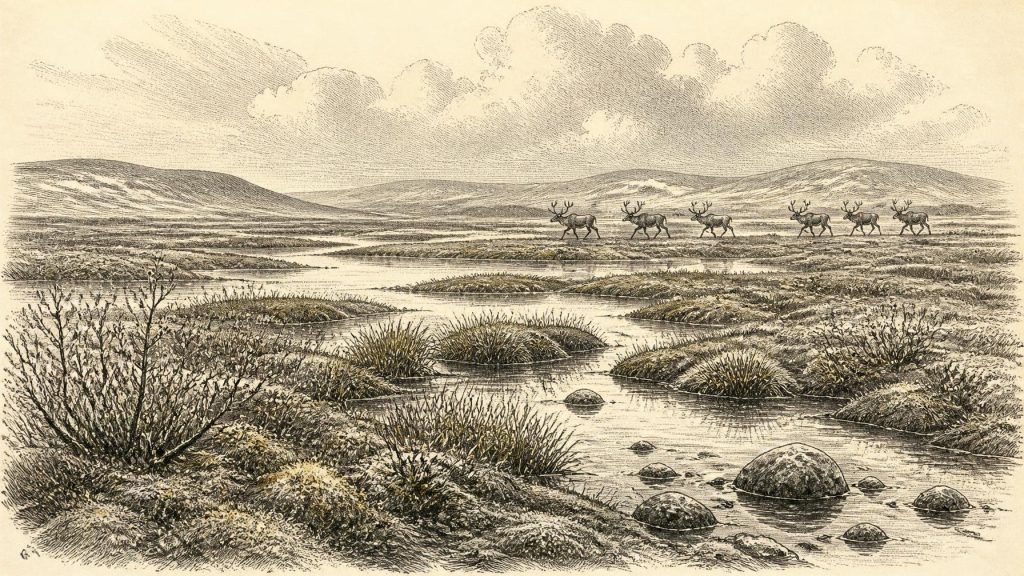
Derryvree is valuable because its silts preserved a small ecological archive beneath later ice. Plant macrofossils include sedges, mosses, buckbean or bogbean (Menyanthes trifoliata), water-milfoil (Myriophyllum alterniflorum) and dwarf willow (Salix herbacea). Together with insect evidence, they indicate shallow freshwater, wet margins and low, open vegetation rather than woodland. This was not a temperate Irish landscape of oak forest and pasture. It was a treeless, periglacial mosaic in which pools, saturated ground, mossy margins and herb-rich tundra could coexist.
The evidence also warns against imagining uniform desolation. Aquatic plants require water that was seasonally or locally open; mosses and sedges signal particular wet habitats; dwarf willow indicates severe conditions but also living ground cover. The landscape was probably highly seasonal, with freezing winters, short summers and unstable ground affected by frost. Yet a buried wetland is a local record. It demonstrates a favourable niche in Fermanagh, not a continuous lake district or identical vegetation from Cork to Donegal.
Climate and ice were changing rapidly on North Atlantic timescales. Reconstructions of the British–Irish Ice Sheet show that the major ice build-up which culminated later, broadly between 27,000 and 23,000 calibrated years ago, was still ahead. The precise onset and extent of earlier advances remain debated, and ice did not behave as a simple island-wide on–off switch. Upland ice, local glaciers and expanding ice-sheet sectors could affect different regions differently. Derryvree’s freshwater deposit matters precisely because it records an interval that was subsequently overridden and sealed by ice.
Castlepook’s Animal Archive
Far south-west of Fermanagh, Castlepook Cave near Doneraile in County Cork—also known as Mammoth Cave—offers Ireland’s richest well-known archive of pre-Last Glacial Maximum vertebrates. Its deposits and older collections contain remains attributed to animals including reindeer, giant deer, brown bear, Arctic fox, lemming, hare and hyaena, while mammoth is represented in the wider Irish Pleistocene record. The cave assemblage was accumulated over a long period and in complex circumstances: carnivores, natural deaths, water, sediment movement and later disturbance all shaped what survived. It is not a single snapshot of one season.
Nonetheless, the fauna establishes that Ireland was intermittently connected to, or accessible from, the wider north-west European faunal world before the great late-glacial ice expansion. Reindeer and lemmings fit open, cold environments; Arctic fox likewise signals harsh northern conditions. Giant deer and brown bear point to ecological variety across the longer assemblage rather than to a single uniform habitat. Some bones have direct radiocarbon ages around this broad period, including a giant-deer specimen dated to about 32,060 ± 630 radiocarbon years BP in the original Irish Quaternary Fauna Project programme. Such dates constrain the age of individual animals, not an exact date for the entire cave fauna.
For everyday animal life, the safest inference is movement rather than permanence. Herd animals would have followed grazing and shelter across an exposed landscape; predators and scavengers followed prey and carrion; caves could become dens, traps, shelters or repositories rather than domestic homes. There is no basis for turning this evidence into a settled human hunting economy, but it shows that the island could support substantial mammals during favourable pre-maximum intervals.
The Human Question
The most arresting object from Castlepook is a reindeer femur bearing a deep linear mark interpreted by zoologist Ruth Carden as a possible stone-tool cut made during butchery. The bone has been presented as approximately 33,000 radiocarbon years old. If the mark is correctly identified, it may indicate a human encounter with a reindeer in Ireland during the wider pre-glacial period. That would be of major importance, because it would push possible human activity far earlier than the securely established Late Upper Palaeolithic evidence from Alice and Gwendoline Cave in County Clare, where a modified brown-bear bone dates to roughly 12,800–12,600 calibrated years BP.
But the distinction between evidence and interpretation is essential. The Castlepook femur comes from an older cave collection, not from a recently excavated, intact occupation surface with associated stone tools, charcoal, food remains and living floor. A radiocarbon result dates the animal bone, not automatically the making of a surface incision. Nor does one potentially butchered bone demonstrate a resident population, a camp, a family group or repeated seasonal occupation. It may record a brief visit by Upper Palaeolithic people; it may yet require reassessment through detailed taphonomic study. Recent work at the cave has strengthened knowledge of its sediments and fauna, but has not produced an unequivocal contemporary toolkit or settlement.
This uncertainty matters for every familiar category of history. There is no evidence for political authority, warfare, diplomacy, formal exchange routes, agriculture, permanent houses, seafaring, metalworking, writing, religious monuments or learned institutions in Ireland at this time. There is equally no warrant for projecting later identities—Gaelic, Celtic, Irish or otherwise—into the deep Pleistocene. If people reached the island, their social relationships, beliefs and speech remain unknown.
Land Bridges and Lost Coasts
Sea level was much lower during the Last Glacial Period than it is now, exposing broad areas of the continental shelf. Ireland was not necessarily an island in its modern sense throughout every phase of this long cold stage. The configuration of coasts, channels, lakes and ice margins altered repeatedly, affecting possible animal and human movement between Ireland, Britain and continental Europe. This is an explanation for opportunity, not proof that a particular group crossed at 30,192 BCE. Routes could still have been blocked by water, ice, dangerous terrain or climate.
Regional contrast is therefore the central historical fact. A freshwater tundra basin in Fermanagh and a bone-bearing limestone cave in Cork are separated by hundreds of kilometres and represent different kinds of evidence. Together they reveal a dynamic Ireland: locally ice-free ground existed before later glaciation; cold-adapted animals reached the island; and a possible human trace remains under scrutiny. They do not yield a national narrative in the modern sense.
What This Moment Leaves Behind
The period’s enduring importance lies in the archive it bequeathed. Later ice advances reshaped terrain, buried older sediments and destroyed or concealed much surface evidence. Derryvree survived between tills; Castlepook retained bones in a cave system; museum collections preserved specimens whose significance can be revisited with new dating, genetic and microscopic techniques. The absence of visible settlements is therefore not proof that no person ever arrived, but it is a firm reason not to invent one.
Around this nominal date, Ireland was a cold and environmentally variable frontier before the Last Glacial Maximum. Its best-attested inhabitants were plants, insects and animals, not historical communities. Its most tantalising human possibility is a single marked reindeer bone. That imbalance is not a defect in the record to be filled with confident storytelling. It is the history: a landscape of wet tundra, cave fauna, low seas and approaching ice, known through fragments and still open to revision.
Primary Sources
- New insights on the fauna of Ireland's Younger Dryas and Early Holocene from Alice & Gwendoline Cave
- The Irish Quaternary Fauna Project
- Quaternary Science Reviews 42 (2012) 74–84
- Radiocarbon Dates from the Oxford AMS System: Archaeometry Datelist 31
- Response of the Irish Ice Sheet to abrupt climate change during the last deglaciation
- Radiocarbon constraints on the age of the maximum advance of the British–Irish Ice Sheet in the Celtic Sea
- Reconstructing the last Irish Ice Sheet 2: a geomorphologically-driven model of ice sheet growth, retreat and dynamics
- Quaternary deposits and glacial stratigraphy in Ireland
- Pleistocene glaciations in Ireland
- Growth and retreat of the last British–Irish Ice Sheet, 31,000 to 15,000 years ago: the BRITICE-CHRONO reconstruction
- A critical review and re-investigation of the Pleistocene deposits between Cranfield Point and Kilkeel, Northern Ireland: Implications for regional sea-level models and glacial reconstructions of the northern Irish Sea basin
- New evidence for a grounded Irish Sea glaciation of the Isles of Scilly, UK
- Ice sheet extension to the Celtic Sea shelf edge at the Last Glacial Maximum
- Maximum extent and dynamic behaviour of the last British–Irish Ice Sheet west of Ireland
- Character of advance and retreat of the southwest sector of the British-Irish Ice Sheet during the last glaciation
- Reconstruction and 36Cl based geochronology of the deglaciation of central Ireland
- Outreach and Education Resources
- Irish Association for Quaternary Studies Guide 13
- Heritage Artefacts of County Cork
- Pleistocene vertebrates in the British Isles
- Archaeological Survey
- Historic Environment Viewer