Derryvree Periglacial Microcosm30184 BCE
Thirty thousand one hundred and eighty-four BCE is a modern label, not a securely resolvable Irish date. Derryvree, County Fermanagh, preserves a wetland interval between glacial advances, broadly dated to 36,900–31,700 calibrated BP, with cold-water plants, mosses, insects and open tundra vegetation. Castlepook Cave, County Cork, records varied Ice Age fauna, although disturbed deposits prevent simple reconstructions. A possibly cut-marked reindeer bone may suggest an early human visit, but remains unconfirmed. No evidence establishes settlement, society or politics. Ireland formed a shifting periglacial landscape of ice, water, animals and possible transient people, documented only by fragmentary, local and revisable evidence.

Dateline
30,184 BCE is not a date at which Ireland can be described year by year. It is a modern calendar label projected far beyond any written or annually resolved record. In archaeological terms it falls roughly 32,000 years before 1950, during the Late Pleistocene, but no excavated Irish deposit can securely be assigned to this single calendar year. The responsible approach is therefore to examine the much wider calibrated ranges that overlap it, distinguish direct evidence from inference, and acknowledge how incomplete the island’s record remains.
A Date Within Broad Ranges
The nearest unusually informative Irish environmental sequence comes from Derryvree, near Maguiresbridge in County Fermanagh. Roadworks in 1969 cut through a drumlin and revealed freshwater silts, fine sands and organic material sealed between two glacial tills. The order of deposits is important: ice had occupied the locality, then a non-glacial interval permitted standing water, plants and animals to establish themselves, before a later ice advance buried the wetland. A radiocarbon measurement on the organic horizon, BIRM-166, was reported as 30,500 radiocarbon years BP, with a substantial uncertainty. Modern calibration places its possible age broadly at about 36,900–31,700 calibrated years BP, approximately 34,950–29,750 BCE.
That range encompasses 30,184 BCE, but it does not identify an event occurring then. Calibration converts a radiocarbon measurement into a probability range; it does not turn it into a historical date. Moreover, Derryvree records one sheltered basin in south Fermanagh, not conditions across the entire island. Nonetheless, it is powerful evidence that parts of Ireland experienced cold, open, periglacial environments with freshwater habitats during this phase of the last glaciation.
Water and Tundra at Derryvree
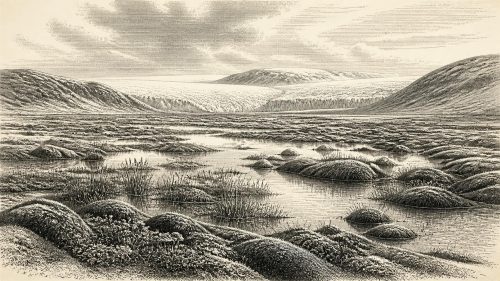
The Derryvree plant and animal remains offer the clearest picture available close to this notional year. Poorly preserved pollen was chiefly herbaceous, while plant macrofossils included mosses and species associated with wet, cold, open ground. Finds attributed to dwarf willow, mountain avens, bogbean, alternate water-milfoil and lesser clubmoss indicate neither a forest nor a uniform sheet of snow. Rather, the basin contained shallow water, saturated margins, mossy ground and sparse tundra-like vegetation. Frost, short growing seasons, exposed ground and seasonal thaw would have shaped life beyond the pool.
This was not the familiar bogland of modern Ireland. It was a dynamic periglacial wetland, perhaps resembling a mosaic of muddy pools, sedge-rich margins and low vegetation, set within a landscape affected by severe cold. Insects recovered from the deposit reinforce that interpretation. Yet even this detailed assemblage cannot establish average temperatures for a particular year, nor prove that every Irish region had identical conditions. Coastal exposure, altitude, distance from ice margins and changing North Atlantic circulation all mattered.
The wider glacial setting was similarly unsettled. The most extensive phase of the British–Irish Ice Sheet is generally placed later, during the Last Glacial Maximum, when ice covered Ireland and much of its surrounding shelf at roughly 27,000–23,000 calibrated years BP. Around 32,000 calibrated years BP, ice growth and retreat had already produced highly varied local conditions. The paired tills at Derryvree are a warning against imagining a simple progression from an ice-free Ireland to a uniformly frozen one. Ice margins moved; water ponded; cold-adapted communities occupied temporary refuges; and later glacial action could destroy or conceal much of the evidence.
Castlepook and the Animal World
In southern Ireland, Castlepook Cave near Doneraile, County Cork, is central to any discussion of this era. Explored in the early twentieth century under the direction of the cave investigator Richard J. Ussher, it produced one of Ireland’s richest Pleistocene faunal collections. Its remains include reindeer, giant deer, woolly mammoth, brown bear, wolf, fox, arctic fox, lemmings, hares and spotted hyaena. This list should not be read as a complete animal community existing simultaneously in one valley, however. Cave deposits accumulated over long periods, bones could be moved by water, scavengers or collapse, and early excavations removed much of the original stratigraphic context.
Recent redating has nevertheless transformed Castlepook’s importance. Improved chemical pretreatment of bone before radiocarbon measurement showed that several older determinations from Irish caves were unreliable. At Castlepook, revised dates indicate that parts of the fauna belong in Marine Isotope Stage 3, broadly before the Last Glacial Maximum, and suggest that giant deer and spotted hyaena may have disappeared locally before about 40,000 calibrated years BP. The cave therefore demonstrates that Ireland was connected ecologically to north-west European cold-stage faunas long before the final advance of the ice sheet.
For 30,184 BCE specifically, reindeer are especially relevant. A reindeer femur from Castlepook has been publicised in County Cork heritage material as bearing a mark interpreted as having been made by a sharp stone tool during carcass processing, and as dating to around 33,000 years ago. If that interpretation and association withstand further microscopic, chronological and contextual scrutiny, it may indicate a brief Upper Palaeolithic human visit to Ireland far earlier than previously accepted. It must not, however, be presented as a settled fact. The cave’s disturbed deposits and the absence of a securely associated stone-tool assemblage make this a significant but unresolved claim.
People: Possibility, Not a Population
There is no securely dated house, hearth, burial, tool-making floor, settlement surface or cemetery in Ireland from around 30,184 BCE. Nor can archaeologists identify a named people, language, political group or social order. The strongest accepted evidence for human presence on the island remains much later: a cut-marked brown-bear patella from Alice and Gwendoline Cave, County Clare, dated to the terminal Pleistocene, around 12,800–12,600 calibrated years BP. It shows that people reached Ireland in the Younger Dryas, but it cannot be used to populate the island twenty millennia earlier.
The Castlepook femur therefore matters precisely because it tests that long gap. A cut mark, if genuine, would imply the use of a sharp implement and knowledge of animal carcass processing; it would not demonstrate permanent colonisation. A small hunting or scouting party could leave very little trace, especially in a landscape later scoured or buried by ice. Conversely, without unequivocal tools, human remains or a sealed occupation deposit, it is equally possible that the mark has a non-human explanation or cannot be tied securely to the bone’s age. The evidence permits cautious discussion of a possible visit, not a narrative of a community.
Life Beyond the Evidence
Political affairs, diplomacy and organised warfare are beyond recovery for Ireland at this time. There is no evidence for territories, chiefs, alliances or conflict in the historical sense. If people did enter the island, their social world would have been that of mobile hunter-gatherers familiar with the seasonal behaviour of animals and the risks of a cold, exposed environment. That is an inference from the broader European Upper Palaeolithic context, not a directly observed Irish society.
The same caution applies to economy and trade. There is no Irish evidence for farming, herding, metalworking, formal exchange networks or long-distance commerce around 30,184 BCE. Food procurement, if humans were present at all, would have depended on wild resources: large mammals such as reindeer and possibly smaller game, alongside whatever plants, birds, fish or freshwater resources were seasonally accessible. A single modified bone would demonstrate butchery, not a dependable subsistence system. No religious sites, art, monuments, written learning or ritual objects can responsibly be assigned to this point in Irish prehistory.
An Island in Motion
Ireland’s most important story around 30,184 BCE is consequently environmental rather than political. Derryvree preserves a local cold-water refuge between glacial advances; Castlepook preserves a time-depth of animal life from a changing southern landscape. Together they show that the island was neither timeless wilderness nor an empty stage awaiting later settlers. It was an unstable northern environment in which water, vegetation, animals, ice and perhaps occasional people moved through narrow windows of opportunity.
The archaeological record does not allow a definitive event for this year. It does allow a more valuable conclusion: Ireland at this point lay within a shifting Ice Age world, and its surviving evidence is fragmentary, local and scientifically revisable. The duty of a year-by-year history at such a depth of time is not to manufacture certainty, but to make that uncertainty legible.
Primary Sources
- A Reconsideration of the Radiocarbon Dating of the Marine Isotope Stage 3 Fauna from Southern Ireland
- The Irish Quaternary Fauna Project
- New Insights on the Fauna of Ireland's Younger Dryas and Early Holocene from Alice & Gwendoline Cave
- First Evidence of a Late Upper Palaeolithic Human Presence in Ireland
- The Colonization of Ireland: A Human Ecology Perspective
- Ireland: Submerged Prehistoric Sites and Landscapes
- Maximum Extent and Dynamic Behaviour of the Last British–Irish Ice Sheet West of Ireland
- Radiocarbon Constraints on the Age of the Maximum Advance of the British–Irish Ice Sheet in the Celtic Sea
- The Timing and Magnitude of the British–Irish Ice Sheet Between Marine Isotope Stages 5d and 2
- Oscillating Retreat of the Last British-Irish Ice Sheet on the Continental Shelf Offshore Galway Bay, Western Ireland
- Response of the Irish Ice Sheet to Abrupt Climate Change During the Last Deglaciation
- Pleistocene Glaciations in Ireland
- The Exploration of Castlepook Cave, County Cork, Being the Third Report from the Committee Appointed to Explore Irish Caves
- Occurrence of Mammalia Relicts at Site Castlepook Cave
- Castlepook Cave: County Geological Site Report
- Heritage Artefacts of County Cork
- Palaeoecology: The Middle Midlandian Palaeoenvironment of South Fermanagh
- The Geological Heritage of County Leitrim
- Dublin Radiocarbon Dates II
- The IntCal20 Northern Hemisphere Radiocarbon Age Calibration Curve (0–55 cal kBP)
- Revisiting Alice and Gwendoline Cave, Co. Clare: New Light on the 1902 Excavations
- A 10Be-Dated Record of Glacial Retreat in Connemara, Ireland, Following the Last Glacial Maximum and Implications for Regional Climate