Giant Deer on Blackwater30149 BCE
Although labelled 30,149 BCE, this period cannot be dated precisely and is understood through broad environmental evidence from Marine Isotope Stage 3. Ireland experienced fluctuating cold conditions before the Last Glacial Maximum, with changing ice, sea levels and land connections. Derryvree, County Fermanagh, preserves a local ice-free freshwater wetland, supporting treeless vegetation, insects and marsh habitats. Southern caves reveal a diverse earlier fauna, including mammoth, reindeer and giant deer, though deposits are time-averaged and giant deer cannot be securely assigned to this date. Human presence remains unproven. The surviving record documents climatic instability, ecological change and glacial erosion across Ireland.
Dateline
The label 30,149 BCE is useful for placing this entry in a modern sequence, but it must not be mistaken for a date at which an Irish event can be recovered. It corresponds roughly to 32,098 years before AD 1950, the conventional ‘present’ of radiocarbon dating. At that depth of time, no excavation, fossil deposit or climate record offers calendar-year precision. Ireland’s evidence belongs instead to broad, calibrated ranges and to the changing environmental phase known as Marine Isotope Stage 3 (MIS 3), within the Midlandian cold stage. What can responsibly be described is an island—or, more accurately, a north-west European landscape whose shorelines and connections were radically unlike those of today—under mounting climatic pressure.
A Date Without an Annual Record
There were no states, rulers, boundaries, written languages or diplomatic communities in Ireland in any recoverable sense. Nor is there evidence for a settled human population at this point. Political affairs, warfare, trade agreements, religion and learning therefore cannot be narrated as they can for later prehistory. Their absence from the record is itself significant: the history available for this period is geological and ecological, reconstructed from cave bones, plant remains, insects, sediments and the traces of moving ice.
That reconstruction has firm limits. The oldest Irish deposits have often been disturbed by later glaciers, water, animals and nineteenth-century excavators. Bone from a cave is evidence that an animal, or material derived from one, entered that cave; it is not automatically proof that the species lived there at the same time as every other bone in a museum collection. Likewise, a date on an organic layer measures the age of carbon in that layer, not the beginning or end of a named ‘year’. The most credible account of Ireland around this notional date must keep evidence and interpretation apart.
Middle Midlandian Ireland
Thirty millennia before the present, Ireland was in the later Pleistocene, during a period of repeated cold oscillations across the North Atlantic world. The traditional Irish term Midlandian covers the last cold stage, but it was not one unbroken ice age. Ice margins advanced and retreated, climates altered over centuries and millennia, and locally ice-free ground could coexist with glaciers elsewhere. The Last Glacial Maximum, when the British–Irish Ice Sheet reached its greatest late-Pleistocene extent, lay in the future: current syntheses place its final maximum advance broadly around 27,000–23,000 calibrated years ago.
That distinction matters. It would be misleading to picture all Ireland at 30,149 BCE as an unvarying, island-wide white wilderness. Equally, it would be wrong to imagine a hospitable green country. Ice-sheet growth was becoming a dominant force in the region. Sea level was much lower than today because vast quantities of water were locked in global ice sheets. The Irish Sea basin and adjoining shelves had a different physical geography, and land, shallow water, seasonal sea ice and glacier fronts successively altered possible routes between Ireland, Britain and continental Europe. Precisely which routes were open at any one moment remains debated.
The regional pattern was complex rather than uniform. Research on the Irish Sea glacier indicates early build-up during late MIS 3, while evidence from Ireland itself shows that cold, non-glacial intervals also occurred. This means that ‘Ireland’ should not be treated as a single environmental zone. Exposed uplands, coastal plains now drowned by later sea-level rise, river valleys, limestone country and sheltered basins would have responded differently to snow, frost, wind and meltwater.
A Wetland Beneath Later Ice
One of the most informative Irish records comes from Derryvree near Maguiresbridge in County Fermanagh. There, roadworks exposed freshwater silts, sands and organic deposits sealed between two layers of glacial till. The sequence establishes an important order of events: ice laid down the lower till; a period followed in which standing or slowly moving freshwater accumulated sediment and organic matter; then later ice overrode or buried the site beneath the upper till. It is direct proof of a local ice-free freshwater interval, not proof that the whole island was simultaneously open.
A radiocarbon determination from the Derryvree organic layer, conventionally reported as 30,500 radiocarbon years BP with a large uncertainty, calibrates to a broad range approximately 36,900–31,700 years before AD 1950. The target date of 30,149 BCE therefore falls near the younger end of that broad calibrated bracket, but cannot be assigned to the deposit as an exact moment. The deposit nevertheless provides the closest well-studied environmental analogue for this entry.
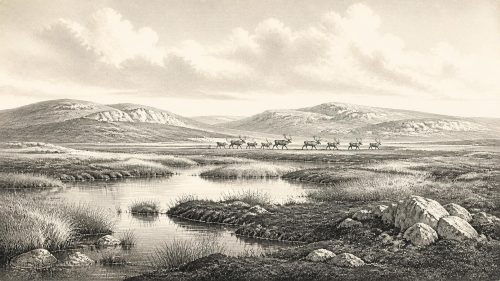
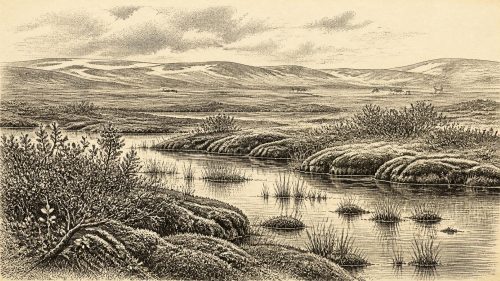
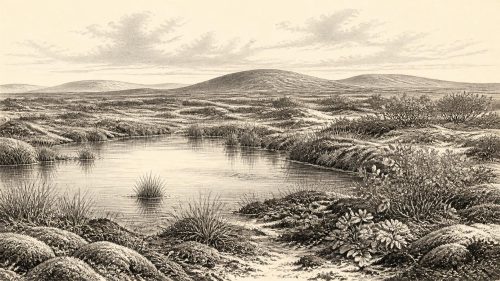
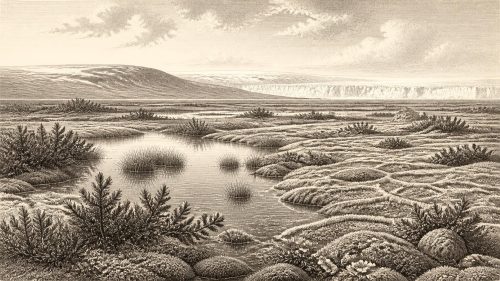
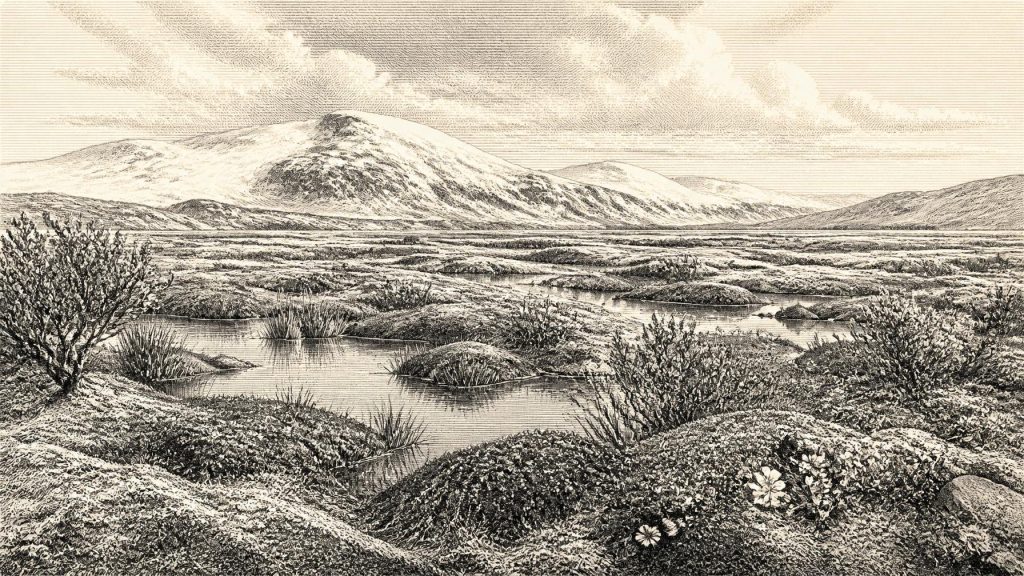
Its plant and insect evidence supports a severe, treeless landscape with freshwater and wet ground rather than an empty frozen desert. Fossils include mosses and sedges, bogbean, water-milfoil, dwarf willow, lesser clubmoss and mountain avens. These remains indicate aquatic and marshy habitats beside low, open vegetation, while cold-adapted insect assemblages point to a northern, periglacial climate. The best interpretation is a mosaic: shallow pools or marsh, sedge-rich margins, patches of hardy plants and exposed frost-affected ground. Such a place could be productive in a short growing season, yet harsh and highly seasonal.
This was not a human-made landscape. There was no farming, clearance, field system, grazing management or settlement visible in the evidence. The organic mud preserves ecological processes: plants growing and decaying, insects breeding, fine sediment washing into water, and later ice sealing the record. It is precisely because the deposit was buried that a fleeting local environment survived the destructive power of subsequent glaciation.
Caves and a Larger Fauna
Southern Irish caves add another part of the picture. Castlepook Cave near Doneraile in north County Cork has yielded Ireland’s richest and most important assemblage of pre-Last Glacial Maximum vertebrate remains. Its collections include material attributed to woolly mammoth, giant deer (Megaloceros giganteus), reindeer, brown bear, wolf, Arctic fox, mountain hare, lemmings and spotted hyaena. Such animals demonstrate that Ireland at intervals in MIS 3 supported far more diverse cold-stage mammal communities than the later island’s fauna.
Yet cave assemblages demand caution. They are time-averaged accumulations, not a photograph of one day’s animal life. Carnivores may have carried carcass parts into caves; water and later disturbance may have moved material; and improved radiocarbon pretreatment has shown that several earlier Castlepook dates were substantially too young. Re-dating indicates that some fauna previously thought closer to the Last Glacial Maximum is appreciably older, and suggests that giant deer and spotted hyaena may have vanished locally before about 40,000 calibrated years ago. Thus, neither species should be confidently placed in Ireland in the exact notional year of this article.
The great antlers of the giant deer still give the period a powerful visual emblem. The animal is often called the ‘Irish elk’, but it was neither confined to Ireland nor an elk; it ranged widely across Eurasia. In Ireland, its remains show that suitable habitats existed during earlier portions of the cold stage. They do not demonstrate a giant-deer herd beside the Derryvree wetland in 30,149 BCE. The responsible conclusion is more modest: the island had recently, in geological terms, formed part of a wider world capable of supporting large herbivores and their predators, but changing climate and advancing ice were repeatedly reshaping that world.
People: Possibility Is Not Proof
Humans unquestionably lived in neighbouring parts of Europe at this time, and Upper Palaeolithic groups had long occupied parts of Britain and the continent. Whether people entered Ireland during MIS 3 is a different question. A reindeer femur from Castlepook has been argued to bear a mark made by a sharp stone edge, and its age has encouraged claims for very early human activity. But the bone lacks a secure excavated Palaeolithic occupation context, the cave deposits have a complicated history, and no associated stone-tool assemblage or securely dated habitation surface confirms the claim.
For that reason, Ireland around 30,149 BCE cannot responsibly be described as inhabited, nor can an imagined hunting party be made the centre of its history. The earliest published direct evidence interpreted as human butchery in Ireland is vastly later: a marked brown-bear bone from Alice and Gwendoline Cave in County Clare, dated to roughly 12,810–12,590 calibrated years BP. Even that later find concerns a brief human action, not evidence of permanent settlement. Sustained and unequivocal colonisation belongs to the Mesolithic, after the end of the Pleistocene.
What the Landscape Can Tell Us
Economy, exchange and culture in the usual historical sense cannot be recovered for Ireland at this date because there is no secure human community from which to infer them. The available evidence instead records a living landscape shaped by climate: freshwater plants and insects in Fermanagh; caves preserving the traces of mammals in Cork; snow, permafrost-like ground conditions and meltwater; and ice sheets whose later movement removed or entombed much of the earlier record.
The principal development was therefore environmental instability. Around the broad interval represented by 30,149 BCE, Ireland was approaching the severe glacial conditions of the Last Glacial Maximum but was not simply its finished product. Local wetlands could exist between episodes of glaciation. Open ground could sustain specialised plants. Animal populations could enter, retreat or disappear as routes and habitats changed. The island’s later history would eventually include people, farms, monuments, kingdoms and written memory. At this much earlier threshold, the surviving Irish past is quieter but no less dramatic: a cold, changing country, preserved in a handful of sediments and bones against the erasure of ice.
Primary Sources
- A Middle Midlandian Freshwater Series at Derryvree, Maguiresbridge, County Fermanagh, Northern Ireland
- The Irish Quaternary Fauna Project
- A Reconsideration of the Radiocarbon Dating of the Marine Isotope Stage 3 Fauna from Southern Ireland
- First Evidence of a Late Upper Palaeolithic Human Presence in Ireland
- The Colonization of Ireland: A Human Ecology Perspective
- New Insights on the Fauna of Ireland’s Younger Dryas and Early Holocene from Alice & Gwendoline Cave
- Response of the Irish Ice Sheet to Abrupt Climate Change During the Last Deglaciation
- The Evolution of the Terrestrial-Terminating Irish Sea Glacier During the Last Glaciation
- Radiocarbon Constraints on the Age of the Maximum Advance of the British–Irish Ice Sheet in the Celtic Sea
- Radiocarbon Constraints on the History of the Western Irish Ice Sheet Prior to the Last Glacial Maximum
- The Deglaciation of the Western Sector of the Irish Ice Sheet from the Inner Continental Shelf to its Terrestrial Margin
- Growth and Retreat of the Last British–Irish Ice Sheet, 31,000 to 15,000 Years Ago: The BRITICE-CHRONO Reconstruction
- Stratigraphic and Palaeo-Geomorphological Evidence for the Glacial-Deglacial History of the Last British-Irish Ice Sheet in the North-Western Irish Sea
- Pleistocene Glaciations in Ireland
- Early Midlandian–Middle Midlandian, Pleistocene, Northern Ireland
- Pleistocene, Northern Ireland
- The Subdivision of the Quaternary Period in Ireland
- A Guide to the Quaternary of Northern Ireland
- Middle Midlandian Interstadial Deposits at Greenagho, Near Belcoo, County Fermanagh, Northern Ireland
- Dryas octopetala L.
- Menyanthes trifoliata L.
- Ice Age Ireland
- Ireland: Submerged Prehistoric Sites and Landscapes
- The Mesolithic in Ireland: When Was It?