
Archived: 7 October 2026
Abstract
Although labelled 30,149 BCE, this period cannot be dated precisely and is understood through broad environmental evidence from Marine Isotope Stage 3. Ireland experienced fluctuating cold conditions before the Last Glacial Maximum, with changing ice, sea levels and land connections. Derryvree, County Fermanagh, preserves a local ice-free freshwater wetland, supporting treeless vegetation, insects and marsh habitats. Southern caves reveal a diverse earlier fauna, including mammoth, reindeer and giant deer, though deposits are time-averaged and giant deer cannot be securely assigned to this date. Human presence remains unproven. The surviving record documents climatic instability, ecological change and glacial erosion across Ireland.
Read Article

Archived: 7 October 2026
Abstract
Thirty thousand years BCE is not a recorded Irish event but an approximate point within Marine Isotope Stage 3, reconstructed from limited environmental evidence. Derryvree, County Fermanagh, preserves wetland sediments between tills, dated by BIRM-166 within a calibrated range. They indicate an ice-free interval with cold, open tundra vegetation, freshwater and seasonal biological activity before later glaciation. Greenland records place the period near a cold stadial, although local conditions varied. Castlepook Cave documents diverse Ice Age fauna, not a simultaneous community. Possible early human activity remains unconfirmed; no secure settlement exists. These archives depict an ecologically inhabited, repeatedly glaciated Ireland.
Read Article
Archived: 5 October 2026
Abstract
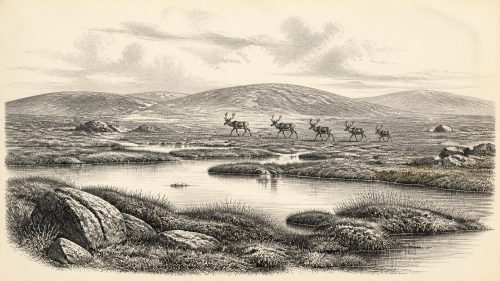
Although 30,245 BCE cannot denote a recoverable Irish calendar-year event, evidence places it within a volatile Late Pleistocene interval. Derryvree, County Fermanagh, preserves freshwater sediments between glacial tills, dated broadly to 34,950–29,750 BCE, indicating cold, treeless tundra-like conditions during an ice-free phase. Castlepook Cave, County Cork, yielded disturbed remains of reindeer, mammoth, giant deer, bears, foxes, wolves, lemmings and hyaenas, documenting changing fauna before the Last Glacial Maximum. A cut-marked reindeer femur may indicate human carcass processing around 31,000 BCE, but remains unconfirmed. No evidence supports settled communities, political events, farming, or a continuous land bridge at this particular time.
Read Article
Archived: 23 September 2026
Abstract
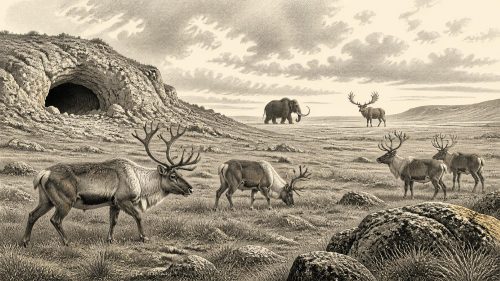
Around 33,000 calibrated years ago, Ireland experienced fluctuating Late Pleistocene conditions before the Last Glacial Maximum. Lower sea levels altered its geography, while cold, open landscapes supported varied fauna. Castlepook Cave, County Cork, Ireland’s richest vertebrate-fossil site of this period, yielded mammoth, giant deer, reindeer, brown bear and spotted hyaena remains. Its deposits were accumulated and disturbed through several processes, and early excavation limited contextual certainty; revised dating has also altered chronologies. A marked reindeer femur may indicate Upper Palaeolithic butchery, but does not prove settlement or continuous occupation. No evidence supports claims about contemporary society, economy, politics or culture.
Read Article
Archived: 23 September 2026
Abstract
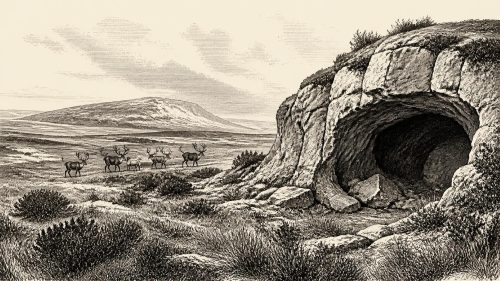
30,812 BCE is a modern label, not a securely dated Irish event. During unstable Marine Isotope Stage 3, Ireland was a changing cold-stage landscape, with altered shorelines, uncertain access routes and fluctuating ice margins. Castlepook Cave, County Cork, preserves diverse Late Pleistocene fauna, including reindeer, deer, mammoth, predators and Arctic species, but disturbed deposits and unreliable early dates prevent precise reconstruction. Derryvree sediments demonstrate freshwater and tundra-like environments between glacial episodes. A marked Castlepook reindeer bone may indicate human butchery around 33,000 years ago, yet no confirmed occupation evidence exists before 10,000 cal BP. Mammals and perhaps people reached Ireland.
Read Article

Archived: 22 September 2026
Abstract
30,859 BCE is not a recoverable Irish date but a notional point within unstable MIS 3. Derryvree, County Fermanagh, preserves freshwater sediments between tills, indicating an ice-free, periglacial tundra wetland with treeless vegetation, seasonal thaw and productive shallow water. Castlepook Cave, County Cork, contains a time-mixed fauna including mammoth, giant deer, reindeer, bear, wolf, hyaena and lemmings, demonstrating cold, open habitats. A possibly stone-cut reindeer femur may indicate mobile Upper Palaeolithic hunters, but cannot prove settlement. Later ice expansion destroyed or obscured much evidence. The period therefore reveals a changing ecosystem, while human presence, society and continuity remain deeply unresolved.
Read Article
Archived: 19 September 2026
Abstract
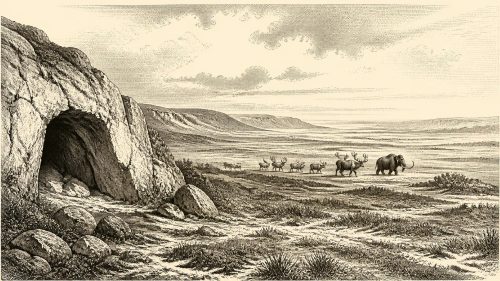
Castlepook Cave in County Cork preserves Ireland’s richest disturbed record of vertebrate fauna before the Last Glacial Maximum, during the climatically unstable later Marine Isotope Stage 3. Around 34,000–32,000 calibrated years ago, Ireland contained shifting cold, open habitats, developing ice and altered coastlines, rather than a uniformly frozen landscape. Mammoth, reindeer, giant deer, bear, wolf, hyena, lemmings and Arctic fox demonstrate connections with wider north-west European ecosystems. A tool-marked reindeer femur suggests fleeting Upper Palaeolithic activity, but cannot establish settlement or occupation. Dating, bone deposition and excavation methods require caution. Castlepook documents an ecological frontier increasingly transformed by advancing ice.
Read Article

Archived: 17 September 2026
Abstract
31,449 BCE is a modern label within volatile Late Pleistocene MIS 3, not a datable Irish year. Derryvree, County Fermanagh, preserves freshwater silts between glacial tills, radiocarbon-calibrated broadly to 34,950–29,750 BCE. Its bogbean, dwarf willow, clubmoss, pollen and insects demonstrate locally ice-free, treeless tundra-like wetlands before later ice advance. Castlepook Cave’s fauna, including mammoth, reindeer, giant deer, predators and small mammals, confirms links with wider Pleistocene Europe. A possibly cut-marked reindeer bone may indicate early human butchery, but remains disputed and cannot prove settlement. No Irish evidence establishes society, institutions or regular exchange. They reveal a living Ice Age landscape.
Read Article

Archived: 16 September 2026
Abstract
About 31,542 BCE, Ireland lay within the fluctuating later Marine Isotope Stage 3, not a recordable historical year. Derryvree, County Fermanagh, provides key evidence: organic freshwater sediments dated broadly to 36,900–31,700 calibrated years BP lie between glacial tills, showing a locally ice-free, cold, treeless wetland with sedges, mosses and hardy plants. Southern cave remains demonstrate intermittent access by fauna including reindeer, mammoth, giant deer and predators, although assemblages are not single communities. A possibly cut-marked reindeer bone suggests transient human activity, but settlement remains unproven. Lower sea levels aided movement before later glaciation buried or destroyed much earlier physical evidence.
Read Article

Archived: 15 September 2026
Abstract
At the notional date of 31,702 BCE, Ireland lay within the climatically volatile Late Pleistocene, approaching extensive glaciation. Precise dating and ice coverage are impossible to establish, since later ice destroyed or buried much evidence. Castlepook Cave in County Cork preserves mixed MIS 3 deposits containing mammoth, reindeer, giant deer, bears, wolves, Arctic foxes, lemmings and spotted hyaenas, indicating cold, open habitats and links with European fauna. Carnivore activity complicates interpretation. A possibly cut-marked reindeer bone offers disputed evidence of human presence, but no securely dated settlements, tools or human remains exist. Castlepook demonstrates environmental change, habitation possibilities, and uncertainty.
Read Article

Archived: 13 September 2026
Abstract
The reference year 31,805 BCE introduces Ireland’s Late Pleistocene animal communities without assigning them to an exact calendar event. Castlepook Cave preserves remains of reindeer, mammoth, giant deer, bear, wolf and spotted hyaena from the wider period. These finds illuminate cold environments before later glaciation. Open habitats could persist locally while ice expanded elsewhere, producing an uneven regional landscape. Later glacial activity erased many earlier surfaces, leaving a fragmentary record. Castlepook studies, Derryvree environmental evidence, museum collections and regional reconstructions provide context. The article explains how surviving animal and sediment evidence informs cautious interpretation of Ireland’s changing Ice Age ecology.
Read Article

Archived: 10 September 2026
Abstract
31,850 BCE is a modern label, not a recoverable Irish historical year, within the unstable later Ice Age. Ireland’s shifting climate, ice margins and lowered seas created changing connections with Britain and continental Europe, though routes remain uncertain. Castlepook Cave near Doneraile preserves Ireland’s richest pre-Last Glacial Maximum fauna, including mammoth, reindeer, giant deer, hyaena, wolves and lemmings, indicating recurring cold open habitats. Cave deposits and revised dating caution against treating these animals as contemporaries. A possibly tool-marked reindeer bone suggests, but cannot prove, temporary human activity. No settlement, tools or surface confirms habitation. Research may refine this environmental archive.
Read Article

Archived: 9 September 2026
Abstract
Around 31,942 BCE, Ireland experienced a cold, unstable Late Pleistocene climate before the Last Glacial Maximum, with ice coverage varying regionally and open tundra-like habitats in ice-free areas. Castlepook Cave, County Cork, preserves a time-layered fauna including mammoth, reindeer, giant deer, bears, wolves, hyaenas and lemmings, demonstrating ecological connections with north-west Europe. Cave deposits cannot reconstruct a single moment, and earlier dating requires reassessment. Human occupation at this date remains unproven: a possible cut-marked reindeer bone needs further testing. Secure evidence of people in Ireland is far later, during the Younger Dryas. No societies, settlements or events can be identified.
Read Article




