Irish Pine’s Atlantic Vigil1942 CE
In 1942, neutral Ireland endured the Emergency while Northern Ireland became an Allied base after American troops arrived in Belfast. De Valera’s government maintained neutrality, emergency controls and censorship, while creating the Central Bank and confronting extremist politics. Shortages of fuel, rubber, food and consumer goods reshaped work, travel and household life; labour migration to Britain remained significant. Irish merchant ships risked Atlantic attack while rescuing survivors, until the Irish Pine was torpedoed with all thirty-three crew lost. Cultural life persisted through Cavan Cathedral, Kavanagh’s The Great Hunger and folklore scholarship, alongside censorship disputes. Ireland faced constraint, danger and change.
Dateline
An Island Divided by War
In 1942, Ireland was not a battlefield in the formal sense, but war ordered the rhythm of life across the island. The twenty-six counties governed from Dublin remained neutral under Éamon de Valera’s Fianna Fáil administration, in what the State called The Emergency. Northern Ireland, by contrast, was part of the United Kingdom and fully committed to the Allied war effort. That constitutional division was not an abstract matter. It shaped security, employment, travel, public speech and the presence of foreign troops. The year made especially plain that the island’s two jurisdictions were experiencing the same global war in strikingly different ways.
De Valera’s Government maintained that neutrality was both a protection for the State and an assertion of independence. It refused to join either belligerent camp and guarded the former Treaty Ports which Britain had handed back in 1938. Yet neutrality did not mean detachment. Ireland depended overwhelmingly on imports carried through dangerous seas, and it sat beside Britain’s principal Atlantic approaches. The authorities therefore had to combine public impartiality with intense concern for national defence, supply and internal security. Emergency legislation, censorship and administrative controls gave ministers exceptional powers over the practical life of the country.
By 1942, the immediate fear of a German landing had receded from its height in 1940, but it had not vanished. The Defence Forces remained mobilised, civil-defence arrangements endured, and the Government continued to regard any unauthorised political or military activity as a potential threat to the State. The Emergency was consequently experienced not simply as a distant European conflict but as a continuing condition of constrained, watchful citizenship.
American Soldiers in Belfast
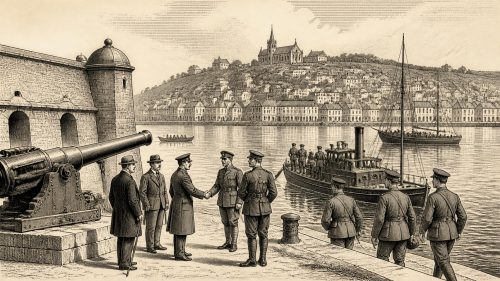
A firmly dated event underlined the island’s strategic importance. On 26 January, the first contingent of United States Army troops arrived at Belfast. Men of the US 34th Infantry Division came ashore after the United States’ entry into the war, their landing marking the first arrival of American ground forces in the European theatre. Northern Ireland now became a major base within the Allied war system: a place for camps, training, transport, airfields, stores and the movement of troops onward to other theatres.
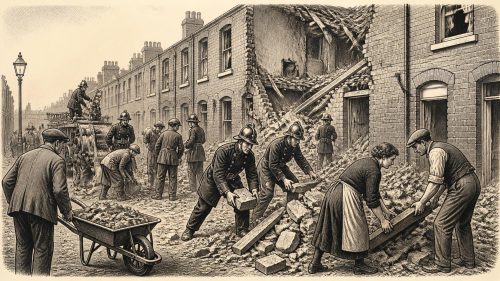
For people in Belfast and in towns and countryside used by the military, the newcomers brought a conspicuous new presence: American uniforms, vehicles, wages and demand for accommodation and services. Their arrival also followed the trauma of the Belfast Blitz of the previous year, when Luftwaffe attacks had exposed the vulnerability of the region’s industrial city and overwhelmed civil-defence preparations. In 1942 the American build-up offered practical military reinforcement, but it also made Northern Ireland still more visibly tied to Britain’s war.
Dublin responded by restating its position on partition and neutrality. The landing of foreign troops in the North was politically sensitive because the Government claimed jurisdiction over the whole island under the 1937 Constitution, while possessing no authority in Northern Ireland. American and British military planning also envisaged defence of the island against an Axis attack. That possibility demonstrated the awkward reality beneath official formulas: the Irish Government insisted on sovereignty and neutrality, while Allied planners considered how they might act in Ireland if the wider war demanded it.
Emergency Government and Its Limits
At Leinster House, the Government continued to legislate and govern under emergency conditions. The Emergency Powers Act of 1939 had authorised orders for public safety, public order and the control of essential supplies and services. Its continuance and amendment in 1942 confirmed that emergency rule was no brief expedient. It was a legal framework through which the State regulated economic life, restricted certain activities and pursued those judged dangerous to security.
The year also produced an important institutional measure. The Central Bank Act, enacted on 4 November, provided for the establishment of the Central Bank of Ireland and the dissolution of the Currency Commission. The change did not solve the shortages of wartime Ireland, nor did it remove the close monetary and commercial connection with Britain. It did, however, mark a significant development in the machinery of the independent State: the creation in law of a central banking institution with defined functions, governance and powers.
Political life was not suspended. The Dáil remained in session and opposition politicians criticised the burdens imposed by controls and scarcity. But the political environment was narrowed by censorship and the emergency powers. In 1942 Gearóid Ó Cuinneagáin founded Ailtirí na hAiséirghe, an extremist movement seeking an authoritarian, corporatist and explicitly Gaelic-Christian order. Its creation is a reminder that wartime Ireland contained currents hostile to parliamentary democracy as well as supporters of constitutional government. The movement was never representative of the country as a whole, but its emergence belonged to a European moment in which dictatorship, nationalism and racial or ideological propaganda had acquired frightening force.
Shortage as Daily Experience
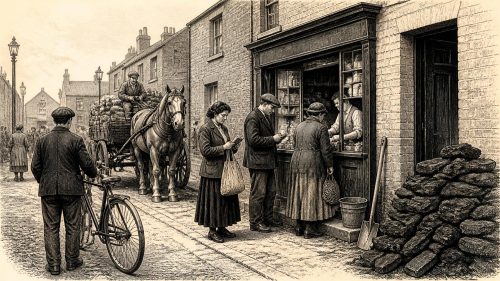
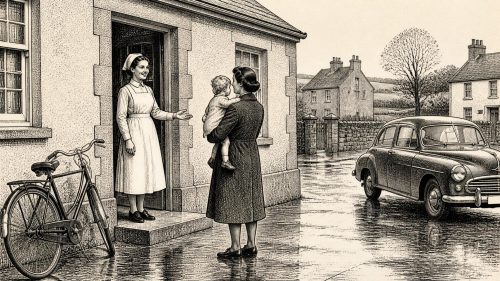
For most households, the defining fact of 1942 was not high diplomacy but scarcity. Ireland’s pre-war economy relied heavily on imports, especially fuel, fertiliser, animal feed, machinery, raw materials and consumer goods. The Atlantic campaign made shipping uncertain; Britain’s own wartime needs further narrowed what could be supplied. Peat, timber, turf-cutting, bicycles, walking and improvised repairs became more important as coal, petrol, rubber and manufactured replacements grew harder to obtain.
Gas rationing was introduced on 3 March. In June, speed restrictions for cars, motorcycles and buses were imposed to reduce tyre wear, an apparently modest measure that reveals the depth of the rubber shortage. Such rules affected journeys to work, trade between town and country, and the maintenance of ordinary social connections. Limits on clothing and footwear, alongside other rationing arrangements, made the care and reuse of possessions a routine domestic concern.
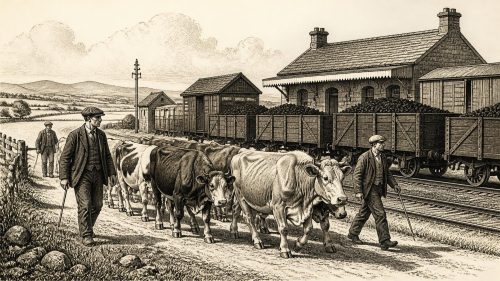
Food supplies were uneven. Bread, potatoes, milk, butter and tea formed the core of many diets, but access and price mattered greatly. Wartime controls were intended to distribute restricted goods and limit inflation, yet people with small incomes remained exposed to rising costs and local shortages. Farming families could possess advantages in milk, eggs, vegetables or turf, though they too faced difficulties obtaining fertiliser, machinery parts and imported feed. The countryside was neither untouched nor self-sufficient; it was bound into the same restricted transport and trading system as the towns.
Employment in Britain continued to matter. Irish men and women had long crossed the Irish Sea for seasonal and permanent work, and wartime labour demand made that connection economically important even as travel was controlled. Remittances sent home from Irish workers in Britain supported families in the State. In December, the Government prohibited direct newspaper advertising in Ireland for jobs in Britain, reflecting official anxiety about labour movement and the pressure that emigration placed on home production and services.
Neutral Ships in a Dangerous Ocean
Irish neutrality could not make the Atlantic neutral. Merchant vessels registered in Ireland carried the supplies on which the country depended, travelling through waters stalked by submarines, mines and aircraft. Their crews worked under the Irish tricolour and conspicuous neutrality markings, but these were not a guarantee of safety. The sea lanes connected Ireland to North America, Britain and the wider world; they also brought the war’s most direct lethal danger to Irish civilians.
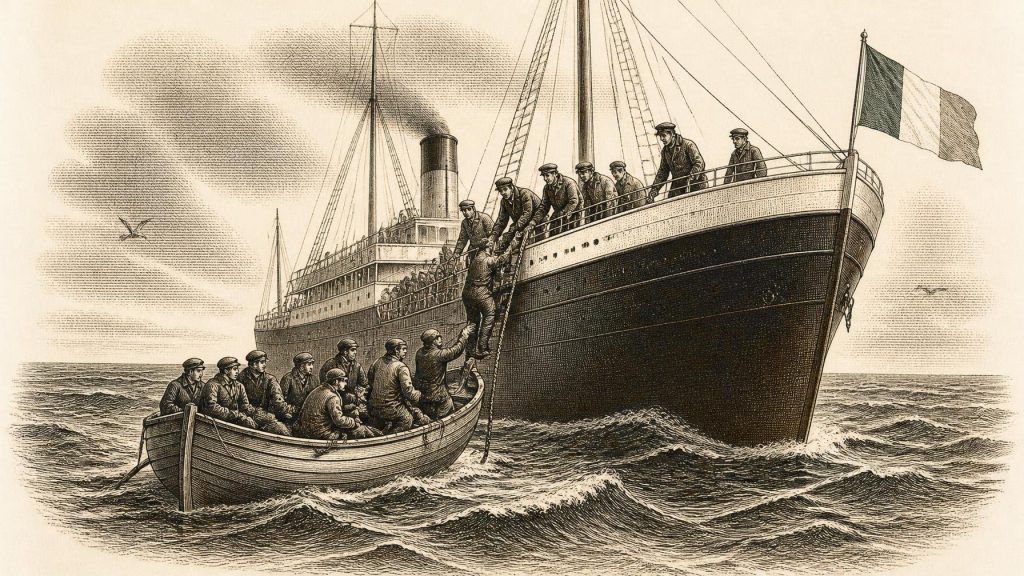
The record of 1942 contains both rescue and loss. On 11 August the Irish Rose rescued seven survivors from the American schooner Wawaloam. Two days later, the Irish Pine rescued nineteen people from the British ship Richmond Castle. On 26 August, the Irish Willow brought aboard forty-seven survivors of the British Empire Breeze; on 17 September, the Irish Larch rescued forty survivors from the Panamanian Stone Street. These were acts of seamanship and humanitarian duty, performed in conditions where stopping to take people from lifeboats exposed a merchant ship to danger.
The year ended more darkly for the Irish Pine. On 15 November, while sailing in ballast for Boston, she was torpedoed by the German submarine U-608 in the North Atlantic. All thirty-three aboard died. The loss was a severe illustration of the risk borne by the small Irish merchant fleet. It also exposed the limits of diplomatic language. Ireland could protest breaches of neutrality, but it could not police the ocean or compel a submarine commander to respect a painted flag.
Buildings, Books and Cultural Argument
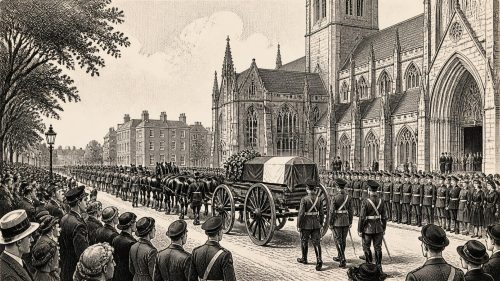
Despite restriction, cultural and religious life continued. In Cavan town, the new Roman Catholic Cathedral of Saint Patrick and Saint Felim reached completion in 1942. Designed by Ralph Byrne’s firm and built by John Sisk and Sons, its monumental neo-classical form, granite and Portland stone projected permanence during an unstable time. Its construction had begun before the war, and its completion in the Emergency connected Catholic institutional confidence with a changing provincial townscape.
Irish publishing also produced work that has lasted far beyond the year. Patrick Kavanagh’s The Great Hunger was issued by the Cuala Press in April in a limited edition of 250 copies. Its bleak vision of frustrated rural life challenged sentimental depictions of the countryside at precisely the moment when farming and food supply were so central to public discussion. Seán Ó Súilleabháin’s A Handbook of Irish Folklore, published for the Folklore of Ireland Society, supplied collectors with a practical guide to recording stories, customs, songs and local knowledge: an organised effort to preserve oral tradition.
Culture also revealed the reach of moral regulation. Eric Cross’s The Tailor and Ansty, a book rooted in the speech and storytelling of Timothy Buckley and Anastasia Buckley at Gougane Barra, was prohibited by the Censorship of Publications Board on 28 September. Sir John Keane challenged the decision in the Seanad in November, but passages he quoted were themselves removed from the official record. The episode showed that, even amid wartime emergency, arguments about sexuality, rural speech, Catholic respectability and the boundaries of permissible literature remained intensely public.
Thus 1942 was a year in which Ireland endured war without formally entering it. American troops transformed Northern Ireland’s military landscape; the Dublin Government defended a difficult neutrality; shortages disciplined homes and journeys; sailors faced the Atlantic’s violence; and new institutions, buildings and books took shape. The year’s history lies in that tension between restriction and continuity: a divided island living beside a total war, yet still making decisions about the kind of society it wished to become.
Primary Sources
- Foreign Relations of the United States, 1942: Telegram from the Minister in Ireland, 27 January 1942
- Foreign Relations of the United States, 1941–1943: Establishment of United States Forces in North Ireland, 11 January 1942
- United States Army in Northern Ireland: Chronology
- The Emergency Powers Act, 1939
- Emergency Powers (Continuance and Amendment) Act, 1942
- Central Bank Act, 1942
- Central Bank Act 1942: Commencement and Legislative History
- Chronological Table of the Statutes: 1942
- Public Business: Central Bank Bill, 1942—Committee, 30 April 1942
- Éamon de Valera Papers: Descriptive Catalogue
- The Irish Army and the Emergency
- Civil Defence in Ireland 1939–45
- Ireland and the Second World War—the Price of Neutrality
- Letter, Boland to Warnock, Documents on Irish Foreign Policy, 16 August 1943
- SS Irish Pine
- Royal Navy War Diary, August 1942
- ISL and Lemass
- Chapter 5: The War Years
- Ó Cuinneagáin, Gearóid Seán Caoimhín
- Seosamh Ó Duibhginn Papers: Descriptive Catalogue
- The Great Hunger: National Library of Ireland Catalogue Record
- Cross, Eric
- Keane, Sir John
- Cathedral of Saint Patrick and Saint Felim, Cavan
- Rationing in 1940s Ireland: Drapers Protest over Clothes Restrictions