Custom House Fire and Truce1921 CE
In 1921, Ireland moved from intense War of Independence fighting towards truce and treaty, amid coercion, raids and executions. IRA engagements at Crossbarry and Tourmakeady maintained pressure, while the Custom House burning destroyed records but cost lives and arrests. May elections confirmed Sinn Féin’s southern mandate and established Northern Ireland’s unionist government. The 11 July truce ended principal IRA–Crown operations but not Belfast’s sectarian violence. London negotiations produced the December Anglo-Irish Treaty, creating a dominion Free State while retaining the Crown, partition and British naval facilities. Signed but unapproved, it deeply divided republicans, leaving border, constitutional and security questions unresolved.
Dateline
War at Its Most Intense
In 1921 Ireland passed, within twelve months, from the hardest fighting of the War of Independence to a truce and then to the agreement that remade most of the island’s constitutional future. None of those transitions was neat. The opening half of the year was marked by raids, ambushes, executions, arrests, martial law and the damaging of roads, barracks and administrative buildings. By its close, Irish and British delegates had signed the Anglo-Irish Treaty. Yet the settlement left partition in place, preserved a constitutional link with the Crown and exposed grave divisions within the movement that had claimed to speak for an all-Ireland republic.
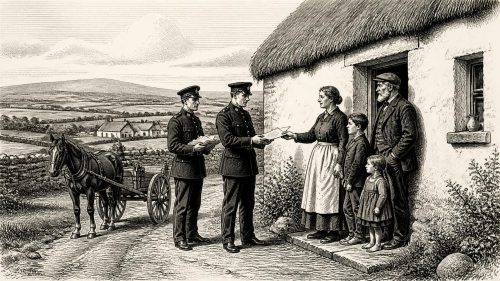
Conditions in much of the south and west remained those of a coercive war. Martial law, proclaimed in several counties late in 1920, continued to shape daily life in 1921. The British military presence was large, while the Royal Irish Constabulary, Auxiliaries and Black and Tans remained targets for the Irish Republican Army (IRA). Republican activists faced arrest, imprisonment and execution; the underground Dáil Éireann could meet only intermittently in the early months, while its courts and sympathetic local authorities were harried by Crown forces. Ordinary people navigated curfews, searches, disrupted transport and the risk that a road, public building or neighbourhood might become the setting for violence.
The conflict did not amount to a single conventional front. It was a struggle over intelligence, movement, policing and the authority of the state as much as over territory. The IRA’s shortage of arms and difficulty in sustaining large operations encouraged smaller attacks, while Crown counter-insurgency methods made open organisation dangerous. Nevertheless, several engagements demonstrated that fighting had not subsided. At Crossbarry in County Cork on 19 March, Tom Barry’s flying column broke through a large encircling force in a running engagement. At Tourmakeady, County Mayo, on 3 May, an IRA column under Tom Maguire attacked Crown forces before escaping after a pursuit. Such actions were militarily limited but politically potent, keeping alive the claim that Britain could not restore normal authority by force alone.
The Custom House Burns
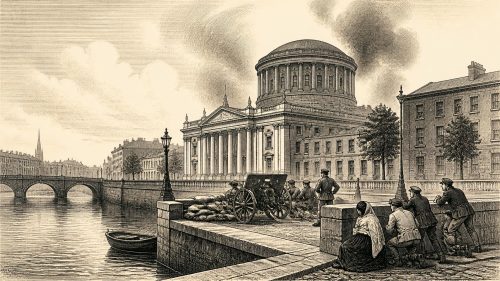
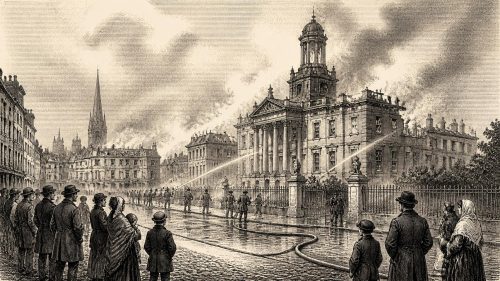
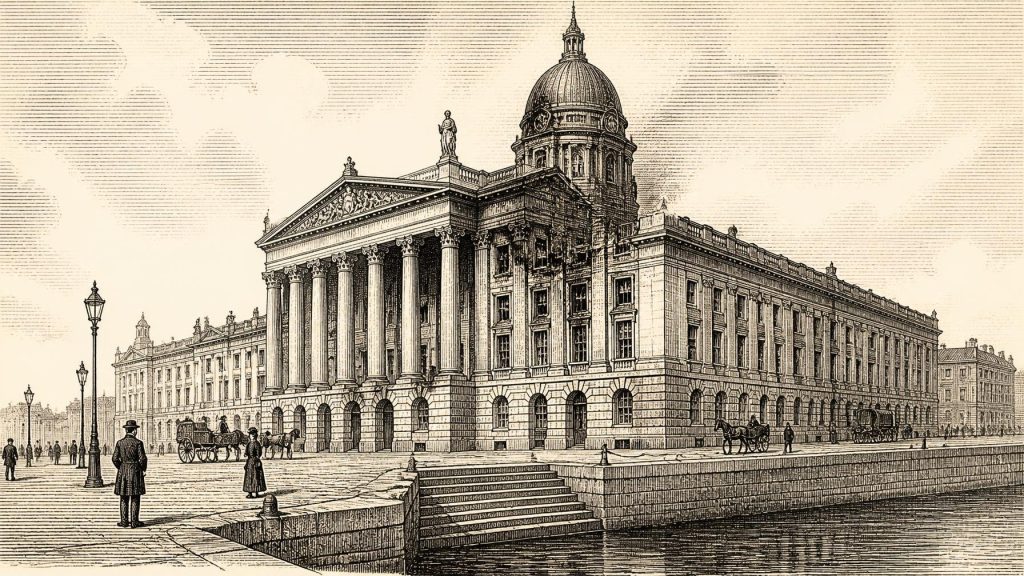
One of the year’s most conspicuous acts occurred in Dublin on 25 May. More than a hundred IRA men entered the Custom House, the headquarters of the Local Government Board and a major emblem of British civil administration, and set it alight. The operation was intended to destroy records as well as to make a public statement. It achieved the latter at a terrible cost. Crown forces reached the scene quickly; five IRA Volunteers and three civilians were killed, and more than a hundred suspects were arrested. The fire wrecked much of James Gandon’s great riverside building, which burned for days.
The attack revealed both the reach and the weaknesses of republican military organisation in the capital. It proved that a large force could be assembled and strike at the centre of government. But the captured Volunteers badly weakened Dublin Brigade manpower at a critical time. For civil servants, families and businesses connected with local government, the destruction also represented a practical disaster: administrative records, workplaces and institutional routines disappeared in smoke. The Custom House was therefore more than a dramatic symbol. It illustrated how the conflict entered the machinery of everyday governance, with consequences extending far beyond the armed men involved.
Two Elections, Two Political Orders
While war continued, the Government of Ireland Act was being put into operation. Westminster’s legislation had created separate parliaments for Northern Ireland and Southern Ireland. Elections held in May 1921 made the contrast between the two systems unmistakable. In the twenty-six-county area designated Southern Ireland, Sinn Féin won 124 of the 128 seats, most without contest. Rather than recognise the new Southern parliament, Sinn Féin treated the poll as an election to the Second Dáil, reinforcing its claim to represent the Irish republic.
The Parliament of Southern Ireland consequently had almost no political life. When it assembled in June, only the four unionist members attended. Its failure was a striking indication that constitutional arrangements designed in London could not command nationalist assent in most of the island. The Second Dáil, however constrained by war, now possessed a renewed electoral mandate which its leaders could invoke in diplomatic dealings with Britain.
In the six counties of Northern Ireland, the election produced a functioning unionist-majority parliament. James Craig, who had succeeded Edward Carson as leader of the Ulster Unionist Party earlier in the year, became Northern Ireland’s first prime minister. The new parliament first met in Belfast City Hall on 7 June. King George V formally opened it there on 22 June and appealed for restraint and conciliation among Irish people. The appeal was important to the emerging peace process, but it did not dissolve the political fact that Northern Ireland had begun operating as a distinct government.
The northern election also gave representation to nationalists and to two women, Julia McMordie and Dehra Parker, elected as Ulster Unionists for Queen’s University. Their presence was historically notable, though the parliament remained overwhelmingly male and unionist. More fundamentally, its establishment created a new arena in which questions of policing, security, employment and allegiance acquired immediate force. For northern Catholics and nationalists, a government founded amid recurring communal violence could not simply be regarded as a neutral new institution.
A Truce, Not Peace
Negotiation became possible because neither side had secured a decisive victory and because the political and human costs of continuing war were severe. Lloyd George invited Éamon de Valera to talks, while de Valera consulted southern unionist figures and sought, unsuccessfully, a wider Irish understanding that included Craig. Terms for a cessation of operations were agreed in early July. The truce took effect at noon on 11 July 1921.
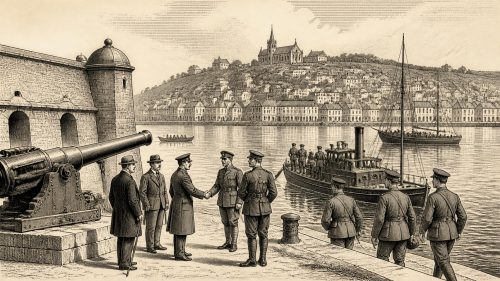
Its importance was immediate. The formal agreement ended active operations between the IRA and British forces without requiring the IRA to surrender its weapons. Liaison machinery was created to handle complaints, prisoners, property and alleged breaches. In towns and villages accustomed to patrols, curfews, raids and fear, the altered atmosphere was palpable. Later testimony records people in Cork city remaining outside after nightfall, testing the end of restrictions that had come to seem ordinary. Republican Volunteers could move more openly, sometimes attracting celebratory crowds and new recruits. This did not mean that local resentments, weapons or competing loyalties had disappeared.
Above all, the truce did not bring comparable safety to Belfast. On 10 July, the day before it came into force, a deadly outbreak of sectarian violence followed an IRA attack on a police convoy in Raglan Street. The violence of Belfast’s ‘Bloody Sunday’ involved shootings, house burnings and widespread injury; civilians, especially in vulnerable mixed or interface districts, bore the heaviest burden. Violence continued in the city after 11 July. Thus the truce ended the principal war between the IRA and Crown forces across much of Ireland, but it did not settle northern conflict or secure the lives and homes of Belfast residents.
The London Settlement
De Valera met Lloyd George in London in July, but their discussions exposed a basic incompatibility. British ministers would not recognise Ireland as an already sovereign republic, and insisted on association with the British Commonwealth and allegiance to the Crown. De Valera maintained that the Irish nation’s unity and independence could not be surrendered as a preliminary condition. Correspondence through August and September did not bridge that gulf, but it led to a formal conference.
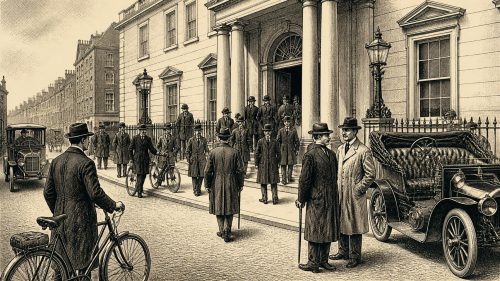
On 11 October, an Irish delegation led by Arthur Griffith and including Michael Collins, Robert Barton, Eamon Duggan and George Gavan Duffy began negotiations in London; Erskine Childers served as secretary. Their authority, and the degree to which they could make binding commitments, would later become contentious. During the talks, the central questions were dominion status, the oath, defence, the position of Northern Ireland and the prospect of an all-Ireland arrangement. Irish delegates sought constitutional freedom and national unity; the British government sought a settlement compatible with imperial security and the refusal of northern unionists to enter an all-Ireland state.
The Articles of Agreement were signed in London in the early hours of 6 December. The Treaty provided for an Irish Free State with dominion status comparable to Canada, Australia, New Zealand and South Africa. It required an oath containing fidelity to the Free State constitution and allegiance to the Crown, provided for a governor-general, and reserved naval facilities at Berehaven, Queenstown (Cobh) and Lough Swilly to Britain. Northern Ireland could opt out of the Free State, and a Boundary Commission was envisaged if it did so. These provisions gave Ireland far greater self-government than Home Rule had promised, but not the independent republic for which many republicans believed they had fought.
An Unfinished Year
By December, conflict had moved from the battlefield to the chamber and the cabinet room, but its stakes were no less sharp. The Dáil began debating the Treaty on 14 December. Supporters argued that it offered a practical route to self-government and an end to war; opponents held that no elected representatives could accept an oath to the Crown, partition or a settlement short of the republic. The vote would not come until January 1922, so it would be wrong to treat 1921 as the year in which the Treaty was accepted. It was the year in which its terms were signed and Ireland’s revolutionary coalition was placed under immense strain.
For Ireland, 1921 was consequently neither a straightforward victory nor simply a pause between wars. The Custom House fire, the creation of Northern Ireland’s institutions, the July Truce and the December Treaty all belonged to the same year, yet pointed in different directions. They ended one political order, established another in the north, and opened the difficult path towards the Irish Free State. They also left unresolved the border, communal security, constitutional allegiance and the meaning of national independence—questions that would shape the violence and politics immediately ahead.
Primary Sources
- Military Archives — Truce Liaison and Evacuation Papers
- UCD Decade of Centenaries — 1912–1923 Timeline
- Houses of the Oireachtas — History of Parliament in Ireland
- Houses of the Oireachtas — Debate on Treaty, 21 December 1921
- University College Cork — The Irish Revolution
- University College Cork — Phase III: January 1921 to July 1921
- University College Cork — Unit 7: The Irish War of Independence, 1919–21
- University College Cork — 1921 Brought Challenges on Multiple Fronts
- University College Cork — Martial Law, December 1920
- University College Cork — Law and Disorder during the Civil War
- CELT, UCC — Official Correspondence Relating to the Peace Negotiations, June–September 1921
- CELT, UCC — Irish Memorandum of 22 November 1921
- The National Archives — Irish Partition: Source Two
- Northern Ireland Assembly — Evolution of Devolution
- Northern Ireland Assembly — Parliament Buildings Marks the Centenary of the State Opening of the Northern Ireland Parliament
- Northern Ireland Assembly — First Parliament
- UK Parliament Hansard — Disturbances, Belfast, 11 July 1921
- RTÉ History — July 10th 1921: Belfast’s Bloody Sunday
- RTÉ Century Ireland — Endgame 1921: Towards Truce and Treaty in Ireland
- Public Record Office of Northern Ireland — Ireland 1900–1925: Crisis, War and Revolution
- History Ireland — The Truce and Preliminary Negotiations Between de Valera and Lloyd George
- History Ireland — To Stop Partition? Arguments for the Parliament of Southern Ireland, 1921
- History Ireland — The Dáil Cabinet’s Mission to Belfast, November 1921 to January 1922
- Military Archives — Truce Timeline