
Saint Jack and the Áras1990 CE
In 1990, Ireland combined growing international confidence with economic insecurity and continuing Northern conflict. Dublin’s European Community presidency hosted discussions on German reunification and future union, while Italia ’90 inspired nationwide celebration after Ireland reached the World Cup quarter-finals. Nelson Mandela’s visit highlighted Irish anti-apartheid solidarity, and abolition of the death penalty marked legal reform. Economic recovery remained uneven, with unemployment at 12.9 per cent. Northern Ireland saw violence alongside tentative political developments. Mary Robinson’s presidential victory over Brian Lenihan, following damaging controversy, made her Ireland’s first woman president and challenged established assumptions about political authority, gender and public life.
Dateline
A Country Between Confidence and Constraint
In 1990 Ireland experienced an unusually vivid succession of public moments: a European presidency, a breakthrough summer in football, Nelson Mandela’s visit, a presidential election that overturned political expectations, and a landmark change in criminal law. Together they gave the Republic an outward-looking appearance that contrasted with everyday insecurity. Unemployment remained high, emigration was familiar to many households, and the Fianna Fáil–Progressive Democrats coalition under Charles Haughey governed a country still emerging from the fiscal and economic crises of the 1980s. In Northern Ireland, the conflict continued to take lives even as tentative new political thinking appeared.
The year should not simply be read as the beginning of later prosperity or peace. Neither was assured in 1990. But its institutions, public rituals and popular culture suggested that Ireland could participate more confidently in international life, while domestic arguments exposed unresolved questions about power, equality, constitutional authority and violence.
Dublin’s European Stage
Ireland held the rotating presidency of the Council of the European Communities from January to June, with Haughey chairing as Europe’s political map changed rapidly after the fall of the Berlin Wall. For a state that had joined the European Economic Community only in 1973 and remained among its poorer members, the presidency was both a demanding administrative task and a chance to present Dublin as a capable European capital.
Two European Council meetings in Dublin gave the role particular weight. At a special meeting on 28 April, Community leaders agreed a common approach to German reunification and relations with the states of Central and Eastern Europe emerging from communism. The regular Dublin meeting at the end of June continued discussion of political union and economic and monetary union. These were not yet the Maastricht Treaty, but they helped set its negotiations in motion. Ireland was hosting decisions about a continent whose divisions were visibly being remade.
High diplomacy collided memorably with popular excitement on 25 June. As leaders met in Dublin, the Republic of Ireland football team played Romania in Genoa in the country’s first World Cup finals. After a goalless match and extra time, Packie Bonner saved Daniel Timofte’s penalty and David O’Leary converted the decisive kick. Ireland won the shoot-out 5–4 and reached the quarter-finals.
Italia ’90 and a Shared Public Moment
Jack Charlton’s side had already made a major impression by reaching the European Championship in 1988, but Italia ’90 produced a broader public response. The team drew with England, Egypt and the Netherlands in the group stage; victory over Romania took it further than many supporters had imagined possible. The quarter-final against hosts Italy on 30 June ended in a 1–0 defeat, Salvatore Schillaci scoring the only goal. Yet the result scarcely diminished the sense of achievement.
Television, pubs, workplaces and family homes became settings for collective spectatorship. RTÉ devoted extensive resources to the tournament, broadcasting 41 matches in anticipation of a national audience. On 1 July the players returned to Dublin aboard an Aer Lingus aircraft renamed Saint Jack. An estimated 50,000 people greeted them at Dublin Airport, with many more along the route to the city centre. The celebration was not triumphalist: a small state and a team drawn from clubs across Ireland and Britain had earned a place on one of sport’s largest stages.
The tournament did not erase political divisions or economic difficulty, and later memory sometimes turns it into a simple prelude to the Celtic Tiger. In 1990 its immediate significance was emotional and social. It supplied an inclusive public language of humour, resilience and belonging at a time when austerity, party rivalry and violence in the North often defined public life.
Mandela, Law and International Solidarity
The same weekend brought another demonstration of Ireland’s international connections. Nelson Mandela arrived in Dublin on 1 July, only months after his release from prison in South Africa. Still a leader of the African National Congress rather than president of South Africa, he addressed Dáil Éireann, an honour rarely afforded a foreign visitor. He also received the Freedom of Dublin, awarded to him in 1988 while he was imprisoned.
Mandela’s visit had a specifically Irish social history behind it. He met nine former Dunnes Stores workers who had struck from 1984 to 1987 rather than handle South African produce, a campaign central to Irish anti-apartheid activism. Their meeting made visible the connection between trade-union action, consumer choices and international solidarity. In public memory, Mandela’s welcome and the football team’s homecoming became entwined as very different expressions of an Ireland looking beyond itself.
On 11 July, the Oireachtas enacted the Criminal Justice Act 1990. Its central purpose was to abolish the death penalty and substitute life imprisonment. The Act also provided minimum periods of imprisonment in specified cases of treason, murder and attempted murder. Capital punishment had long ceased to be used in the state, but the legislation removed it from the statute book. In a year marked elsewhere on the island by killing and imprisonment, it was a significant assertion of a different penal principle in the Republic.
Recovery Without Security
Economic conditions were improving, but improvement did not mean comfort. Fiscal retrenchment and the social-partnership approach initiated in the late 1980s had helped stabilise public finances, while exports and output grew. The unemployment rate nevertheless stood at 12.9 per cent in 1990. Employment growth had begun to return, but it lagged behind output growth and was not enough to dispel the insecurity that had shaped the previous decade.
At year’s end, the National Economic and Social Council published A Strategy for the Nineties: Economic Stability and Structural Change. Its appearance reflected the governing assumption that recovery required continued discipline, industrial development, education and negotiated social policy. The document belongs firmly to 1990; the much more dramatic transformation associated with the later 1990s should not be projected backwards onto this year.
Cultural life also mixed renewed confidence with older images of rural Ireland. Jim Sheridan and Noel Pearson’s film The Field, adapted from John B. Keane’s play and starring Richard Harris, received its Dublin world premiere in 1990. Its story of land, inheritance and local power was set in an earlier west of Ireland, but its scale and cast underlined the growing ambition of Irish screen production.
Conflict and New Language in the North
Northern Ireland remained far from peace. The Fair Employment (Northern Ireland) Act 1989 came into force on 1 January 1990, strengthening the statutory framework intended to address religious inequality in employment. Its implementation acknowledged that discrimination and unequal opportunity were not peripheral matters, but part of the political and social conditions in which the conflict endured.
Peter Brooke, the British Secretary of State for Northern Ireland, sought during the year to restart political discussions among the constitutional parties. Progress was repeatedly delayed by disagreement over procedure, the Anglo-Irish Agreement and the Irish Government’s place in any talks. Violence continued alongside those efforts. Two RUC officers were shot dead in Belfast on 30 June; on 23 September an off-duty Ulster Defence Regiment soldier was killed at Oxford Island, County Armagh; and the inquest into the 1989 murder of solicitor Pat Finucane heard evidence about a weapon stolen from Palace Barracks and later supplied to loyalist paramilitaries.
In November, Brooke stated that Britain had no selfish strategic or economic interest in Northern Ireland. The statement did not resolve the constitutional dispute and angered many unionists. Yet it mattered because it more clearly separated British governmental interests from any presumption that the Union must be maintained irrespective of the wishes of Northern Ireland’s people. The IRA’s three-day Christmas ceasefire, its first for 15 years, was limited and did not end the conflict. Still, both developments showed that political assumptions were being tested.
Religious life was also touched by loss. Cardinal Tomás Ó Fiaich, Catholic Primate of All Ireland and Archbishop of Armagh, died on 8 May while visiting Lourdes. His funeral at Armagh drew major public attention, including controversy over the presence of Sinn Féin leaders Gerry Adams and Martin McGuinness. The episode showed how ecclesiastical occasions could remain inseparable from the island’s political tensions.
The Presidential Upset
The year’s most consequential domestic political event was the presidential election of 7 November. The candidates were Brian Lenihan of Fianna Fáil, then Tánaiste and Minister for Defence; Mary Robinson, nominated by Labour and the Workers’ Party; and Fine Gael’s Austin Currie, a former civil-rights campaigner and Northern Ireland politician. Robinson brought an unusual profile to the contest: a barrister, former senator, legal academic and public advocate associated with human rights and social reform.
Lenihan led on the first count, receiving 694,484 votes to Robinson’s 612,265 and Currie’s 267,902. But the campaign had been transformed by controversy over January 1982, when senior Fianna Fáil figures had sought to contact President Patrick Hillery as he considered a request to dissolve the Dáil. Lenihan’s contradictory accounts of his role damaged his credibility. Under pressure that threatened the coalition government, Haughey dismissed him as Tánaiste and Minister for Defence on 31 October, although he remained Fianna Fáil’s presidential candidate.
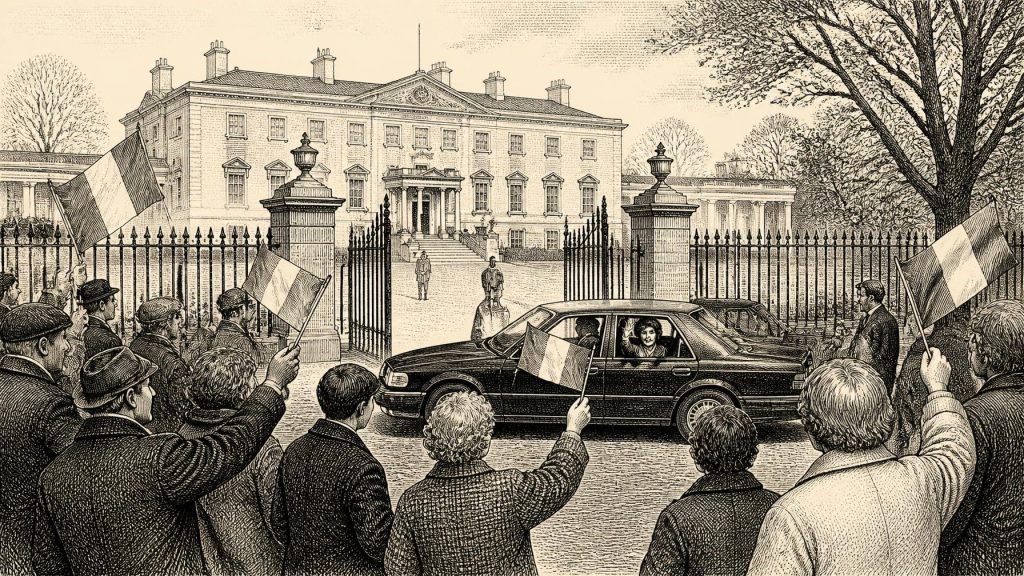
Currie’s transfers decided the result. Robinson received 205,565, reaching 817,830 votes against Lenihan’s 731,273. She was declared elected and inaugurated at Áras an Uachtaráin on 3 December as Ireland’s first woman president. The election was not a wholesale rejection of established parties or an instant settlement of the social questions Robinson represented. It was, however, a dramatic rebuke to assumptions that the presidency belonged by custom to Fianna Fáil and to male political seniority.
By year’s end, Ireland had not escaped its constraints. Its economy remained vulnerable, Northern violence persisted and Haughey’s government had survived a serious shock. Yet 1990 left enduring images: European leaders in Dublin, Bonner’s save in Genoa, Mandela meeting anti-apartheid campaigners, and Robinson entering the Áras. They marked a country still divided and uncertain, but increasingly willing to imagine public life in broader, less inherited terms.
Primary Sources
- Mary Robinson
- 07 November 1990 Presidential Election
- Presidential Elections 1938–2025
- Áras an Uachtaráin Telephone Log, 27 January 1982
- Telephone Calls Backgrounder
- Ireland and the EU: Timeline of Key Events
- Special Meeting of the European Council, Dublin, April 1990
- Dublin European Summit: Conclusions of the Presidency, June 1990
- Ireland Into Last Eight at World Cup Finals
- Boys in Green Return From Italia ’90
- World Cup Adventure Ends
- Italia ’90 Coverage
- Nelson Mandela Addresses Dáil Éireann
- Mandela’s Visit to Dublin Retrospective
- Criminal Justice Act, 1990
- A Chronology of the Conflict – 1990
- Peter Brooke
- Fair Employment (Northern Ireland) Act 1989
- Social Sustainable Development Indicators Ireland 2017
- OECD Economic Surveys: Ireland 1991
- A Strategy for a Competitive Irish Economy
- Bringing The Field To The Big Screen 1990
- Agrometeorological Bulletins
- Twenty-Sixth Dáil