O’Connell Acquittal1844 CE
In 1844, Ireland combined political mobilisation, entrenched poverty and uneven modernisation. Daniel O’Connell’s conviction was overturned by the House of Lords, restoring him to public life but revealing limits on Repeal. Thomas Davis’s A Nation Once Again strengthened cultural nationalism within Young Ireland. Workhouses, already housing and relieving many people, exposed chronic vulnerability before the famine. The Dalkey Atmospheric Railway and Richard Turner’s engineering demonstrated technological ambition, while Belfast’s linen trade reflected industrial growth alongside insecurity. Catholic institution-building included St Malachy’s Church and Dublin’s first St Vincent de Paul conference. Francis Rynd’s hypodermic treatment illustrated Irish medical innovation amid precarity.
Dateline
In 1844 Ireland stood between a forceful campaign for constitutional change and the social fragility that would soon be exposed with terrible clarity. The year brought no single national catastrophe, nor did it fulfil Daniel O’Connell’s demand to repeal the Union. Instead, it revealed several Irelands at once: a politically mobilised country watching its foremost leader leave prison; a poor country in which the workhouse had become an established institution; an industrialising north-east tied to linen and trade; and an urban society generating new churches, charities, newspapers, engineering works and medical knowledge.
The firmly dated events of 1844 matter because they illuminate those wider conditions. An atmospheric railway entered regular service between Kingstown and Dalkey in March. O’Connell’s conviction was overturned by the House of Lords in September. Thomas Davis published a ballad that would outlast the political moment in which it was written. In December, Catholic Belfast acquired a striking new church, while Dublin saw the beginnings of the Society of St Vincent de Paul in Ireland. These were not separate stories. They belonged to a society in which political allegiance, faith, poverty, commerce and ideas were closely entwined.
O’Connell Returns From Prison
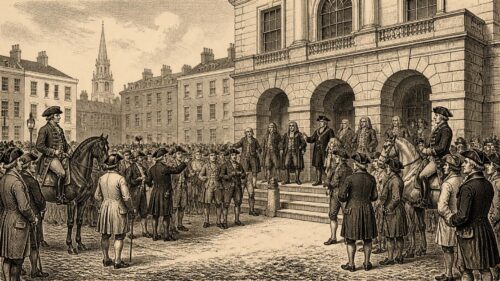
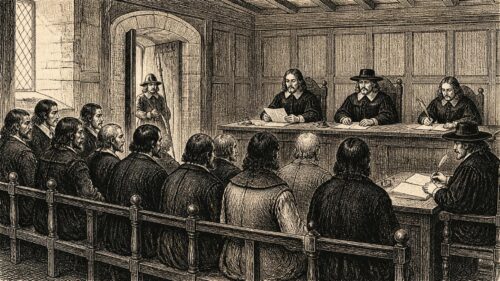
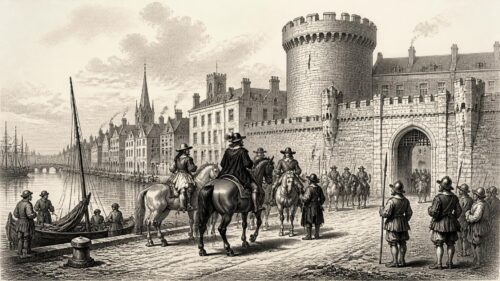
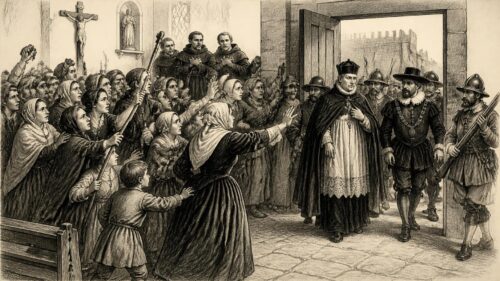
The dominant political event was Daniel O’Connell’s release from Richmond Bridewell. The prosecution of O’Connell and several leading Repealers followed the government’s suppression of the projected monster meeting at Clontarf in October 1843. O’Connell had cancelled that meeting rather than risk a clash with troops, but he and his associates were nevertheless prosecuted for conspiracy. A Dublin jury found them guilty in February 1844, and O’Connell spent several months in prison after sentence was imposed.
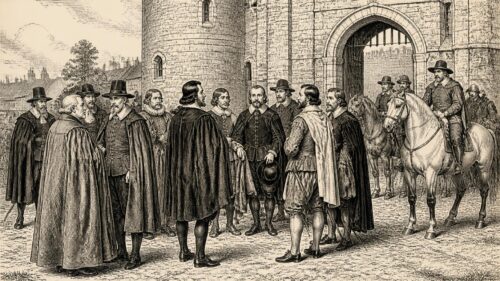
On 4 September 1844 the House of Lords reversed the judgment. The decision did not concede repeal, nor did it vindicate every political claim made by O’Connell’s movement. It was a legal reversal based on defects in the proceedings and indictment. Yet it was politically momentous. O’Connell’s imprisonment had presented the Repeal Association with an immediate test: could a mass constitutional movement survive the coercion of the state while remaining disciplined and peaceful? His release was celebrated in Dublin, and restored its leader to public life.
It would be misleading, however, to describe September as a simple Repeal triumph. The cancellation at Clontarf had already shown the limits of O’Connell’s strategy of assembling immense crowds to exert moral pressure on Westminster. Robert Peel’s Conservative government had demonstrated that it would not yield to such pressure. O’Connell remained the commanding Irish popular politician, but the aura of irresistible advance surrounding the campaign in 1843 had weakened. In 1844, Irish constitutional nationalism was therefore both resilient and constrained: capable of organisation, publicity and legal resistance, yet unable to force its central demand onto the British political agenda.
Print, Song and a National Argument
Political disappointment did not still the nationalist press. The Nation, founded in 1842 by Thomas Davis, Charles Gavan Duffy and John Blake Dillon, was far more than a record of Repeal Association meetings. It tried to cultivate a shared Irish public culture through history, poetry, antiquarian interest, economic comment and political argument. Its writers increasingly supplied the movement with a language of nationality that was cultural as well as parliamentary.
On 13 July 1844, The Nation published Davis’s “A Nation Once Again”. The date is secure; the later fame of the song should not obscure its original setting. It emerged from the Young Ireland circle while that circle still broadly worked alongside O’Connell, not after a formal breach. Davis’s vision was expansive in aspiration: Ireland should become a nation through character, learning, sacrifice and civic purpose. It was also shaped by the political realities of Union, religious division and exclusion from power.
The song’s publication is a useful marker of an important development, but not evidence that all Irish people shared its outlook. Unionism remained strong, especially among many Protestants and commercial interests in Ulster; local loyalties and material concerns often mattered more than abstract nationality. Even within Repeal, the older leader and the younger writers differed in temperament and emphasis. The irreversible split between O’Connell and Young Ireland lay in the future. In 1844, their coexistence gave the movement much of its creative energy.
Poverty Before the Blight
Later knowledge makes it tempting to treat 1844 only as the year before the potato blight arrived in Ireland. That would flatten the experience of contemporaries. There was no nationwide potato-failure emergency in 1844. Nevertheless, chronic poverty was already deeply embedded, particularly among labourers, cottiers, widows, older people and those unable to find regular work. Large families commonly depended on tiny plots, seasonal employment, credit and the potato’s exceptional capacity to feed people from limited ground. Such arrangements could sustain life in favourable circumstances, but they left little reserve against illness, unemployment, rising prices or harvest failure.
The Irish Poor Law had been operating for several years, and its workhouses had become a defining feature of local administration. Retrospective official figures record 113 unions in operation in 1844, with 39,175 people in workhouses at the end of the year and 105,358 relieved during it. These were substantial numbers, yet the system was never designed to answer all poverty in a country of more than eight million people. Relief was deliberately restrictive, financed through local rates and centred on the deterrent principle of indoor assistance.
Rules issued in 1844 reveal the institutional world encountered by an applicant. Admission required a guardian’s order or an emergency decision by the master or matron. New inmates were registered, medically inspected, searched and assigned to designated wards. Classification separated men, women, boys, girls, children and the sick; daily life was regulated by bells, work, diet and discipline. Parents could see children under specified conditions, but the system’s underlying purpose was supervision rather than domestic comfort. It offered a last refuge, not a social safety net capable of protecting the rural poor from a major subsistence crisis.
This was the significance of 1844 in hindsight: the administrative machinery that would be overwhelmed after 1845 already existed, as did the social inequalities that made so many households vulnerable. The coming disaster was not present in full, but neither did it arise in a society untouched by want.
Railways, Linen and Uneven Change
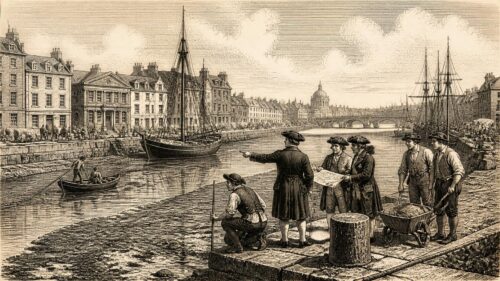
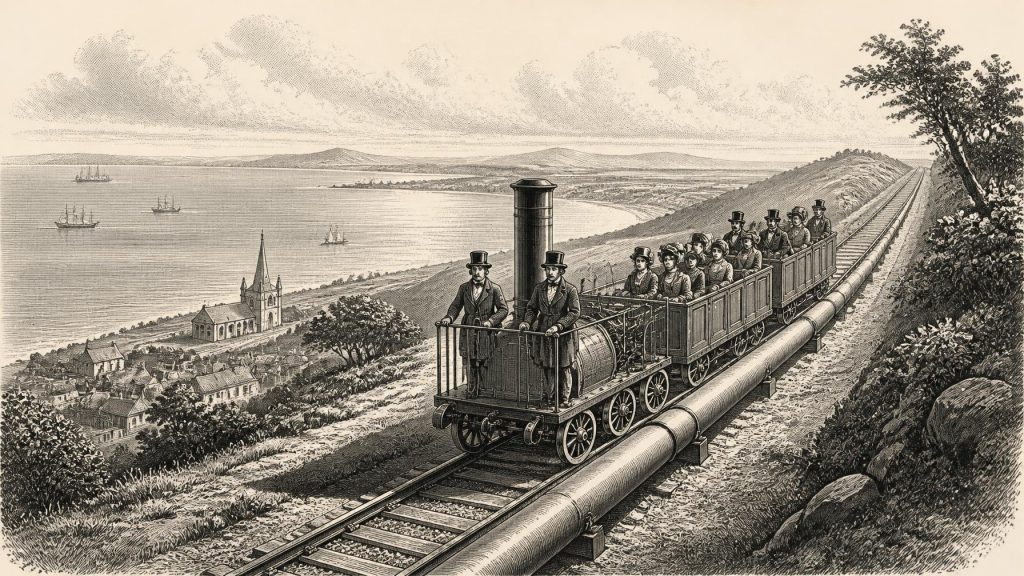
On 29 March the Dalkey Atmospheric Railway formally opened for service. Running from Kingstown, now Dún Laoghaire, to Dalkey along part of the former quarry tramway, it used atmospheric pressure rather than a locomotive to draw carriages uphill. A stationary engine evacuated air from a pipe; pressure acting on a piston attached to the train supplied the pull. The return journey descended by gravity under braking. For passengers, it was a remarkable modern spectacle; for investors and engineers, it was an experiment in the practical possibilities and shortcomings of new transport technology.
The line also showed how Irish modernity was geographically uneven. Dublin’s coastal railway connected a port, suburbs and leisure destinations, while much of the island still depended on roads, carts, fairs and coastal shipping. Railways promised speed, mobility and an enlarged market, but they did not by themselves alter insecure rural employment or unequal access to land.
In the north-east, Belfast’s linen economy offered another, different image of change. William Thompson’s 1844 survey of Irish industrial resources described mechanical flax spinning and weaving as concentrated in Ulster, while warning that impressive local estimates should be treated cautiously. Mills, hand production, merchants, bleach greens, ports and overseas markets connected Belfast and its hinterland to Britain and beyond. Linen supported large numbers of workers, including women employed in spinning, weaving and related labour, but prosperity was neither universal nor evenly distributed. Industrial employment could be insecure and poorly paid; the contrast with agricultural Ireland was real, yet not a contrast between wealth and want.
Dublin enterprise reached beyond the island. Richard Turner’s Hammersmith Iron Works at Ballsbridge was engaged in the great Palm House project at Kew, designed with Decimus Burton and built between 1844 and 1848. Turner’s work represented Irish skill in wrought iron, glasshouse construction and engineering at a time when Irish manufacturing was often overshadowed by British industrial centres. The project belonged to imperial botany and metropolitan display, but its fabric was substantially the work of a Dublin-based manufacturer.
Faith, Charity and Civic Institutions
Religion remained inseparable from public life, but 1844 offers evidence of active institution-building rather than merely sectarian controversy. In December, Bartholomew Woodlock chaired the meeting that established the first Irish conference of the Society of St Vincent de Paul, St Michan’s, in Dublin’s inner city. The society had originated in Paris in 1833; its Irish beginning was part of a wider Catholic associational culture. Its practice of personal contact and practical aid would become especially important in communities facing hardship. The foundation should not be projected forward as if it could solve structural poverty, but it marked the creation of a durable voluntary response to it.
The following day, 15 December, Archbishop William Crolly dedicated St Malachy’s Church in Belfast. Its opening answered the needs of a substantial and growing Catholic population served previously by only two Catholic churches. The building, with its Tudor Revival exterior and distinctive fan-vaulted interior, was an ambitious statement of Catholic confidence in a rapidly changing industrial town. Its construction also reflects a more complicated civic landscape than a simple division between communities: the site had been conveyed in trust for Belfast Catholics by Adam McClean, a Presbyterian.
Medicine, too, produced a small but consequential Irish innovation. During 1844 Francis Rynd of Dublin’s Meath Hospital used a hollow needle to introduce sedative fluid beneath the skin in treating neuralgia. His later account placed the first procedure in May 1844. Claims of “firsts” in medical history need caution, since instruments and techniques developed through several hands, but Rynd’s work is widely recognised as an early and important step towards hypodermic injection. It was a reminder that Irish institutions could contribute to international scientific practice even while public provision for the poor remained severely limited.
A Year of Structures
What 1844 left behind was not one decisive settlement, but a set of structures and possibilities. O’Connell’s release preserved constitutional nationalist politics while exposing its limits. Davis’s song gave nationalism a memorable cultural voice. The workhouse rules formalised a harsh system already dealing with persistent destitution. Dalkey’s railway and Turner’s ironwork displayed technical confidence, while Belfast’s linen and St Malachy’s Church testified to regional growth and urban institution-building. In Dublin, St Vincent de Paul created a new channel for organised charity. Ireland was changing, but it was changing unevenly—and the resilience visible in 1844 rested upon social foundations far more precarious than many contemporaries could yet see.
Primary Sources
- O'Connell, Daniel | Dictionary of Irish Biography
- Daniel O'Connell and Others v The Queen, House of Lords, 4 September 1844
- The State Trials—Reversal of the Judgment, Hansard, 5 September 1844
- Shaw's Authenticated Report of the Irish State Trials
- The Correspondence of Daniel O'Connell, Volume VII, 1841–1845
- Davis, Thomas Osborne | Dictionary of Irish Biography
- A Nation Once Again | CELT, University College Cork
- The Nation: Selections, 1842–1844 | National Library of Ireland catalogue
- The Nation 1845–1846 | South Dublin Libraries Local Studies
- The Atmospheric Road: Dún Laoghaire | Columbia University
- An Historical Sketch of Engineering in Ireland
- Irish Workhouse Rules, 1844
- A History of the Irish Poor Law, by George Nichols
- Clare Work Houses, 1844
- Part 8 of The Industrial Resources of Ireland | CELT, University College Cork
- Address by President Mary Robinson for the Opening of the Intervarsity Conference of the St Vincent de Paul Society
- The Establishment and Development of the Society of St Vincent de Paul in Ireland, 1844–2005
- Belfast St Malachy | National Churches Trust
- St Malachy's Church: ‘Strangers Will Look with Admiration’ | Belfast Entries
- Turner, Richard | Dictionary of Irish Architects
- Turner, Richard | Dictionary of Irish Biography
- Palm House Secrets and Facts | Royal Botanic Gardens, Kew
- Rynd, Francis | Dictionary of Irish Biography
- Francis Rynd: First Hypodermic Injection | Ask About Ireland
- A Chronology of Ireland | CELT, University College Cork