Victory at Thurles1174 CE
In 1174, Strongbow’s Anglo-Norman army suffered a decisive defeat near Thurles when Domnall Mór Ua Briain and Conchobar Máenmaige led Munster and Connacht forces against an expedition ravaging Munster. The reverse exposed the fragility of Henry II’s new lordship, already weakened by overseas commitments and uneven control beyond coastal towns. Heavy losses forced Strongbow to Waterford, where Hiberno-Norse inhabitants killed garrison members before Raymond le Gros brought reinforcements from Wales. Alliances remained temporary, while dynastic violence continued elsewhere. Church life endured: Gelasius, archbishop of Armagh, died, was succeeded by Cornelius, and a synod met at Birr. Warfare burdened rural communities
Dateline
In 1174 the Anglo-Norman foothold in Ireland came close to a serious military crisis. Only a few years had passed since the capture of Waterford and Dublin and Henry II’s assertion of royal lordship. Richard de Clare, known as Strongbow, held much of Leinster under the English king, but conquest on parchment was not control on the ground. Gaelic rulers retained armies, loyalties shifted rapidly, and the Hiberno-Norse communities of the port towns remained political actors in their own right. The year’s defining event, the defeat of Strongbow’s forces near Thurles, demonstrated both the strength of Irish resistance and the limitations of temporary victory.
A Fragile New Lordship
Henry II had left Ireland in 1172, entrusting authority to men whose interests did not always coincide. Strongbow possessed a vast claim through his marriage to Aífe, daughter of Diarmait Mac Murchada, but he depended on scattered garrisons, timber castles, imported soldiers and cooperation from selected Irish rulers. Dublin, Waterford and Wexford gave the newcomers ports through which reinforcements, horses, weapons and news could cross the Irish Sea. Beyond those centres, their reach was uneven.
The wider Angevin revolt of 1173–74 also mattered. Strongbow and other lords had been summoned overseas to support Henry II against his rebellious sons and their allies, reducing the forces available in Ireland. Opposition consequently gathered in Leinster, Ossory and Munster. Campaigns recorded under 1173 fed directly into the crisis of 1174: Domnall Mór Ua Briain, king of Thomond, advanced against the Anglo-Norman position at Kilkenny with Connacht troops commanded by Conchobar Máenmaige, son of the high-king Ruaidrí Ua Conchobair. The garrison abandoned its recently established castle, which was then destroyed or rendered unusable.
The dating of some connected events differs between chronicles. Mac Carthaigh’s Book places Strongbow’s clash with Domnall Cáemánach Mac Murchada and a destructive expedition to Lismore in 1174, while other annals associate Lismore’s plundering with 1173. It is safest to view these as stages in campaigning that crossed the annalists’ year divisions. Lismore’s church was reportedly despoiled and a very large payment demanded from the papal legate. Whatever the exact sequence, the episode reveals how ecclesiastical wealth could become a military target.
The Road to Thurles
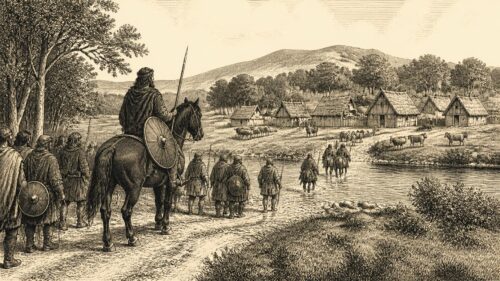
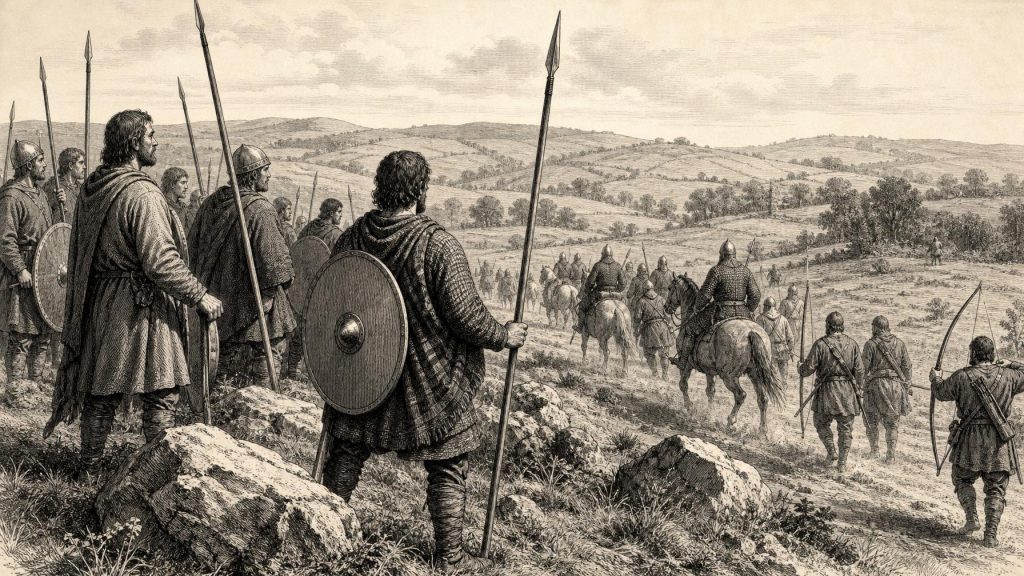
Strongbow answered the loss of initiative by leading an army into Munster. The Irish annals describe its purpose bluntly as ravaging or plundering. The force moved through Cashel and towards Éile, a territory covering parts of modern Tipperary and adjoining districts. Ruaidrí Ua Conchobair responded by bringing a hosting into Ormond in support of Munster, while Domnall Mór assembled the Dál Cais. Connacht contingents included warriors from the west and from Síl Muiredaig, the ruling kindred of the Ua Conchobair dynasty. Conchobar Máenmaige was a prominent commander.
Strongbow called for reinforcements from Dublin. The annals describe knights, officers and archers arriving in a substantial body, accompanied or supported by the town’s Ostmen, the Hiberno-Norse inhabitants whose political and military choices cannot be reduced to a simple Irish-versus-English division. Members of the same urban communities might cooperate with Anglo-Norman rulers in one campaign and resist them in another.
The Battle
The armies met at Durlas Ua Fócarta, generally identified with Thurles. No contemporary source supplies a secure day, and modern claims for a precise date should be treated cautiously. The Annals of Ulster simply record that Domnall Ua Briain and Conchobar Máenmaige gained the battle over the people of the English king. The Annals of Inisfallen give Domnall and the men of Thomond the leading role, while the fuller accounts stress the combined strength of Munster and Connacht.
The battle ended in a decisive Anglo-Norman defeat. The mechanics are not described, so it would be wrong to invent a detailed sequence of cavalry charges or ambushes. Strongbow’s army was operating far from its secure ports and faced opponents who knew the routes, river crossings and broken countryside. Its reliance on reinforcements brought from Dublin may itself indicate the risks of the expedition.
Medieval casualty totals vary. The Annals of Inisfallen and Mac Carthaigh’s Book report approximately seven hundred dead, the latter adding four knights. The Annals of Tigernach and the Four Masters give seventeen hundred. Such figures often magnified the scale and moral meaning of victory, and none can be verified. Nevertheless, agreement across independent annalistic traditions leaves no doubt that the losses were heavy. Strongbow withdrew to Waterford, while Domnall returned to Thomond in triumph and Ruaidrí’s forces went back towards Connacht.
Crisis at Waterford
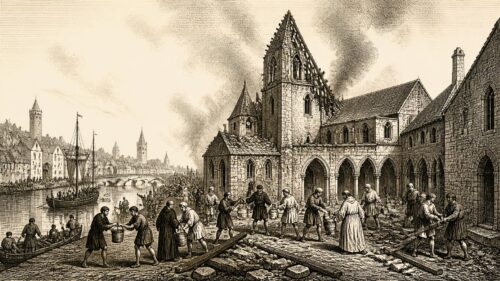
The defeat encouraged resistance elsewhere. The Annals of Inisfallen state that Waterford’s constable and two hundred companions were killed by the town’s own foreigners, meaning its Hiberno-Norse population. Gerald of Wales, writing from an Anglo-Norman and Geraldine viewpoint, likewise describes an insurrection in which members of the English garrison were attacked. His narrative places Strongbow in acute danger until Raymond le Gros returned from Wales with a compact force of knights, mounted soldiers and archers.
Gerald credits Raymond with stabilising the position, escorting Strongbow from Waterford and restoring confidence among the settlers. His family loyalties and hostility towards some rivals require caution, but the broad picture is plausible: maritime reinforcements prevented a battlefield reverse from becoming a general collapse. The episode also showed the strategic importance of Waterford harbour. Whoever held the port could communicate with south Wales and obtain soldiers and supplies much faster than an inland army could move.
Politics Beyond the Conquest
Thurles did not create lasting Irish unity. Ruaidrí and Domnall cooperated because their immediate interests aligned, not because a permanent national coalition had formed. Within a year they would again be rivals. Local disputes also continued during 1174. Ruaidrí Ua Cerbaill, king of Éile, was killed by his own brother on Inis Clothrann in Lough Ree. Máel Ruanaid Ua Ciarda, king of Cairbre in the midlands, was killed by Dublin Ostmen acting with Gaelic allies. Máel Sechnaill Ua Donnagáin, king of Ara, was slain by Ua Conaing. These deaths reveal an island still governed through overlapping dynasties, personal alliances, hostages and feuds.
Church and Learning
The year brought notable losses to the Irish Church. Gilla Meic Liac, or Gelasius, archbishop of Armagh and successor of Patrick, died on 27 March. The Annals of Ulster describe him as eighty-seven years old and in the thirty-seventh year of his episcopate. Formerly abbot of Derry, he had become one of the principal leaders of twelfth-century church reform. At the Synod of Kells–Mellifont in 1152 he received the pallium confirming Armagh’s metropolitan rank. Although elderly during Henry II’s intervention, he remained closely connected with the reforming programme and Armagh’s claim to primacy.
He was succeeded during 1174 by Conchobar Mac Con Caille, commonly Latinised as Cornelius. His tenure was brief, but his selection maintained an Irish succession at Armagh during a period of political upheaval. The annals also record a synod at Birr, though they preserve no decrees. Its bare mention is important: warfare had not stopped the Church’s bishops and senior clergy from meeting to address collective business.
Another major death was that of Flann Ua Gormáin, chief lector of Armagh, on 20 March. His obituary says that he had studied for twenty-one years among the Franks and Saxons before spending another twenty years directing Ireland’s schools. The language may be honorific, but it testifies to active intellectual connections between Ireland, Britain and continental Europe. Armagh was not an isolated monastic remnant; it was an ambitious centre of Latin learning supported by ecclesiastical and royal patronage.
Other deaths included Máel Pátraic Ua Banáin, bishop of Connor and Dál Araide, who died on Iona, and Máel Ísu Ua Connachtáin, bishop of the Síl Muiredaig diocese associated with Elphin. The diocese of Westmeath was reportedly annexed to Clonmacnoise with the consent of the Irish clergy. The administrative meaning is not entirely clear, but the decision belongs to the continuing effort to reconcile older monastic jurisdictions with territorial dioceses.
Work, Wealth and Survival
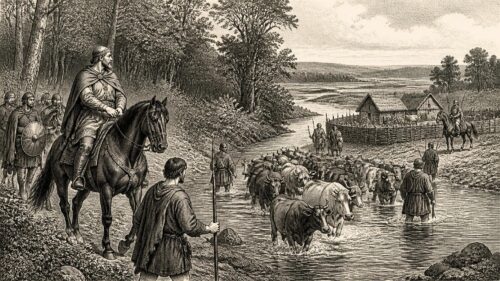
For most inhabitants, 1174 was experienced not through formal diplomacy but through demands for food, cattle, transport and labour. Ireland remained overwhelmingly rural. Households depended on mixed farming, especially cattle and dairying, together with pigs, sheep and crops such as oats and barley. Armies consumed stored grain, drove away herds and took captives. A hosting could therefore damage a district long after its warriors had departed.
Towns formed a different but connected world of merchants, craftspeople, sailors and fighting men. Dublin and Waterford retained strong Hiberno-Norse traditions while adapting to new rulers. Imported coin circulated, but cattle, silver by weight and payments expressed in marks remained important measures of value. Churches accumulated livestock, metalwork, books and revenues, explaining both their spiritual authority and their vulnerability to raiding.
Timber castles and defended boroughs were beginning to alter parts of Leinster and Meath, yet the abandoned fortification at Kilkenny showed that settlement was not secure. In 1174 the new lordship survived, but it had not mastered Ireland. Thurles proved that coordinated Gaelic armies could defeat its knights in the field; Waterford proved that urban allegiance could not be assumed. The year was consequently a warning to conquerors and a moment of vindication for their opponents, without being the final victory either side desired.
Primary Sources
- The Annals of Ulster: Year U1174
- The Annals of Tigernach
- Annals of the Four Masters: Annal M1174
- Annals of Inisfallen: Annal AI1174
- Mac Carthaigh’s Book: Annals 1174–1175
- Annales Hiberniae
- The Historical Works of Giraldus Cambrensis
- Overlord Becomes Feudal Lord, 1172–85
- The First Normans in Munster
- Ua Briain, Domnall Mór
- Ua Conchobair, Ruaidrí
- Ua Conchobair, Conchobar Máenmaige (‘of Máenmag’)
- Clare, Richard de (‘Richard fitz Gilbert’, ‘Strongbow’)
- Fitz William, Raymond (‘le Gros’)
- Mac Murchada, Domnall Cáemánach
- Gilla Meic Liac (Gelasius)
- Ua Gormáin, Flann
- ‘Rules and Good Conduct’: The Re-formation of Lay Society
- Archdiocese of Armagh: Historical Overview
- Medieval Ireland 1150–1550
- Medieval Rural Settlement Project
- The Loss of the Southside of the Castle
- Reginald’s Tower
- 950–1450: Vikings, Normans and Medieval Mints