

Waterford’s Restored Charter1626 CE
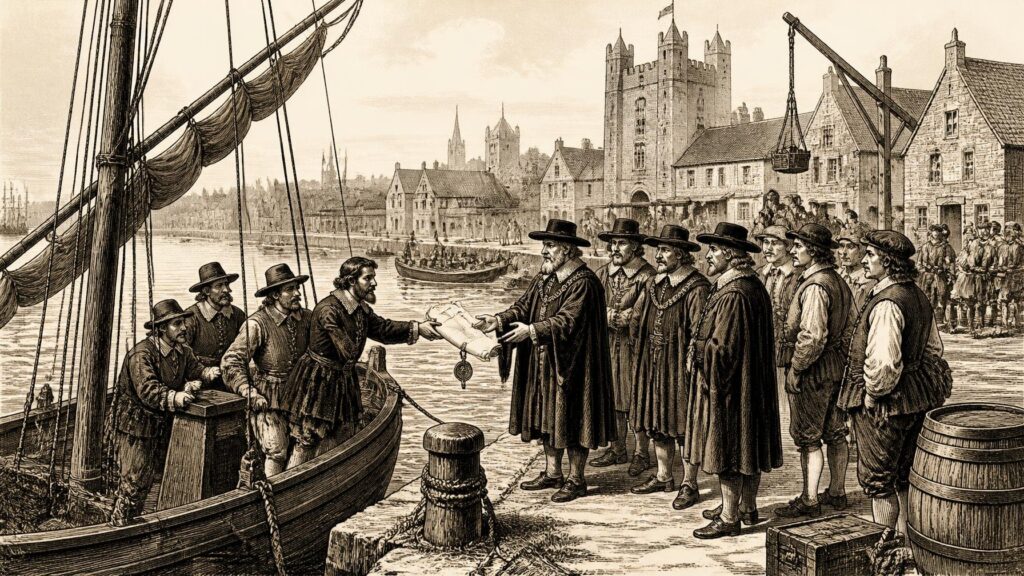
In 1626, Lord Deputy Falkland governed Ireland amid fiscal, religious and landholding tensions. Charles I restored Waterford’s charter, withdrawn after civic officers refused the oath of supremacy, enabling Catholic municipal leadership within Protestant legal constraints for an alleged £3,000. The Crown advanced plantation in Upper Ossory, reshaping contested Fitzpatrick lands. To fund 5,500 troops during war with Spain, Falkland offered proposed Graces, including land-title security, reduced recusancy penalties and officeholding opportunities for Catholics. Protestant bishops, led intellectually by James Ussher, opposed toleration. Aodh Mac Cathmhaoil became Catholic archbishop of Armagh, dying in Rome; Niall Garvach O’Donnell died imprisoned in Tower.
Dateline
In 1626, Ireland was governed for Charles I by Henry Cary, Viscount Falkland, the lord deputy. The kingdom was not at war within its own shores, but it was far from politically settled. The Crown needed money for defence at a time of war with Spain; Catholic landowners sought security of title and relief from religious penalties; Protestant officeholders feared that concessions would weaken the established church and their own political predominance. Two developments firmly placed in this year show the pressures particularly clearly: the restoration of Waterford’s civic charter and the opening of negotiations over the army and the proposed ‘graces’.
A Charter Returned to Waterford
On 26 May 1626 Charles I issued Waterford with a new charter, restoring privileges which the city had lost under James I. Waterford’s earlier charter had been taken into royal hands after the city’s leading officers repeatedly refused the oath of supremacy, the oath which acknowledged the monarch rather than the pope as head of the church. From 1618, the loss of the charter had meant an unsettled municipal administration and a sharp reminder that corporate self-government could be made conditional upon religious conformity.
The charter of 1626 was therefore more than a formal parchment. It restored the legal machinery through which a major port governed itself: mayor, corporation, courts, property, local revenues and the authority to manage civic affairs. It reached Passage on 25 July, and contemporary local tradition recorded that the city paid £3,000 for the settlement: a very substantial price. The transaction reveals both Waterford’s resources and the Crown’s financial appetite. Charles gained cash and a political gesture of goodwill; Waterford regained a workable civic constitution.
The restoration did not make Waterford religiously free in a modern sense. The city’s overwhelmingly Catholic mercantile population still lived under a Protestant state church and laws against recusancy. But it allowed Catholic civic leadership to re-emerge within the Crown’s legal framework. For merchants, mariners, artisans and householders, this mattered in practical ways. Civic government regulated markets, quay-side order, disputes, local taxation and the many small obligations of life in a busy river port. Waterford’s recovery of its charter thus offered an unusually visible example of accommodation between an English king and a Catholic-majority Irish town.
Upper Ossory and the Geography of Title
Elsewhere, accommodation was much harder to find. In Upper Ossory, in present-day County Laois, the Crown proceeded in 1626 with a plantation based on its claimed title to lands long dominated by the Fitzpatrick or Mac Giolla Phádraig lordship. The legal groundwork had been laid by an inquisition at Maryborough in 1621, which accepted a royal claim of inheritance associated with the de Clare family. Such findings converted old and contested feudal arguments into instruments for remaking ownership on the ground.
‘Plantation’ should not be imagined as a single event in which one population instantly replaced another. It was a programme of surveys, patents, grants, new manors and pressure upon existing proprietors. In Upper Ossory, it threatened the territorial standing of a family that had accommodated itself to Tudor rule through surrender and regrant while retaining deep local authority. Grants and rearrangements in 1626 show the Crown trying to turn an inherited claim into a more dependable landed interest, one tied to English law, favoured proprietors and the royal revenue. For local tenants, freeholders and dependants, the consequences lay in changing landlords, rents, obligations and access to land rather than in an abstract constitutional dispute.
Defence for a Price
The broadest political initiative of the year arose from the cost of the army. Ireland was strategically important to the Stuart monarchy, particularly while England was fighting Spain. Yet the royal forces stationed in Ireland were poorly funded, and maintaining soldiers by local exactions and billeting was a recurrent source of resentment. On 22 September 1626, Charles ordered the maintenance in Ireland of a standing force of 5,000 foot and 500 horse. The question was who would pay.
Falkland was instructed to seek support from the Irish nobility and gentry. In return, the Crown circulated proposed concessions later remembered as the ‘Graces’, or matters of grace and bounty. The package was not a completed settlement, nor was it a parliamentary statute in 1626. It was a bargaining offer. Its themes were nonetheless important: lighter enforcement of recusancy penalties, greater access to offices for loyal Catholics, and especially better security for landholders whose titles might otherwise be challenged by the Crown. Recognition of long possession was of pressing interest not only to Catholics but to many landowners whose estates rested on complicated histories of conquest, grant and inheritance.
Meetings of the nobility and gentry followed during the autumn, with a diary of the assembly beginning in October. The negotiations exposed a central difficulty of early Stuart rule in Ireland. The monarchy wished to obtain revenue without summoning a parliament that might prove awkward; the political nation wanted assurances that any payment purchased durable rights. The need for an army made compromise attractive, but it also made the stakes higher. A force raised in the name of defence could become an instrument of coercion if the relationship between Crown and country broke down.
Protestant Alarm
The proposed concessions alarmed many Protestant clergy and officials. On 26 November 1626, twelve Church of Ireland bishops signed a judgement against tolerating Roman Catholicism. James Ussher, the Church of Ireland archbishop of Armagh, was the leading intellectual presence behind this resistance. The bishops argued that toleration was wrong in principle and that it must not be purchased with financial contributions. Their intervention made public the incompatibility between the Crown’s short-term fiscal pragmatism and a powerful Protestant conviction that the state should advance religious uniformity.
This was not merely a quarrel among theologians. Religion shaped access to municipal office, the legitimacy of schools and clergy, landholding confidence, and the language through which loyalty was judged. It also aggravated disagreement inside Dublin government. Falkland’s administration was increasingly divided from Adam Loftus, the lord chancellor, and Sir Francis Annesley, the vice-treasurer. On 31 March 1626 the English privy council had imposed procedures intended to manage the Falkland–Loftus conflict. The compromise did not remove the deeper competition for influence, patronage and control of Irish policy.
Irish Catholicism Beyond the Kingdom
The year also illustrates how Irish religious life extended beyond Ireland. Aodh Mac Cathmhaoil, better known in English as Hugh MacCaghwell or Mac Aingil, was appointed Roman Catholic archbishop of Armagh on 27 April and consecrated in Rome on 7 June. A Franciscan theologian from County Down, he had taught and worked across Spain, the Low Countries and Italy, and helped to secure St Isidore’s in Rome as a centre for Irish Franciscan learning. He died of fever in Rome on 22 September while preparing to return to Ireland.
His brief archiepiscopate did not alter conditions on the island, but his career is significant. Catholic renewal depended heavily on networks of colleges, convents, scholarship, patronage and printing abroad, because the official Irish church was Protestant. Irish Catholic clergy could be trained in continental institutions and then maintain links with communities at home. The contrast between Mac Cathmhaoil’s Rome-centred career and Ussher’s defence of the established church captures the divided religious culture of 1626 without reducing it to a simple division between Irish and English.
The End of an Ulster Career
Another death connected 1626 to the unfinished consequences of the Nine Years’ War. Sir Niall Garvach O’Donnell, a rival claimant within the O’Donnell dynasty of Tyrconnell, died in the Tower of London during the year. He had aided English forces against his O’Donnell kinsmen, only to be arrested after the rising of Sir Cahir O’Doherty and held for years without the secure political position he had expected. His death closed a life shaped by Gaelic dynastic rivalry, alliance with the Crown and the destruction of the older political order in Ulster.
Thus 1626 was not defined by one dramatic Irish battle or rebellion. Its importance lies in bargains and institutions: a charter restored at Waterford, a plantation advanced in Upper Ossory, a proposed army financed by concessions, and clerical resistance to that bargain. These developments did not resolve Ireland’s conflicts. They clarified them. Questions of municipal autonomy, land title, royal finance and public religion were being pressed into sharper forms, with consequences that would become still more dangerous in the decades ahead.
Primary Sources
- Cary, Henry
- Loftus, Adam
- Mac Cathmhaoil (Mac Aingil), Aodh (MacCaghwell, Hugh; Cavellus, Hugo)
- O'Donnell, Sir Niall Garvach
- Egan, Boetius
- Fitzpatrick, John (‘Jack’)
- State Papers Ireland 1509–1782: government papers on Irish affairs
- Calendar of the State Papers Relating to Ireland of the Reign of Charles I (and Commonwealth), 1625–1660
- Early Stuart Irish Warrants, 1623–1639: The Falkland and Wentworth Administrations
- Versions: Manuscripts and Sources for 1625–1626
- Waterford and the Great Governing Charter of 1626 Explored
- Waterford City Charter
- The Ancient and Present State of the County and City of Waterford
- County Waterford Urban Archaeological Survey
- Waterford and the Charter in the Ireland of 1626
- Studies in Irish History, 1603–1649
- Ireland under the Stuarts and during the Interregnum
- Ideology and Early Modern Ireland
- Briefe Relation of Ireland, and the Diversity of Irish in the Same
- The Irish Admiralty: Its Organisation and Development, c. 1570–1640
- Provincial Government and Administration in Jacobean Munster
- The Carrigan Manuscripts: The Will of Thady Fitzpatrick, MD, 1674