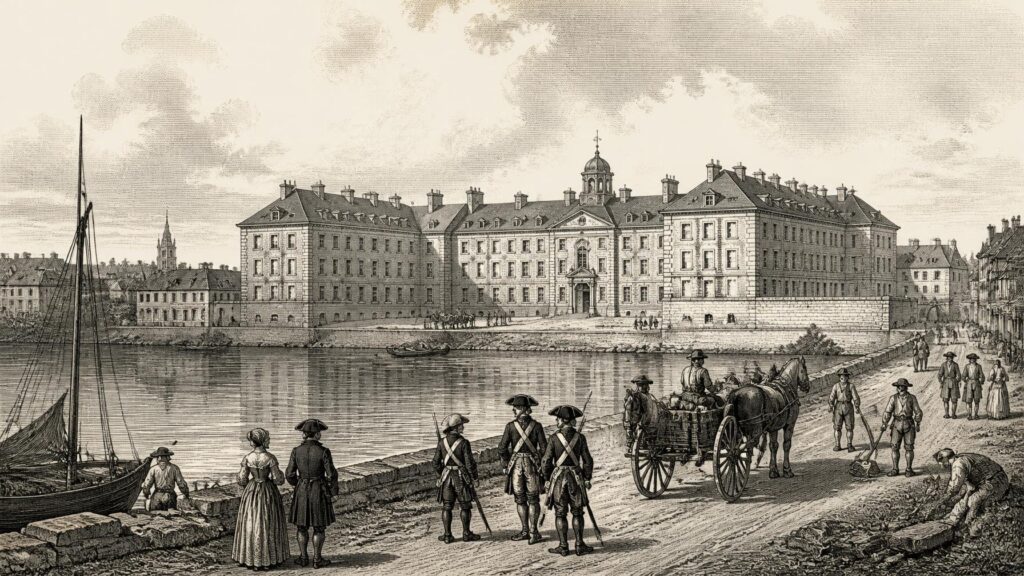
Burgh’s Royal Barracks1706 CE
In 1706, Ireland was governed largely through Dublin Castle proclamations while parliament remained prorogued under Queen Anne and Lord Lieutenant Ormond. The War of the Spanish Succession prompted naval recruitment, thanksgiving services and completion of Dublin’s Royal Barracks, strengthening military administration. Measures against robbery and outlaws asserted state authority, while restrictions on Protestant conversion reinforced the penal regime and Protestant ascendancy. Economic orders regulated wine prices and butter packing, reflecting the importance of export trade. Constitutional debate persisted through Molyneux’s work. Meanwhile, O’Heyne documented Catholic continuity from Louvain, and Francis Makemie’s Philadelphia presbytery demonstrated Irish Presbyterian links across the Atlantic.
Dateline
In 1706 CE, Ireland experienced no great battle on its own soil, no meeting of parliament and no single dramatic alteration of government. Yet the year is unusually revealing. A sequence of proclamations issued through Dublin Castle, the completion of the Royal Barracks beside the Liffey, and acts of religious and commercial regulation show how Queen Anne’s Irish administration reached into ports, churches, markets and local communities. Ireland remained a separate kingdom under the crown, governed in the lord lieutenant’s absence by officials in Dublin, but its security, economy and religious order were closely tied to a wider British and European war. The year’s evidence is administrative rather than intimate: it records what the state wished to control, not a complete picture of how every Irish person lived.
A Kingdom Governed From Dublin Castle
Queen Anne was sovereign of Ireland in 1706, while James Butler, second duke of Ormond, held the office of lord lieutenant. Ormond was a major Irish landowner and an important Tory figure, but he was often in England. His administration relied upon office-holders, the Irish privy council, judges and military commanders at Dublin Castle. Sir Richard Cox, lord chancellor since 1703, was among the most consequential of them. In November, Cox was created a baronet of Dunmanway in County Cork, an honour that recognised a career combining law, landed influence and high office. It also demonstrated the crown’s reliance on a Protestant governing class whose authority rested on property, patronage and the post-war settlement.
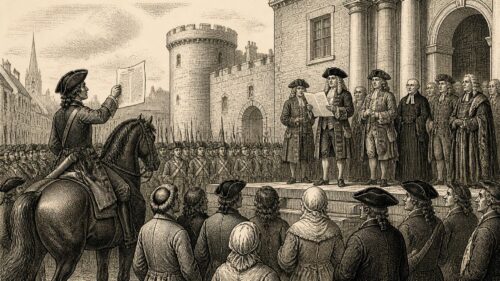
There was no parliamentary session in Ireland during the calendar year. On 27 May, a proclamation extended the prorogation of parliament until 4 March 1707. That detail matters. The Irish parliament existed, but it was not a continuously meeting national legislature and it operated under substantial constitutional constraints. Executive government could therefore proceed for months through council business, proclamations, courts and local officers. The sparse political record of 1706 should not be mistaken for political tranquillity: it instead points to a system in which decisions were frequently made above and beyond public parliamentary debate.
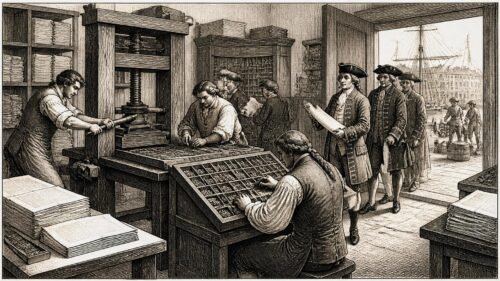
Across the water, English and Scottish commissioners began negotiations in April that would lead to the Union of 1707. Ireland was not a party to those negotiations. Nevertheless, the prospect of a new British political structure made questions of Ireland’s constitutional status more pointed. A 1706 edition of William Molyneux’s The Case of Ireland’s Being Bound by Acts of Parliament in England, Stated kept alive an argument first made in the 1690s: if England claimed legislative power over Ireland, where was Ireland’s consent? The book was not an official programme, nor proof of a united Irish opinion, but its renewed circulation shows that constitutional dependency remained an active subject of Irish political thought.
War, Recruitment and the New Barracks
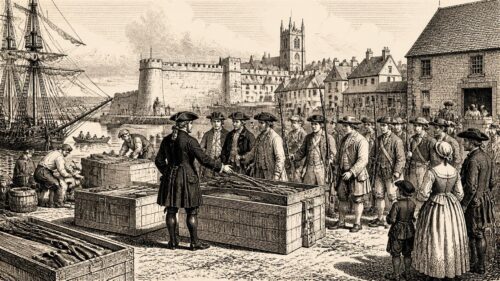
The War of the Spanish Succession shaped Irish affairs even though its principal campaigns were fought far away. Ireland supplied men, provisions, ports and revenue to the wider war effort. On 3 January 1706 a proclamation encouraged both seamen and landmen to enlist in the Royal Navy; further recruitment measures followed on 12 February and 22 March. Such repeated appeals suggest that naval manpower was a continuing need, and they connected coastal communities and seafaring labour directly to imperial warfare. Enlistment offered wages, movement and possible advancement, but it also carried the dangers of disease, shipwreck and combat.
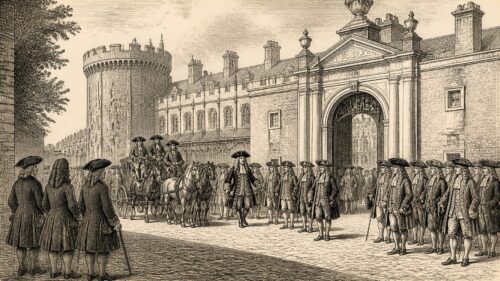
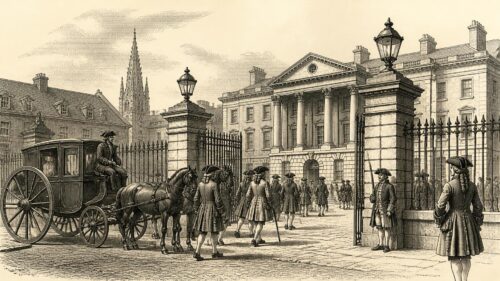
The year also saw the completion of the first phase of Dublin’s Royal Barracks, now Collins Barracks, on the north side of the Liffey between Oxmantown and the Phoenix Park. Designed by the surveyor-general Thomas Burgh and initiated under Ormond’s influence, the complex was an exceptionally ambitious military building for early eighteenth-century Ireland. It concentrated troops in purpose-built accommodation rather than dispersing them through private billets, inns and civic buildings. Its scale changed the western edge of Dublin: soldiers, officers, suppliers, labourers and military traffic became a permanent part of a district that had previously stood nearer the city’s fringe.
That construction should not be read simply as preparation for invasion or rebellion. Barracks were instruments of routine government as well as war. They made it easier to maintain garrisons, guard strategic routes, provide escorts, enforce proclamations and move units for overseas service. In a kingdom still marked by memories of the Williamite war and by official suspicion of Jacobitism, a visible military presence was also a statement of confidence by the Protestant state. Dublin’s built environment was therefore being reshaped by the requirements of a European conflict.
On 3 December, the Irish authorities proclaimed a public thanksgiving to be observed on 31 December. It formed part of a wider royal observance of the military successes of 1706, especially the allied victory at Ramillies in May. Irish churches were thus drawn into a political language that interpreted victory as providential favour. The ceremonies did not mean that Irish people shared one view of the war, but they show the established Church of Ireland serving as a public channel through which crown, war and worship were joined.
Order, Crime and Confessional Power
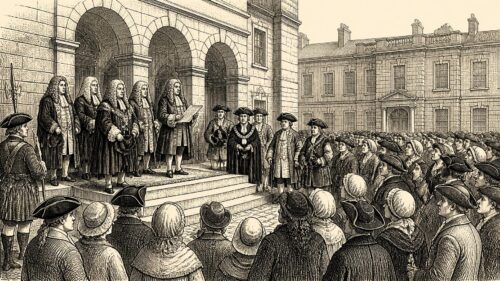
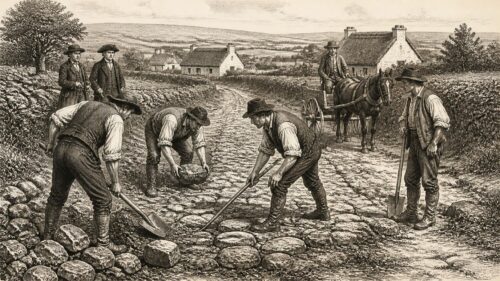
Several proclamations reveal the practical anxieties of government. A declaration of 9 February sought information about robbers of the Treasury. On 20 February, persons presented as outlaws in a wide scattering of counties—including Londonderry, Queen’s County, Kilkenny, Cork, Wexford, Meath, Cavan and Longford—were ordered to surrender. These notices do not permit a conclusion that crime suddenly surged throughout Ireland. They do, however, show a government concerned with revenue, legal authority and the ability of sheriffs and courts to bring named absentees within reach of the law. In a country of uneven roads, strong local ties and limited administrative manpower, proclamations were an important means of projecting Dublin Castle’s demands into the counties.
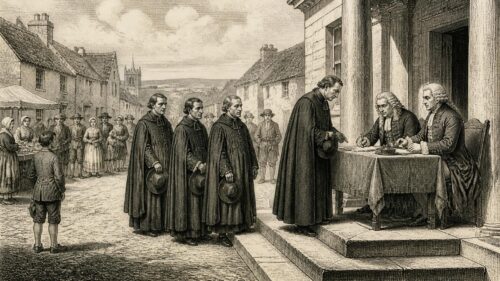
Religion was even more central to the political order. On 11 April, a proclamation prohibited the conversion of Protestants to Catholicism. It belonged to the penal-law regime consolidated after the Williamite victory and given a major statutory form in the Act to prevent the further growth of popery, passed in the early years of Anne’s reign. The established Church of Ireland enjoyed legal privilege; Roman Catholics, who formed the large majority of the population, faced restrictions intended to diminish their political, educational and institutional power. The April measure was therefore not evidence that conversion was widespread in 1706. Rather, it illustrates official fear that the Protestant interest—understood as religious allegiance, landholding security and political loyalty—might be weakened.
For Catholic families, everyday religious life did not vanish, but it had to be negotiated under pressure. Priests and religious communities continued to sustain worship, kinship networks and education where they could, while the state treated Catholic institutional continuity as a potential political problem. The contrast between official policy and actual practice is important: laws announced from Dublin were not identical with life in every parish, townland or household. The surviving material for 1706 records the coercive intentions of the state much more clearly than it records Catholic resilience.
Markets, Butter and Urban Growth
Economic regulation appears in smaller but revealing notices. On 12 February, the administration set prices for wines, an intervention touching merchants, tavern keepers, householders of means and Dublin’s imported-goods trade. More significant for Ireland’s wider economy was the proclamation of 10 December enforcing the law on butter packing. Butter was already one of the chief supports of Irish external trade. It travelled from dairying districts through market towns and ports in casks, where quality, weight and packing mattered to merchants and overseas purchasers alike. The proclamation does not prove an innovation in production during 1706, but it shows the state recognising that reliable standards were essential to commercial reputation.
This was part of an economy in which pasture, cattle and dairy produce connected rural labour to Atlantic and continental markets. Cork, Youghal, Waterford, Dublin and other ports performed different roles in that network. The benefit was uneven. Large graziers, merchants, landlords, coopers, carriers and exporters could gain from expanding provision trades, while cottiers, labourers and small tenants faced the vulnerabilities of rents, harvests, prices and seasonal employment. The 1706 proclamation tells us more about the commercial expectations of government than about the income of an individual dairy household, but it confirms that the quality of an Irish export had become a matter of public policy.
Memory, Learning and Irish Connections Abroad
One of the year’s most important cultural events took place outside Ireland. At Louvain, the Dominican priest John O’Heyne published his Epilogus chronologicus, a compilation on Irish Dominican convents, foundations and members. O’Heyne, who came from the Athenry area and had lived through exile, return and renewed displacement, wrote from the Irish Dominican college of Holy Cross. His book preserved information about a Catholic religious world badly disrupted by seventeenth-century warfare and post-war restrictions. It was not a neutral modern history: it was a work of memory, devotion and institutional recovery. Yet precisely because it named people and houses that official Protestant records often ignored, it became an invaluable witness to Irish Catholic continuity.
The year also highlights an Irish Protestant connection across the Atlantic. Francis Makemie, born near Ramelton in County Donegal and formed within the Ulster Presbyterian world, helped organise the first presbytery in America at Philadelphia in the spring of 1706 and again in December. The exact day of the first meeting cannot responsibly be fixed because the opening leaf of its minutes is lost; the year and Makemie’s leading role, however, are secure. His achievement belonged to America, not to an event in Ireland, but it directly reflects Irish religious migration and the transatlantic reach of Ulster Presbyterian networks.
Seen together, these developments make 1706 a year of consolidation rather than spectacle. The Royal Barracks embodied armed authority in stone; recruitment notices drew Ireland into a maritime war; religious proclamations enforced a confessional hierarchy; butter rules protected commercial credibility; and Irish Catholics and Presbyterians maintained intellectual and religious connections beyond the island. Ireland in 1706 was not isolated or politically dormant. Its most consequential changes were being registered in buildings, proclamations, books and networks that linked local life to Dublin Castle, Britain, Europe and the Atlantic world.
Primary Sources
- Statute Law Revision Act 2015
- An Introduction to the Architectural Heritage of County Dublin North City
- Thomas Burgh, Dictionary of Irish Architects 1720–1940
- Butler, James, Dictionary of Irish Biography
- Cox, Sir Richard, Dictionary of Irish Biography
- O'Heyne, John, Dictionary of Irish Biography
- Makemie, Francis, Dictionary of Irish Biography
- State Papers Ireland 1509–1782: Government Papers on Irish Affairs
- Ormond Papers Additional Collection List
- The 1706 Negotiations
- The Case of Ireland's Being Bound by Acts of Parliament in England Stated
- Constitutional Theory: Background to Eighteenth-Century Ireland
- Statute Law Revision (Ireland) Act 1878, Section 2
- Economic Trends, 1660–91
- History of the Commercial and Financial Relations between England and Ireland from the Period of the Restoration, Part 9
- Cox (Cork & Kilkenny), Landed Estates Database
- Museum as a Barracks
- Eighteenth-Century Dublin
- Hibernia Dominicana
- Francis Makemie 1657–1708
- History: Presbytery of Philadelphia – The First Presbytery of the United States
- Thanksgivings in the Reign of Queen Anne