Tiaquin Castle Demolished1266 CE
In 1266, Connacht experienced conflict among Gaelic rulers, settler communities and Walter de Burgh’s lordship. Tiaquin Castle was demolished and Conmaicne ravaged, while townships, castles and grain stores were burned. Áed Ó Conchobair, king of Connacht, pursued rivals and projected authority into Bréifne, deposing Art Ó Ruairc, installing Conchobar Buide and taking hostages. His regime also used blinding as political punishment. Raids, killings and a failed Burke hosting demonstrated an unsettled balance of power. Despite warfare, monasteries, dioceses and learned families remained active, recording deaths, appointments and consecrations. Ireland’s order endured through violent, local negotiation of resources, fortifications and succession.
Dateline
In 1266, Connacht was a landscape of broken castles, burned stores, contested lordships and active religious institutions. The year’s fullest surviving record comes from Annála Connacht, which assigns a notably dense sequence of events to this calendar year. Its notices do not provide a continuous narrative, and they rarely explain motives; nevertheless, taken carefully, they reveal how Áed Ó Conchobair, king of Connacht, asserted authority amid pressure from the lordship of Walter de Burgh, conflict with settler communities and rivalry among Gaelic dynasties.
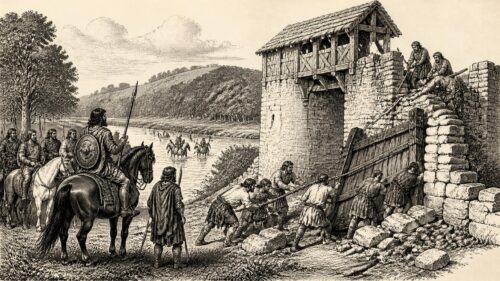
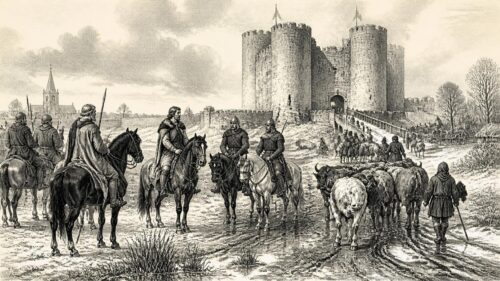
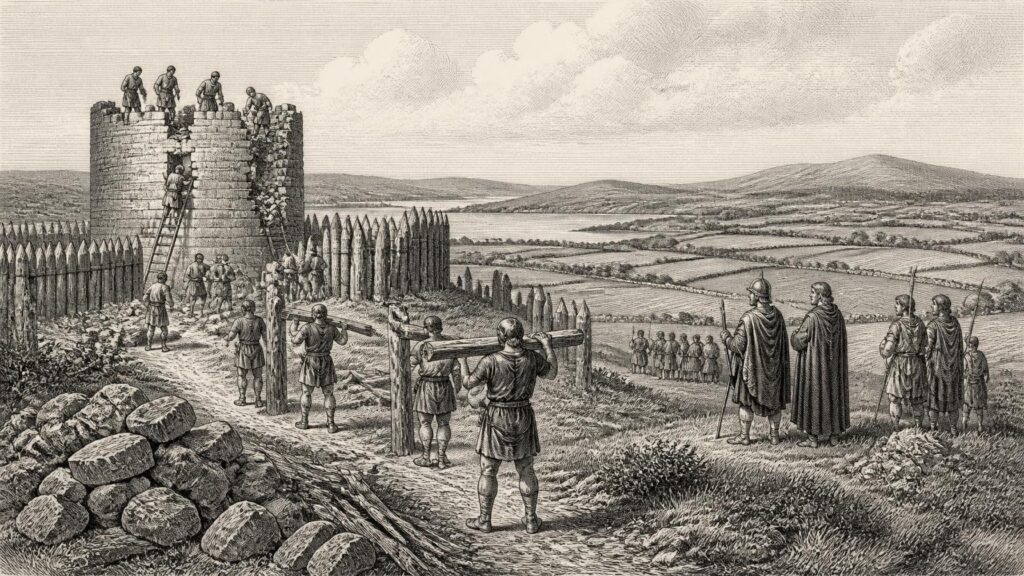
The destruction of Tiaquin Castle is the year’s starkest image. The annal simply says that the castle was broken down and that all Conmaicne was laid waste. It does not identify the attackers, describe the fortress or give a precise day. Yet the pairing of a ruined stronghold with devastation across a whole territory suggests warfare aimed at more than a single garrison. Tiaquin, in the Uí Maine region of what is now east County Galway, lay in a zone where Gaelic lordships, colonial interests and routes between Connacht’s plains and midlands met. Its destruction was therefore a local act with wider political meaning.
War in the Connacht Borderlands
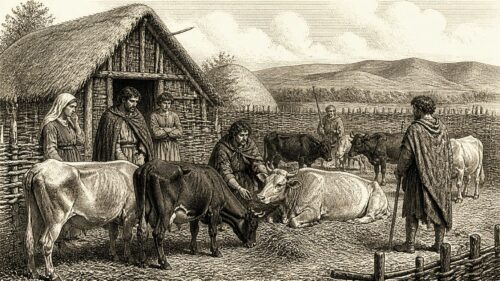
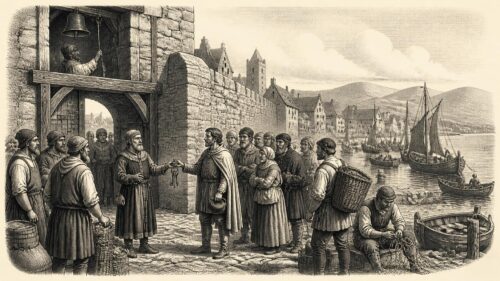
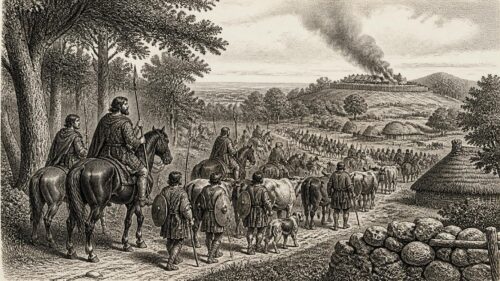
Castles, townships and grain stores recur throughout the annal for 1266. Flann Ruad Ó Flainn burned the township of Ballintogher and killed many of its Galla, the term used in Irish annals for settlers or foreigners. In Tír Fhiachrach, now broadly north-west County Mayo, many castles were burned with their corn. Stored grain was valuable wealth: it sustained households and military followings, supplied fortified places and could be carried away or destroyed to weaken an opponent. Burning it was an attack on both livelihood and lordship. The evidence does not justify claiming a general famine in 1266, but it does show that ordinary cultivators, tenants and inhabitants of defended settlements bore the immediate cost of campaigning.
Violence also travelled along the western shorelands. Domnall Ó hÉgra, king of Luighne, was killed while burning Ardnaree against the Galla. His death came in the course of an offensive rather than in a detached battlefield encounter. The annal records separately that followers of Áed Ó Conchobair killed Welshmen and Leinstermen in west Connacht, bringing thirty-one heads to their king. This grim trophy was an emphatic public proof of service and victory. It also complicates any simple division between “Irish” and “English”: the opponents described here included people from Wales and Leinster, while political alliances in thirteenth-century Ireland regularly crossed language, ancestry and regional origin.
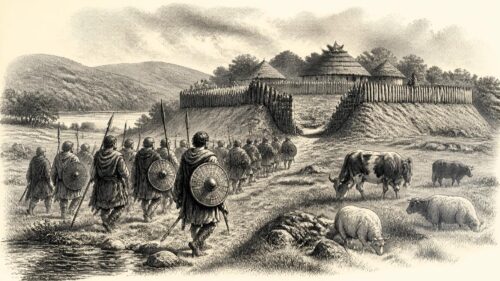
Walter de Burgh, lord of Connacht and earl of Ulster, was another powerful participant in the year’s warfare. Annála Connacht says that Mac William Burke led a hosting against Ó Máel Sechlainn. At Áth Crochta, many of his men drowned, and he withdrew without either victory or hostages. Such a failure mattered. A hosting was costly to assemble and feed, and the taking of hostages was a conventional means of turning a raid into an enforceable political settlement. The annal’s wording makes clear that de Burgh gained neither.
These entries belong to a longer struggle, not a war beginning neatly on 1 January 1266. Walter de Burgh had inherited wide claims in Connacht, while the Ó Conchobair kings retained substantial regional power. Áed had succeeded his father Fedlimid as king early in 1265. Modern biographical scholarship identifies renewed campaigning against him in 1266, while the annalistic record shows his forces striking colonial settlements and his rivals at several points. The result was not a settled frontier, but an unstable balance in which castles could fall, raiding parties could succeed and a magnate’s expedition could return empty-handed.
Áed’s Kingship Beyond Connacht
Áed Ó Conchobair’s most direct political intervention came in Bréifne. The annal says that he entered the region, deposed Art son of Cathal Riabach Ó Ruairc, installed Conchobar Buide son of Amlaib Ó Ruairc as king, and took hostages from all the chieftains of Bréifne. This was a decisive demonstration of overlordship. The appointment of Conchobar was not the creation of a stranger: he belonged to the Ó Ruairc dynasty and possessed a credible hereditary claim. But Áed’s military presence and demand for hostages made clear that the settlement rested on Connacht power.
Hostages in this setting were political securities, normally drawn from ruling families or leading kindreds. Their surrender marked submission and made renewed defiance dangerous. The episode therefore reveals an Ireland governed through personal and dynastic relationships as much as through fixed territorial borders. Áed did not annex Bréifne in a modern sense. Rather, he intervened in a disputed kingship, elevated a favourable claimant and sought guarantees from the region’s lesser rulers.
The same annal records an even harsher exercise of power within the Connacht political world: Diarmait Ruad Mac Diarmata and Donn Cathaig Mag Oirechtaig were blinded by Áed. No motive is supplied, so it would be unsafe to assign one. Blinding was, however, a potent punitive act in medieval rulership, capable of removing men from public competition without killing them. Alongside deposition and hostage-taking, it indicates that Áed’s kingship was active, coercive and dependent on the management of powerful subordinate families.
Other deaths show how precarious local rule could be. Mathgamain Ó Céirín, king of Ciarraige, was killed by the Galla of Dunmore. Mathgamain Ó Cuilen, king of Clann Glas, was killed by his wife, the annalist attributing the act to jealousy and a single knife-stroke. The latter is an unusually intimate notice amid reports of armies and castles, but it should not be overread as evidence for wider social patterns. Its value lies in showing the annalist’s interest in the sudden removal of a recognised local ruler, whatever the setting of his death.
Churches, Clerics and Learned Families
Conflict did not suspend religious life. Toirrdelbach, son of Áed son of Cathal Crobhdearg Ó Conchobair, died at the Cistercian monastery of Knockmoy. Founded by Cathal Crobhdearg around 1190, Abbeyknockmoy was closely associated with the Connacht kings and provided a prestigious religious setting for their family. The recorded death of this descendant there underlines the abbey’s continuing place in dynastic memory, prayer and burial culture. Sadb, daughter of Cathal Crobhdearg, also died in the year.
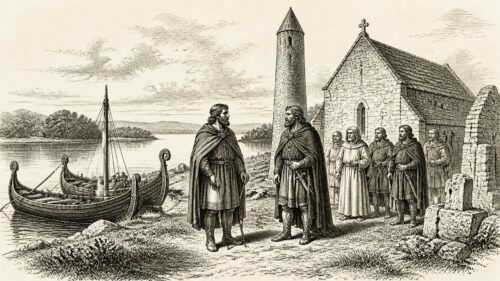
The annal further records the deaths of Máel Ísu Ó hAnáin, prior of Roscommon and Athleague, and Tomás Ó Máelchonaire, archdeacon of Tuam. These brief obituaries point to an ecclesiastical landscape knit together by monasteries, cathedral clergy and learned families. In the diocese of Luighne, Tomás Ó Miadacháin succeeded to the bishopric; the orders of both bishops were conferred on the same day, though the annal gives no date. Near year’s end, a bishop-elect arrived from Rome for Clonfert and received episcopal orders at Athenry on the Sunday before Christmas. A preaching friar, Ó Scoba, was also made bishop at Armagh for Tír Chonaill.
These notices are important because they show movement and connection beyond warfare. Rome, Armagh, Athenry, Tuam, Roscommon and the western dioceses formed parts of a church whose personnel travelled, whose appointments required consecration and whose institutions endured through political disruption. The death of Máel Eóin Bodur Ó Máelchonaire, described as ollamh of the Síl Muiredaig, similarly records the loss of a senior learned figure. Such families preserved legal, genealogical and historical learning that helped rulers articulate descent, status and rights.
A Year of Pressure Rather Than Resolution
One southern annal, the Annals of Inisfallen, places “great warfare” between the FitzGeralds and Mac William de Burgh under 1266. Its compressed entry offers no location or sequence, and its neighbouring notices show that its chronology cannot always be treated as a precise guide to events in the calendar year. It is best used as evidence that the wider FitzGerald–de Burgh conflict remained memorable, not as proof of a single, securely dated Irish battle in 1266.
The more firmly year-linked Connacht material conveys a different but complementary reality: no side had imposed a lasting settlement. Tiaquin Castle was demolished; Conmaicne was ravaged; settlements and grain were burned; men died in raids, drownings and household violence; and Áed Ó Conchobair reshaped the kingship of Bréifne through force and hostages. Yet churches ordained bishops, monasteries received members of ruling families and learned office continued. In 1266, Ireland’s political order was not collapsing into chaos. It was being repeatedly negotiated, violently and locally, through the control of people, provisions, fortified places and legitimate succession.
Primary Sources
- Annála Connacht, Part 43: Annal 1266
- Annála Connacht: Background Details and Bibliographic Information
- Annals of Inisfallen, Part 78: Annal AI1266
- The Annals of Ulster
- The Annals of Ulster: Editorial and Bibliographic Information
- Annals of the Kingdom of Ireland by the Four Masters, Volume 3
- Burgh, Walter de — Dictionary of Irish Biography
- O'Connor (Ó Conchobair), Fedlimid — Dictionary of Irish Biography
- O'Rourke (Ó Ruairc), Conchobar Buide — Dictionary of Irish Biography
- O'Rourke (Ó Ruairc), Cathal Riabach — Dictionary of Irish Biography
- O'Neill (Ó Néill), Áed Buide — Dictionary of Irish Biography
- O'Kelly (Ó Cellaig), Conchobar — Dictionary of Irish Biography
- Ua Conchobair, Ruaidrí — Dictionary of Irish Biography
- Abbeyknockmoy Cistercian Abbey — Heritage Ireland
- Abbeyknockmoy Cistercian Abbey — Monastic Ireland
- School of the West — Heritage Ireland
- National Monuments in State Care: Galway
- Record of Monuments and Places, County Galway
- Garbally Castle — Skehana and District Heritage
- Barony of Tiaquin — Skehana and District Heritage
- Annals of the Kingdom of Ireland: Index Locorum
- National Monuments Service: Archaeological Survey