Plunkett Restoration1670 CE
In 1670, under Lord Lieutenant John Berkeley, Ireland remained dominated by the Protestant land settlement and military power established after Cromwellian conquest, yet experienced limited religious latitude. Oliver Plunkett returned as Catholic archbishop of Armagh, rebuilding clerical discipline and hierarchy. Bishops met in Dublin, issued pastoral statutes and declared civil loyalty, despite rivalries between Plunkett and Dublin’s Peter Talbot. Plunkett’s Clones council extended reform and he mediated pardons for Tyrone tories. William Penn defended Quakers while managing Cork estates. Trade adapted to English livestock restrictions, Dublin gained Barrack Bridge, and rebuilding, estate consolidation and constrained negotiation reshaped society across Ireland.
Dateline
In 1670 Ireland remained a kingdom shaped by a recent conquest, a contested Restoration settlement and the everyday compromises needed to keep peace. The Cromwellian wars were over, but their consequences lay in ownership, religion and the physical landscape: confiscated estates, new Protestant proprietors, displaced Catholic elites and a standing army whose presence underpinned government from Dublin Castle. Against that hard background, the year brought a notable, though precarious, opening in public Catholic organisation. The arrival of Archbishop Oliver Plunkett in Ulster, the meeting of Catholic bishops in Dublin on 17 June, and further church assemblies during the summer made 1670 a moment when a battered ecclesiastical structure began visibly to reassemble.
A New Lord Lieutenant
Government changed hands early in the year. On 4 February John Berkeley, Baron Berkeley of Stratton, was appointed lord lieutenant of Ireland; he was sworn in on 12 April, replacing John Robartes. Berkeley came to office after a period of strained politics. The Restoration land acts had, by the middle of the 1660s, largely confirmed the transfers of property made during the Cromwellian period. Some Catholic proprietors had recovered land, but the broad result of conquest remained: political authority and much landed wealth were securely Protestant.
Berkeley did not overturn that settlement. His instructions joined financial discipline to religious government, while London expected the Irish administration to preserve order at low cost. Yet he differed in tone from officials who saw every Catholic priest or dissenting Protestant as a political danger. He was notably civil towards Quakers, encouraged the filling of vacant Church of Ireland bishoprics, and was willing to allow Catholic bishops a degree of room so long as they demonstrated civil loyalty. This was practical toleration, granted from above and capable of being withdrawn, rather than equality before the law.
The limits were plain. The Church of Ireland remained established and endowed; Catholics possessed neither secure public rights nor control of the state. Presbyterians and Quakers also faced legal vulnerability when they worshipped outside the established church. Nevertheless, the change of viceroy mattered. Berkeley’s arrival offered Catholic churchmen an opportunity to travel, meet and negotiate more openly than had often been possible in the previous decade.
Oliver Plunkett Comes Home
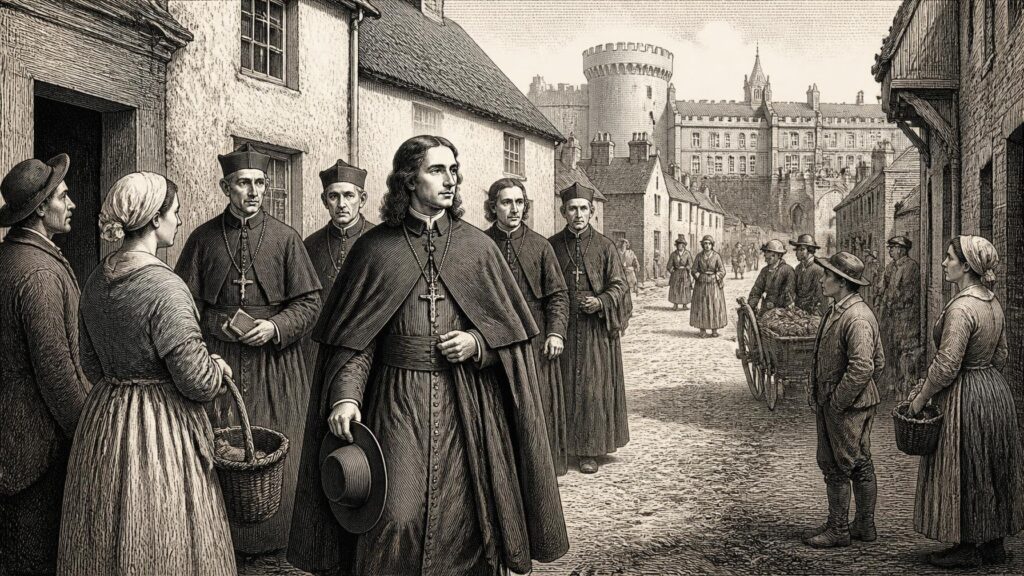
In March, Oliver Plunkett reached Ireland to take up the archbishopric of Armagh after more than two decades abroad. He had been educated in Rome and consecrated bishop at Ghent in December 1669. His return was consequential because the Catholic hierarchy had been badly depleted by war, exile and official pressure. Dioceses lacked bishops; parish organisation was uneven; religious orders survived but were constrained; and priests often worked with little security. Plunkett entered a church whose adherents formed the great majority of the population, but whose institutions were weak and whose leaders had to judge constantly how visible they could safely be.
His first task was pastoral reconstruction. In and around the Armagh province, he began meeting clergy, addressing vacancies and urging regular discipline. This was not merely internal housekeeping. A functioning hierarchy could ordain clergy, supervise marriage and sacramental life, regulate collections and schools, and connect Irish Catholics with Rome and continental colleges. It also made the church more legible—and potentially more suspect—to the government.
Plunkett’s arrival did not mean that all Catholics spoke with one voice. Old divisions from the Confederate and Cromwellian decades endured, including disagreement over the so-called Remonstrance, a declaration of loyalty to Charles II that some Catholic clergy had supported and others had rejected. There were also tensions between secular clergy and religious orders, between older local customs and Roman disciplinary ideals, and between the claims of Armagh and Dublin to primatial precedence. The revival of church government therefore exposed arguments as well as repairing absence.
Dublin’s June Assembly
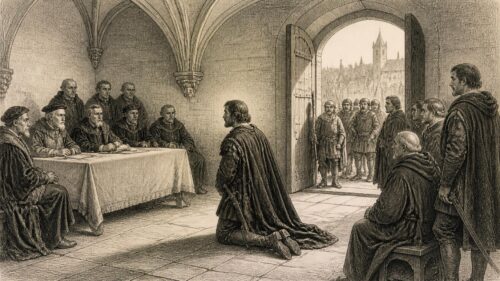
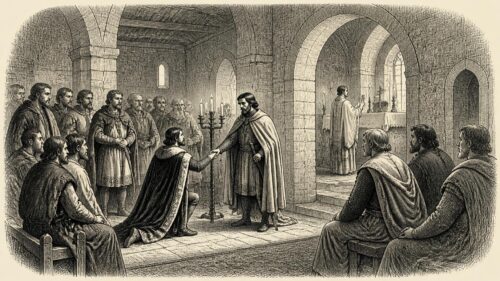
The best firmly dated ecclesiastical event of the year occurred on 17 June, when bishops assembled in Dublin. The meeting included the four archbishops and the bishops of Meath and Ossory. It considered the appointment of further bishops and adopted ten statutes on pastoral matters. Among other concerns, the bishops sought to regulate religious orders’ collection of alms, or questing. Such business reveals a church concerned not only with survival but with standards, authority and the practical distribution of scarce resources.
The assembly also presented Berkeley with a restrained address of loyalty to the king in temporal affairs. Its wording mattered. Catholic bishops wished to show that obedience to the pope in spiritual matters did not entail disloyalty to Charles II in civil government. Berkeley had approved the declaration in advance, an indication of how closely religious administration and political calculation were intertwined.
Yet the gathering was marked by rivalry. Peter Talbot, the Catholic archbishop of Dublin, pressed an alternative declaration of allegiance and challenged Plunkett’s claims to Armagh’s primacy. The dispute was handled tactfully: decisions were issued in the name of the bishop of Ossory, acting as secretary, rather than in either archbishop’s name. This procedural compromise avoided an immediate rupture, but it did not settle the question. The contrast is instructive. Catholic restoration in 1670 was real enough to permit synods and statutes, but not so secure that competing leaders could risk open division.
Clones, Tyrone and Negotiated Peace
Plunkett carried the year’s work beyond Dublin. In August he convened a provincial council at Clones, bringing together his suffragan bishops and superiors of the Franciscan and Dominican orders. Its twenty-eight decrees addressed clerical conduct, lay behaviour and the ordering of Catholic life. The council also removed Terence O’Kelly, vicar-apostolic of Derry, from office. Such an act illustrates the reach Plunkett hoped to exercise: the hierarchy was attempting to enforce discipline across provinces that had experienced prolonged war, dispossession and administrative disruption.
Religion also intersected with security. In September, with Berkeley’s approval, Plunkett met a substantial group of Tyrone tories—armed men living outside effective state control, some connected to dispossessed families and local networks. He helped arrange pardons and safe conduct for fifteen leaders to leave the king’s European dominions. This was a small but meaningful act of mediation. The government used a Catholic archbishop’s local credibility to reduce a source of disorder; Plunkett, in turn, could present himself as a servant of peace rather than an enemy of the regime.
It would be wrong to portray this as reconciliation between conquered and conqueror. The settlement that produced toryism remained in place, and the offer of departure to selected leaders says much about the narrow terms on which peace was made. Still, the episode shows that authority in Ireland could not be exercised solely through garrisons and proclamations. It also depended on brokers who could speak across confessional, regional and social boundaries.
Quakers, Cork Estates and Conscience
Another religious story ran through the year in the experience of William Penn. Penn’s visit to Ireland, begun in 1669, continued into 1670. He had family estates in County Cork and attended to leasing and estate management, but he also worked energetically for Quakers who had been imprisoned or harassed for attending unauthorised meetings and refusing oaths. His Irish journal shows a world of horse travel, local meetings, petitions to authority and difficult dealings between landlords and tenants.
The record is valuable precisely because it is not a neutral picture. Penn observed drainage, hedging, measurement and mapping on his estates with approval, treating them as marks of improved and profitable husbandry. He also used the landlord’s legal power of distraint, impounding a tenant’s cattle in a dispute. The journal therefore captures rural change from the viewpoint of a Protestant estate owner. Its silences are equally revealing: the Catholic people whose earlier dispossession made such estates available appear only fleetingly. In 1670, agricultural “improvement” could mean investment and greater output for some, but also firmer control over land and tenants for others.
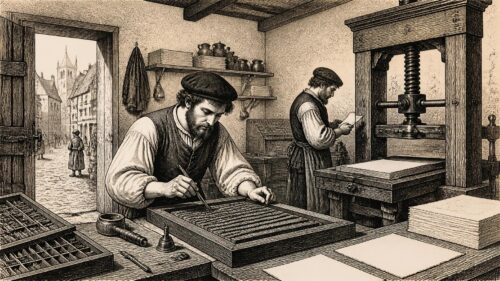
In Dublin, a 1670 edition of Penn’s The Great Case of Liberty of Conscience entered print. Written amid the wider persecution of dissenters, it argued against coercion in matters of worship. The book’s appearance in an Irish press is an important cultural marker. Dublin was not simply an administrative capital: it was a place where arguments about law, religion and authority could be printed and circulated. Yet the argument for liberty stood apart from the unequal realities of the kingdom, where legal protection varied sharply according to confession, status and connection.
Trade, Building and a Changed Landscape
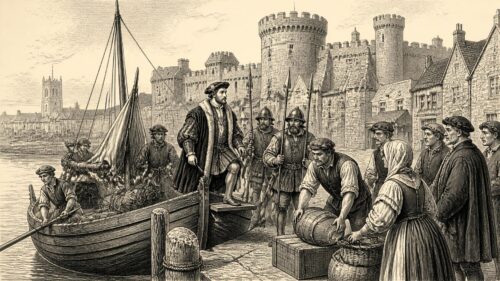
The economy of 1670 was adapting to the English ban on importing Irish cattle and several Irish animal products, imposed in 1666–67. The prohibition had hit a trade central to many landlords and graziers, but it also encouraged a redirection towards salted provisions, butter, hides, tallow, wool and markets in continental Europe. A contemporary observer in 1670 remarked on increased building and shipping in Irish cities and ports. That observation should not be mistaken for universal prosperity: recovery was uneven, and rural households remained exposed to rents, local power and the consequences of a land settlement they had not shaped.
Dublin itself displayed modest material change. A wooden Barrack Bridge was erected across the Liffey in 1670, near the Royal Barracks on the north side. It improved a strategic crossing in a city where military infrastructure, government and commerce were closely linked. The bridge was a practical structure rather than a grand monument, but it represented the remaking of the capital under Restoration rule: roads, crossings, barracks, quays and offices served both expanding urban life and the needs of a colonial administration.
By the end of 1670, no permanent constitutional settlement of religion had been achieved. Berkeley’s latitude could not guarantee the future, and the Catholic bishops’ renewed activity would later provoke fresh anxiety and repression. But the year’s dated meetings, appointments, journeys and publications show an Ireland less static than later narratives of inevitable persecution suggest. Beneath the authority of Dublin Castle, institutions were being rebuilt, trade was being redirected, estates were being tightened and contested communities were finding limited ways to negotiate power.

Primary Sources
- Berkeley, Sir John
- Plunkett, St Oliver
- Talbot, Peter
- Jones, Richard
- Margetson, James
- Robinson, Sir William
- Brenan, John
- My Irish Journal, 1669–1670
- The Great Case of Liberty of Conscience once more briefly debated
- Penn Documents (in Chronological Order)
- The Great Case of Liberty of Conscience: bibliographical record
- State Papers Ireland 1509–1782: government papers on Irish affairs
- Calendar of the State Papers Relating to Ireland, 1660–1670
- BERKELEY, John (1607–78)
- Restoration, Revival, and Survival, 1660–1700
- English Money and Irish Land: the “Adventurers” in the Cromwellian Settlement of Ireland
- Economic Trends, 1660–91
- The Anglo-Irish Livestock Trade of the Seventeenth Century
- History of the Commercial and Financial Relations between England and Ireland from the Period of the Restoration
- Civil and Down Surveys
- Reconstructing the Seventeenth-Century Landscape of the Pale
- Restoration Dublin in the Ireland of its Time c. 1660–1700
- Dublin: A Short History
- Barrack Bridge and the Military Gate, Dublin