
Joy’s First News-Letter1737 CE
In 1737, William Cavendish, third duke of Devonshire, became lord lieutenant, linking Dublin administration to Walpole’s London government as Parliament convened under Protestant landed dominance. Proclamations addressed gold, silver and copper currency, crime, riots, vagrancy and begging, revealing official dependence on magistrates, rewards and local knowledge. George Berkeley’s Querist advocated economic improvement while reflecting elite assumptions about poverty and labour. Francis Joy founded the Belfast News-Letter, creating a provincial news channel despite limited readership. Religious divisions persisted under penal laws, while trade, linen and agriculture connected Ireland unequally to British and Atlantic markets. The year exposed social vulnerability without crisis.
Dateline
In 1737, Ireland’s public life acquired a new printed voice in Belfast while its Dublin government confronted old and sensitive questions of money, authority and order. The year did not bring a war or a constitutional revolution. Its significance lies instead in a cluster of firmly dated developments: William Cavendish, third duke of Devonshire, became lord lieutenant; the authorities attempted to settle a contentious currency question; Parliament met in Dublin; and Francis Joy began the Belfast News-Letter. Together these events show a kingdom governed through London-connected patronage, Dublin institutions and local magistracy, but increasingly bound together by print, commerce and argument.
A New Lord Lieutenant
On 9 April 1737 William Cavendish, third duke of Devonshire, was appointed lord lieutenant of Ireland, replacing Lionel Sackville, duke of Dorset. He was sworn in on 7 September. The office made Devonshire the crown’s chief representative in a kingdom that retained its own Parliament, executive administration and legal institutions, yet remained constitutionally subordinate to Great Britain. The Declaratory Act of 1720 had asserted Westminster’s authority to legislate for Ireland and to hear final appeals. Thus Irish political life operated within narrow boundaries, even where Dublin’s parliamentarians guarded their local influence fiercely.
Devonshire was a great Whig aristocrat rather than an Irish political innovator. His appointment nevertheless mattered because the lord lieutenant distributed patronage, oversaw the administration and represented the connection between the Irish political elite and the government around Sir Robert Walpole in London. His arrival also preceded the opening of Parliament on Tuesday 4 October. A contemporary printed list of peers, bishops and members identifies this as the Parliament then sitting at Dublin. Its membership was overwhelmingly drawn from the established Church of Ireland and the landed interests that dominated borough and county representation.
That political world was not representative of most inhabitants. Roman Catholics formed the great majority of the population but lived under a body of penal legislation that restricted property, education, public office and religious organisation in varying and unevenly enforced ways. Presbyterians and other Protestant dissenters, particularly important in Ulster, also stood outside the established church and lacked full political equality. The apparent calm of high politics therefore rested on a highly stratified society, in which access to power depended upon confession, land, patronage and local standing.
Coin, Credit and Contention
Currency became the sharpest public issue associated with Devonshire’s first months. On 29 August a proclamation regulated the value of gold coins in Ireland, bringing the relationship between gold and silver into line with the British standard. This was not an abstract adjustment. Coin values affected rents, debts, wages, imports and the bills of exchange through which merchants settled accounts across the Irish Sea. Ireland had long experienced difficulty with a dependable circulating medium, especially small change, and differences between Irish and British valuations could encourage one metal to leave the country.
The announcement belonged to a longer controversy rather than beginning from nothing in 1737. The disastrous political memory was the attempted introduction of William Wood’s copper coinage in the 1720s, against which Jonathan Swift had mobilised opinion in the Drapier’s Letters. That episode had fused practical fears about bad money with arguments about Ireland’s constitutional status. In 1737 the dispute centred on the valuation of precious-metal coin, but it could still evoke the larger question of who had the right to regulate an Irish economy whose trade and finance were closely connected to Britain.
Official records make clear that the government was also worried about copper currency. A proclamation of 6 May concerned halfpence and farthings coined for the kingdom and continued their currency. These measures demonstrate an administration trying to manage several forms of money at once: low-value coin needed for everyday exchange, and gold and silver whose official valuation affected larger payments. They do not, by themselves, reveal how every market trader or labourer responded. Yet they show why monetary policy was experienced not merely in counting-houses but in shops, fairs, rent days and wage payments.
George Berkeley, Church of Ireland bishop of Cloyne, supplied a striking intellectual response to such concerns. The third part of his anonymously issued Querist was printed in Dublin in 1737. Berkeley framed his economic programme as a long sequence of questions rather than a conventional treatise. He pressed readers to consider tillage, domestic manufacture, employment, credit, banking, education and the balance between imports and home production. His purpose was to make economic improvement appear a national moral duty.
Berkeley’s writing is valuable precisely because it exposes both insight and limitation. He recognised poverty, underemployment and the shortage of money as serious problems. He urged schemes intended to put people to work and to retain wealth within Ireland. But his proposed remedies came from a Protestant bishop and estate-owning world, and included assumptions about social discipline, labour and religious reform that many of those discussed had no voice in shaping. The Querist is therefore evidence of the anxieties of 1737, not a transparent description of the lives of Ireland’s poor.
Disorder and the Reach of Government
Several proclamations issued during the year point to official concern over security. On 19 May a reward was offered for information leading to the apprehension of the murderers of John May in County Cork. A separate order in April promised a reward after an attempted break-in on Capel Street, Dublin, while February brought a pardon-and-reward proclamation concerning the robbery of a postboy near Portmorris. These notices should not be inflated into evidence of a nationwide crisis. They do show, however, how the state publicised criminal violence and relied on rewards, local knowledge and magistrates to extend its limited reach.
Dublin received particular attention. A proclamation of 19 August sought to prevent riots and disorders in the city; on 17 September local law officers were instructed to prevent riots and unlawful assemblies. Another proclamation on the same day ordered named “tories, robbers and rapparees” to surrender. Such language was the government’s vocabulary for armed or fugitive offenders, not a neutral social description. Its use indicates official alarm, but the surviving summary of the proclamation does not permit a responsible reconstruction of the motives, numbers or identities of everyone involved.
On 7 October, only days after Parliament assembled, the authorities ordered the apprehension of idle vagabonds and vagrant beggars. This was a familiar early modern response to poverty: mobility was treated as a potential threat to public order. It also reveals a harder everyday reality beneath parliamentary ceremony. Seasonal workers, displaced tenants, travelling poor people and those without recognised household support could all face suspicion. Government language collapsed very different circumstances into the category of vagrancy, making social insecurity an object of policing rather than relief.
Belfast Enters Print
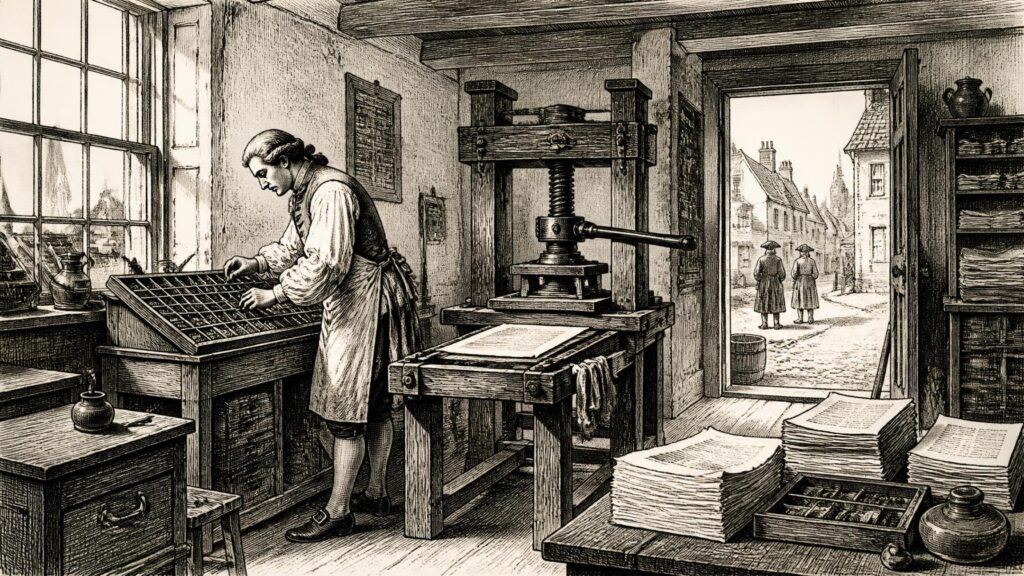
Against this background, the first publication of the Belfast News-Letter on 1 September was a development of lasting importance. Francis Joy, a Belfast attorney and printer, established the paper after acquiring a small printing concern. It appeared from the Sign of the Peacock in Bridge Street. No copy of the inaugural 1737 issue is known to survive; the earliest surviving issue is from October 1738. The foundation date is nevertheless well established, and the loss of the first number is itself a reminder that the paper record of eighteenth-century Ireland is incomplete.
The new paper did not create a mass democratic public. Literacy, disposable income and access to distribution all constrained readership. Nor should Belfast in 1737 be imagined as the later industrial city of linen mills and shipyards. It was a growing provincial port and market town whose merchants, craftsmen, professionals and surrounding rural suppliers needed news of prices, shipping, government, credit and events overseas. A printed news-sheet could travel beyond its immediate purchasers through coffee houses, inns, shops, workplaces and oral retelling.
Its arrival also gives 1737 a regional importance. Dublin already possessed a lively print culture, including newspapers such as the Dublin Evening Post, but a durable Belfast title helped strengthen Ulster’s informational links with Scotland, Britain, Atlantic commerce and the rest of Ireland. The News-Letter would later become an indispensable, if politically situated, record of local advertisements, elections, commerce and public controversy. In its first year, its more modest achievement was simply to establish a recurring printed channel from Belfast.
Church, Trade and Uneven Prosperity
Religion remained embedded in government as well as private devotion. On 2 December an order altered prayers for the royal family in the Book of Common Prayer, demonstrating how the established church’s liturgy connected parish worship to monarchy and state. For Catholics, whose hierarchy continued to function despite legal restrictions, the year brought the death of Hugh MacMahon, Roman Catholic archbishop of Armagh, on 2 August. Based at Drogheda in his later years, MacMahon had helped uphold clerical discipline and episcopal administration. His death marked a significant transition within the Catholic leadership, even though it made little impression on the official parliamentary world.
The broader economy of 1737 was defined by unequal connections rather than isolation. Cattle products, provisions and other agricultural goods moved through ports, while linen manufacture offered expanding opportunities in parts of Ulster and beyond. The industry depended on households spinning yarn, weavers, bleaching greens, merchants and credit networks; it was not yet the factory-centred system of a later age. Trade rules and British mercantile priorities constrained Irish enterprise, especially in woollens, while linen enjoyed encouragement but remained tied to wider imperial markets.
There is no securely dated national harvest disaster or environmental turning point to assign to 1737. It would be wrong to read the catastrophic frost, food shortage and disease of 1739–41 back into this year. What can responsibly be said is that many households already lived close to subsistence, exposed to price changes, rent demands and precarious employment. Berkeley’s insistence on poverty, the government’s language about begging, and the intense concern with coinage all illuminate that vulnerability from different, elite perspectives.
Thus 1737 was a year of institutions taking shape and tensions becoming visible. Devonshire’s appointment renewed the machinery of viceregal government; proclamations exposed anxieties over money and public order; Berkeley turned economic grievance into a programme of improvement; and Joy’s Belfast paper created a new platform for the circulation of news. None transformed Ireland overnight. Taken together, they reveal a kingdom in which authority was formally secure but practically dependent on persuasion, print, local power and the fragile workings of everyday exchange.
Primary Sources
- Cavendish, William
- Statute Law Revision Act 2015
- A Compleat List of the Lords Spiritual and Temporal; Together with the Knights, Citizens, and Burgesses of This Present Parliament [1737]
- The Querist, Containing Several Queries Proposed to the Consideration of the Public. Part 3
- Berkeley, George
- George Berkeley as an Economic Querist
- George Berkeley: Berkeley’s Social Activism and Social Thought
- MacMahon, Hugh
- The Belfast Newsletter Index, 1737–1800
- Extant Issues of The Belfast Newsletter, 1737–1800
- On This Day 1790: 230 Years Since the Death of Francis Joy
- UK Government Launches Newly Digitised Historic Editions of World’s Oldest English Language Daily Newspaper
- Constitutional Differences: Parliament and Ireland
- Scottish and Irish Mints
- The Swift Code: Jonathan Swift’s War on Currency
- The Rev. Dean Swift’s Reasons Against Lowering the Gold and Silver Coin
- History of the Commercial and Financial Relations Between England and Ireland from the Period of the Restoration
- Part 8 of History of the Commercial and Financial Relations Between England and Ireland from the Period of the Restoration
- Religion, Law, and Power: The Making of Protestant Ireland 1660–1760
- The Irish Linen Trade under the British Mercantile System
- Holdings: The Dublin Evening Post
- Access the Electronic Irish Statute Book