First Defenders1784 CE
In 1784, Rutland’s new administration resisted Irish parliamentary reform, and Henry Flood’s measure was defeated, exposing the limits of legislative independence under Anglican patronage. Reform meetings and Volunteer delegates continued to demand broader representation, while Catholic leaders debated whether further relief risked existing gains. In County Armagh, raids by Peep o’ Day Boys amid competition for land, linen work and security prompted the first organised Defenders near Ballymacnab. Expanding linen exports and the Grand Canal service to Robertstown indicated commercial growth, yet insecurity and inequality persisted. The year ended without settlement, revealing divisions of power, religion, property and livelihood throughout.
Dateline
In 1784, Ireland’s political arguments about independence and reform reached a sharper test, while a local conflict in County Armagh exposed the fraught social conditions beneath public debate. The year did not bring a single national rupture. Instead, it marked a consequential convergence: the new administration of the duke of Rutland sought to contain reform; Henry Flood’s campaign to change parliament failed again; Catholic political organisation showed both renewed energy and internal caution; and, in the linen districts of mid-Ulster, competition over land and work helped produce the first group known as the Defenders.
These developments belonged to a kingdom that had gained a substantially more autonomous legislature in 1782–83, but not a representative democracy. The Irish parliament was still dominated by Anglican landowners, borough patrons and office-holders. Catholics remained excluded from parliament and from the parliamentary franchise. Most inhabitants—Catholic, Presbyterian and Anglican alike—had no meaningful vote. For households dependent on a small farm, spinning, weaving or irregular labour, the language of constitutional liberty could seem remote, even as its consequences were felt in prices, taxes, trade and local authority.
A New Viceroy, an Old System
Two firmly dated events set the political tone. On 12 February 1784 William Pitt appointed Charles Manners, fourth duke of Rutland, lord lieutenant of Ireland. Rutland arrived in Dublin on 24 February with Thomas Orde as chief secretary. The appointment mattered because Pitt’s ministry needed a durable way of governing Ireland after the constitutional changes of 1782. Britain had renounced its claimed right to legislate for Ireland, and the Irish parliament had acquired greater legislative freedom. Yet executive power, patronage and the lord lieutenant’s office still connected the Dublin administration closely to the British government.
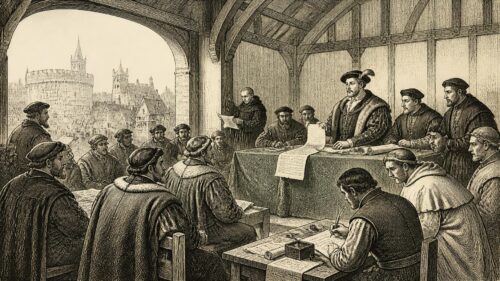
Rutland and Orde inherited an uneasy political scene. The Volunteer movement, raised during the American war as a force for local defence, had become a platform for demands for parliamentary reform. Its delegates had met in Dublin late in 1783, but the House of Commons had rejected the reform proposal associated with that convention. The failure did not settle the question. Rather, it made clear that legislative independence did not itself cure the flaws of a parliament in which many seats were controlled by patrons and many communities were barely represented.
Henry Flood returned to the issue in March 1784. His reform measure was defeated in the House of Commons on 20 March. The defeat showed the strength of the parliamentary interest that reformers attacked: office-holders, pensioners and borough proprietors had powerful reasons to preserve the existing structure. Flood’s programme was not democratic by modern standards. It did not propose Catholic parliamentary representation, and its ambitions were constrained by the Protestant character of the constitution. Nonetheless, it challenged the practical control of parliament by a narrow political class.
The result also revealed a changing relationship between politics inside and outside Parliament House. Flood’s supporters could point to petitions from counties and to the earlier Volunteer convention; his opponents treated organised armed opinion as an unacceptable pressure upon the legislature. Henry Grattan, though he supported Flood’s March effort, resisted the implication that MPs should yield to extra-parliamentary coercion. The division between constitutional reformers who distrusted popular mobilisation and radicals prepared to use it would remain important in Irish politics.
Reform Beyond Parliament House
Reform agitation did not simply disappear after March. On 7 June, a Dublin ‘Aggregate’ meeting of freemen, freeholders and inhabitants considered parliamentary reform. Associated with figures such as James Napper Tandy and William Todd Jones, it restated the case for a more independent and representative Commons. Its resolutions also favoured extending the franchise to Catholics, although the prospect of Catholics sitting in parliament was still treated more cautiously. That distinction demonstrates both the reach and the limits of reform language in 1784: even advocates of change often stopped short of religious and political equality.
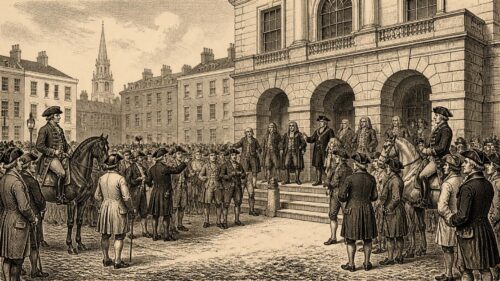
In November, Volunteer delegates gathered again in Dublin, this time at the Royal Exchange. The meeting was evidence that some activists still hoped to revive a national reform campaign. But the movement no longer possessed the unity or force it had displayed at the height of the constitutional struggle. The failure of Flood’s bill, and the determination of Rutland’s administration to resist alterations to representation, weakened confidence that conventions and public resolutions could compel parliamentary change. By the end of the year, the government considered order in Dublin more securely restored, though its officials also tended to interpret varied grievances as evidence of coordinated disaffection.
This was not merely an argument among celebrated parliamentarians. Political participation was mediated through corporations, guilds, newspapers, taverns, county meetings and voluntary associations. It was also sharply unequal. A Dublin artisan, a country freeholder, a Catholic merchant and an Ulster Presbyterian might all hear the language of liberty, yet possess very different legal rights, economic resources and access to public power. The reform controversy made those inequalities more visible without resolving them.
Catholic Politics and Caution
The Catholic Committee remained a significant arena of political discussion in 1784. Earlier relief acts had eased some disabilities affecting Catholic property and worship, but the penal system had not vanished, and Catholics continued to be excluded from the central institutions of political power. The committee brought together gentry, merchants and professionals who differed over how far, and how quickly, to press for further relief.
That division emerged clearly at a committee meeting in May. Thomas Browne, fourth Viscount Kenmare, sought a resolution disavowing demands for additional relief. The attempt failed: the meeting ended acrimoniously without a resolution. The incident should not be mistaken for a national Catholic uprising or a settled programme. It does, however, securely show disagreement within Catholic political leadership. Cautious figures feared that association with Volunteer reform, radical rhetoric or demands judged too extensive would alarm the government and jeopardise gains already secured. Others believed that continued deference would leave Catholics permanently outside the constitution.
Commercial Catholics were prominent in this political world. Thomas Braughall was elected again to the committee in 1784, representing several places including Dundalk, Naas, Drogheda and Dublin’s St Audoen parish. Such representation reflects the importance of urban trade networks and Catholic mercantile wealth. Yet it also underlines a central contradiction: men could acquire wealth, organise petitions and participate in civic life, while remaining unable to share fully in parliamentary government.
The Armagh Threshold
The most consequential development of 1784 may have occurred far from Dublin’s debating chambers. Historical research conventionally locates the first posse of Defenders near Ballymacnab, County Armagh, in this year, following a night-time attack attributed to the Protestant Peep o’ Day Boys. The surviving evidence does not safely permit a precise day or a simple origin story. It does permit the conclusion that 1784 was the beginning of the organised Defender presence in the Armagh disturbances.
Those disturbances should not be reduced to timeless religious hatred. County Armagh was a densely settled linen-producing region in which smallholders and cottiers competed intensely for leases, conacre, spinning and weaving income. Catholic families, including people moving from poorer western districts, could bid for land or compete in domestic linen work. Protestant households faced the same insecure rural economy. Religious identity, local status and economic rivalry therefore reinforced one another.
The Peep o’ Day Boys used raids, often justified as searches for weapons supposedly held illegally by Catholics. Such raids could include the destruction of spinning wheels and the intimidation or expulsion of families. For a household dependent on yarn spun at home, the loss of a wheel was an attack on livelihood as well as property. The first Defenders organised watches and patrols in response. Their emergence was defensive in immediate form, but it created a pattern of collective mobilisation, oath-bound organisation and reciprocal fear that would spread beyond its local beginnings in later years.
It is important not to project later events backwards. The Battle of the Diamond, the mass expulsions from Armagh and the founding of the Orange Order all lay in the future. In 1784, the pattern was still developing: market and fair fights, local rivalries, raids and counter-organisation. Yet the year deserves attention because it shows how quickly a struggle over security, tenancy and employment could take an explicitly sectarian shape.
Canals, Linen and Uneven Improvement
Economic evidence gives 1784 a different appearance: one of expansion and connection. For the year ending 25 March 1784, recorded exports of plain linen cloth reached 24,961,898 yards, a marked recovery from the preceding year’s figure. Such totals should not be read as a measure of universal prosperity. They record export trade, not the security of every spinner or weaver. Still, they confirm linen’s central place in the Irish economy and help explain why disturbances in Armagh’s linen country carried such high stakes.
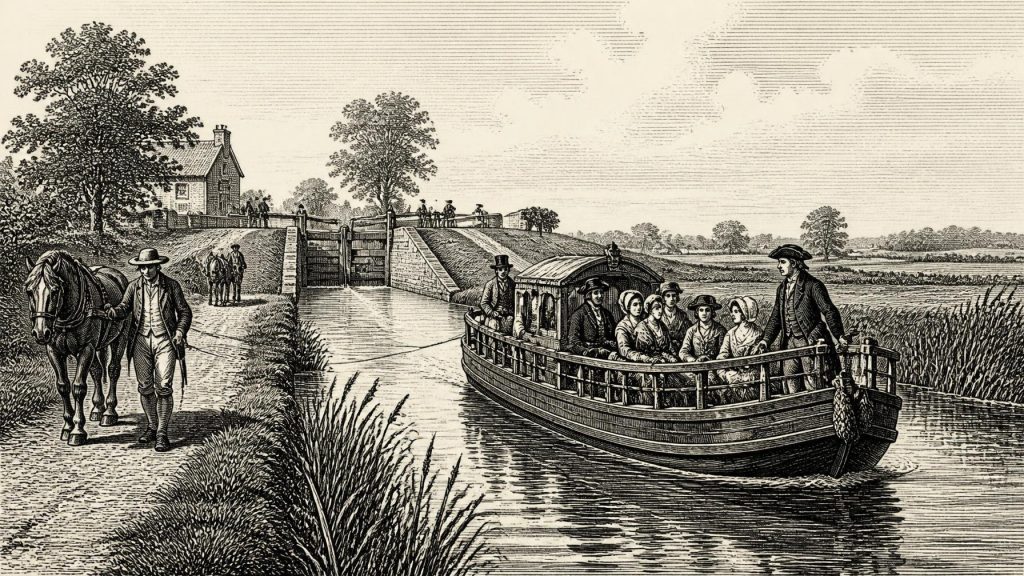
The year also brought a tangible transport advance. In 1784, the Grand Canal’s passenger-boat service was extended to Robertstown in County Kildare. The canal was not yet a completed route across Ireland, nor had the Barrow line reached Monasterevin—that came in 1785. But the extension was a practical enlargement of the corridor linking Dublin with the inland counties. Passengers, letters, small parcels and commercial information could move along a new engineered waterway, while the construction itself reshaped local labour and landscapes around locks, embankments and bog crossings.
These two facts—linen exports and a longer canal service—capture the unevenness of the year. Ireland was more commercially active and better connected than before. Dublin merchants, canal investors, linen factors and landowners could see opportunity in freer trade and improved communications. For many rural households, however, improvement meant dependence on volatile markets, insecure tenancies and competition for the tools of domestic manufacture. The armed watches near Ballymacnab and the passenger boats reaching Robertstown belonged to the same Ireland: one increasingly tied together by commerce, yet divided by power, property and religion.
An Unsettled Settlement
By the close of 1784, Ireland had not entered revolution, and no general settlement had been achieved. Rutland’s government had contained the immediate parliamentary reform challenge; Flood had suffered a conspicuous defeat; and Catholic leaders remained divided over strategy. But the political questions had not gone away. Who represented Ireland? Could religious exclusion coexist with claims of national liberty? Would economic growth bring security, or intensify competition?
The first Defenders near Ballymacnab supplied the year’s most troubling answer. Their formation was local and should be described with care, yet it revealed a capacity for rural people to organise outside official institutions when protection seemed unavailable. In Dublin, reformers argued over the constitution. In Armagh, households guarded themselves against the next raid. The distance between those experiences was one of the defining facts of Ireland in 1784.
Primary Sources
- Peep O’Day Boys and Defenders: Selected Documents on the Disturbances in County Armagh, 1784–1796
- Popular Disturbances in Late Eighteenth-Century Ireland: The Origins of the Peep of Day Boys
- Manners, Charles
- Orde (Orde-Powlett), Thomas
- Flood, Henry
- Grattan, Henry
- Jones, William Todd
- Browne, Thomas
- Braughall, Thomas
- Bellew, Sir Patrick
- Hervey, Frederick Augustus
- Dermott, Anthony
- Keogh, John
- Butler, Simon
- The History of the Grand Canal
- History of the Commercial and Financial Relations Between England and Ireland from the Period of the Restoration, Part 14
- Observations on the Present State of the Linen Trade of Ireland: In a Series of Letters
- Pre-Union British Statutes
- Statute Law Revision Act 2015
- An Historical Review of the State of Ireland: From the Invasion of that Country under Henry II to its Union with Great Britain on 1 January 1801
- Ireland and the Industrial Revolution: The Impact of the Industrial Revolution on Irish Industry, 1801–1922
- The Irish Parliament