

Moyne and the Breifne Rout1460 CE
In 1460, Richard of York’s Drogheda parliament affirmed his lieutenancy and declared that Ireland was governed by laws accepted in its own parliament, while regulating defence, finance and local administration. Conflict exposed fragile frontiers: Conn O’Conor Faly defeated lordship forces, and English troops killed John O’Reilly of East Breifne, prompting Cathal O’Reilly’s succession. Captivity and maritime warfare further shaped regional politics. Franciscan patronage and Observant reform expanded through Moyne, Sherkin and Enniscorthy, although foundation dates remain uncertain. The killing of Killaloe’s bishop showed clerical vulnerability. Overall, the year revealed overlapping jurisdictions, military households, contested lordship power and resilient religious networks.
Dateline
In 1460 Ireland was not governed by one rhythm or one political community. The king of England, Henry VI, remained lord of Ireland; Richard, duke of York, was the king’s lieutenant and an exceptionally powerful landholder; the towns and shires of the English lordship maintained their own institutions; and Gaelic and Gaelicised lordships exercised authority across most of the island. This was also a year in which the formal politics of the lordship produced an unusually emphatic constitutional statement, while warfare and succession altered power on several frontiers. The surviving record is uneven. Parliament supplies unusually precise dates for its sittings, whereas the Irish annals often record a killing, defeat or foundation without locating it more closely than a lordship or diocese. That distinction matters in reconstructing the year.
York’s Parliament and Irish Law
Richard of York’s position connected Ireland directly to the escalating crisis in England later called the Wars of the Roses. Having sought refuge in Ireland after his political enemies prevailed in England in 1459, York was received as lieutenant. An Irish parliament first met at Drogheda on 7 February 1460, then sat or was repeatedly adjourned through the spring and summer before ending on 21 July. Its legislation confirmed York’s ten-year patent as lieutenant and treated resistance to his authority as treason. The measure was practical as well as partisan: York needed an Irish political base, and many within the lordship had reason to prefer the authority of an established lieutenant to directions sent from hostile factions in England.
The parliament is chiefly remembered for its assertion that Ireland was bound only by laws passed or accepted in an Irish parliament. It also insisted that the country possessed its own franchises, usages and customs, and protected the liberties of Dublin, Waterford and Drogheda. This was not a declaration of national independence in a modern sense. It was an assertion by the political community of the lordship—dominated by clerical and landed elites of the English settlement—that Irish law and administration could not simply be overridden by English writs or statutes. Its immediate purpose was to safeguard York and his supporters. Yet the language was consequential: it stated that Ireland was a political body with its own parliamentary consent.
Other acts show a government concerned with the everyday machinery of lordship. They addressed coinage, exchequer accounting, sheriffs and local courts; one required men with an annual income of £20 to maintain a mounted archer, equipped with bow and arrows, ready for war. Such rules reveal the limits of central resources. Defence depended heavily on locally prosperous men meeting military obligations, rather than on a large standing royal force. The same parliament legislated for churches, towns and private disputes, a reminder that even amid political emergency, law-making dealt with rents, revenue, property and jurisdiction.
York left Ireland for England in September 1460. His departure did not mean that the island had become quiet or united behind him. Rather, the parliament’s work gave his Irish allies an institutional language for resisting external interference. At the same time, the reach of its acts was strongest in the towns, counties and lordships where English legal institutions operated. Beyond them, authority was negotiated among regional dynasties, churchmen, military households and local communities.
War on the Midland March
One annalistic entry records that Conn O’Conor Faly inflicted a “great defeat” on the Foreigners, the usual Irish annalistic term for the English of the lordship and their associates. The baron of Galtrim was killed with many others. The sources do not securely identify the battlefield or date within 1460, so it would be wrong to attach the encounter to a particular modern place. Its political setting, however, is clear enough. O’Conor Faly’s territory lay beside the vulnerable western edge of the English settlement, and conflict between Offaly and the lordship’s Midland communities was recurrent.
This victory should not be reduced to a simple Irish-versus-English encounter. The forces called “Foreigners” could include descendants of settler families long established in Ireland, while Gaelic rulers made alliances across cultural and political boundaries when it suited their interests. Nevertheless, the death of a baron was a serious loss, and the annal’s emphasis on the scale of the defeat suggests a sharp check to lordship power on that frontier. Raiding, cattle-taking, hostage-taking and the destruction of crops or settlements were not incidental to such campaigning: they were methods by which rulers supplied followers, punished opponents and made claims to territory visible.
Military service was organised through households rather than impersonal armies. The death of Henry Mac Cabe, described by the annalists as a notable constable, illustrates this world. He died of a brief illness while accompanying O’Farrell in Annaly, and his body was carried to Cavan for burial by 280 gallowglasses armed with battle-axes. The number may have had commemorative force, but it still conveys the substantial armed retinue associated with a leading captain. Gallowglasses—professional heavy infantry of Gaelic and Hebridean background—were integral to fifteenth-century Irish warfare, and their presence tied the politics of Breifne, Fermanagh and Annaly to wider Irish Sea networks.
The Disaster in East Breifne
The most precisely dated secular disaster of the year occurred on 3 September. John O’Reilly, king of East Breifne, his brother Aedh, Eoghan “Blind-eye” Mac Cabe and many others were killed when the English defeated O’Reilly’s force. The Annals of Ulster call John “king of the two Breifnes”, a grander formulation than his effective rule in East Breifne, but it conveys both his ambition and the shock created by his death. The annalist says there had been no tale concerning a Connacht man so momentous since the death of Cathal Red-hand O’Conor.
John had inherited a politically contested kingship in 1449 and had worked pragmatically with neighbouring powers and with representatives of the lordship. His death in 1460 demonstrates the fragility of those arrangements. The annals do not give a trustworthy battle-site, nor do they provide a full account of the English force, so the encounter cannot responsibly be turned into a detailed set-piece. What can be said is that the loss abruptly removed a ruler whose position had helped hold East Breifne together. Cathal O’Reilly, John’s brother, was made king afterwards. Succession was never merely automatic: inauguration required the support of leading kin, clients, military families and neighbouring powers.
The response recorded by the Annals of Ulster also reveals the social reach of lordship. Ireland’s bardic companies, pilgrims and poor mendicants, it says, mourned John and Aedh. Annalistic praise is stylised and should not be read as a census of public feeling. Even so, the passage identifies a real network of poets, travellers and religious poor who depended on aristocratic hospitality and moved between regions. A ruler’s fall could therefore matter beyond his immediate followers, removing a patron, protector and distributor of resources.
In the north-west, the release of Aedh Ruadh O’Donnell, son of Niall Garbh, was another development with future importance but a firmly recorded place in 1460. Henry O’Neill freed him after four full years of captivity. The annals add that Henry had favoured the rival sons of Neachtain O’Donnell, who held the chieftainship during the prisoner’s confinement. The episode exposes how captivity functioned in high politics: a captive claimant was both a bargaining asset and a potential instrument of intervention in a neighbouring lordship.
Friaries, Patronage and Reform
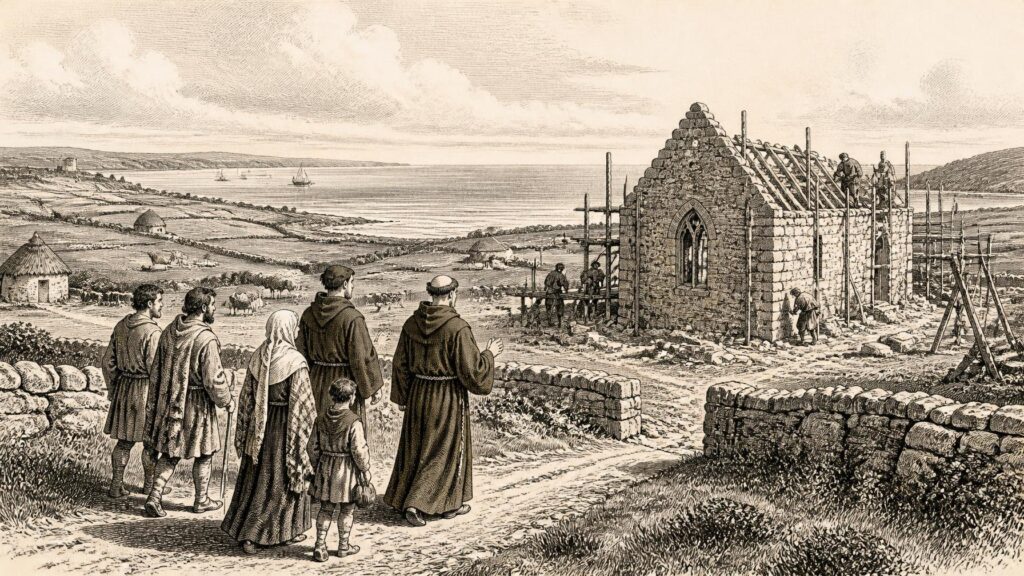
Religion furnished some of the year’s most durable foundations, although the dating of individual houses needs care. The Annals of the Four Masters place the foundation of a Franciscan house at Maighin, or Moyne, in Tirawley in 1460, crediting Mac William Burke and the initiative of Nehemias O’Donohue, identified as the first Irish provincial vicar of the Observant Franciscans. Other evidence indicates that a community was already present at Moyne before 1455, and the church was consecrated in 1462. Thus 1460 is best treated not as an unqualified beginning of building on an empty site, but as the date preserved by the annalistic tradition for the Burke–O’Donohue foundation and its Observant identity.
The distinction is important because the Observant movement was a reform within the Franciscan order, committed to a stricter interpretation of poverty, discipline and religious life. In August 1460 Pope Pius II confirmed O’Donohue as vicar provincial and authorised the conversion of up to four Irish Franciscan houses to Observant practice, subject to the friars’ consent. Moyne, close to Killala Bay and the River Moy, was consequently part of a wider institutional renewal rather than an isolated country monastery. Patronage by the Mac William Burkes provided land, protection and resources; friars supplied preaching, confession, liturgy and a focus for burial, commemoration and learning.
The Four Masters also record Franciscan foundations at Inis Arcain, now Sherkin Island in O’Driscoll territory off the Cork coast, and at Inis Córthaidh, Enniscorthy, beside the Slaney in the diocese of Ferns. These entries establish 1460 as a significant year in the annalistic record of Franciscan expansion, though later traditions differ over patrons and whether every house was Observant from its first days. Together, a coastal island lordship, a Connacht Burke lordship and a Leinster river town show that religious patronage crossed the island’s political divisions. Friaries were not outside secular society: their foundations depended on lords, but they also helped create institutions whose congregations, benefactors and spiritual clientele extended beyond one dynasty.
Violence could reach the Church as well. The bishop of Killaloe, an O’Brien, was killed by Brian an Chobhlaigh O’Brien on the island of Cluain Ramfhoda. The annals date the killing to the year but do not preserve motives sufficient for a confident reconstruction. It nonetheless shows that episcopal office did not place a man beyond the rivalries of powerful kindreds. In late medieval Ireland, clerics could be major landholders and political actors as well as pastors.
A Connected, Contested Island
A failed maritime expedition underlines the importance of the sea. Donnell, William and John O’Malley sailed with O’Brien’s sons towards Corca Bhaiscinn in west Clare against MacMahon. Before they could regain their ships, the three O’Malleys were killed, Donnell O’Brien was captured, Mahon O’Brien drowned while making for his vessel, and their followers suffered heavily. No detailed date or landing-place is supplied. Yet the episode confirms that seaborne movement was routine for lordly warfare, linking the Atlantic coast of Connacht with Thomond and Munster. Ships carried not only merchants and pilgrims but armed men, dynastic alliances and risks.
1460 therefore leaves a record of both institution-building and abrupt destruction. York’s parliament articulated the legal separateness of the lordship’s political community; regional fighting exposed the insecurity of its borders; the fall of John O’Reilly remade leadership in East Breifne; and Franciscan foundations or reforms strengthened religious networks from Mayo to Wexford and Cork. The year’s evidence does not support a single story of advance or decline. It shows an Ireland of overlapping jurisdictions, mobile armed households, resilient religious patronage and communities whose lives were shaped by decisions made in Dublin and Drogheda, in castles and lordly halls, at river crossings, and on the sea.
Primary Sources
- The Annals of Ulster: Year U1460
- Annals of the Kingdom of Ireland: Volume 4 English Translation
- Irish Statute Book: Statute Law Revision Act 2007
- Irish Statute Book: Pre-Union Irish Statutes
- Richard of York
- ‘Ireland corporate of itself’
- CIRCLE: Irish Chancery Letters of Henry VI (1422–1461)
- CIRCLE 2.0: Irish Chancery Project
- Moyne Abbey
- Monasteries of the Moy
- Enniscorthy (Co. Wexford)
- St. Mona’s Church – Sherkin Island – A History
- The Franciscans in Ireland, 1400–1534: From Reform to Reformation
- Gaelic Society and Economy
- Seaborne Trade and the Commercialisation of Fifteenth- and Sixteenth-Century Gaelic Ulster
- English Lordship of Ireland and the Irish Sea World: Re-assessing the Origins of the Kildare Ascendancy, c.1390–c.1513
- From Boom to Bust: The Lordship of Ireland and the European ‘Commercial Revolution’
- O'Reilly (Ó Raghallaigh), Eóghan
- Irish Script on Screen: MS 23 P 6, The Annals of the Four Masters
- Annals of the Kingdom of Ireland: Library Catalogue Record
- Exploring the Irish Annals
- Poynings’ Law