Leighlin’s Burning, Wogan’s Parliament1297 CE
In 1297, John Wogan’s Dublin parliament introduced elected knightly representatives from counties and liberties of the English lordship, seeking consent for measures on defence, policing, road clearance and collective military contributions. It also advanced royal administration through the creation of counties Kildare and Meath, while preserving powerful private liberties. These reforms responded to persistent insecurity: Slieve Margy forces burned Leighlin, while leading Orior figures were killed near Dundalk. Elsewhere, annals recorded the deaths of Moylurg’s lord, chiefs and bishops, and disputes over Elphin. Edward I’s wars constrained affairs. The year revealed authority as selective, contested and dependent on local institutions.
Dateline
In 1297, Ireland’s political map was being redrawn even as violence exposed the limits of government. The most consequential development was a parliament convened under John Wogan, the king’s justiciar, at Dublin. Its surviving ordinances sought to make the English lordship more governable: counties and liberties were to contribute to defence, roads were to be cleared, and local communities were to bear greater responsibility for policing a landscape in which raids, refuge and retaliation remained commonplace. Yet the same year saw Leighlin burned and leading men of Orior killed near Dundalk. Far from describing a settled country, the records reveal a lordship attempting to organise itself amid enduring regional conflict.
A Parliament of Counties and Liberties
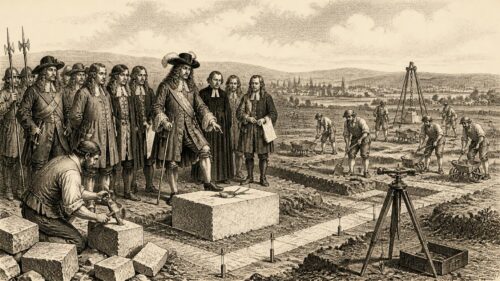
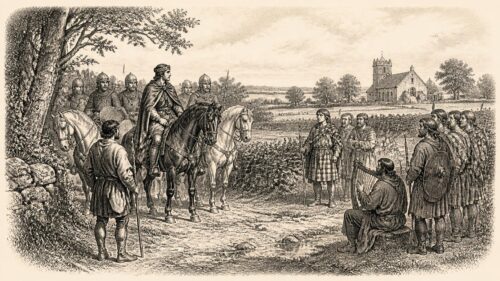
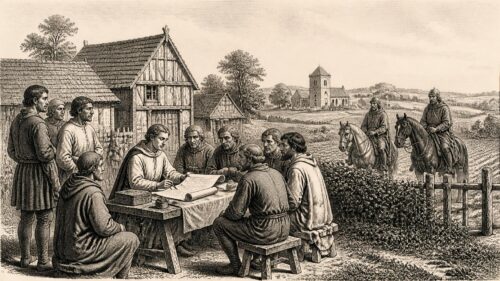
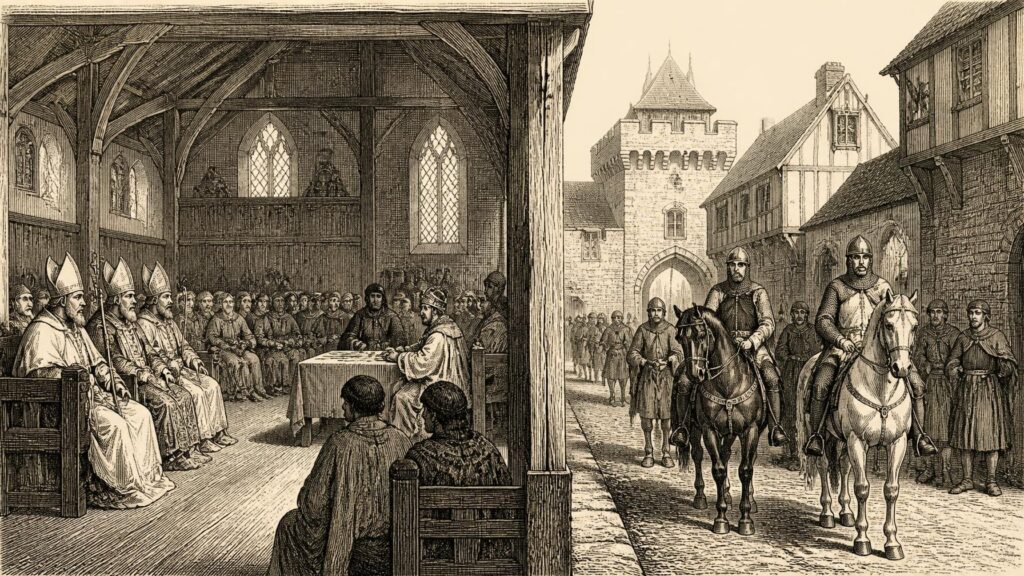
The Dublin parliament of 1297 is often called the first representative parliament in Ireland, but that phrase needs care. It was not an assembly representing all the island’s inhabitants, nor a parliament of Gaelic Irish lordships. Rather, it brought an electoral element into the government of the English lordship. Writs instructed the sheriffs of ten counties and the seneschals of five liberties to assemble their full county or liberty courts and secure the election of two “honest and discreet” knights. These men were to come with authority from their communities to act and receive decisions on their behalf.
That procedure mattered. Government in the lordship had long rested on the justiciar, royal officials, bishops, magnates and great landholders. In 1297, communities defined through county and liberty courts were expressly drawn into law-making and the maintenance of order. The representatives were not modern members of parliament, elected by a broad population; they were knights chosen within the political society of the settler lordship. Nevertheless, the summons recognised that county communities could be bound only through authorised consent. It was an important institutional step in the history of Irish parliamentary practice.
The parliament’s purpose was practical rather than ceremonial. Its ordinances were presented as measures to establish peace more firmly. They addressed roads and wooded routes, places where undergrowth allowed raiders to evade pursuit after plundering. Lords of woods and their tenants could be required to clear the ancient king’s highway. This was a revealing instruction. Movement through Leinster and the frontier districts depended upon passable routes for messengers, traders, officials, livestock and armed parties alike. A blocked or overgrown way was not merely an inconvenience: it could make royal justice ineffective and turn travel into danger.
Shiring the Lordship
Administrative change gave the parliament an unusually lasting significance. In this year the former liberty of Kildare passed into royal hands after William de Vesci surrendered his Irish possessions to Edward I. Legislation associated with the parliament made Kildare a county under the Crown’s sheriff rather than a liberty exercised by a private lord. The county then covered a far larger area than the present county, extending into lands later associated with Offaly and Laois. Its creation did not mean that royal control suddenly became complete on the ground; it provided a framework for taxation, justice, military obligation and record-keeping.
County Meath was also newly formed in 1297 from part of the old de Lacy inheritance. Elsewhere, powerful liberties remained central to government: Meath, Wexford, Carlow, Kilkenny and Ulster had their own seneschals and were separately summoned. The contrast between county and liberty was fundamental. A county was administered through royal officers, above all the sheriff; a liberty gave a great lord extensive delegated powers. The parliament therefore marked not a uniform conquest of Ireland but a selective tightening of royal administration in territories where it could work.
Its legislation also envisaged collective military burdens. The community of Leinster, despite the earlier division of that great lordship into several liberties, was treated as a body expected to levy contributions and maintain war against hostile Irish forces. That language records an English governmental outlook, not an impartial description of every conflict. It nevertheless shows why shiring, roads, local courts and taxation belonged together: they were instruments intended to sustain a frontier society under pressure.
Leighlin in Flames
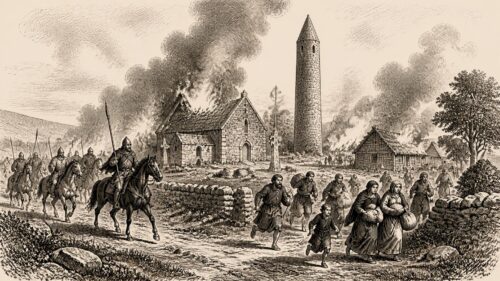
One firmly dated annalistic notice gives the year an immediate human reality: Leighlin was burned by the Irish of Slieve Margy. The brief Latin annals do not specify the season, the precise buildings destroyed or the number of people affected. It would be irresponsible to invent a siege or battle from that silence. But Leighlin was an ecclesiastical and settlement centre on an important route through south Leinster, and burning it was a sharp assault on the built, cultivated world that the lordship’s officials hoped to protect.
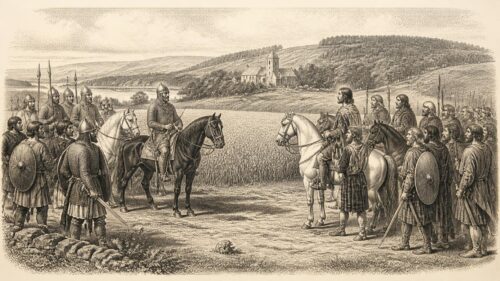
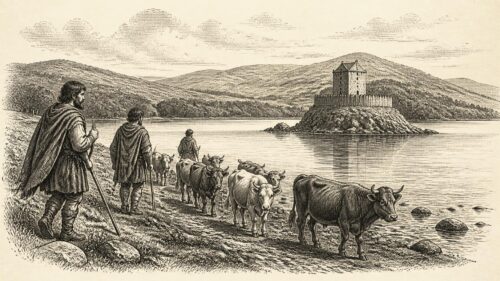
The men of Slieve Margy came from a region around the modern Laois–Carlow border where Gaelic lordship and English-held settlements met. Raiding could seize cattle, food, goods and hostages; it could also communicate political resistance and compel negotiation. The fire at Leighlin thus belongs beside the parliament’s concern with roads, local defence and the pursuit of raiders. It demonstrates why such measures were debated, while also showing that legislation was no guarantee of security.
Orior and Dundalk
In the north-east, the annals record another violent episode. Cú Uladh Ó hAnluain, lord of Orior, his brother, Aengus Mac Mathghamhna and many leading followers were killed by the English of Dundalk as they returned home from the Earl of Ulster. The wording is important. It implies a prior connection, service or encounter involving the Earl of Ulster, rather than simply an unprovoked clash on a road. The surviving notices do not safely explain the immediate cause, and later writers’ guesses should not be substituted for evidence.
What can be said is that Orior lay in a politically contested zone between the Anglo-Irish settlements of Louth and the Gaelic polities of south Ulster. Dundalk was a walled and commercially active town, but it was also a military community whose inhabitants could act collectively. The deaths of Ó hAnluain, Mac Mathghamhna and their companions were therefore more than a local affray. They removed figures of consequence from the regional balance of power and illustrate how quickly dealings between lords, townsmen and neighbouring Gaelic groups could turn fatal.
Moylurg Loses a Lord
Western and north-western records give 1297 a different tone: succession, commemoration and ecclesiastical patronage. Conchobar Mac Diarmata, lord of Moylurg and Airtech and senior kinsman of the Muinter Máelruanaid, died and was buried at Boyle. The Annals of Connacht praise him in the conventional but telling language of lordship: he was celebrated for valour, protection, hospitality, truth and princely rule. Such praise should not be read as a neutral biography, but it indicates the qualities expected of a successful Gaelic ruler—military capacity, the defence of dependants, material generosity and the ability to arbitrate disputes.
His burial at Boyle underlines the role of monasteries as dynastic centres. Boyle Abbey was not simply a place of prayer. It was a burial ground, a landholder, a focus of memory and an institution woven into the political life of Moylurg. The death of Manus Ó hAinlige, chief of Kinel-Dofa, also appears in the year’s annals. One source says he died; another gives a more dramatic account, saying that he was killed treacherously at Annaduff. The discrepancy is a useful warning: medieval annals preserve invaluable near-contemporary traditions, but their wording, detail and chronology must be compared rather than mechanically combined.
Bishops, Monks and Rome
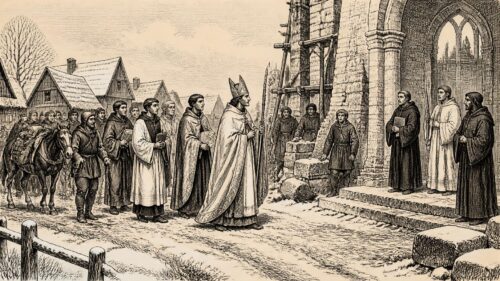
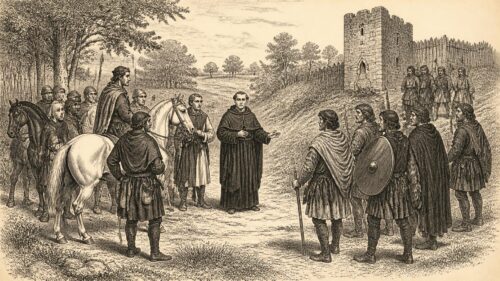
Church affairs were unusually visible in the annals for 1297. Máel Sechnaill Mac Briain, abbot of Boyle, was elected or assumed the bishopric of Elphin. His rival, Marianus Ó Donnabair, a Dominican friar who had been elected earlier, travelled towards Rome to contest the appointment and died on the journey. The episode shows that an Irish diocesan vacancy could reach beyond its locality. Election, monastic affiliation, competing claims and an appeal to papal authority linked Boyle and Elphin to the wider Latin Church.
Henry Mac Oirechtaig, bishop of Connor and a Cistercian monk, died and was buried at Drogheda according to one annalistic tradition. A further entry records that William Ó Dubthaig died after falling from his horse, though the surviving compilations differ over whether he was bishop of Clonmacnoise or Clonfert. The safe conclusion is not to choose between incompatible notices, but to recognise how dangerous ordinary travel could be and how closely episcopal office remained connected with religious houses. Bishops were spiritual leaders, landlords, judges and political intermediaries; their deaths could affect several communities at once.
An Island Under Wider Pressures
These Irish events unfolded in the reign of Edward I, whose wars in Britain and France drew heavily upon the resources of his lordships. In 1296, Wogan, Richard de Burgh, earl of Ulster, Theobald Butler and John fitz Thomas had gone with other Irish magnates to the king’s Scottish campaign. The Annals of Connacht preserved a stark account of Irish and English forces in Scotland destroying property, churches and a house of Dominican friars. That expedition belongs to the preceding year, but its demands formed part of the immediate background to 1297: men, revenue, supplies and political attention were not available without limit.
Contemporary governmental language could still describe Ireland as “at peace after its manner”. The phrase was not a claim that violence had ceased. In 1297 it meant something closer to a precarious level of order in which revenues might be collected and administration might function, despite raids, feuds and frontier killings. Leighlin’s burning and the deaths near Dundalk reveal the qualification embedded in those words.
A Year of Uneven Authority
The year’s significance lies in that unevenness. In Dublin, officials and landholding communities developed procedures that would shape the lordship’s parliament and local administration. In Kildare and Meath, new counties expressed a royal wish to govern more directly. At Leighlin, Orior, Boyle and Elphin, however, the records show a different Ireland: contested frontiers, local lordships, monastic networks, dangerous journeys and institutions that depended on personal authority as much as written ordinance. The parliament of 1297 was a genuine landmark, but it was a response to insecurity, not proof that insecurity had been overcome.
Primary Sources
- Annála Connacht
- Annala Uladh: Annals of Ulster otherwise Annala Senait
- Annals of the Four Masters, Part 13
- Annales Hiberniae
- Annales Hiberniae, text section 2
- Annales Breves Hiberniae
- Annals of Inisfallen, Part 81
- Exploring the Irish Annals
- Statute Law Revision Act 2007
- The Enactments of the 1297 Parliament
- ‘Ireland corporate of itself’
- The Dublin Parliament of 1297
- ‘Geographical loyalty’? Counties, palatinates, boroughs and ridings
- A Community in Competition: The Barons of Leinster in Thirteenth-Century Ireland
- Irish Parliaments in the Reign of Edward II
- English Rule in Ireland, c.1272–c.1315
- Private Sources at the National Archives
- A Guide to the Records Deposited in the Public Record Office of Ireland
- Courting the Past: Reconstructing Ireland’s Lost Records
- Early Statutes of Ireland
- Irish Legal Research: Historical Statutes and Background on Early Irish Law
- Statute Law Revision Bill 2007: Committee Stage