
Swift’s Patients, Mosse’s Rotunda1757 CE
In 1757, Protestant-ruled Ireland remained politically restricted under Poynings’ Law and the penal code, while Dublin witnessed significant institutional beginnings. Lord Lieutenant Bedford’s dispute with John Ponsonby exposed rivalries within the governing Protestant elite, against the background of the Seven Years’ War. Charles O’Conor, John Curry and Thomas Wyse initiated cautious Catholic political organisation, later associated with the Catholic Committee. St Patrick’s Hospital, funded through Jonathan Swift’s bequest, admitted its first patients, while Bartholomew Mosse opened his purpose-built lying-in hospital at Rutland Square. Parliament also authorised the Wide Streets project, initiating statutory urban redevelopment and reshaping access to Dublin Castle.
Dateline
In 1757, Ireland did not experience a single dramatic turning point: there was no battle on Irish soil, no constitutional settlement and no sudden alteration in the laws governing the kingdom. Yet the year is unusually revealing. In Dublin, three developments connected public authority, charity and the built environment: a small Catholic political association began to take shape; St Patrick’s Hospital admitted its first patients; and Bartholomew Mosse’s new lying-in hospital opened on the north side of the city. At the same time, legislation authorised a new route from Essex Bridge towards Dublin Castle, an apparently local improvement that would begin the long remaking of the capital’s streets.
These events belonged to a Protestant-ruled Kingdom of Ireland whose parliament met at College Green but operated under significant constitutional restraint. Poynings’ Law required Irish legislation to pass through the Irish and British privy councils before it could be considered in Dublin. Political power, offices and parliamentary representation were concentrated in the hands of a comparatively small Protestant elite, while the great majority of the population, Roman Catholic in religion, lived under the remaining restrictions of the penal code. The institutions and initiatives visible in 1757 did not undo that unequal order. They do, however, show groups and individuals beginning to work within, around and sometimes against its limits.
Bedford and the Political Establishment
John Russell, fourth duke of Bedford, was lord lieutenant in Ireland during 1757. His vice-regal administration arrived amid tensions within the Protestant political class. John Ponsonby, speaker of the Irish House of Commons and first commissioner of revenue, expected a decisive role in government through the established system of great parliamentary interests and patronage. Bedford instead initially pursued what contemporaries described as an impartial policy. That decision denied Ponsonby the influence he believed his position entitled him to exercise and helped sharpen a contest over who would manage parliamentary business, appointments and access to Dublin Castle.
This was politics conducted through family alliances, borough influence, pensions and office rather than popular elections in a modern sense. The Irish House of Commons was not sovereign: the legislative procedure restricted its initiative, and executive authority rested with the crown’s lord lieutenant and chief secretary. Still, the Commons possessed leverage, particularly over money bills and revenue. The dispute surrounding Bedford and Ponsonby therefore mattered because it exposed the continuing negotiation required to make the Dublin administration work. In 1757 the argument remained principally one within the ruling Protestant interest, not a movement towards representative government for Ireland as a whole.
The wider setting was the Seven Years’ War, which had begun in 1756. Ireland was not a theatre of land war in 1757, but it was bound into Britain’s military and fiscal system. The island supplied men for imperial service, maintained garrisons and depended upon vulnerable sea routes for trade. War also intensified official concern with revenue, credit and security. It would be misleading to portray every Irish political decision of the year as a direct consequence of the conflict; nevertheless, the war formed the international horizon of Bedford’s government and of merchants trading through Irish ports.
A Catholic Committee in Formation
One of the year’s most consequential small beginnings occurred in Dublin. Charles O’Conor of Belanagare, the Roscommon antiquary and Catholic political writer, worked with the physician and historian John Curry and Thomas Wyse of Waterford to organise Catholic interests more systematically. Later accounts identified a meeting at the Globe Coffee House in Essex Street in 1757 as the first meeting of this group. Only a handful of men attended. The more settled and wider Catholic Committee developed in 1760, so it is important not to project its later county network and influence backwards fully into 1757. But the year can responsibly be treated as the beginning of the associational experiment from which that committee emerged.
The significance lay less in numbers than in method. O’Conor and his associates sought communication, information and a measured collective voice near the seat of government. They were not attempting an armed challenge to the state. Their aim was to press for relief from laws that bore heavily upon Catholics in property, education, public life and political participation. The men involved came from, or appealed to, the Catholic gentry, mercantile and professional worlds: social groups with resources, literacy and connections, yet without equality before the law.
O’Conor’s The Protestant Interest of Ireland Considered, published in 1757, made a strategic argument in a language intended to be heard by Protestant readers. Rather than treating Catholic well-being as opposed to the kingdom’s security, it argued that penal exclusion damaged Ireland itself. O’Conor was both a political pamphleteer and a serious student of Irish manuscripts and early history. His work connected the preservation of Gaelic learned tradition with an Enlightenment-style case for reasoned reform. The committee’s first steps were cautious, but they helped establish habits of Catholic organisation that would become increasingly important in later decades.
Care, Confinement and Swift’s Bequest
On 26 September, St Patrick’s Hospital in Dublin admitted its first patients. The institution owed its existence to Jonathan Swift, dean of St Patrick’s Cathedral, who had left his estate to establish a hospital for people then described in the language of the period as “fools and mad”. The royal charter had been obtained in 1746, and a purpose-built hospital had been erected, but the building could not immediately operate: money was needed for furnishing, staffing and the continuing expense of care. The admissions of 1757 marked the point at which Swift’s charitable intention became an operating institution.
The first intake consisted of six men and four women, recorded in the terminology of the time as pauper patients. That wording is historically important, not merely offensive by modern standards: it reveals a charity aimed at people who could not readily purchase private care. It also reminds us that eighteenth-century ideas of mental illness, treatment and personal liberty differed profoundly from those of today. Admission to an institution could provide food, shelter and supervision where families had few alternatives; it could also involve confinement and the loss of autonomy. No romantic story of humanitarian progress can be read simply from the opening day.
Nonetheless, St Patrick’s was a remarkable Irish foundation. It was the first purpose-built psychiatric hospital in Ireland and among the earliest institutions of its kind. Its opening brought a specialised charitable establishment into the city’s medical landscape, alongside older voluntary and state-supported hospitals. The hospital’s survival depended on trustees, estate income, donations, management and labour as much as on Swift’s original bequest. In that respect, 1757 shows charity as an organised social system, not merely an act of private benevolence.
Mosse’s New Lying-In Hospital
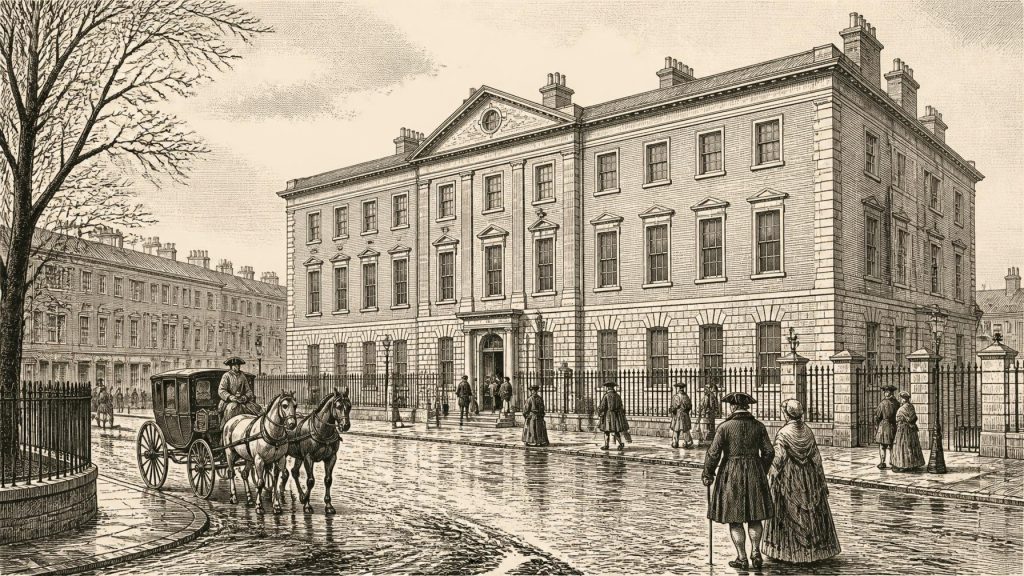
Less than three months later, on 8 December, Bartholomew Mosse’s New Lying-In Hospital opened in purpose-built premises on Rutland Square, now Parnell Square. Mosse had founded the earlier Dublin Lying-In Hospital in 1745 in South Great George’s Street. Its purpose was practical and ambitious: to provide care for women in childbirth and to create a setting in which midwifery could be taught. The move of 1757 gave the undertaking a permanent architectural presence and began the continuous occupation of the site associated with the Rotunda Hospital.
The building was designed by Richard Cassels, one of the leading architects of Georgian Ireland. Its construction was funded through a combination of philanthropy and enterprise. Mosse used public entertainments and pleasure gardens on the site to attract paying visitors and raise money for the hospital. Such fundraising is a useful corrective to the idea that eighteenth-century medicine was wholly state-financed or confined to private households. Dublin’s expanding urban society could turn sociability, music and recreation into support for a charitable medical institution.
The hospital’s opening should not be mistaken for safe childbirth in the modern sense. Eighteenth-century maternity care remained dangerous, and the hospital served only a limited portion of the women who gave birth in Dublin and beyond. Yet its importance was real. It joined clinical care, record-keeping, instruction and charitable provision in a single institution. Along with St Patrick’s Hospital, it made 1757 a notable year in the history of organised care in Ireland, especially for people whose needs were often dealt with at home, in parishes or through improvised family support.
Making a Passage to the Castle
Another development of 1757 was less visible at first but eventually altered Dublin’s physical shape. An act of the Irish parliament authorised commissioners to make a wide and convenient way from Essex Bridge to Dublin Castle. The legislation was enacted in 1757 and received royal ratification in 1758; the commissioners’ active institutional history is therefore often dated from the following year. This distinction matters. It is accurate to see 1757 as the legislative origin of the Wide Streets project, but not to claim that its later streetscape had already appeared.
The initial objective was a route that would improve passage between the Liffey crossing and the centre of administration. The body created under the act possessed substantial powers to acquire property, demolish buildings and lay out new streets and building plots. Its first great route would open as Parliament Street in 1762. Later generations would associate the commissioners with the widening of Dame Street and the development of Westmoreland Street, D’Olier Street and Lower Sackville Street. In 1757, however, the essential fact was authorisation: urban improvement had been given a statutory machinery capable of overriding older patterns of property and movement.
That choice reflected the congestion of a growing capital. Medieval and early-modern lanes, irregular building lines, carts, pedestrians, traders and carriages competed in streets never planned for the scale of eighteenth-century Dublin. Improvement promised better access, commercial convenience and a more imposing approach to the Castle. It also carried costs. Wider streets required the purchase and removal of existing homes and businesses, showing that Georgian “improvement” could distribute its benefits and burdens unevenly.
A Year of Foundations
Rural Ireland remained the home of most of the population, and 1757 cannot responsibly be assigned a single island-wide harvest crisis, migration surge or agrarian outbreak on the surviving evidence considered here. Daily life continued to be shaped by tenancy, seasonal labour, local markets, religious division and regional economies of tillage, grazing, linen and provisioning. The year’s strongest documentary landmarks are instead concentrated in Dublin.
They were not minor matters. A cautious Catholic association found its first footing; Swift’s hospital began receiving patients; Mosse’s maternity hospital entered its new home; and parliament supplied the legal basis for a new kind of urban authority. None transformed Ireland overnight. Together they reveal a society in which political exclusion persisted, yet collective advocacy, specialised charity, medical organisation and planned urban change were acquiring firmer institutional form.
Primary Sources
- Russell, John — Dictionary of Irish Biography
- Ponsonby, John — Dictionary of Irish Biography
- O'Conor, Charles — Dictionary of Irish Biography
- Poynings' Law — UK Parliament
- Poynings' Law and the Making of Law in Ireland, 1660–1800 — Four Courts Press
- History and Archives — St Patrick's Mental Health Services
- Archives and Museum — St Patrick's Mental Health Services
- The Charter of His Majesty King George II for Erecting and Endowing St Patrick's Hospital — Google Books
- Images in Psychiatry: St Patrick’s Hospital — American Journal of Psychiatry
- History of Rotunda Hospital — The Rotunda Hospital
- Your Impact — Rotunda Foundation
- Dublin Lying-in Hospital — Wellcome Collection
- Maternity Care — Ask About Ireland
- Parliamentary Commissions: Wide Streets Commissioners — Dublin City Council
- Wide Streets Commission — Irish Archives Resource
- Wide Street Commission Architectural Drawings: Introduction — Dublin City Library and Archive
- The Wide Streets Commissioners: Their Importance for Dublin Architecture — Irish Georgian Society
- John Montague, Dublin Improvement and the Origins of the Wide Streets Legislation — Irish Georgian Society Journal
- The Dublin Gazette, Number 712: Tuesday 21 June 1757 to Saturday 25 June 1757 — Virtual Record Treasury of Ireland
- Bedford Manuscripts: Correspondence of the Duke of Bedford, Lord Lieutenant of Ireland — National Library of Ireland Sources
- History of the Commercial and Financial Relations Between England and Ireland from the Restoration — CELT, University College Cork
- War and the Economy — Oxford Academic
- Ireland, France, and the Atlantic in a Time of War: Reflections on the Bordeaux–Dublin Letters, 1757 — Routledge
- Two Maps of Eighteenth-Century Dublin and Its Surroundings by John Rocque — National Library of Ireland Catalogue