
Thurot at Carrickfergus1760 CE
In February 1760, François Thurot’s French force of about 600 men captured Carrickfergus, requisitioned supplies and threatened Belfast, prompting local defences, negotiations and widespread mobilisation. The raiders departed on 26 February and were defeated two days later off the Isle of Man, where Thurot was killed. The episode exposed Ireland’s coastal vulnerability during the Seven Years’ War. In Dublin, Catholics established a committee to seek cautious relief from penal laws, supported by public debate. George II’s death brought George III’s accession, dissolution of parliament and electoral agitation. Rural insecurity, religious inequality and surviving Gaelic musical traditions also shaped Irish life.
Dateline
In 1760 Ireland was drawn abruptly into the global Seven Years’ War. For five February days, a small French force occupied Carrickfergus on the northern shore of Belfast Lough, exposing the vulnerability of a kingdom often treated in London as secure behind the Royal Navy. The landing was brief and strategically unsuccessful, yet it produced a sharp local crisis: a garrison surrendered, Belfast prepared for attack, provisions became military currency, and thousands of civilians and volunteers gathered under arms. Elsewhere, quieter developments mattered no less. Catholics in Dublin created a new committee to pursue relief from the penal laws, while the death of George II brought George III to the Irish throne and opened a new political cycle.
A French Landing in Antrim
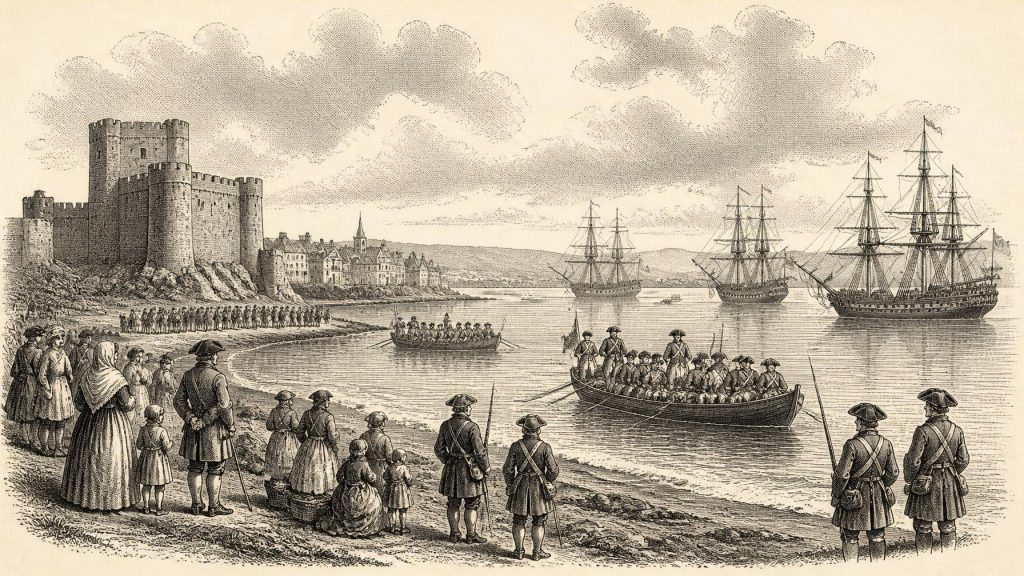
The best-dated event of the year began on 21 February, when three French frigates under the privateer and naval commander François Thurot entered Carrickfergus Bay. Their force numbered about 600 men. It was a fragment of a wider French wartime enterprise, not the advance guard of a successful conquest of Ireland. Nevertheless, Carrickfergus was a fortified port with a long military history, and its capture made an immediate impression. The town stood close to the route into Belfast Lough and possessed a castle which, though old and inadequately maintained, could not simply be ignored by an invading force.
The local garrison was small. Lieutenant-Colonel John Jennings’s men resisted, but the French gained the advantage and Carrickfergus Castle and town surrendered on 22 February. Accounts differ in their exact emphasis and some later retellings enlarge particular episodes, but the broad sequence is secure: Thurot’s men held Carrickfergus for several days, drew supplies from the district, and used the position to threaten Belfast. The episode was therefore not merely a naval raid seen from afar. For the inhabitants, it brought soldiers into streets and houses, disrupted ordinary authority, and raised the prospect of plunder, requisition and wider war.
The French commanders had reasons to hesitate. A direct advance on Belfast might have offered a richer prize, but it would have left a fortified place in their rear. Time also worked against them. Their ships had reached Ireland after a difficult voyage, and their landing force could not rely on a steady flow of ammunition, food or reinforcements. Carrickfergus gave them shelter and leverage, but it also fixed them in place at the moment when local resistance and official alarm were gathering.
Belfast Mobilises
Belfast was then a growing commercial town, connected by the lough to Irish Sea and Atlantic trade. The French threat showed both its prosperity and its insecurity. A contemporary-derived account records a demand sent from Carrickfergus for wine, brandy, beer, bread and cattle. Such demands were coercive, but they also reveal the practical objects of eighteenth-century warfare: an expedition survived only if it could obtain food, drink, transport and cash from the locality it frightened.
The inhabitants and surrounding countryside did not wait passively. Men arrived in Belfast under arms; an entrenchment was made near Milewater Bridge and armed with small cannon. Later accounts describe a force of roughly 3,000 assembling, including tenants and other local people carrying old firearms, scythes fixed to poles and other improvised weapons. The numbers and picturesque details should be treated with care, but the rapid mobilisation itself is well attested. Belfast could not depend upon a large standing force, so defence rested on a mixture of local initiative, social obligation and the expectation that respectable inhabitants would protect the town’s trade and property.
Negotiation accompanied preparation. Belfast sent provisions down the lough, though some people resisted supplying an enemy and weather complicated the passage of the boats. At Carrickfergus, hostages and messengers became part of the pressure applied to secure delivery. These exchanges make the crisis more intelligible than a simple tale of French attackers and British defenders. Civilians, ministers, merchants, labourers, boatmen and local magistrates all faced decisions under threat, while the town’s immediate safety depended as much on supplies and information as on weapons.
Departure and Defeat at Sea
Thurot’s force left Carrickfergus on 26 February. It had not captured Belfast, secured a durable base or triggered the larger French intervention feared by British officials. Two days later, on 28 February, Captain John Elliot’s squadron engaged the French off the Isle of Man, in the action commonly called the Battle of Bishops Court. Thurot was killed and his ships were defeated or taken. Contemporary prints later commemorated the encounter as a decisive naval victory.
For Ireland, the result removed the immediate danger but not the lesson. The raid demonstrated that hostile vessels could enter the Irish Sea and make a landing in Ulster despite British naval strength. It also reinforced the strategic importance of ports, loughs and coastal towns. Carrickfergus, Belfast and the waters between Ireland and the Isle of Man had briefly become a front in a war fought across Europe, North America, the Caribbean, India and the Atlantic.
Catholic Organisation in Dublin
While Antrim reacted to invasion, an important political development took place in Dublin. On 2 April, John Curry, Thomas Wyse and Charles O’Conor of Belanagare were involved in establishing a more organised Catholic Committee at the Elephant Tavern in Essex Street. This was not a mass democratic movement: the political system excluded Catholics from parliament and from the parliamentary franchise, while representation within the committee itself was shaped by merchants, professionals, clergy and men of property. Even so, its formation marked a purposeful effort to speak collectively for a population long constrained by the penal laws.
The committee’s aims were cautious. Its advocates stressed loyalty to the crown and sought practical relief rather than immediate transformation of the constitution. That caution reflected the world of 1760. Catholics remained burdened by restrictions affecting landholding, education, political participation and public life, although the enforcement and practical effects of particular laws varied. The French landing made loyalty an especially sensitive subject. Catholic campaigners had to persuade government and Protestant opinion that relief would strengthen, rather than endanger, the kingdom at a time of war with Catholic France.
Print gave these arguments a wider life. Henry Brooke’s Case of the Roman-Catholics of Ireland, issued in 1760, argued from a Protestant standpoint that the existing laws harmed the nation as well as Catholics. Its appearance did not signal that the restrictions had been removed; substantial legislative relief lay in the future. But it shows that the question was being debated in public, in terms of economic usefulness, security and civil order as well as theology.
A New King and an Old Parliament
The constitutional setting also changed in the autumn. The long-standing Irish parliament was dissolved by proclamation dated 1 October. On 25 October George II died, and his grandson succeeded as George III, king of Ireland as well as Great Britain. The accession did not alter Ireland’s subordinate constitutional position. The Irish legislature was Protestant in membership and operated under severe constraints, including Poynings’ Law and the asserted legislative authority of Westminster. Yet a new reign meant a new parliament and a general election, giving political writers and borough interests reason to organise.
In November, Charles Lucas issued Seasonable Advice to the Electors of Members of Parliament at the Ensuing General Election. Lucas was then still outside Ireland after years of exile, but his pamphlet addressed electors in Ireland generally and Dublin in particular. Its timing matters. It belonged to the political opening created by the accession, and it anticipated Lucas’s return and election for Dublin in 1761. In 1760, however, it was a printed intervention rather than a parliamentary triumph: a call for vigilance over representation in a system where most inhabitants had no vote at all.
Faith, Music and Unequal Lives
The year’s surviving evidence is concentrated in ports, printed pamphlets and political correspondence; it does not provide a complete diary of life across the island. Broader conditions nevertheless shaped every event. Most people lived in rural communities, dependent on seasonal labour, small holdings, rents and local markets. Religious status, access to land and ties to landlords or patrons could decisively affect security. The later Whiteboy disturbances should not be projected backwards into 1760, but pressures over rents, commons, tithes and rural authority already formed part of the social landscape from which such protest would emerge.
There is also a more tentative cultural connection to the year. Arthur O’Neill, the blind harper whose memoirs were recorded much later, recalled restringing and playing the medieval harp then associated with Brian Boru in Limerick when he was young, around 1760. The exact year cannot be demonstrated beyond doubt, and the instrument was not in fact Brian Boru’s personal harp. Yet the recollection is valuable: it points to the continued presence of hereditary harping, aristocratic patronage and Gaelic musical memory within an Ireland often described only through its laws and wars.
Thus 1760 was a year of sudden alarm and slower political preparation. Thurot’s raid ended within days, but it made Ireland’s exposed coastline impossible to ignore. The Catholic Committee and the succession of George III, by contrast, did not bring instant change. They marked beginnings: organised Catholic petitioning and a new reign under which arguments about representation, dependency, trade and religious disability would become increasingly difficult to contain.
Primary Sources
- The Dublin Gazette, Number 987: Saturday, 23 February 1760 to Tuesday, 26 February 1760
- Published Records of the Irish Houses of Parliament
- A Chronology of Ireland
- Françoise Thurot Captures Carrickfergus
- Bloomfield House, 1775–1798
- Versions: Carrickfergus, 1760
- The Battle of Bishops Court, 28 February 1760: the Commencement of the Action
- The Gallant Action off the Isle of Man Where Captain Elliot Defeated Thurot, 28 February 1760
- Collection Results: Seven Years’ War, Battle of Bishops Court, 1760
- A Journal of the Late Expedition under M. Thurot
- Curry, John
- O’Neill, Arthur
- John Curry on Literary, Political and Economic Affairs and the Position of Irish Catholics, 1760–61
- The Farmer’s Case of the Roman Catholics of Ireland
- Ireland in the Age of Revolution, 1760–1805, Part I, Volume 1
- Statute Law Revision Act 2015
- Irish Statute Book: Pre-Union Irish Statutes
- The Irish Parliament
- George III: King and Politicians
- Irish Opinion and the American Revolution, 1760–1783
- The Penal Laws: Origins, Purpose, Enforcement and Impact
- The Laws of Ireland, 1689–1850: A Brief Introduction
- The National Music of Ireland, Containing the History of the Irish Bards, the National Melodies, the Harp, and Other Musical Instruments of Erin