Culloden Repercussions1746 CE
In 1746, Ireland experienced the repercussions of Culloden rather than battle, as Irish exiles in French service fought for the Jacobites while Dublin Castle guarded against recruitment and disorder. Chesterfield’s administration ended amid continuing Catholic exclusion and official caution. Poor harvests, wartime demand and trade disruption prompted embargoes on provisions and salted meat, alongside grain imports and quarantine changes. Government proclamations targeted outlaws, organised fasts, and extended authority through local institutions. Westminster restricted Irish glass exports, while linen remained encouraged. John Cennick began Moravian work in Dublin, and Jonathan Swift’s bequest secured St Patrick’s Hospital’s legal foundation, illustrating charitable change.
Dateline
For Ireland, 1746 was not a year of battle on its own soil, but it was a year in which war, anxiety and regulation reached deeply into everyday life. The defeat of Charles Edward Stuart’s Jacobite army at Culloden in April ended the last serious Stuart bid for the crowns of Britain and Ireland. Irish people were connected to that struggle in several ways: through soldiers in French service, through the government’s suspicion of recruitment for the Stuarts, and through the enduring consequences for a Catholic majority living under a Protestant political order. At the same time, official proclamations reveal a state concerned with provisions, crime, shipping and public worship. The year’s history lies as much in Dublin Castle notices and port commerce as in the famous Scottish battlefield.
Culloden’s Irish Dimension
On 16 April 1746 the Jacobite army was defeated by the Duke of Cumberland’s government forces at Culloden Moor near Inverness. The battle belonged geographically to Scotland, but it was directly relevant to Ireland because the Stuart cause had long carried Irish hopes as well as Scottish ones. A restored Catholic Stuart monarch might, many Irish Catholics believed, offer relief from the disabilities imposed after the Williamite wars. That hope was neither uniform nor sufficient to produce an Irish rising in 1745–46. Ireland did not rise for Charles Edward Stuart. Yet the prospect alarmed the Hanoverian administration, which had treated the island as a potentially vulnerable rear of the British state throughout the crisis.
The Irish presence at Culloden was real, though it must not be confused with an Irish national army sent from Ireland. It came principally through the Irish Brigade and other Irish Jacobite exiles in French service. Irish merchants and officers had helped Charles’s venture in 1745; Irish advisers, notably John O’Sullivan, were prominent in his command. At Culloden, a detachment of Irish piquets under Brigadier Walter Stapleton formed part of the Jacobite second line, while men of Fitzjames’s Horse also served with the force. The Irish regulars covered the retreat after the battle and, unlike many Highland fugitives, were treated as prisoners of war when they surrendered. Their experience showed the international character of the conflict: the Stuart enterprise linked Scotland, Ireland, France, Spain, the Atlantic merchant world and the continuing War of the Austrian Succession.
Culloden did not suddenly remove every Jacobite sentiment in Ireland. It did, however, make a practical restoration still more remote. The defeat confirmed that French assistance could not be relied upon to transform Irish discontent into a successful rebellion. It also strengthened a pattern already visible during the rising: the government remained watchful, but many Catholic landowners and clergy avoided a venture for which there was no convincing prospect of adequate foreign military support. The outcome did not end the penal system, nor did it erase Catholic memory of lost land and political exclusion. It did narrow the horizon of immediate armed expectation.
Chesterfield’s Departure
The viceroy at the centre of Ireland’s management during the Jacobite scare was Philip Dormer Stanhope, fourth earl of Chesterfield. Appointed lord lieutenant in January 1745 and sworn in at Dublin in August, Chesterfield combined sociability with a hard political purpose. He sought to prevent rebellion without indiscriminate provocation. His policy towards Catholics was conditional: loyalty would receive leniency; disloyalty would bring severe repression. That mixture of reassurance and threat was characteristic of a government governing a kingdom in which the political nation was overwhelmingly Protestant but the great majority of inhabitants were Catholic.
In 1746 Chesterfield’s Irish administration came to an end. On 11 April a proclamation arranged a further prorogation of parliament, and on 23 April he left Dublin for England. The timing is striking: his departure came only a week after Culloden, though it should not be treated as a reaction to news from the battlefield. Chesterfield was required in London, where he became secretary of state for the northern department. His brief Irish viceroyalty nevertheless left a reputation for personal accessibility and for avoiding the panic that might have turned suspicion into a wider crisis. He later warned that poverty, rather than “popery”, posed the more serious danger in Ireland: a revealing judgement in a country still shaped by recent food shortages, unequal landholding and insecure work.
Recruiters, Rapparees and State Power
The official record for 1746 shows that government concern did not vanish with the Stuart defeat. On 4 April, before Culloden, proclamations offered rewards for the discovery of people recruiting men for foreign military service and for those recruiting for the Pretender. The distinction mattered. Service in continental armies was a long-established outlet for Irishmen, especially Catholics excluded from political power at home; the French Irish regiments were the most celebrated example. But in wartime, recruiting abroad could also be construed as a security threat, particularly when it might feed a Jacobite expedition. The proclamations were not proof that a widespread rising was under way. They demonstrate instead the administration’s determination to deter networks that could connect Irish manpower with foreign enemies and the Stuart cause.
Order was also pursued at county level. On 27 June, a proclamation required “tories, robbers and rapparees” who had been presented by grand juries in Antrim, Kerry, Tyrone, Kildare and Leitrim to surrender. These labels were capacious eighteenth-century official terms for armed offenders and fugitives; they should not automatically be read as evidence of organised Jacobitism. Their appearance across counties in north, west and east Ireland nevertheless points to a familiar difficulty of rural government. Grand juries, magistrates, informers and proclamations supplied the machinery through which the state attempted to reach beyond the capital. For people in the countryside, authority could be encountered less as parliamentary debate than as warrants, rewards, local patrols and the threat of prosecution.
Provisioning a Kingdom at War
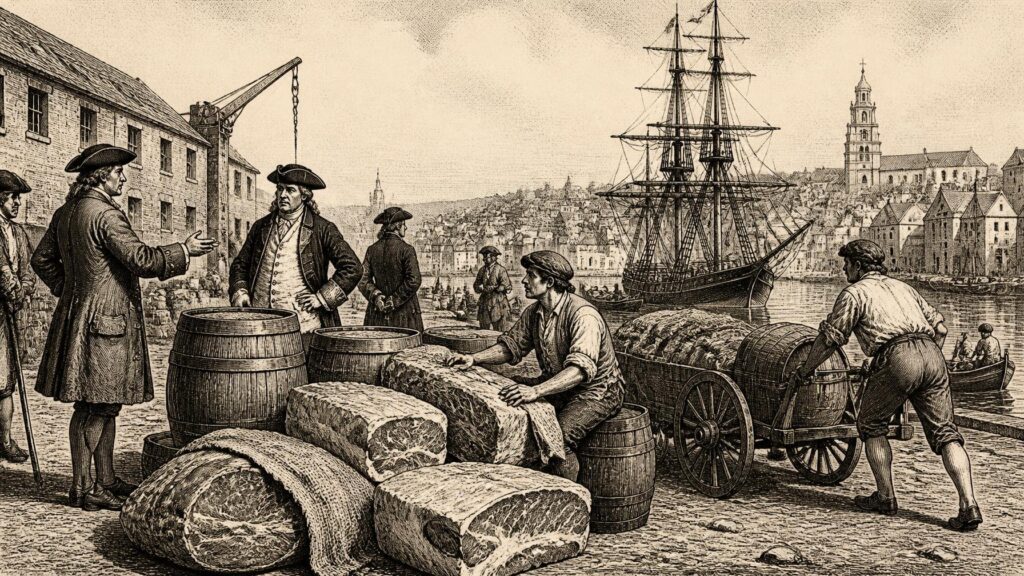
Food supply was another urgent subject. On 16 January the Irish administration embargoed the exportation of provisions. On 29 March it suspended the usual requirement for ships arriving from the Mediterranean to perform quarantine, a measure with obvious implications for maritime movement and commerce. Then, on 4 September, it embargoed exports of salt beef and pork. These were not minor commodities. Salted provisions were central to Ireland’s outward trade, above all through Cork but also through Dublin, Limerick and Waterford. Cattle, pigs, butter and preserved meat connected Irish pastureland, slaughterhouses, salting yards, coopers, carriers, merchants, sailors and imperial consumers.
The measures need to be read against both war and scarcity. The War of the Austrian Succession disrupted Atlantic and European trading routes while creating heavy military demand for durable food. Meanwhile, the Irish harvests of 1744 and 1745 had been poor. Research on eighteenth-century trade identifies 1745–46 as a period of exceptionally large grain and flour imports into Ireland, helped by supplies from regions less severely affected by harvest failure. The evidence does not justify calling 1746 a repeat of the catastrophic famine of 1740–41. It does show a precarious food economy in which deficient harvests, prices, imports and export controls were matters of public policy. The salt-meat embargo was therefore a conspicuous intervention in an expanding provision trade, balancing the needs of war and domestic supply against the interests of exporters.
On the same date as the September embargo, the Irish government appointed 9 October as a day of fasting and thanksgiving. Such proclamations made political events visible in parish churches and local communities. They joined religious observance to loyalty and public order, placing the suppression of rebellion within a providential account of national safety. A further public fast was ordered in December for 7 January 1747. These were not merely ceremonial notices. In an age when church attendance, proclamations and printed prayers carried official messages far beyond Dublin, they were instruments by which the state asked subjects to understand war, survival and monarchy.
New Institutions and Religious Currents
Two quieter developments reveal other dimensions of Irish life. In June, John Cennick arrived in Dublin to begin the mission that would make him a formative figure in the Irish Moravian movement. His first Dublin preaching attracted an audience reported at 150 people. Cennick’s evangelical preaching, hymn-singing and small religious societies represented a form of Protestant religious energy distinct from the established Church of Ireland. His work would later take him especially into Ulster, where Moravian congregations and chapels developed. In 1746, however, it was only a beginning: a new religious network entering a society whose confessional divisions were already embedded in law and politics.
On 8 August, the governors of St Patrick’s Hospital in Dublin were incorporated under the terms of Jonathan Swift’s bequest. Swift, dean of St Patrick’s Cathedral, had died in 1745 and left £12,000 to establish what he called a house for “fools and mad”. The language is now rightly obsolete, but the institutional purpose was significant: a specialist hospital for people experiencing mental illness. The charter did not mean that a finished hospital immediately received patients. Building, staffing and finance still had to be secured, and the institution opened only in 1757. Yet 1746 marked the legal foundation of an important Dublin charity and a lasting part of Swift’s public legacy.
Trade, Manufacture and Uneven Change
War also exposed Ireland’s constrained place in the British commercial system. From 25 March 1746, legislation of the Parliament of Great Britain prohibited the export of glass from Ireland. The restriction was a direct blow to an Irish manufacturing interest and a reminder that important rules governing Irish trade were made at Westminster rather than by the Irish parliament. It contrasted with official encouragement for linen, whose growth was supported through the Linen Board and depended heavily on household labour: flax growing, spinning, weaving, bleaching and marketing. In many northern districts, linen brought cash into small farming households, but its benefits were uneven and did not dissolve the wider vulnerabilities of rural society.
There was local change as well as regulation from above. In County Cavan, the Plunkett family sold their Virginia estate in 1746 to the Taylours of Kells. This was not a national turning point, but it illustrates the continuing transfer of estates that shaped settlement, investment and the prospects of small towns. The new owners later promoted improvements in Virginia. Such developments unfolded alongside, rather than apart from, the larger forces visible in 1746: landlords and tenants, markets and roads, religious identities and the reach of government all formed part of one changing kingdom.
Thus Ireland’s 1746 was defined not by a single domestic drama but by its connection to a wider crisis. Culloden closed a military chapter of Jacobitism while leaving political exclusion and cultural memory in place. Dublin Castle’s proclamations reveal a government policing recruitment, outlawry and provisions; the salt-meat embargo shows how closely warfare touched the food economy. Cennick’s arrival and Swift’s hospital charter, meanwhile, point to new religious and charitable institutions. The year was one of containment, adjustment and foundations laid under the long shadow of war.

Primary Sources
- Statute Law Revision Act 2015
- Stanhope, Philip Dormer
- Battle of Culloden
- The Battle of Culloden: The Irish Connection
- The Oxford History of British and Irish Catholicism, Volume III: Relief, Revolution, and Revival, 1746–1829
- The Oxford History of British and Irish Catholicism, Volume II: Uncertainty and Change, 1641–1745
- Problems in the Interpretation and Revision of Eighteenth-Century Irish Economic History
- The Provision Trade
- Central Aspects of the Eighteenth-Century Constitutional Framework in Ireland: The Government Supply Bill and Biennial Parliamentary Sessions, 1715–82
- History of the Commercial and Financial Relations Between England and Ireland from the Period of the Restoration
- History of the Commercial and Financial Relations Between England and Ireland: Part VI
- History of the Commercial and Financial Relations Between England and Ireland: Part VIII
- Ireland and the Global Cotton Industry, 1700–1850
- Jonathan Swift’s Legacy: Celebrating 280 Years of St Patrick’s Hospital
- Swift’s Hospital: A History of St Patrick’s Hospital, 1746–
- John Cennick
- John Cennick, a Brief Biography
- Swaddling John and the Great Awakening
- John Cennick (1718–1755): His Role in the Eighteenth-Century International Revivals, Formation, Doctrine, Activity in Ireland
- Development of Virginia
- The Linen Industry
- Jacobites and Catholic Royalists
- Jacobitism and Cultural Memory, 1688–1830
- The Organisation of the Jacobite Army, 1745–1746