
Dorbéne’s Brief Primacy1713 CE
In 713, annalistic evidence records political and ecclesiastical transitions across Ireland and the Gaelic sea-world. Cormac, king of Munster, died in battle at Cam or Carn Feradaig, opening a succession from which Cathal son of Finguine emerged. Cú Cherca of Osraige and Sechnasach of Uí Maine also died, while other killings illustrate regional violence. Church leaders Fáilbe Bec of Clonmacnoise and Bishop Baetán died. At Iona, Dorbéne held the primacy for five months before dying on 28 October. These notices reveal overlapping local kingships, influential monastic networks, and links between Ireland, Iona, Pictland and Northumbria during a year of change.
Dateline
The evidence for 713 is unusually revealing in one respect: it shows how a year of apparently short annalistic notices could still bring sudden change to communities from Munster to the midlands and across the sea to Iona. It was not a year in which Ireland became a single political unit, nor one dominated by a recorded island-wide campaign. Rather, the surviving notices register the death of a Munster king in battle, changes among regional rulers, and losses at major churches. Together they expose the interconnected character of early eighth-century Ireland: kingship was local and competitive, while monasteries linked districts, peoples and sea routes.
A chronological caution is necessary. The Irish annals were copied and organised centuries after many of their earliest entries were first recorded, and their year-numbering is not always identical. The Annals of Ulster places its entry headed U713 under an Anno Domini calculation equivalent to 712, while the Annals of Inisfallen explicitly labels the death of Cormac at Cam Feradaig as 713. Modern synchronisation work places the cluster of notices considered here in 713 CE. The year can therefore be used responsibly, but not with invented day-by-day precision. One exception is unusually firm: Dorbéne’s death on Iona is recorded as Saturday, 28 October.
A King Falls in Munster
The most consequential Irish political event connected to this year was the death in battle of Cormac, king of Munster. The Annals of Ulster calls him Cormac son of Ailill; the Annals of Inisfallen identifies the fallen ruler at the battle of Cam Feradaig as Cormac son of Máenach, king of Cashel. Such differences in patronymic detail are a reminder that early medieval dynastic records must be handled critically. Both traditions, however, agree on the essentials: a king of Munster was killed in fighting.
The Annals of Tigernach supplies further, though chronologically displaced, detail by naming the engagement as the battle of Carn Feradaig and associating it with the Déis Tuaiscirt, a north Munster people. Earlier, in 708, the Annals of Inisfallen had recorded Cormac’s harrying of Cliú, suggesting an active and potentially coercive relationship between the Cashel kingship and northern Munster. It is reasonable to connect the fatal encounter to that contested political landscape; it is not safe to turn the terse record into a full campaign narrative, or to claim a precisely located battlefield beyond what the sources support.
Cormac’s death demonstrated the limits of provincial authority. A king styled ruler of Munster could be killed by opponents within the broad region over which he claimed superiority. Munster was not administered as a modern province from a fixed capital. Its leading Éoganacht dynasties at Cashel competed with, bargained with and fought other powerful kindreds. Control rested on personal lordship, military followings, tribute, hostage-taking and alliances, all of which could be rapidly disturbed when a ruler died.
The succession has particular importance. The regnal tradition credits Cathal son of Finguine with a twenty-nine-year reign, implying that he succeeded after Cormac’s death in 713. Cathal would become one of the most formidable Munster rulers of the eighth century, but that later prominence should not be read back as proof that his accession was automatic or uncontested. For 713, the responsible conclusion is narrower: Cormac’s killing opened a decisive transition in Munster, from which Cathal emerged as king.
Deaths and Regional Power
Three other royal notices underline the dispersed nature of political life. Cú Cherca, king of Osraige, died. Osraige lay between the great spheres of Munster and Leinster and was important precisely because it could not simply be treated as the possession of either. Its ruler’s death mattered to neighbouring kings as well as to the people whose obligations and protection were bound up with that kingship. The annals do not tell us the manner of Cú Cherca’s death, the identity of an immediate successor, or whether a conflict followed. Silence should not be filled with a guessed succession struggle.
Sechnasach, king of Uí Maine, also died. Uí Maine was a substantial Connacht polity, extending across territory later associated chiefly with east Galway and south Roscommon. Its kingship was one among numerous regional lordships that shaped the daily political map of Ireland. The wording “king of Uí Maine” matters: it describes authority over a people and territory, not a county, and it coexisted with wider claims made by Connacht overkings and powerful Uí Néill rulers elsewhere.
The Ulster annal additionally notes that Cinaed son of Derili and a son of Mathgernan were killed. Neither place nor political setting is supplied. Their deaths may have resulted from feud, raiding or battle, but the source does not say which. The entry is valuable less as a solved episode than as evidence of the routine violence that annalists considered worth recording when people of rank were involved.
At the island-wide level, no single entry for 713 records a new high king or a general settlement. Fergal of Cenél nÉogain was already a major northern Uí Néill dynast and a leading contender for Tara after the death of Congal Cennmagair in 710. Yet the deaths in Munster, Osraige and Uí Maine show why a claim to overarching kingship was never the same thing as direct rule. Ireland’s political order was a field of overlapping dominions, in which local rulers retained real agency.
Churches in Mourning
The year is especially well marked in ecclesiastical records. Fáilbe Bec, abbot of Clonmacnoise, “rested”, using the conventional Christian language of death. Clonmacnoise stood by the Shannon at a major north–south water route and near an important east–west land corridor. It was more than a retreat for monks: its community included clergy, dependants, craftspeople and visitors, while its position brought it into contact with kings, traders and travellers. The death of its abbot was therefore an institutional event as well as a religious one.
Baetán, bishop of Inis Bó Finne, also died. The terse notice does not justify a detailed biography or even certainty about the particular island meant by the place-name, but it confirms the continued standing of island churches and bishops within the Irish ecclesiastical landscape. The presence of both abbots and bishops in the year’s notices is a useful corrective to overly neat descriptions of an “abbatial” Irish church. Religious authority could be expressed through different offices, communities and saintly affiliations.
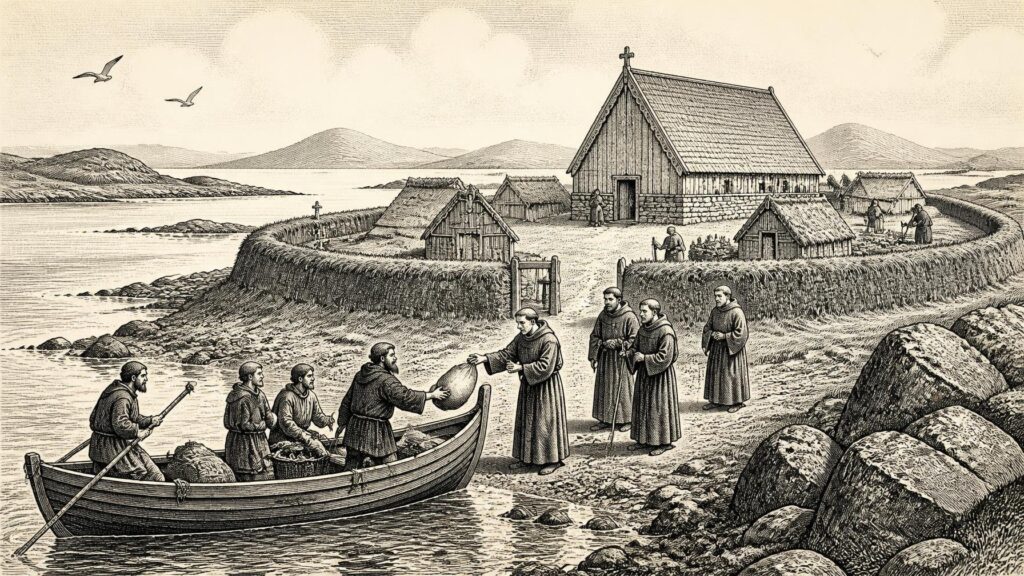
Most striking was the brief primacy of Dorbéne at Í, the Irish name for Iona. The Annals of Ulster reports that he obtained the abbacy or chair of Iona, held the primacy for five months, and died on 28 October. Iona was geographically in the Hebrides, but it belonged centrally to Irish history. Founded by Columba, an Irish saint, it stood within the Gaelic sea-world joining northern Ireland, Dál Riata in western Scotland and communities farther afield. Boats, rather than roads, made the island accessible; its apparent remoteness today can obscure its early medieval connections.
Dorbéne’s five months should not be mistaken for evidence of a straightforward vacancy and replacement. The succession of Iona’s abbots in this period is difficult, and the annals elsewhere name Dúnchad as abbot during overlapping years. Scholars therefore debate what Dorbéne’s “primacy” represented within the Columban community. What is firm is that the annalist regarded his acquisition of the chair and his death as events of enough importance to date exactly. What remains uncertain is the internal arrangement that produced this short tenure.
Learning, Labour and the Wider Sea
Iona’s importance rested not only on prayer but on learning, memory and material resources. Its community belonged to the Columban familia, a network of churches and monasteries connected by devotion to Columba, personnel, property and shared prestige. Such houses preserved Latin Christian learning, copied texts, educated clerics and kept records from which annalistic history ultimately developed. The notice of Dorbéne’s death is itself a small product of that literate world.
Its people were not detached from ordinary labour. Monastic settlements required food, fuel, buildings, boats, animals and the work of both religious and lay households. Irish monasteries commonly occupied enclosed sites and drew support from surrounding lands and patrons. At Clonmacnoise, as at other great centres, religious life existed alongside farming, craft production, hospitality and exchange. Cattle remained especially important as wealth and as a means of rendering obligations, but the sources for 713 do not provide harvest figures, prices, weather observations or a named commercial voyage. Those omissions set a limit on what can be said about the year’s economy.
The annals nevertheless place Ireland within a wider archipelagic setting. They record the death of a daughter of Oswy in the Northumbrian monastery of Hilda and the captivity of Tolarg son of Drostan at the hands of his brother, the Pictish king Nechtan. These were not Irish events, but their appearance beside Irish notices reflects the same clerical networks that linked Iona to Ireland and northern Britain. In 713, Irish history was neither isolated nor politically unified: it was shaped by regional rivalries at home and by religious, cultural and maritime connections across the Irish Sea.
For most people, life continued beyond the annals in farmsteads, small settlements and ecclesiastical communities. Families tended livestock and crops, maintained houses and enclosures, travelled on local obligations, and lived with the consequences of decisions made by kings and church leaders. The record does not preserve their names. Yet the deaths of Cormac, Cú Cherca, Sechnasach, Fáilbe Bec, Baetán and Dorbéne show how quickly authority could change hands. In that sense, 713 was a year of transitions: violent at Carn Feradaig, uncertain in several regional kingdoms, and poignantly brief at Iona.
Primary Sources
- The Annals of Ulster, Year U713
- The Annals of Ulster, Year U713 (Latin text)
- The Annals of Tigernach, Annals T712–T715
- Annals of Tigernach (Irish and Latin text)
- The Annals of Inisfallen, Annals AI707–AI717
- Annals of the Four Masters, Annal M713
- The Annals of Ulster
- Annals of the Four Masters
- Chronological Synchronisation of the Irish Annals, 488–722
- Cathal, Dictionary of Irish Biography
- Fergal, Dictionary of Irish Biography
- CELT Frequently Asked Questions
- CELT List of Published Texts
- Early Christian Monasteries, Ask About Ireland
- Ordinary People in Early Christian Ireland, Ask About Ireland
- The Earthen Rath or Lios, Ask About Ireland
- Churches and Ecclesiastical Enclosures, Ask About Ireland
- Clonmacnoise Monastic Site, Heritage Ireland
- Clonmacnoise Monastic Site Highlights, Heritage Ireland
- Iona Abbey and Nunnery: History and Stories, Historic Environment Scotland
- St Mary’s Abbey, Iona, Monastic Settlement, Historic Environment Scotland
- Early Mechanisms of Abbatial Succession: The Case of Iona (563–704)
- A New Jerusalem ‘At the Ends of the Earth’: Interpreting Charles Thomas’s Excavations at Iona Abbey 1956–63
- Contributions Towards the Political History of Munster, 450–800 A.D.
- Columba, Iona and Lindisfarne, Early Christian Ireland