Whig Prologue1712 CE
In 1712, Ireland remained tense following Williamite wars, with Tory administrators under Sir Constantine Phipps accused by Whigs of favouring Jacobitism and interests. Dublin’s conflict erupted when Dudley Moore delivered a banned Whig prologue on William III’s anniversary, provoking proceedings. Religious policy combined missionary outreach and exclusion: John Richardson published an Irish-English prayer book while penal laws constrained Catholics; Quaker pioneer William Edmundson died. Banbridge gained a bridge across the Bann, aiding communications. Livelihoods depended on agriculture and expanding linen exports, shaped by imperial restrictions, war and landholding. These events reveal authority contested through politics, religion, print, commerce and infrastructure.
Dateline
In 1712 Ireland was neither quiet nor at war. The great Williamite fighting of the 1690s had ended two decades earlier, while the War of the Spanish Succession was moving towards its diplomatic conclusion abroad. Yet Irish public life remained charged by memories of revolution, religious insecurity and the question of who properly represented the Protestant interest. The year’s best-documented Irish disturbance was not a battle, parliamentary rebellion or foreign landing, but a confrontation in a Dublin theatre. Its subject was a prologue; its consequences exposed a divided political culture.
Government Without Settlement
Queen Anne was monarch of Ireland in 1712, but practical government was conducted through a small Protestant governing class, the Irish privy council, office-holders, judges, borough corporations and the established Church of Ireland. The lord lieutenant was James Butler, second duke of Ormond, a great Irish landowner and Tory hero. He was, however, often absent in England. Dublin administration therefore depended heavily upon the Lords Justices and the lord chancellor, Sir Constantine Phipps.
The calendar year began amid a transition in those arrangements. Phipps and Richard Ingoldsby acted as Lords Justices after Ormond’s return to England in December 1711. In March 1712 Archbishop John Vesey of Tuam became a Lord Justice alongside Phipps. This was not a routine bureaucratic substitution. Phipps was an emphatic Tory, and his administration was regarded by many Whig Protestants as partisan, high-church and dangerously indulgent towards Jacobite sympathies. His supporters, conversely, saw him as defending the Church of Ireland and the lawful authority of the crown.
These labels need careful handling. Irish Whigs and Tories did not divide simply over abstract constitutional theories. Their conflicts were intensified by the still recent Williamite settlement, by competition for offices and borough influence, and by fears concerning Catholics, Presbyterians and the Stuart claimant in exile. Political allegiance was expressed through churches, corporation meetings, pamphlets, coffee-houses, commemorative dates and public ceremony as much as through an Irish parliament, which was not sitting during 1712. The previous parliamentary session had ended in 1711; a new election and parliament lay ahead in 1713.
Dublin’s municipal dispute gave this atmosphere an unusually practical edge. The privy council’s effort to control borough office-holders and thus future parliamentary influence clashed with Whig strength in the Dublin corporation. The stand-off impaired ordinary civic administration and legal business. It was a reminder that the capital’s institutions were not neutral machinery: control of a sheriff, alderman or mayor mattered because it could affect justice, patronage and elections.
A Prologue Becomes a Riot
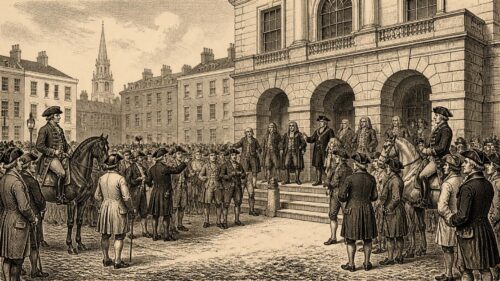
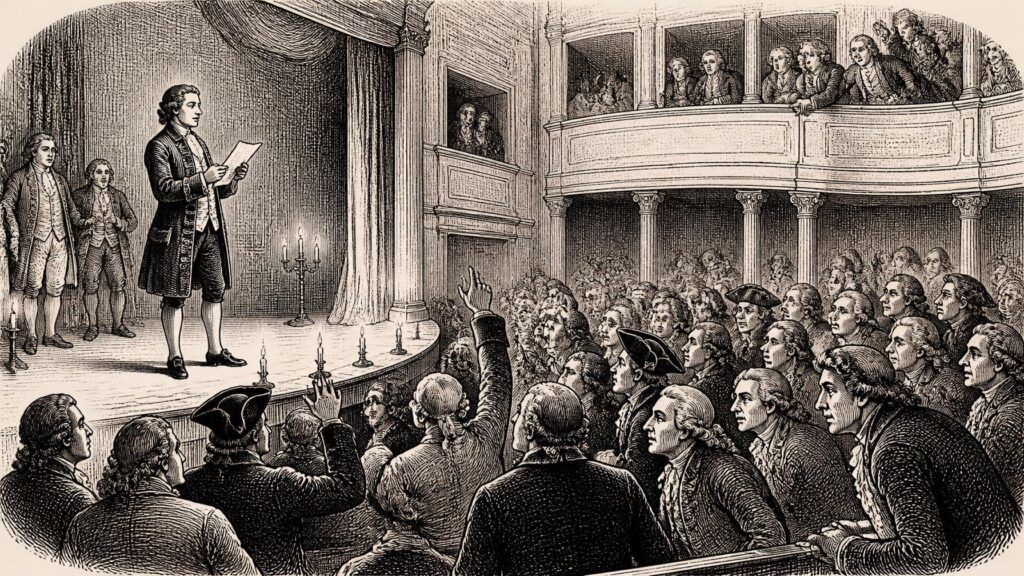
The sharpest incident came at the Queen’s Theatre in Dublin on Tuesday, 4 November. That date is securely fixed by the surviving printed prologue, which describes the occasion as the anniversary of the late King William. It should therefore be preferred to later summaries that assign a different November date. William III’s memory had become a powerful Whig emblem: for Protestants who identified the Revolution of 1688 with liberty and security, annual observance of his birthday and landing offered an occasion for loyalty, theatre and party display.
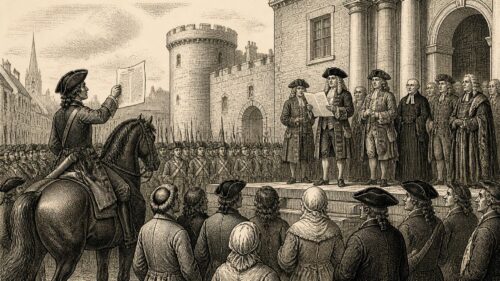
Nicholas Rowe’s Tamerlane had long been fitted to that purpose. Its virtuous conqueror could be read as an image of William, while the tyrannical Bajazet invited comparison with Louis XIV and, in a more domestic political register, with arbitrary rule. Samuel Garth’s Whig prologue made the allusion still plainer. The authorities ordered that it should not be spoken in Dublin in 1712. That decision turned an evening’s entertainment into a test of political authority.
Dudley Moore, described in later accounts as a young gentleman, went onto the stage and delivered the prohibited words himself. A disturbance followed and Moore was prosecuted for riot. The episode was sufficiently serious to generate memoranda preserved among the papers of the period, and it later became a conspicuous complaint against Phipps’s conduct. It would be wrong to treat the affair as evidence that Dublin was on the verge of insurrection. Rather, it shows how intensely public symbols could be contested in a city where a playhouse audience included lawyers, office-seekers, merchants, students and members of the political elite.
The quarrel also illuminates a changing public sphere. Printed sheets could carry a prologue beyond the theatre, while replies and counter-replies transformed performance into argument. Theatre was not separate from politics: the choice of play, the right to speak a text, the behaviour of the crowd and the decision to prosecute were all understood as statements about power. In 1712, Dublin’s stage became a place where the memory of William III, the legitimacy of the Tory administration and the boundaries of permissible speech collided.
Irish Prayer and Protestant Purpose
Another firmly datable development in 1712 took place on paper rather than on stage. John Richardson’s edition of the Book of Common Prayer, Leabhar na nOrnaightheadh cComhchoitchionn, was printed in London. The National Library of Ireland’s copy identifies it as a text in Irish and English. It was a revised Irish version of the 1662 prayer book, and the Society for Promoting Christian Knowledge helped meet part of the printing cost.
The existence of an Irish-language Anglican prayer book should not be mistaken for a broad official acceptance of Irish cultural autonomy. Richardson’s project was explicitly missionary. In the same year he circulated a Short history of attempts to convert what he termed the ‘popish natives of Ireland’ to the established religion, accompanied by a proposed programme of Irish-speaking ministers, printed religious texts and schools. His language reveals the assumptions of the Protestant establishment: Irish was valued as an instrument through which Catholic Irish speakers might be brought into the Church of Ireland and, in Richardson’s scheme, into English-language schooling as well.
That makes the publication historically revealing. It recognised that English alone could not reach all the people whom Protestant reformers wished to influence. But it also belonged to a system of confessional inequality. The penal legislation of Anne’s reign had already restricted Catholic education, clerical organisation, inheritance and public authority. No single new landmark penal statute belongs securely to 1712 itself; the year must instead be understood within laws already in force. Catholic worship and community life continued, but under legal disabilities which favoured the established church and sought to weaken Catholic institutional continuity.
Religious Ireland was nevertheless more varied than a simple Anglican–Catholic division suggests. Presbyterians formed important communities, especially in Ulster, though they too faced disabilities as Protestant dissenters. Quakers had long-established meetings and commercial networks. On 31 August 1712 William Edmundson, a leading pioneer of Irish Quakerism, died at Rosenallis in Queen’s County, now County Laois. His death was not a national political event, but it marked the passing of a figure who had helped establish a durable dissenting presence in Ireland from the 1650s onward.
A Bridge on the Bann
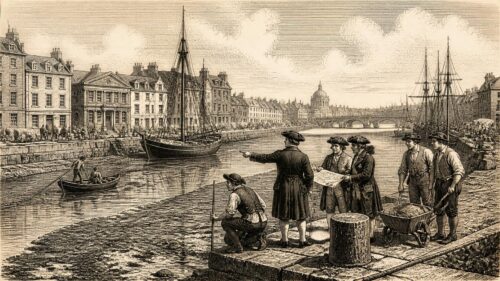
In County Down, a bridge built across the River Bann in 1712 gave Banbridge both its enduring name and a stronger connection to the principal route between Dublin and Belfast. Later accounts consistently associate the town’s name with this crossing. The bridge did not instantly create the substantial linen town that Banbridge became later in the century, and it would be misleading to project that later prosperity back into a single building year. Still, a permanent crossing altered movement through the locality: travellers, carts, livestock and goods no longer depended upon the older ford at Huntly Glen.
Its significance lay in geography as much as construction. The Upper Bann valley linked the growing commercial zones of Ulster, and improved passage across a river supported market exchange and roadside settlement. The future town developed around this point on the road. In 1712 it was a modest but material sign that regional change could occur through infrastructure rather than grand state policy.
Work, Trade and Uneven Prospects
Most people in Ireland experienced 1712 through rent, labour, harvests, livestock, household production and local markets rather than through Dublin’s political dramas. The economy remained predominantly rural, but it was closely tied to overseas demand and to restrictions imposed within the English and British mercantile system. Cattle, meat, butter, hides and wool mattered greatly; linen offered a particularly important route for Ulster households and merchants. Spinning and weaving were commonly dispersed through homes and small settlements, connecting women’s and men’s work to merchants, bleachers and exporters.
A trade series for the year ending 25 March 1712 records 1,376,122 yards of linen cloth exported, valued at £86,007, alongside linen yarn. These figures do not measure all production or all local consumption, and the accounting year overlaps two calendar years. They nevertheless offer a rare numerical glimpse of an expanding export activity. The Trustees of Linen Manufacture, established in 1711, represented official encouragement for an industry considered compatible with English interests after restrictions on Irish woollens. Banbridge’s new crossing belonged to the same broad, though not identical, landscape of communications, household manufacture and northern commercial growth.
The approach of peace mattered too. The Utrecht congress had opened in January 1712, but the war continued through the year. Ireland supplied manpower, provisions and commerce within a wider Atlantic and European world, yet the peace settlement was not completed until 1713. For Irish producers and merchants, overseas war and imperial regulation could alter markets beyond their control. Opportunities in linen and provisions coexisted with unequal landholding, insecure tenures and the legal exclusion of most Catholics from political power.
Thus 1712 was a year of connected but very different Irish experiences. In Dublin, a forbidden prologue provoked a riot because historical memory and party politics had become combustible. In print, an Irish prayer book embodied both linguistic engagement and a campaign for religious conversion. At Banbridge, a new bridge reshaped a local route across the Bann. Together these developments show an Ireland in which authority was asserted through ceremony, law, language, commerce and the built landscape—often with consequences larger than the events themselves first appeared to warrant.

Primary Sources
- The prologue that was spoke at the Queen's Theatre in Dublin, on Tuesday the 4th of November, 1712
- Phipps, Sir Constantine
- Butler, James
- Vesey, John
- Print and Party Politics in Ireland, 1689-1714
- Add MS 61609, British Library Archives and Manuscripts Catalogue
- Commons Chamber, 15 April 1823
- The Book of Common Prayer, and administration of the sacraments … = Leabhar na Nornaightheadh Ccomhchoitchionn
- Richardson, John
- A short history of the attempts that have been made to convert the popish natives of Ireland, to the establish'd religion
- Statutes in Chronological Order: The Reign of Queen Anne
- Introduction: Irish Penal Laws
- ‘Reasonable Inconveniences’: The Theory and Practice of the Penal Laws
- The Penal Laws: Origins, Purpose, Enforcement and Impact
- Edmundson, William
- Banbridge Place Plan: Discovery Report
- Banbridge, a market and post-town
- Banbridge Masterplan Executive Summary
- History of the Commercial and Financial Relations between England and Ireland from the Period of the Restoration
- The Provision Trade
- Ireland in the Early Modern World: Introduction
- Jones, Richard
- The crisis in Ireland and the disintegration of Queen Anne’s last ministry