Írgalach at Inis Mac Nesáin702 CE
In 702, although annalistic dating varies between 701 and 702, Irish records note political and ecclesiastical deaths. Muiredach Muillethan, king of Connacht and ancestor of Síl Muiredaig, died, potentially affecting regional succession. Írgalach of Brega, grandson of Conaing, was killed by Britons at Inis Mac Nesáin, modern Ireland’s Eye, demonstrating dangerous Irish Sea connections without proving an invasion. Faeldobar of Clogher, other kings, an abbot and scholars also died. These notices reveal interdependence between rulers, churches and learning. Most people remained unrecorded, sustaining rural communities whose labour, farming, tribute and seaborne travel underpinned early medieval Irish society amid dynastic instability.
Dateline
In 702 CE, Ireland’s surviving annalistic record is brief but unusually revealing. It places the deaths of a Connacht king and a Brega dynast in the same year, alongside the passing of an Ulster abbot and several other prominent figures. The most vivid entry records that Írgalach, grandson of Conaing, was killed by Britones at Inis Mac Nesáin, the small island now known as Ireland’s Eye, off the coast north of Dublin. The entry is firm about the death and its location; it is not, however, a full contemporary narrative of a campaign. Taken together, the notices show an island in which regional kingship, ecclesiastical authority and seaborne connections were closely entangled.
A Year Preserved in Annals
The dating of early Irish events requires care. The Annals of Ulster place these notices under an annal whose internal label corresponds to AD 701, while the Annals of Tigernach and Chronicon Scotorum assign them to 702. Modern historical convention generally uses 702 CE for the death of Muiredach Muillethan of Connacht and for Írgalach’s killing. This is a reminder that the annals were compiled and copied over centuries: they are indispensable evidence, but their year-numbers are not mechanically exact in every manuscript tradition.
That caution also helps define what belongs here. The battle of Claenath, in which Cellach Cualann of Leinster defeated Fogartach son of Niall and Bodbchad of Mide was killed, is sometimes loosely connected with the early 700s in modern summaries. The Annals of Tigernach place it in 704, not 702. It was part of the same unstable political world, but it should not be presented as an event of this calendar year.
The Death of Muiredach Muillethan
The annals record the death of Muiredach Muillethan, son of Fergus, king of Connacht. His byname, meaning ‘broad-crowned’ or ‘broad-topped’, distinguishes him from many men named Muiredach. Chronicon Scotorum adds an important retrospective note: from him descended Síl Muiredaig, a dominant royal kindred in later Connacht. That statement reflects later genealogical politics as well as ancestry, but it confirms that his death mattered to those who shaped the historical record.
Muiredach’s kingdom was not a unitary state with a permanent capital. Connacht comprised competing populations and lineages, held together imperfectly by an overking whose authority depended on kinship, clientship, tribute and the ability to gather armed followers. Royal power was exercised in places: at assembly sites, churches, river crossings, royal residences and the estates from which food-renders were drawn. A king’s death could therefore unsettle arrangements far beyond his household, opening questions about succession, alliances and obligations.
There is no securely dated annalistic statement that names Muiredach’s successor in 702 itself. Later evidence makes Cellach son of Rogallach the king who would defend Connacht successfully against the high king Loingsech at Corann in 704. It is reasonable to see Muiredach’s death as part of the transition that preceded Cellach’s prominence, but it would go beyond the evidence to describe a particular inauguration or succession struggle in 702.
A Killing on the Eastern Sea
Írgalach’s death is the year’s sharpest political event. He belonged to the Uí Néill world of Brega, the fertile lowland region around the lower Boyne and adjacent territories in modern Meath and north County Dublin. His family, the Uí Chonaing, competed within Síl nÁedo Sláine, itself a major branch of the southern Uí Néill. In the preceding year, the annals say, Írgalach had killed Niall son of Cernach. Niall’s son Fogartach would later become a powerful king of Tara. The killing at Inis Mac Nesáin thus removed a man from an already violent contest among Brega’s ruling kindreds.
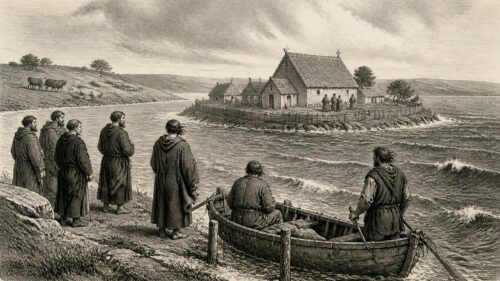
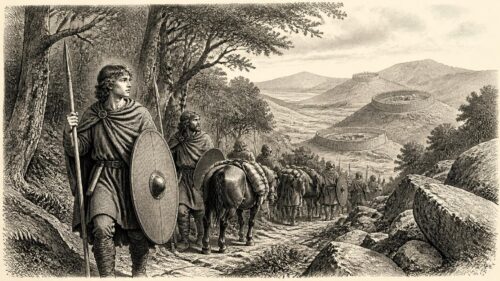
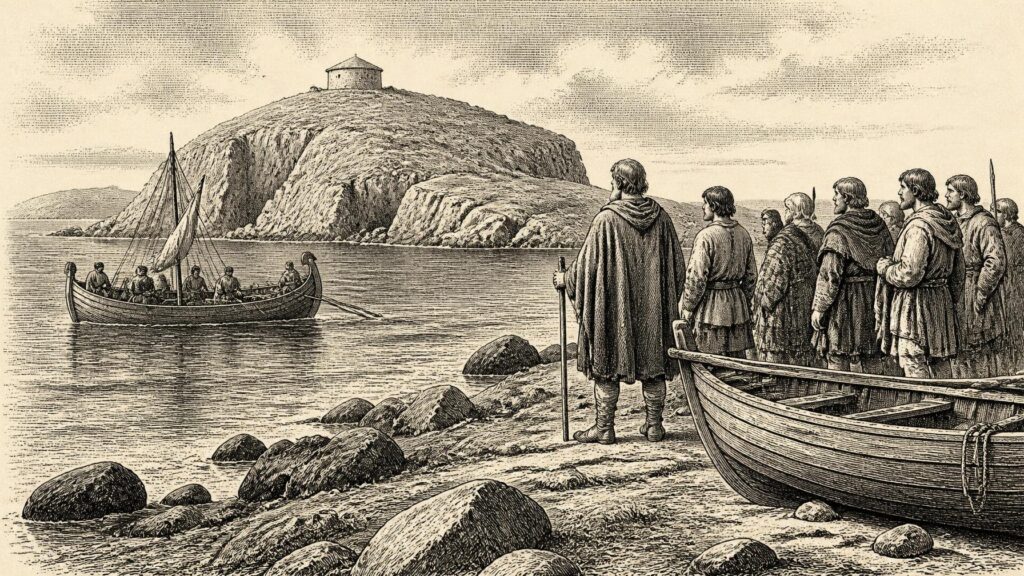
The terse notice in the Annals of Ulster says that Írgalach was killed by Britons “in Inis Mac Nesáin”. This does not prove a large invasion, nor does it identify the attackers’ home kingdom, commander or purpose. “Britons” is the annalists’ broad designation for people from Britain. Yet the location is significant. Ireland’s Eye stands in the seaways facing the Irish Sea, close to the coastal approaches of Brega and the future Dublin region. Ships, travellers, raiders, ecclesiastics and traders crossed these waters long before the Viking age. The event therefore offers a rare, dateable glimpse of lethal contact across the channel at a maritime threshold.
A much later narrative source, the Fragmentary Annals of Ireland, greatly enlarges the episode. It portrays Írgalach as cursed by Adomnán of Iona after earlier wrongdoing, gives him ominous dreams, and describes a British fleet driven into harbour by a storm before one of its warriors kills him. The story is valuable evidence for how later Irish writers interpreted Írgalach’s death: as divine judgement against an oppressive ruler. Its dreams, speeches and moral symmetry cannot be treated as independently verified reportage from 702. Nonetheless, its use of a fleet and storm is compatible with the basic fact that the killing happened in a coastal, Irish Sea setting.
Churches, Learning and Local Authority
The year also brought the death of Faeldobar of Clochar, that is, Clogher in present-day County Tyrone. The annals call his death a “repose”, the customary Christian language for an ecclesiastic’s passing. Clogher was one of the important churches of northern Ireland, and Faeldobar’s notice indicates the standing of its community within the networks that supplied annalists with news. The sources do not provide a biography, but the commemoration itself shows that religious office was deemed worthy of national record.
The Annals of Ulster additionally list Maicnia, king of Uí Echach Ulad; Ailill son of Cenn Fáelad, king of Ciannachta; Garbán of Mide; Colgu son of Maenach, abbot of Lusca; and two learned men, Luath Foigde and Crach Erpais. Such clustered obits must not be converted into evidence for an epidemic: the annal gives no cause linking these deaths. They do, however, show the range of people recognised by annalistic culture. Kings and abbots appear beside scholars, suggesting that learning, religious communities and secular lordship were mutually dependent sources of prestige.
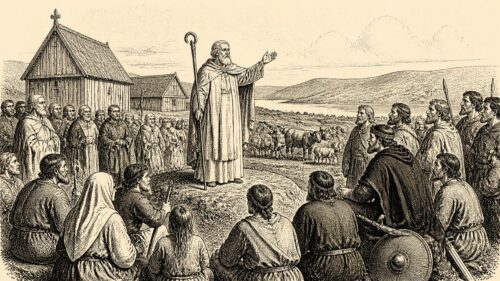
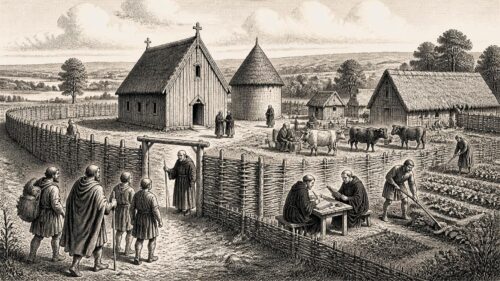
Irish churches were not simply isolated places of prayer. Their enclosed settlements could include churches, dwellings, workshops, burial grounds, stores, grazing land and cultivated plots. Communities such as Clogher and Lusk connected local families to wider networks of literacy, legal memory and exchange. Clerics copied books in Latin and Irish, calculated Easter, administered property, received visitors and preserved genealogies and obituaries. In 702, these institutions helped give political deaths a durable place in history.
Life Beyond the Annals
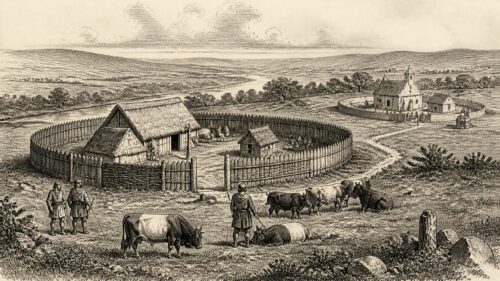
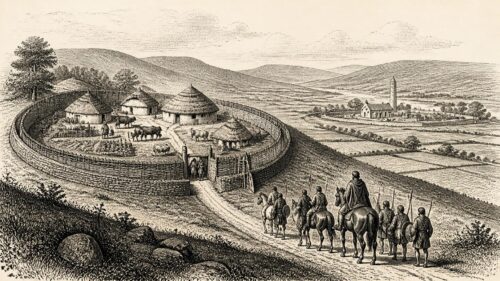
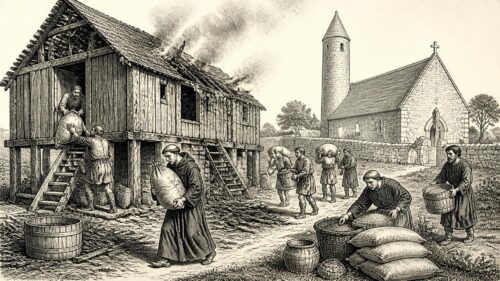
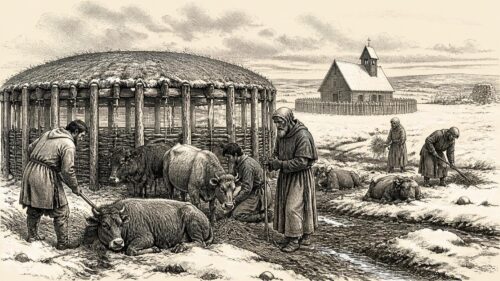
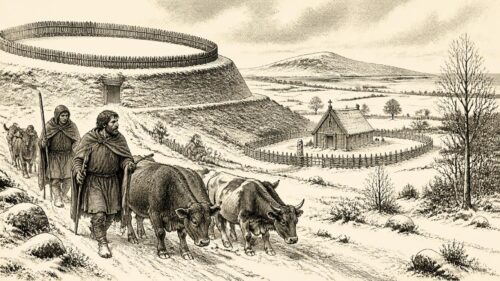
Most people living in Ireland in 702 did not appear by name in any chronicle. They lived chiefly in dispersed rural settlements, including ringforts: enclosed farmsteads built with earthen banks and ditches, or with stone walls in suitable landscapes. Houses were normally of timber and other perishable materials. Fields and pastures supported mixed farming, with cattle especially important not only for milk, meat and hides but also as stores of wealth and units in payments, fines and tribute. Cereals, dairy produce and livestock underpinned both household survival and elite hospitality.
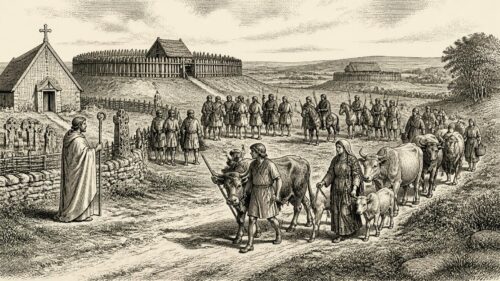
The political events of the year were therefore not remote from ordinary life. A royal succession could alter who demanded food-renders or military service. Conflict could bring the movement of armed bands across farmland, the seizure of cattle, or pressure on churches that held stores and estates. Conversely, a secure relationship with a king could protect a community’s claims. The annals’ attention to rulers and religious leaders reflects the hierarchy of their writers, but those leaders depended upon the labour of farmers, herders, craftspeople, boatmen and household retainers.
Sea routes were equally practical. Coastal and riverine travel connected Ireland’s regions and linked them with western Britain and Scotland. Boats carried people, livestock, foodstuffs, raw materials, books and religious ideas as well as warriors. The death of Írgalach near Ireland’s Eye should not be allowed to stand for all such traffic, but it makes plain that the Irish Sea was not a boundary isolating Ireland. It was a route of communication—and, at times, danger.
What 702 Changed
No surviving source describes 702 as a dramatic national turning point. Ireland had no single government capable of recording its affairs in a unified way, and the annals’ concentrated notices should not be mistaken for a complete account of the year. Still, the deaths of Muiredach and Írgalach mark real changes in two strategically important political zones: Connacht in the west and Brega on the eastern approaches to the Irish Sea.
Within a few years, Connacht would defeat Loingsech, one of the most powerful Uí Néill rulers, at Corann; Brega’s dynastic feuds would continue; and Fogartach, son of the Niall killed by Írgalach, would eventually rise to the kingship of Tara. Those later outcomes should not be read backwards as inevitable. In 702, the evidence supports something more restrained but still compelling: a kingdom in Connacht lost its ruler, a Brega dynast was killed in contact with men from Britain, and churches across Ireland continued to register the passing of the people whose authority shaped early medieval society.
Primary Sources
- The Annals of Ulster (to AD 1201)
- The Annals of Tigernach
- Chronicon Scotorum
- Annals of the Four Masters, Volume 1
- Part 53 of Annals of the Four Masters
- Fragmentary Annals of Ireland
- CELT Project: Annals of Tigernach
- CELT Project: Chronicon Scotorum
- CELT Project: Fragmentary Annals of Ireland
- List of Published Texts at CELT
- Írgalach
- Fogartach
- Loingsech
- Congal Cennmagair
- Cellach
- Fínshnechtae Fledach
- Early Medieval Farmsteads
- Irish Field Monuments: Ringforts
- National Monuments Service: Monument Class and Scope Notes
- Early Christian Monasteries
- Churches and Ecclesiastical Enclosures
- Christian Ireland, 5th–8th Centuries
- Clonmacnoise Monastic Site
- High Crosses