Colmán of Linn Ua Chaille699 CE
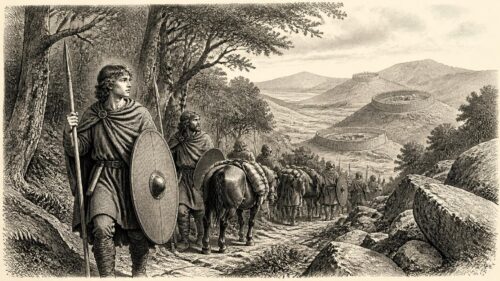
In 699, the Annals of the Four Masters record the death on 30 March of Colmán of Linn Ua Chaille, though his office remains unknown. They also assign deaths of Ailill, king of Munster, and Conall of Uí Fhidgeinte, and Írgalach’s killing of Niall Ua Cernach in Brega. Parallel annals date these political events shortly later, demonstrating chronological divergence in transmitted records. The notices illuminate ecclesiastical commemoration, unstable dynastic authority and aristocratic violence. Set after the synod of Birr, they also evoke a rural society where churches, kinship, cattle, agricultural production and local kingship shaped everyday life and political power.
Dateline
In 699 CE, the fullest surviving annalistic notice for Ireland records the death, on 30 March, of Colmán of Linn Ua Chaille. The same annal places in this year the deaths of Ailill son of Cú Cen Máthair, styled king of Munster, and Conall son of Doineannach, chief of Uí Fhidgeinte, as well as the killing of Niall Ua Cernach by Írgalach Ua Conaing at Dromain Ua Casáin. These entries make 699 appear unusually crowded. Yet they require care: the surviving Irish annals do not always preserve an identical chronology for the late seventh and early eighth centuries. The precise date of Colmán’s death is securely stated only in the later Annals of the Four Masters; the associated political notices occur under a later year-number in the Annals of Ulster and Chronicon Scotorum. They belong to this narrow period, but cannot all responsibly be treated as events fixed beyond doubt to the modern calendar year 699.
A Date in the Annals
Colmán’s obituary is brief: “Colman, of Linn Ua Chaille, died on the 30th of March.” Such compact notices are typical of the annals, but their very precision is valuable. They show that religious communities remembered the deaths of holy men and senior church figures by the day of the month, not merely by a regnal year or broad generation. The name Linn Ua Chaille has commonly been associated with the area of Magheralin, in present-day County Down, though the identification and Colmán’s exact institutional position should not be overstated. The notice does not call him bishop or abbot, nor does it describe a foundation, miracle, or burial. It establishes only that he was a person whose death merited entry in a historical record.
That restraint matters. Later Irish tradition frequently expanded the lives of saints, linked them to churches, relics and landscapes, and supplied genealogies or narratives absent from early sources. For 699, however, the evidence permits a more modest conclusion: Colmán was remembered within the ecclesiastical world of northern Ireland, and his death was marked on 30 March in a tradition subsequently incorporated into the Four Masters. Even this small entry opens a view onto a society in which churches maintained calendars, commemorated benefactors and religious leaders, and participated in networks of learning that reached far beyond any single settlement.
Why 699 Is Chronologically Difficult
The dating problem is not a technicality. The Annals of the Four Masters, compiled in the seventeenth century from earlier material, assign Colmán’s death and the political notices to 699. The Annals of Ulster record the deaths of Ailill and Conall and the killing of Niall under U701, an entry whose own internal heading corresponds to AD 700; Chronicon Scotorum places related notices under 701. The Annals of Tigernach preserve Ailill’s accession rather than a matching death notice in their entries around this point. Modern historians therefore compare manuscripts, regnal sequences and external chronological clues rather than treating any one annal-number as an unquestionable modern date.
The result is clear enough for a year-by-year account. Colmán’s dated 30 March commemoration is the event explicitly placed in 699 by the Four Masters. Ailill’s death, Conall’s death and Niall’s killing can be discussed as events assigned to 699 in that source, while acknowledging that parallel annals place them shortly afterwards. This is not indecision: it is the proper way to read sources whose chronological frameworks drifted apart during transmission. It also gives a useful insight into early medieval record-keeping. Irish annals were not modern newspapers. They were layered historical compilations, copied and recalculated across centuries, preserving much genuine early material but not always its original year-label intact.
Deaths and Power in Munster
The Four Masters name Ailill son of Cú Cen Máthair as king of Munster. He belonged to the Éoganacht Glendamnach, a leading Munster dynasty associated with the royal landscape around Cashel. His father, Cathal Cú Cen Máthair, had ruled Munster earlier in the seventh century, and his brother Finguine had preceded him. Dynastic descent was more than family memory: it was a political resource. A king’s claim drew force from ancestry, marriage, fosterage, clients, ecclesiastical alliances and the ability to reward followers with cattle, land-use rights and protection.
Calling Ailill “king of Munster” should not suggest rule over a unified state with fixed borders and a permanent administration. Munster contained numerous peoples and lesser kings. Authority was negotiated among competing branches of the Éoganachta and with other powerful groups, including the Déisi and Uí Fhidgeinte. Ailill’s death, whether placed in 699 or a year or two later, was thus significant as a moment of uncertainty within southern Irish kingship. The sources do not describe a battle, funeral or successor, so it would be wrong to invent a succession crisis. Nevertheless, the death of a regional overking necessarily altered the balance of obligations and opportunities among Munster’s political families.
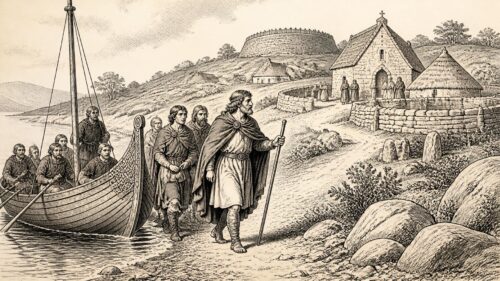
Conall son of Doineannach, described as chief or king of Uí Fhidgeinte, is recorded beside Ailill. Uí Fhidgeinte occupied territory in western Munster, broadly in the region later associated with parts of Limerick. The juxtaposition may not prove that the two men died in connected circumstances, but it does show the annalist’s attention to several levels of authority: an overking of Munster and the ruler of a substantial local people. Ireland around 700 was organised through such overlapping political scales. A powerful king of Tara might claim a wider supremacy; provincial rulers asserted dominance across regions; and the everyday security of most communities depended upon the smaller túath, its kin-groups and its local ruler.
A Killing in Brega
The year-entry’s starkest notice is the killing of Niall Ua Cernach by Írgalach Ua Conaing at Dromain Ua Casáin. The Annals of Ulster preserve the core statement, though without the place-name, and place it in their subsequent chronological sequence. Both men belonged to the world of Síl nÁedo Sláine, a branch of the southern Uí Néill whose power was centred in Brega, the fertile plain around the Boyne and Blackwater. Brega was a politically charged landscape: it contained major royal sites, rich agricultural land and routes linking the midlands, Ulster and the Irish Sea coast.
The entry does not supply a motive. It does not say that a battle took place, identify companions, or explain whether Niall was ambushed, executed or killed in a wider feud. The responsible conclusion is simply that Írgalach killed a rival or opponent from the same broad dynastic milieu. Such terse reporting nevertheless conveys the violence built into aristocratic politics. Kingship was not inherited automatically by the eldest son. Adult male relatives of a ruling kindred could be eligible, and competition within a dynasty could be lethal. Later traditions turned Írgalach and Niall into figures in moral and prophetic narratives associated with Adomnán, but those accounts belong to later literary shaping and should not be read back as a contemporary explanation of the killing.
After Birr
Only two years before the Four Masters’ 699 entry, the synod of Birr had promulgated Cáin Adomnáin, the Law of Adomnán, under the patronage of Adomnán of Iona and the king of Tara, Loingsech son of Óengus. The law sought protection for women, children and clerics in war and imposed severe penalties on those who violated them. Its guarantor list joined ecclesiastical and secular authority across Ireland and western Scotland. Ailill is named among its royal guarantors, though his title there is more limited than “king of Munster”, another reminder that political rank could be expressed differently in different texts.
Nothing proves that the law was invoked in connection with Niall’s death or with any event recorded for 699. Its relevance is contextual, not causal. Yet it illuminates the political atmosphere in which those notices belong. Violence was common enough for leading churchmen and kings to define protected classes and attach collective enforcement to their safety. The law did not end conflict. Rather, it demonstrates an effort to discipline warfare and to make rulers answerable before sacred authority, compensation rules and public guarantors.
Churches, Households and Production
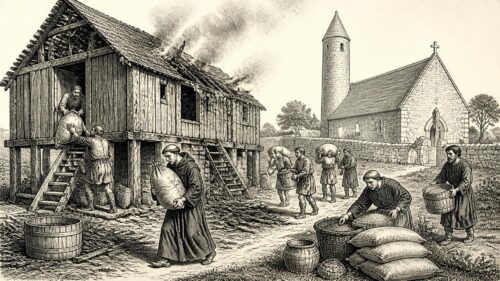
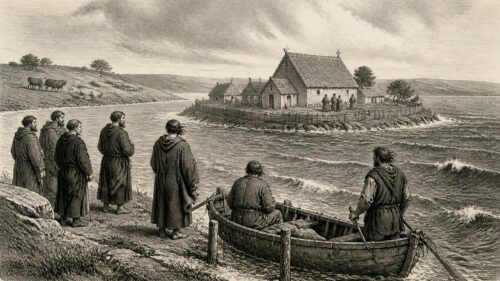
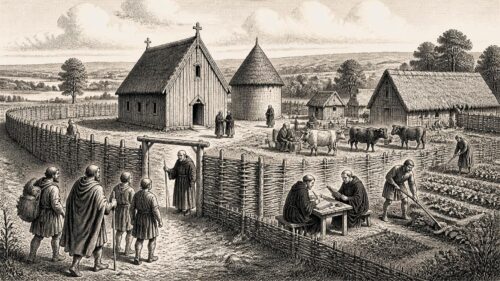
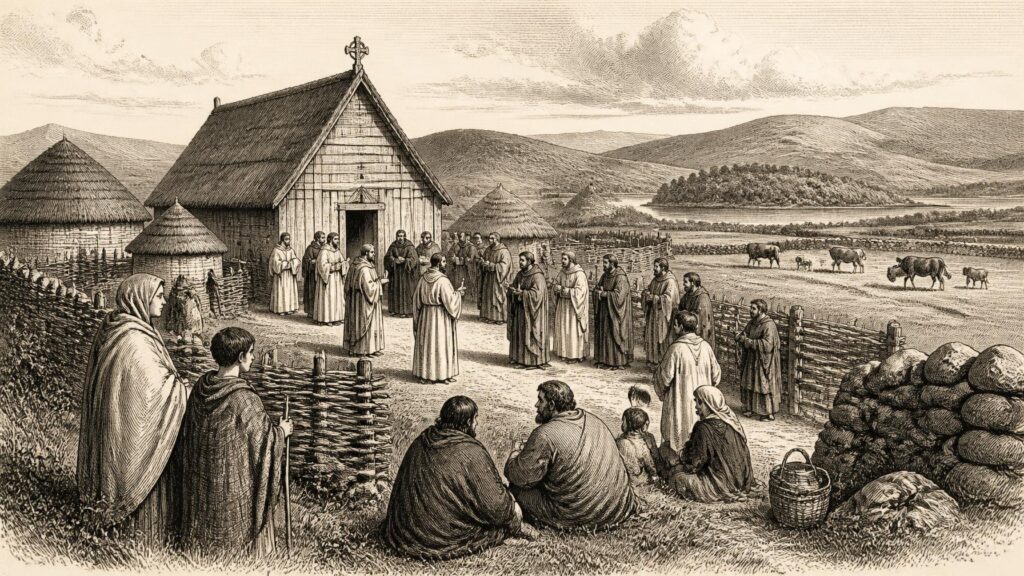
Colmán’s commemoration also points towards the religious institutions embedded in ordinary life. Ireland had no Roman-style cities, but major churches and monasteries could be populous centres of worship, hospitality, craft production, schooling and exchange. Kildare, for example, was flourishing by the late seventh century. Such places did not stand outside secular society: they held land, received food-renders, fostered ties with dynasties and required labour from tenants, dependants and religious communities. Latin learning, biblical study and the writing of annals were sustained through these institutions, alongside the spoken Irish culture of kin, law and poetry.
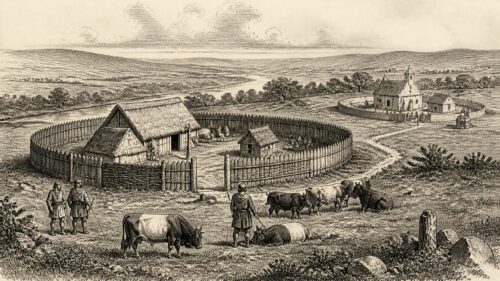
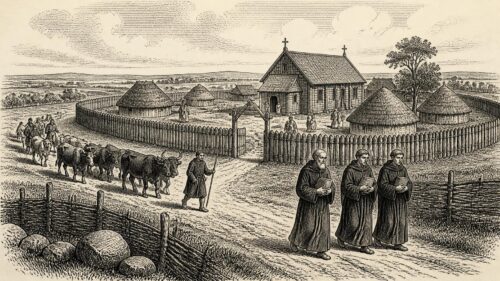
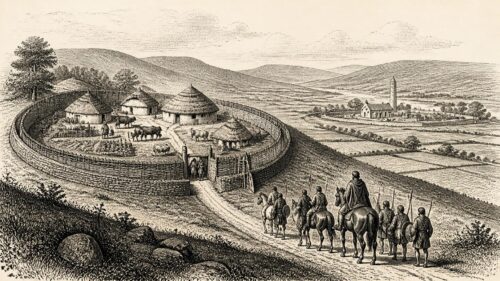
For most people, daily life was rural. Households occupied enclosed farmsteads, often ringforts or raths, with timber houses and spaces for animals. Cattle were central to wealth, dairy production, tribute and legal valuation; they also required pasture, herding and protection. Grain, particularly oats and barley, remained essential, while woodland, wetlands, rivers and shorelines supplied fuel, building materials, fish and wild resources. This was not an isolated island economy, but exchange was usually organised through social relationships, render and gift rather than coinage and urban markets. The political deaths noted in 699 therefore mattered materially: changes among kings and chiefs could redirect demands for food, cattle, military service and hospitality.
A Narrow but Revealing Record
699 does not yield a single grand event comparable to a famous battle or a major ecclesiastical council. Its surviving record is instead a cluster of deaths, one dated religious commemoration and one killing among the political elite. Properly handled, that narrowness is instructive. Colmán’s 30 March obituary reveals the calendar-conscious memory of an Irish church. The notices of Ailill and Conall show how political authority was distributed across provincial and local rulers. Niall’s death reveals the dangerous rivalries of Brega’s ruling kindreds. And the uncertainty of their exact year-labels warns against false precision. Ireland at the end of the seventh century was a landscape of powerful but unstable dynasties, productive rural communities and increasingly influential churches: the year 699 is best understood through those intersecting worlds, not through an invented story of a single decisive turning point.
Primary Sources
- Annals of the Four Masters, Part 53
- The Annals of Ulster, Year U701
- The Annals of Ulster
- The Annals of Tigernach, Part 11
- Chronicon Scotorum, Part 71
- Chronicon Scotorum
- Fragmentary Annals of Ireland, Part 8
- Loingsech
- Cathal Cú Cen Máthair
- The Chronology and Sources of the Early Irish Annals
- Home Page for Dr Daniel P. McCarthy
- Adomnán's ‘Law of the Innocents’: Cáin Adomnáin
- Ireland in the Seventh Century: A Tour
- Religion and Society in Ireland
- Kingship, Society, and Sacrality: Rank, Power, and Ideology in Early Medieval Ireland
- The Idea of the Three Orders of Society and Social Stratification in Early Medieval Ireland
- The Organization of Exchange in Early Christian Ireland
- Changing Human-Cattle Relationships in Ireland: A 6000-Year Isotopic Perspective
- County Kildare Urban Archaeology Survey
- Ordinary People in Early Christian Ireland
- Early Christian Monasteries
- Exploring the Irish Annals