Campo Delenn’s Peace721 CE
In 721, Cathal son of Finguine of Munster and Murchad son of Bran of Leinster devastated Mag Breg, challenging Uí Néill authority around Tara. Fergal son of Máel Dúin, king of Tara, responded by imposing cattle tribute and taking hostages from Leinster, demonstrating his political supremacy. Inisfallen instead preserves a Munster-centred claim that Cathal and Fergal made peace and that Fergal submitted. Inmesach the religious established a law proclaiming Christ’s peace across Ireland at Campo Delenn. Annals note conflict between Connachta and Corco Baiscinn, deaths of rulers and churchmen, and reveal rivalry, ecclesiastical influence, and limits of evidence for life.
Dateline
In 721 CE, Ireland’s annals place warfare, royal bargaining and an unusually explicit act of Christian peacemaking side by side. Cathal son of Finguine and Murchad son of Bran devastated Mag Breg, the politically charged plain around Tara; Fergal son of Máel Dúin then exacted cattle-tribute and hostages from Leinster; and a religious figure named Inmesach established a “law” with the peace of Christ over Ireland. These are firmly associated with the year by the principal annalistic traditions, although the surviving sources differ in emphasis and their chronological systems require care. What cannot responsibly be recovered is a continuous narrative: no annal tells us the route of an army, the terms of a settlement, or the experience of any named farming household.
Brega Under Attack
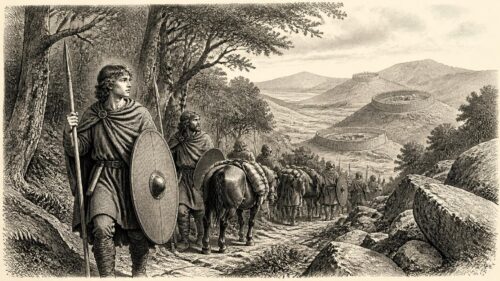
The most consequential recorded action was the wasting of Mag Breg by Cathal son of Finguine and Murchad son of Bran. The Annals of Ulster, Annals of Tigernach and Fragmentary Annals agree on the essential point: Cathal and the Leinster king Murchad acted together against Brega. “Wasting” was not a formal battle-name. It signals destructive campaigning—raiding settlements, taking livestock and provisions, burning or damaging what could not be carried away, and undermining the standing of a rival ruler. Brega was no remote frontier. Its rich lowlands and royal sites, including Tara, lay at the heart of southern Uí Néill power. An incursion there was therefore a deliberate challenge to the political order associated with the king of Tara.
Cathal was an Éoganacht ruler from Munster, while Murchad belonged to the Uí Dúnlainge dynasty of Leinster. Their co-operation brought together interests from Ireland’s southern half against a region linked to the Uí Néill. The annals do not preserve the terms of their alliance, nor do they identify every local ruler affected in Brega. Yet the choice of target matters. A raid in Brega advertised that Cathal’s ambitions and Murchad’s grievances could be carried beyond their own provincial frontiers. It also exposed the limits of describing early medieval Ireland as a land ruled through a single, settled national kingship. Authority rested on competing dynasties, client peoples, church alliances and the ability to assemble armed followers.
The year also marked an important moment in Munster’s internal politics. The Annals of Inisfallen records the death of Eterscél son of Máel Dúin, styled king of Cashel. Modern historians have treated that death as a significant part of the context in which Cathal could establish a more effective provincial overkingship. That conclusion is an interpretation rather than a statement made by the annals themselves: the sources do not say that Eterscél’s death automatically made Cathal king of all Munster. Still, Cathal’s appearance in a major expedition against Brega in the same year shows him acting on a scale that reached far beyond a local Munster dispute.
Fergal and Leinster
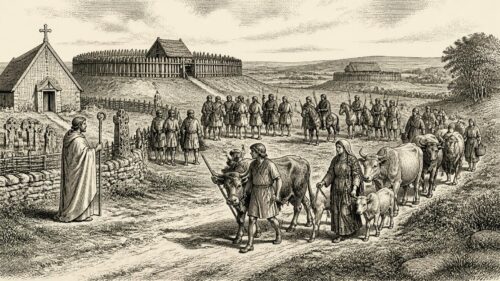
Fergal son of Máel Dúin, king of Tara and leading ruler of Cenél nÉogain, answered the pressure not with a recorded expedition into Munster but with an invasion of Leinster. The Annals of Ulster says that he imposed the cattle-tribute and secured Leinster’s hostages; Tigernach similarly records the binding of the bórama, the celebrated cattle-tribute, and the binding of hostages upon the Leinstermen. The wording presents a real political result, not merely an attempted raid. Fergal had compelled an acknowledgement of superiority from a kingdom that had just joined Cathal in attacking Brega.
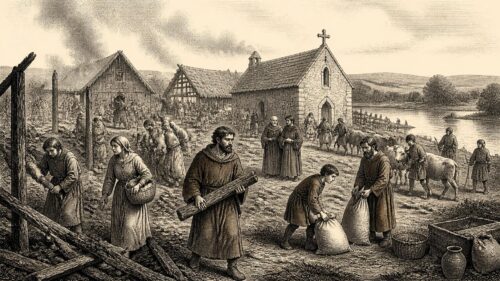
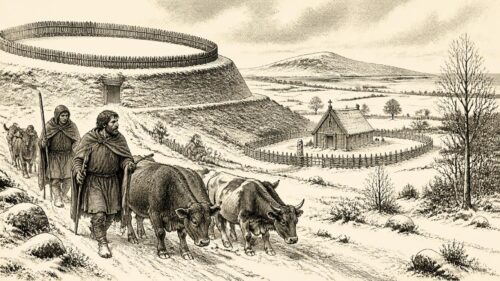
Cattle were central to wealth, food, breeding, hospitality, compensation and political payment in early Irish society. A tribute expressed in cattle was thus not a minor fiscal detail. It could transfer movable wealth, burden communities with gathering and driving animals, and demonstrate a king’s capacity to demand obedience. The annals give no number of cattle taken in 721, so later literary accounts of enormous tribute payments must not be read back as a measured record of this campaign. Even so, the practical effects of a successful royal demand would have reached well below the level of kings: households responsible for herds, dependants who worked the land, and local leaders obliged to find stock or support a military host all had an interest in its outcome.
Hostages were equally important. They were living guarantees, usually drawn from politically valuable families, whose safety depended upon continuing compliance. The annals do not name the hostages, say where they were held, or explain how long they remained in Fergal’s power. Their seizure nevertheless demonstrates that Leinster’s submission was intended to be more than symbolic. It was an attempt to secure future conduct after a year in which its king had helped devastate Brega. The episode also formed the immediate background to the far more destructive confrontation between Fergal and Leinster in 722, but that battle belongs to the following calendar year and should not be anticipated as though it had already happened in 721.
A Southern Account of Peace
The Annals of Inisfallen offers a strikingly different continuation. After recording Cathal’s devastation of Brega, it says that Cathal and Fergal made peace and adds that Fergal submitted to Cathal. It is valuable evidence that a settlement, or at least a claim of settlement, was remembered in connection with the raid. The assertion of Fergal’s submission, however, cannot be accepted without qualification. Inisfallen is a Munster-centred chronicle, and the entry closes with a retrospective celebration of five Munster kings said to have ruled Ireland after conversion. That list reaches to Brian Bóruma, who died in 1014, showing that at least this element is substantially later than 721.
The prudent conclusion is narrower but still revealing. Cathal’s attack on Brega was important enough to be represented in Munster historical memory as an encounter between the king of Munster and the king of Tara, ending in peace. The Ulster and Tigernach traditions preserve instead Fergal’s successful coercion of Leinster. Taken together, the records do not prove that either king became master of all Ireland. They show two powerful rulers competing through raids, alliance and settlement, each tradition framing the same political landscape in ways favourable to its own region.
Inmesach’s Law
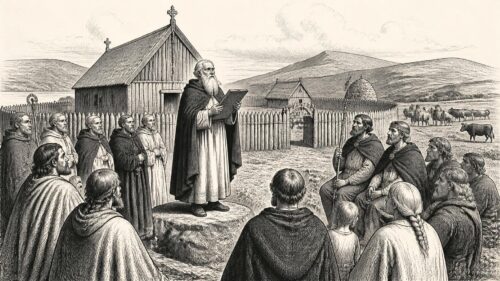
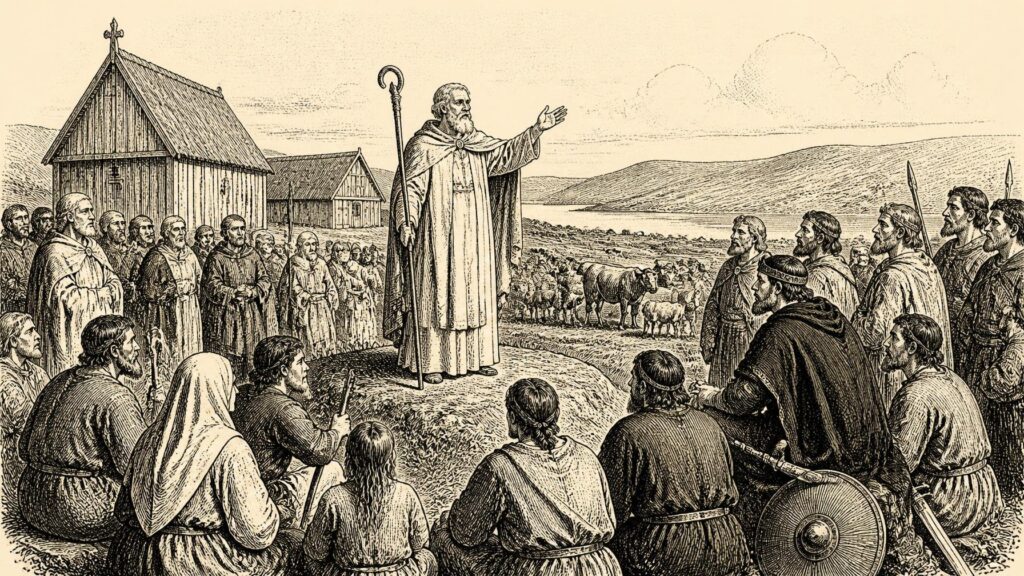
The year’s most distinctive religious record comes from the Annals of Ulster and Tigernach. Inmesach, described simply as “the religious”, established a law with the peace of Christ over the island of Ireland. Tigernach adds that this occurred at Campo Delenn. The place cannot be securely identified from the surviving entry, and the annals do not preserve the law’s provisions. It is therefore unsafe to imagine a detailed assembly, to assign exact protections for women, clerics or non-combatants, or to identify the measure with another better-known ecclesiastical law.
Nevertheless, the formulation is exceptional and meaningful. It joins lex, law, to pax Christi, the peace of Christ, and claims an island-wide reach. In a year of raids, tribute and hostages, churchmen could present peace not as the absence of politics but as a binding public order backed by religious authority. Such a law would have depended for its practical force on kings, local rulers and ecclesiastical communities recognising it. The annals do not tell us whether it was obeyed everywhere or for how long. Its record is important precisely because it reveals a contemporary ideal: violence and lordship could be subject to a Christian restraint proclaimed in the name of the whole island.
Local Wars and Ecclesiastical Losses
Other notices prevent the year being reduced to a contest between Munster, Tara and Leinster. A battle took place between the Connachta and Corco Baiscinn, the people of a kingdom in what is now western County Clare; a son of Talamnach fell. Neither the battlefield nor the cause is supplied. The entry is a reminder that regional powers on opposite sides of the Shannon could engage in conflict independently of the famous dynastic rivalry further east. It also cautions against imagining provinces as unified blocks: local kingdoms had their own rulers, interests and armed followings.
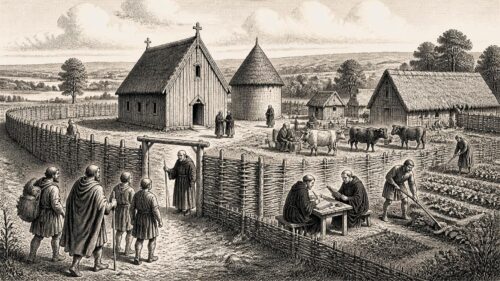
The Annals of Ulster records the death of Dúnchad Bec, king of Cenn Tíre, in Kintyre. Though in modern Scotland, Kintyre belonged to the closely connected Gaelic-speaking Irish Sea world, and its appearance in an Irish chronicle reflects political and ecclesiastical horizons extending across the channel. The death of Maenach, abbot of Lann Léire, and that of Cuanna of Ros Eó were also entered. Such brief obituaries offer no biography, but they show religious houses and holy persons being treated as matters of public record alongside kings and campaigns. Monasteries were centres of worship, learning, landholding and hospitality; their leaders were part of the institutional landscape through which authority operated.
What the Record Cannot Show
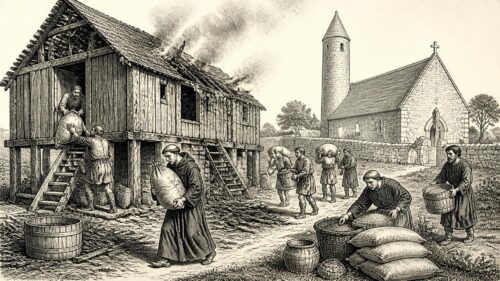
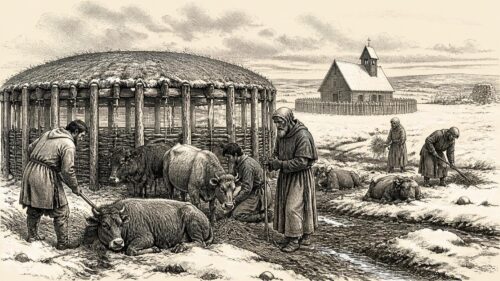
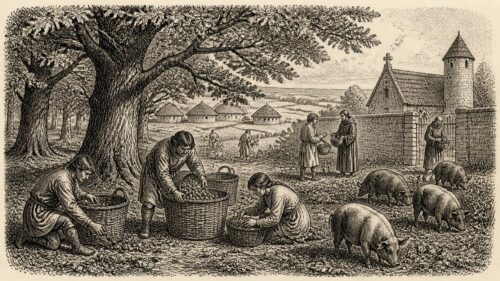
For everyday life, 721 is frustratingly silent. There is no securely dated annalistic notice for this year of harvest failure, cattle disease, epidemic, unusual weather, market activity or overseas trade. It would be wrong to supply such detail merely because it is plausible for an early medieval rural society. The entries do, however, make clear that livestock and food resources were inseparable from power. A devastation of Brega, a cattle-tribute imposed on Leinster and a conflict involving Connacht and Corco Baiscinn all point to a political economy in which control of land, herds, labour and access to seasonal produce was contested by force.
Nor should the sources be made more exact than they are. The early Irish annals preserve terse notices copied and reshaped over centuries; their year-numbering sometimes differs between texts. Cross-checking Ulster, Tigernach, Inisfallen and the Fragmentary Annals permits the principal events above to be placed responsibly in 721 CE, while also exposing regional bias and later editorial expansion. The result is not a complete chronicle of a year, but a sharply focused view of its pressures: Brega was ravaged, Leinster was compelled, a peace was claimed, and Inmesach’s Christian law offered an alternative language through which order across Ireland might be imagined.
Primary Sources
- The Annals of Ulster: Year U721
- Annals of Tigernach: Annal T721
- Annals of Inisfallen: Annal I721
- Fragmentary Annals of Ireland
- TEI Header for The Annals of Ulster
- Cathal
- Fergal
- The Chronology and Sources of the Early Irish Annals
- Irish Annals: Chronology and Synchronisms
- The Practice of Irish Kingship
- The Leinster Tribute Feud
- Contributions Towards the Political History of Munster, 450–800 A.D. (continued)
- The Vikings in Ninth-Century Ireland: Sources and Settlements
- Lebor na Cert, Part 1
- CELT Project: Lebor na Cert
- Irish Sagas: Bóroma Sources
- Early Irish Population-Groups: Their Nomenclature, Classification, and Chronology
- Narratives in Early Irish Law Tracts
- Irish Texts at CELT
- List of Published Texts: Nation and Kingship