

Duncannon and the Nuncio1645 CE
In 1645, the Catholic Confederation strengthened its position by capturing Duncannon Fort after Thomas Preston’s siege, gaining control over an important Waterford Harbour defence but not coastal supremacy. Secret negotiations between Edward Somerset, earl of Glamorgan, and Confederate representatives promised religious concessions and troops for Charles I, but their disclosure damaged royalist prospects. Archbishop Malachy Ó Caollaidhe died amid Connacht fighting. Papal nuncio Giovanni Battista Rinuccini arrived with money, arms and authority, intensifying demands for enforceable Catholic guarantees. War imposed severe local burdens, while Jesuits founded a Galway school and John Colgan published a major saints’ collection at Leuven abroad.
Dateline
In 1645, Ireland’s war was neither a single rebellion nor a straightforward contest between king and parliament. The Catholic Confederation, governed from Kilkenny, held much of the country and possessed armies, taxation machinery and diplomatic agents. Yet it shared the island with royalist authorities centred on Dublin, English parliamentary garrisons and ports, and Scottish covenanting forces in Ulster. The ceasefire agreed between the Confederates and the king’s representative, James Butler, marquess of Ormond, did not encompass every belligerent. Raiding, sieges, disrupted harvests and the movement of armed men therefore remained facts of life. What made 1645 especially important was the convergence of military success, secret diplomacy and a new papal intervention.
A Fort at the Harbour Mouth
The most securely dated Irish military event of the year was the Confederate capture of Duncannon Fort, at the entrance to Waterford Harbour. Thomas Preston’s Leinster army began its siege on 20 January. The fort was a formidable strategic position: whoever held it could threaten or protect shipping moving between Waterford, the Irish Sea and continental routes. It was also an English-held outpost embedded in a region otherwise strongly influenced by the Confederation. Its governor, Lord Esmonde, had to depend upon a comparatively small garrison, sea supply and the strength of the fortifications.
The siege demonstrated both the Confederation’s ambitions and the practical limits of seventeenth-century warfare. Artillery had to be dragged, mounted and supplied; infantry required food, pay or credit; and a besieging army exposed the surrounding district to heavy demands for carts, animals, fuel and provisions. A contemporary account associated with Franciscan Bonaventure Barron survives as a diary of the operation. Later accounts differ slightly on the calendar date of the surrender, owing in part to old- and new-style dating, but agree that Esmonde capitulated on 18 or 19 March. Preston allowed the garrison to march out under terms, while the Confederates acquired a valuable defensive and naval asset.
That achievement did not make the south-east secure. In Munster, Murrough O’Brien, Lord Inchiquin, commanded a parliamentary interest based around Cork and its maritime connections. Confederate commanders also operated against Youghal, but they could not close a port that could be supported from the sea. The contrast with Duncannon was instructive. A fort could be reduced by a sustained local siege; a well-connected harbour town remained tied to English naval power. War thus shaped Irish regional life unevenly. Inland communities endured troops on the march and levies in kind, while coastal towns could be lifelines, fortified enclaves and commercial competitors all at once.
Negotiating for the King
Military pressure sharpened the political question that dominated Confederate policy: what settlement, if any, could be made with Charles I? The king needed Irish assistance in the wider Wars of the Three Kingdoms, while many Confederate leaders sought legal security for Catholic worship, church property and the landholding interests of their supporters. Their objectives overlapped, but not perfectly. Some regarded an agreement with Ormond and the crown as the best available route to stability. Others feared that a bargain which merely suspended persecution, without firmly restoring Catholic rights, would leave the purposes for which the Confederation had mobilised unmet.
In this setting Edward Somerset, earl of Glamorgan, acted under a private royal warrant that gave him latitude to negotiate where public royal policy could not safely go. On 25 August, Glamorgan concluded an agreement with representatives of the Confederate Catholics. The surviving copy records religious concessions and an undertaking of Irish military assistance to the king. Its secrecy was itself revealing. Charles could seek help from Irish Catholics, but feared the reaction of English and Scottish Protestant opinion if extensive concessions became public. The agreement was not a settled peace for Ireland; it was a confidential attempt to convert Irish Catholic military resources into royalist advantage.
Its exposure had immediate consequences. Malachy Ó Caollaidhe, archbishop of Tuam and a leading Confederate councillor, travelled from Kilkenny to Connacht in September. He sought to support Confederate forces confronting hostile parties operating from Sligo, where Scottish and settler interests remained powerful. In late October, during the confused fighting around Ballysadare, Ó Caollaidhe was killed. The best modern biographical account dates his death to 31 October, while older narratives differ by several days. More consequentially, papers connected with the Glamorgan negotiations were recovered and passed to London, where they were printed. What had been designed as secret diplomacy became damaging evidence for Charles’s enemies that he was prepared to make far-reaching concessions to Catholics.
Rinuccini’s Landing
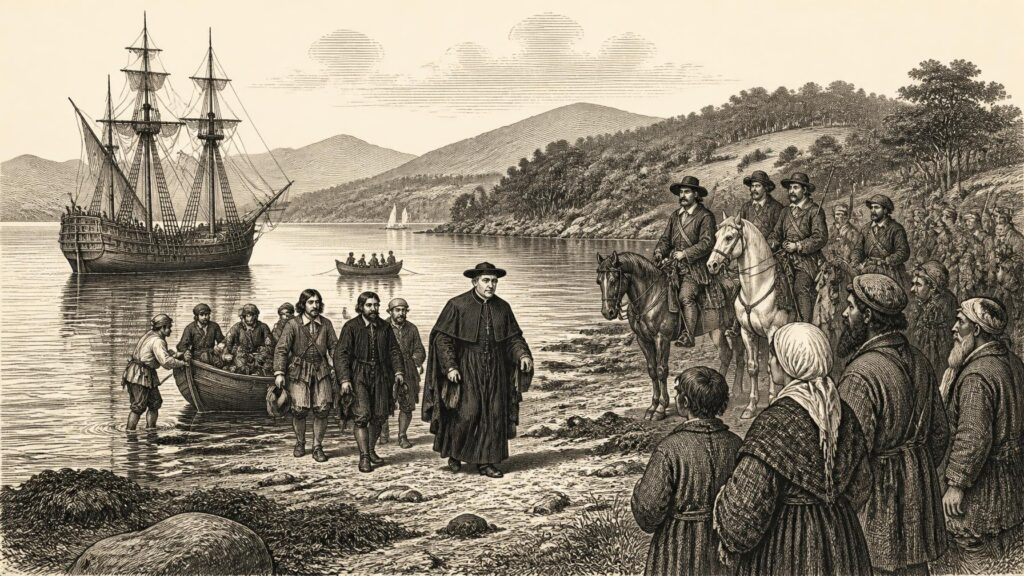
Only days before Ó Caollaidhe’s death, another arrival transformed the atmosphere of Confederate politics. Giovanni Battista Rinuccini, archbishop of Fermo, had been appointed by Pope Innocent X as extraordinary nuncio to the Confederate Catholics. He sailed from the French Atlantic coast in the San Pietro, evading hostile vessels, and reached Kenmare Bay on 21 October according to his own correspondence and the later editorial synopsis of the nuncio’s papers. His party brought money, arms and ammunition. The quantities reported in later accounts vary, so the essential point is safer than any single tally: this was material aid at a moment when Confederate armies and magazines were under severe strain.
Rinuccini’s route through Kerry and Munster was a political procession as well as a journey. He was received at Macroom, then travelled by way of Limerick before reaching Kilkenny in November. His arrival connected the Irish war visibly to Roman and European Catholic networks. It also gave fresh authority to clergy and laymen who believed that religious guarantees must be explicit, public and enforceable before a settlement with the crown could be accepted. Rinuccini came to sustain the Catholic cause and the king, but those aims could pull in different directions when royal necessity required compromise.
By the end of 1645, he had not yet overturned the Confederate government or dictated a final policy. It is misleading to project later ruptures back into the moment of his landing. The Supreme Council still governed from Kilkenny; Ormond still represented the king in Dublin; and negotiations were still unfinished. Nevertheless, the nuncio’s presence altered the balance of argument. He had papal credentials, external resources and a mandate centred on Catholic interests. His arrival made it harder to treat religion as a secondary item to be postponed until after a military alliance with the king had been secured.
War Beyond Ireland’s Shores
Ireland’s conflict was also entangled with fighting in Scotland and England. Troops recruited in Ireland, including men associated with Alasdair MacColla’s Gaelic forces, served in the royalist campaign in Scotland during 1645. Their victories and reverses mattered to Irish calculations because they affected the prospect of royalist recovery and the availability of trained soldiers. Yet the movement of men across the narrow seas did not mean that Ireland could be treated merely as a reservoir of manpower. Every proposed expedition abroad raised difficult questions at home: which army would be weakened, who would pay, and what political price would Irish Catholics receive for their service?
For ordinary people, such grand calculations translated into local burdens. Armies required grain, cattle, horses, cloth, leather and labour. Garrisons restricted movement; coastal danger interrupted shipping; and communities close to contested routes faced requisition and uncertainty. The evidence does not permit a single national measure of hardship for 1645, nor did all districts experience war in the same way. But the siege of Duncannon, operations in Munster and the Connacht fighting show how military needs penetrated farms, market towns and households. The Confederation’s ability to sustain war rested not only on battlefield commanders but on collectors, suppliers, clergy, local elites and civilians compelled or persuaded to support them.
Schools, Saints and Catholic Memory
Conflict did not extinguish learning. In Galway, Jesuits founded a school in 1645 through the support of Edmund Kirwan. Latin was the classroom language, while Jesuits assigned to the Irish mission were expected to know Irish. The foundation was modest beside the armies manoeuvring across the island, but it represented a durable Catholic educational presence in a city whose trade, civic life and confessional identity were all being tested by war.
On the continent, the Donegal Franciscan John Colgan published his Acta sanctorum veteris et maioris Scotiae, seu Hiberniae sanctorum insulae at Leuven. The large Latin collection assembled and edited material on Irish saints whose feast days fell in the early months of the year. It drew upon manuscripts, earlier scholarship and the labours of Irish Franciscan networks abroad. Published while Ireland was divided by armies, it asserted the antiquity and intellectual seriousness of Irish Catholic tradition for a European readership. Thus 1645 was not only a year of forts, secret articles and armed expeditions. It was also a year in which schools opened, books circulated and Irish religious memory was deliberately preserved.
By December, no decisive settlement had been achieved. Duncannon gave the Confederation a strategic success, but not command of the coast. Glamorgan’s agreement revealed the opportunities and dangers of dependence on a beleaguered king. Ó Caollaidhe’s death exposed Connacht’s vulnerability, while Rinuccini’s arrival introduced a powerful new voice into Irish public life. The year closed with Catholic Ireland better connected to Rome and continental scholarship, yet more sharply confronted by the unresolved question at the heart of the war: whether military strength and diplomatic leverage could secure a peace that Catholics considered worthy of acceptance.
Primary Sources
- Rinuccini, GianBattista
- O'Queely, Malachy
- Colgan, John
- Duncannon Fort
- Agreement (copy), made between Edward, Earl of Glamorgan, and representatives of the Confederate Catholics, 25 August 1645
- Commentarius Rinuccinianus Vol. I
- Commentarius Rinuccinianus Vol. II
- Commentarius Rinuccinianus, Vol. VI: Synopsis and Indices
- History of the Irish Confederation and the War in Ireland, 1641–1643: table of contents and publication details
- Latin Document Executed on Behalf of Cardinal Rinuccini
- Commentarius Rinuccinianus de Sedis Apostolicae Legatione ad Foederatos Hiberniae Catholicos per Annos 1645–1649
- Commission and Instructions for Lord Inchiquin to be Lord President of Munster, 14 January 1645
- The Irish Cabinet: Or His Majesties Secret Papers, for Establishing the Papall Clergy in Ireland
- Diary of the Siege of Duncannon Fort, 1645
- The Siege of Duncannon
- A Survey of the Articles of the Late Rejected Peace
- Catholic Reformation in Ireland: The Mission of Rinuccini, 1645–1649
- History of the Irish College Leuven
- John Colgan
- Acta Sanctorvm Veteris Et Maioris Scotiae, Sev Hiberniae Sanctorvm Insvlae
- Our History
- Galway/Gaillimh: Irish Historic Towns Atlas, No. 28