

Sigginstown’s Uneasy Cessation1643 CE
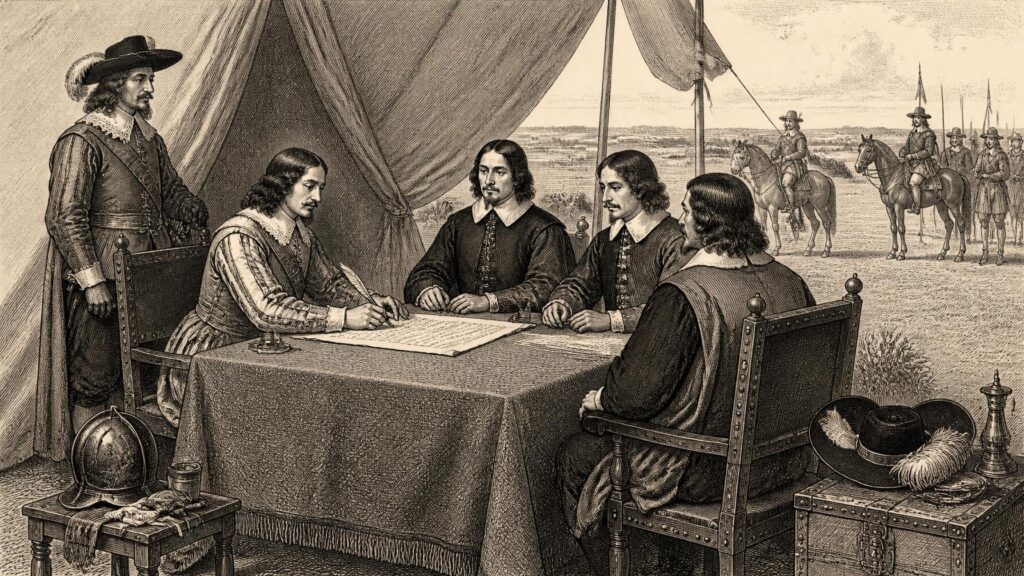
In 1643, Ireland’s conflict within the Wars of the Three Kingdoms continued despite shifting military and political circumstances. Confederate forces captured Birr but suffered defeat at New Ross, while achieving a Munster success at Cloughleagh. Supply shortages, taxation, agricultural regulation, trade controls and anti-Catholic measures revealed wartime pressures around Dublin. On 15 September, Ormond and Confederate commissioners agreed the Sigginstown Cessation, a year-long armistice involving territorial arrangements, diplomacy and payments. It excluded Scottish Covenanting forces in Ulster and resolved neither religion nor landownership. The truce intensified Confederate debates, enabled northern planning, and coincided with Mícheál Ó Cléirigh’s work at Louvain.
Dateline
In 1643, Ireland’s war did not end; it changed its rhythm. The conflict unleashed in 1641 had become part of the wider Wars of the Three Kingdoms, involving Catholic Confederates organised from Kilkenny, the royal administration centred on Dublin, English parliamentarian interests, and the Scottish Covenanting army in Ulster. Campaigning, taxation, confiscation, food supply and religious allegiance were inseparable. The year’s defining dated event was the Cessation of Arms agreed on 15 September at Sigginstown, County Kildare, between James Butler, marquess of Ormond, acting for Charles I, and commissioners authorised by the Confederate Catholics. It brought a one-year truce across much, but not all, of Ireland. Its importance lay less in peace than in its frank acknowledgement that neither side could simply defeat the other.
Spring Campaigns in Leinster
The year opened with a notable Confederate success. On 20 January, Thomas Preston captured Birr Castle in King’s County, now County Offaly. Preston was a professional soldier with long experience in continental warfare, especially siegecraft, and his arrival had strengthened the Confederate cause in Leinster. Birr’s fall showed that the Catholic Confederation could take and hold significant positions, not merely raise local forces. Yet it also exposed a persistent problem: armies could seize places, but feeding, paying and coordinating them over long distances was much harder.
Ormond, commander of the royal army in Dublin, attempted to restore the initiative. He marched from Dublin on 1 March with a field force intended to strike at the Confederate-held south-east. Reaching New Ross on 12 March, he found that expected supplies sent by sea had not arrived. That logistical failure mattered. An army could not remain in the field without food, ammunition, transport and money, and the roads and countryside through which it moved had already been damaged by two years of war.
On 18 March, north of New Ross, Ormond’s troops defeated a larger Confederate army under Preston. The Battle of New Ross was a serious reverse for the Confederates, whose troops were less effective in open battle than Preston’s reputation as a continental veteran might have suggested. Yet it was not the decisive restoration of royal authority that Ormond needed. His wider operation against New Ross and Wexford had already been curtailed by supply difficulties, and the victory chiefly enabled him to return towards Dublin rather than to conquer the Confederate heartlands. The episode captured the military balance of 1643: tactical success did not automatically produce strategic control.
War, Revenue and Provisions
Administrative orders issued in and around Dublin give an unusually direct view of the pressures felt beyond battlefields. In January the authorities called in plate for the relief of the army. During February and March they issued directions concerning corn, ploughing and cultivation on lands described in official language as belonging to rebels, including an order allowing sowing north of County Dublin. These measures show a government trying to turn contested land into food for a garrisoned capital and its forces.
Policy also reveals the strain placed upon urban life. A proclamation of 1 April ordered “papists” and other people who were not householders to leave Dublin within six days. This was an act of security and confessional exclusion, not a neutral measure of civic regulation. In a city dependent on military protection and maritime supply, residence itself could become a political test. Later orders concerned the herring fishery and the import of corn, victuals, salt and other goods; excise rates; the coinage of small money; and, in August, imposts at Drogheda and Trim for army relief, as well as a tobacco impost.
Such records should not be treated as a complete account of prices or harvests across Ireland. They do, however, firmly demonstrate the practical concerns of 1643: cereal cultivation, fisheries, imported provisions, cash of small denomination, customs revenue and the discipline of troops. An August proclamation forbidding the pillage of houses or goods in Dublin on pain of death is especially revealing. Civilian property, stores and shelter were essential resources in wartime, while undisciplined soldiers could endanger the very communities on which an army depended.
Fighting in Munster
War also continued in Munster. In May, the Confederate general assembly appointed James Tuchet, earl of Castlehaven, to replace the ineffective Garret Barry in command in the province. Castlehaven was an energetic cavalry commander and a politically connected Catholic nobleman. On 4 June Confederate forces won an important local success at Cloughleagh, near Fermoy, an action commonly associated with Funcheon Ford. Castlehaven’s horse helped defeat troops commanded by Sir Charles Vavasour, who had occupied the tower house at Cloughleagh.
The scale of this engagement should not be inflated into a transformation of the war. It was nevertheless one of the Confederates’ few clear battlefield victories that year, and it mattered in the struggle against Murrough O’Brien, Lord Inchiquin, whose parliamentarian-aligned forces retained strength in parts of Munster. The fighting illustrated another feature of the conflict: loyalties were not reducible to a simple Irish-versus-English divide. Catholic Confederates, Protestant royalists, English parliamentarians, Scottish Covenanters and local interests all shaped the military map.
The September Cessation
Negotiation had become attractive because prolonged war was exhausting both sides. The formal agreement reached at Sigginstown on 15 September was a cessation, or armistice, for one year, rather than a final peace settlement. Ormond signed under Charles I’s authority. The Confederate commissioners included Donough MacCarthy, Viscount Muskerry; Sir Lucas Dillon; Nicholas Plunkett; Sir Robert Talbot; Sir Richard Barnewall; Turlough O’Neill; Geoffrey Browne; Ever MacGennis; and John Walsh. Their authority had been issued at Cashel on 7 September.
The text regulated military restraint and the practical division of possession. It also allowed the Confederate Catholics to send agents to the king under safe conduct. An accompanying instrument dealt with payment of £30,800 in instalments. The agreement therefore combined a ceasefire, a territorial accommodation, access to royal diplomacy and a substantial financial obligation. Subsequent official proclamations on 19 and 21 September ordered observance of the cessation, the latter explicitly referring to the Supreme Council of the Confederate Catholics of Ireland.
Its limits were as important as its provisions. It did not settle the public standing of Catholic worship, undo plantations, determine the ownership of land seized during the wars, or establish the constitutional claims that Confederate politicians would later present to the king. Nor did it make the Confederation an independent state. Rather, it recognised it as a powerful armed body with which the king’s representative had to bargain. For Catholic landowners, clergy, lawyers and soldiers, that recognition was significant; for Protestant communities who feared dispossession and for parliamentarian sympathisers, it was alarming.
The cessation also did not bind every armed force in Ireland. In Ulster, the Scottish Covenanting army under Robert Monro did not accept it, and conflict there remained active. This was a crucial qualification. The agreement reduced fighting between Ormond’s royalist forces and many Confederate forces, but it did not turn Ireland into a country at peace. It redirected attention towards diplomacy while leaving the northern war and deep political distrust unresolved.
Confederate Politics After the Truce
The truce sharpened divisions within the Confederate leadership. The death in July of Nicholas Preston, Viscount Gormanston, weakened the established leadership of the Pale Catholic nobility. Muskerry and allies favourable to negotiation with Ormond gained greater influence. In November, a Confederate general assembly meeting at Waterford considered the continuing northern threat. It ordered that Castlehaven should lead 6,000 men north in the following campaigning season to join Owen Roe O’Neill against the Scottish forces, while another November decision appointed Muskerry to head a delegation to negotiate with Charles I at Oxford.
These were plans, not achievements of 1643, but they show what the cessation made possible: the Confederates could debate priorities across the island, organise finance and diplomacy, and contemplate a concentrated northern campaign. They also foreshadowed tensions between provincial armies and commanders. O’Neill’s Ulster force, Preston’s Leinster army and Castlehaven’s Munster command served a common Catholic association without becoming a seamless national army.
Learning Amid Upheaval
War did not extinguish Irish intellectual life. At Louvain, the Franciscan lay brother and scholar Mícheál Ó Cléirigh printed Foclóir nó Sanasán Nua, a glossary of difficult Irish words, in 1643. It was the only one of his many works published during his lifetime. Ó Cléirigh, chief compiler of the annals later called the Annals of the Four Masters, had spent years gathering and copying manuscripts across Ireland before returning to the Irish Franciscan college in the Spanish Netherlands. His glossary was intended for the instruction of younger scholars and preserved learning rooted in the Irish manuscript tradition.
Ó Cléirigh died at Louvain before the end of the year; the precise date is not known. His death and the appearance of his glossary offer a necessary counterpoint to the year’s military record. Even while armies requisitioned grain, governments regulated coin and movement, and negotiators bargained over armed power, Irish-language scholarship continued through religious and continental networks.
By year’s end, the Cessation of Arms had created breathing space but no durable settlement. It exposed the territorial reach and administrative capacity of Confederate Ireland, relieved immediate pressure on Ormond’s Dublin government, and transferred unresolved questions into negotiation. The year’s legacy was thus an uneasy pause: legally proclaimed, materially expensive, regionally incomplete and politically fraught.
Primary Sources
- A Proclamation Concerning a Cessation of Armes, Agreed and Concluded on at Siggingstowne, 15 September 1643
- Statute Law Revision Act 2015: Schedule 2, historic Irish proclamations and orders
- Butler, James
- Preston, Thomas
- Tuchet, James
- MacCarthy, Donough
- Ó Cléirigh, Mícheál (O'Clery, Michael)
- Boyle, Richard
- Boyle, Elizabeth
- An Impartial Relation of the Most Memorable Transactions of General Owen O'Neill and His Party, 1641–1650
- Orders Made and Established by the Lords and Others Assembled at Kilkenny, 24 October 1642: The Catholics' Demands, 1644
- Orders Made and Established by the Lords and Others Assembled at Kilkenny, 24 October 1642: The Protestants' Demands, 1644
- The Cessation of Arms in 1643
- King Charles Negotiates with the Confederate Council
- The Cessation of Arms, 1643–5
- Irish Catholic Confederation and the Cessation of Arms, 1643
- Waterford in the Confederate Wars
- Commentarius Rinuccinianus, Volume VI
- A Declaration of the Lords and Commons Assembled in Parliament Concerning the Present Lamentable Estate and Miserable Condition of Ireland
- Mícheál Ó Cléirigh: Library Catalogue Records
- History of the Irish College Leuven
- Peacemaking in Ireland and England, 1642–1646