
Kilkenny’s Confederate Model1642 CE
In 1642, Ireland’s uprising became organised war amid the Wars of the Three Kingdoms. Catholic leaders united Gaelic and Old English interests around defence of worship, property and liberties, while professing loyalty to Charles I. Synods at Kells and Kilkenny promoted an oath of association. In October, the Kilkenny General Assembly established a Supreme Council, subordinate councils, military administration and taxation, creating a fragile Catholic government. Royalist, Protestant and Scottish forces retained key territories; defeats at Kilrush and Liscarroll checked Catholic arms. Owen Roe O’Neill’s return aided Ulster’s future resistance. War brought displacement, requisitioning and violence to all communities nationwide.
Dateline
In 1642, Ireland’s crisis became organised war. The rising that had begun in Ulster in October 1641 had already spread far beyond its first conspirators, drawing in Catholic landowners, Gaelic Irish communities, Old English gentry, Protestant settlers, Crown troops and, increasingly, forces from Scotland and England. This was not a simple contest of two sides. Allegiance to Charles I could coexist with opposition to the Dublin government; religious identity, landholding, local protection and family connection mattered as much as abstract political labels. Yet during this year Catholic leaders created institutions capable of speaking and acting for a large part of the island. The association conventionally called Confederate Ireland began to take recognisable constitutional form at Kilkenny.
A Kingdom Drawn into Wider Wars
Ireland’s emergency was inseparable from the mounting conflict across the Stuart monarchies. Charles I was king of Ireland, Scotland and England, but his authority was being disputed in each kingdom. English parliamentarians feared that the Irish rebellion might be used to strengthen royal power; Irish Catholics feared renewed dispossession, religious coercion and the punishment of all who had taken up arms. In March, the English Parliament secured royal assent to the Adventurers’ Act, which raised money for war in Ireland by promising subscribers repayment in confiscated Irish land. The measure did not determine who would eventually own those lands, but it gave a stark financial form to Catholic anxieties: military defeat might bring not only penalties but wholesale loss of estates.
That prospect encouraged a political convergence which had seemed unlikely only months earlier. Catholic gentry of the Pale, whose families had long worked within the institutions of the Irish kingdom, came into association with leaders rooted in Gaelic lordships and with members of the Catholic clergy. They differed in language, social background and immediate aims. Many nevertheless shared a wish to defend Catholic worship, safeguard property and obtain redress from the king while professing loyalty to him. Their programme was therefore neither a straightforward bid for an independent republic nor mere obedience to a royal administration. It was an attempt to recover power and security within a kingdom whose established government they regarded as hostile or incapable of protecting them.
Religion, Oaths and Political Union
Firmly dated ecclesiastical meetings marked important stages in that process. On 22 March, a Catholic synod at Kells, led by Hugh O’Reilly, archbishop of Armagh, treated the conflict as a just war of defence. A further gathering at Kilkenny in May brought together senior clergy and helped promote an oath of association. The oath bound Catholics to the defence of the king, the Catholic religion and the liberties of Ireland, while committing them to obey the directions of a collective council. This language matters. It made religion central to the movement, but linked it to monarchy and civil order rather than presenting rebellion as lawlessness.
The clerical role also reflected practical need. In places where royal courts, sheriffs and military protection had broken down, communities needed recognised intermediaries, channels for messages and some authority over armed followers. Bishops, priests, noblemen and lawyers could help supply these. That did not mean that the population moved as one. The emerging Catholic administration was dominated by men of property and standing, and its claims to represent the kingdom were necessarily constrained by war, uneven communications and the exclusion of those living in government-held or Scottish-controlled districts.
Campaigns in Leinster and Munster
War nevertheless continued to decide what any political scheme could achieve. On 15 April, the royalist army commanded by James Butler, twelfth earl of Ormond, defeated forces under his Catholic kinsman Richard Butler, Viscount Mountgarret, at Kilrush in County Kildare. Ormond’s success enabled him to relieve threatened government positions and demonstrated that the Catholic coalition did not yet possess a disciplined field army able to stop professional troops. The encounter also exposed the intricacy of Irish politics: Mountgarret and Ormond belonged to the same extended Butler world, but stood on opposing sides of the military crisis.
In Munster, the fighting was equally local and destructive. Catholic forces sought to press the Protestant-held enclave around Cork, while the Crown’s defenders relied on fortified towns, ports and supplies from the sea. On 3 September, a Confederate force was defeated at Liscarroll in north Cork by troops associated with Murrough O’Brien, Lord Inchiquin, and Richard Boyle, earl of Cork. Liscarroll did not settle Munster’s future, but it checked a major Catholic effort and preserved a strategically important Protestant base. Such fighting commonly revolved around castles, walled towns, roads, stores and livestock rather than spectacular set-piece battles alone. Control of food and shelter was military power.
Ulster’s Deepening Emergency
Ulster remained the most fractured theatre. In April, a Scottish Covenanter army under Major-General Robert Monro arrived, based at Carrickfergus and intended to defend the Protestant settler interest and suppress the rebellion. Its arrival added an organised Scottish force to the many local British Protestant militias already fighting in the province. In June, ministers and officers connected with the Scottish army established the first presbytery in Ireland at Carrickfergus. Thus military intervention brought an institutional religious development as well as new troops: Presbyterian structures took firmer root in north-east Ulster amid a landscape of displacement and fear.
On 8 July, Owen Roe O’Neill landed at Doe Castle in Donegal after decades of military service in the Spanish Netherlands. His return was highly symbolic. A nephew of Hugh O’Neill, earl of Tyrone, he carried the prestige of the old Ulster lordship and the practical experience of Continental warfare. He also brought experienced officers and military knowledge that the northern Catholic forces badly needed. But he did not arrive to command a ready-made army. Recruiting, feeding, arming and disciplining men in a devastated province were slow, difficult tasks. His presence gave the Ulster Catholics a formidable future leader; it did not immediately reverse the balance of power in 1642.
The October Assembly
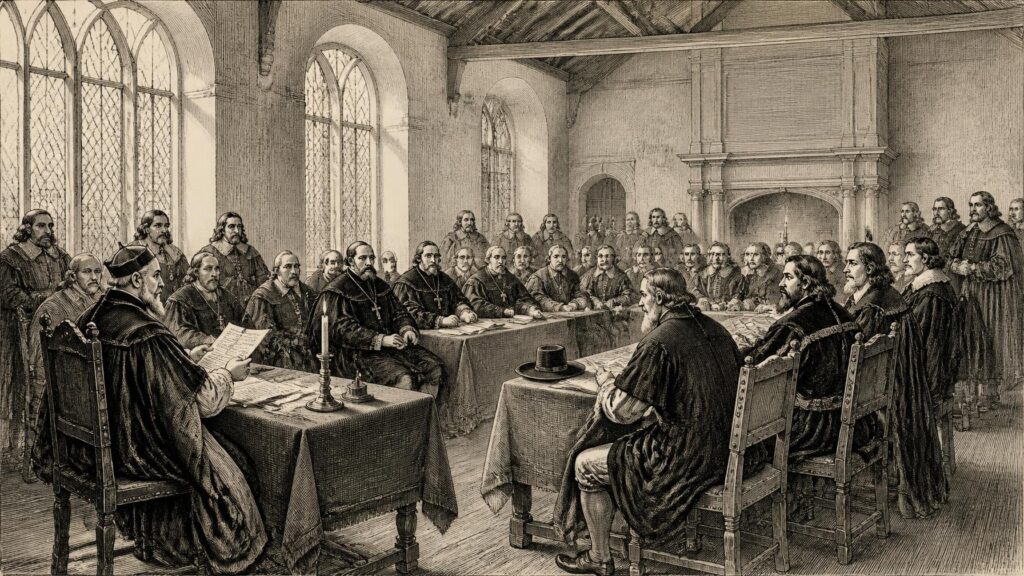
The decisive political event of the year came on 24 October, when a General Assembly of the Confederate Catholics met at Kilkenny. Its surviving orders provide unusually direct evidence of what the delegates intended. They established a Supreme Council of twenty-four members, elected a president, and envisaged provincial and county councils beneath it. The assembly provided for military command, public charges, the administration of justice and the appointment or confirmation of sheriffs. It also sought to regulate conduct among the confederates and to make government more than the personal following of individual magnates.
This was an impressive act of wartime institution-building, but its character should be described carefully. The assembly deliberately did not call itself a parliament, and its members continued to acknowledge Charles I as their sovereign. Its constitutional ambition was to preserve what it understood as the ancient liberties of the Irish kingdom, secure free Catholic worship and negotiate a settlement with the Crown. Kilkenny became the administrative centre because it was comparatively secure, well placed between provinces and equipped with urban and ecclesiastical resources. The Confederate leadership was not creating peace; it was building an apparatus through which to tax, recruit, negotiate and govern while war continued.
Representation was wider than a private council but far from democratic in a modern sense. Lords, clergy and male freeholders held the political stage. Women, labourers, servants, displaced tenants and the urban poor appear chiefly in the records as dependants, refugees, victims, providers of goods or people subject to military demands. Even among the political elite, influence was unequal. Leinster interests and great families were prominent in the earliest council, while effective representation from the hardest-hit parts of Ulster and from Connacht was more limited. The Confederation’s language of Irish Catholic unity was therefore an aspiration and a tool of mobilisation as well as a description of reality.
Everyday Life in a Year of War
For ordinary people, 1642 meant insecurity more often than constitutional debate. The 1641 Depositions, collected from Protestant survivors and refugees by government-appointed commissioners, preserve thousands of pages of testimony about loss of homes, goods, crops, animals and kin. They are indispensable evidence for the upheaval, but they must be read with care: they were gathered within a partisan and traumatic setting, often recorded rumours alongside direct experience, and cannot be treated as a simple count of deaths. Even so, they leave no doubt that violence, expulsions, imprisonment and dispossession had transformed daily life for Protestant communities, especially in Ulster, and that retaliatory violence compounded the crisis.
Catholic communities, too, endured requisitioning, burned property, forced movement and the burden of quartering soldiers. Armies on all sides required bread, cattle, horses, shoes, powder, carts and labour. Garrison towns became places of refuge but also of crowding, high prices and disease risk. Country people faced the danger that crops might be seized before harvest, animals driven away, or a journey to market intercepted by soldiers. It is safer to speak of these pervasive wartime pressures than to attach a single island-wide experience to every household: conditions varied sharply between a defended port, a contested borderland and a district held securely by one side.
An Unfinished Settlement
By the end of 1642, Ireland had not been conquered by any army or united behind any government. Dublin remained the seat of royal authority; Protestant forces held important towns and regions; the Scottish army had established a powerful presence in east Ulster; and the Confederates had created a national Catholic political framework at Kilkenny. The outbreak of civil war in England during the summer further complicated every calculation, reducing the prospect of a quick English intervention while tying Ireland ever more closely to the Wars of the Three Kingdoms.
The year’s lasting importance lies in this transformation from uprising to organised, if fragile, confederacy. The leaders assembled at Kilkenny gave Catholic Ireland a council, a representative gathering and a language of government founded on God, king and country. Yet the same year also revealed the limits of that achievement: divisions within the Catholic coalition, hostile armies on several fronts, ruined local economies and civilians whose survival depended on forces they could scarcely control. Ireland entered 1643 with institutions of war in place, but with no secure path to peace.
Primary Sources
- Orders Made and Established by the Lords Spiritual and Temporal, and the Rest of the General Assembly for the Kingdom of Ireland, Met at Kilkenny, 24 October 1642
- Orders Made and Established by the Lords Spiritual and Temporal, and the Rest of the General Assembly for the Kingdom of Ireland, Met at Kilkenny, 24 October 1642: Part 2
- Orders Made and Established by the Lords Spiritual and Temporal, and the Rest of the General Assembly for the Kingdom of Ireland, Met at Kilkenny, 24 October 1642: Part 3
- Orders Made and Established by the Lords […] at Kilkenny […] 24th October 1642
- The 1641 Depositions Project
- ‘Rebell Privy Counsellors’: The First Catholic Confederate Supreme Council, July 1642
- The Confederation of Kilkenny
- Confederate Catholics at War, 1641–1649
- A Failed Revolution? The Irish Confederate War in its European Context
- Contesting the Sovereignty of Early Modern Ireland
- KILRUSH 1642
- Copy of a Letter from Lord Inchiquin, at Cork, to the Lords Justices, Giving an Account of the Capture of the Castle of Liscarroll, and Asking for Supplies. Sept. 10, 1642
- A Continuation of the Diurnal Occurrences and Proceedings of the English Army Against the Rebels in Ireland, from the First of Aprill, to This Present. 1642
- O'Neill, Owen Roe (Ó Néill, Eoghan Rua)
- Monro (Munro), Robert
- The Presbyterian Revolution in Ulster, 1660–1690
- Civil War
- State Papers Ireland 1509–1782: Government Papers on Irish Affairs
- Politics, 1641–1660
- Ireland from Independence to Occupation, 1641–1660
- Constitutional Analysis of Confederate Ireland, 1642–51
- Flight of the Earls Special Issue
- Summoning Her Children to Which Flag?
- The Ormond Lordship in County Kilkenny, 1515–1642: The Rise and Fall of Butler Feudal Power