Smerwick Massacre1580 CE
In 1580, the Second Desmond Rebellion widened into a multi-regional and international crisis. Pelham and Ormond’s destructive Munster campaigns captured Carrigafoyle, using artillery, naval power and scorched-earth tactics that disrupted food supplies and rural life. In Leinster, Baltinglass joined Fiach MacHugh O’Byrne’s revolt, and Grey’s army suffered defeat at Glenmalure. A papal-backed Spanish and Italian force landed at Smerwick but surrendered after siege; 500–600 defenders were massacred. Arrests, executions and raids deepened fear. Although Crown forces demonstrated formidable reach, Desmond and Leinster rebels remained active, while warfare inflicted growing social devastation. The year left Ireland unpacified, divided and increasingly impoverished.
Dateline
A War Enlarged
In 1580, conflict in Ireland ceased to look like a contained rising in Munster and became a crisis spanning several provinces, political communities and seas. The Second Desmond Rebellion had begun in 1579, but this calendar year brought a succession of events that demonstrated both the Crown’s capacity for destructive military intervention and the continuing ability of its opponents to exploit Ireland’s terrain, kinship networks and Catholic connections abroad. The taking of Carrigafoyle in Munster, the revolt of James Eustace, Viscount Baltinglass, in Leinster, the English defeat at Glenmalure, and the landing and destruction of a papal expedition at Smerwick were all firmly connected to 1580.
The principal conflict remained the war against Gerald FitzGerald, fifteenth earl of Desmond, and his allies. Yet its participants cannot neatly be divided into “English” and “Irish”. Desmond was an Old English earl; Thomas Butler, tenth earl of Ormond, who commanded for the Crown in Munster, was likewise an Old English magnate. Gaelic lords, English officials, Welsh and English soldiers, Catholic clergy, continental adventurers and local farming households all encountered the war differently. Allegiance was also unstable. Some lordships made submissions when troops approached, sought protection, or tried to preserve cattle and tenants; others resisted, supplied rebels, or changed course as military prospects shifted.
Munster Under Campaign
Sir William Pelham, serving as lord justice, joined Ormond at Rathkeale in County Limerick on 10 March and began a coordinated offensive through Limerick, Kerry and the Desmond heartland. The campaign was deliberately severe. Royal forces aimed not only to defeat armed companies but to break the resources that fed and sheltered them: stores, crops, livestock, castles, woodland refuges and the local authority of Desmond’s adherents. That strategy made the distinction between battlefield and household dangerously thin. For cultivators, tenants, labourers and displaced families, an army’s arrival could mean loss of food, animals, shelter and the security needed to sow or harvest.
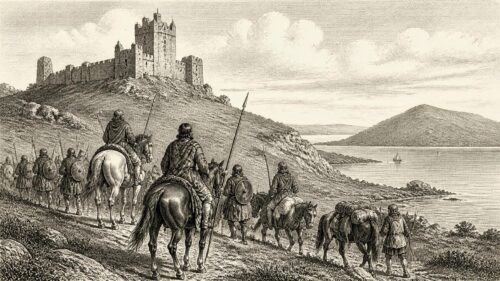
The most conspicuous early success was the capture of Carrigafoyle Castle, on the Shannon estuary in north Kerry, during the spring campaign. The tall tower-house controlled an important waterside position and was held for the rebels. Pelham’s artillery reduced a fortress whose strength had been formidable in an earlier age; those within were executed after its fall. The seizure mattered beyond the ruin of one castle. It exposed the lower Shannon approaches, weakened a Desmond defensive point and advertised the destructive advantage of Crown artillery and naval support.
Pelham and Ormond followed their initial advance with a further summer expedition in Kerry, assisted by a blockade along the coast. Contemporary government policy was intended to deny the rebels supplies and to encourage local lords to abandon Desmond. It did produce submissions, but it also extended devastation across districts already strained by war. Sources from the year record scarcity of food, while later accounts of the rebellion describe the far deeper famine that developed as repeated campaigning damaged agricultural life. It is important not to transfer every later consequence back into 1580: the full demographic catastrophe belonged to several years of war. Nevertheless, by this year the processes that made it possible—burning, raiding, disrupted cultivation, flight and the obstruction of provisioning—were plainly under way.
Religion gave the rebellion an international language and helped explain its political danger to Elizabeth I’s government. Nicholas Sander, an English Catholic priest working with the rebels, had arrived in Ireland in 1579 and continued during 1580 to seek and promise help from Catholic Europe. His programme was not simply local resistance: it envisaged a restoration of Catholicism against the Elizabethan settlement. That aspiration appealed to some, but it did not dissolve older rivalries or guarantee sustained support. Desmond himself was increasingly a fugitive amid a punishing war, and the hoped-for foreign rescue remained uncertain.
Leinster Ignites
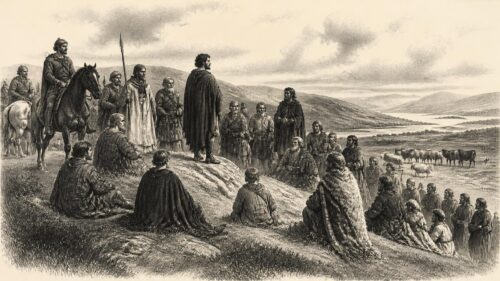
While Pelham campaigned in the south-west, rebellion spread alarmingly close to Dublin. Fiach MacHugh O’Byrne, the powerful lord of Glenmalure in the Wicklow Mountains, had accumulated grievances against encroaching government authority and the conduct of its officers. In June he and allies raided into Wexford and Idrone. James Eustace, third Viscount Baltinglass, joined the rising in July. Baltinglass was a Catholic Old English peer of the Pale, not a Munster dependant of Desmond, and modern scholarship treats his revolt as autonomous, although it was stimulated by the wider crisis and shared its Catholic political idiom.
This was especially disquieting for the Dublin administration. The Pale had long been the Crown’s core zone of settlement, law and revenue in Ireland. A revolt involving a peer, younger gentlemen and neighbouring Gaelic leaders challenged the assumption that the boundary between the government’s obedient districts and the mountain lordships could be securely policed. It also exposed how tenuous that boundary was. Kinship, marriage, clientage, service and religious sympathy crossed it, while coercive measures could create new enemies as readily as they suppressed old ones.
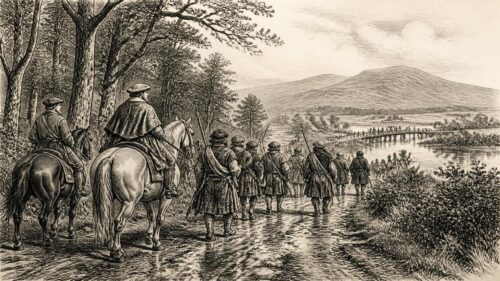
Arthur Grey, fourteenth Baron Grey of Wilton, arrived as lord deputy in August. His appointment marked a harder military response at a moment when ministers feared a widening Catholic combination. Grey moved quickly against Baltinglass and O’Byrne. On 25 August his force entered Glenmalure, a steep, wooded valley where the O’Byrnes held the advantage of ground and local knowledge. Grey is reported to have had about 2,000 men; the precise scale of losses remains less certain than the outcome. His infantry was driven into retreat and suffered heavily under attack from O’Byrne’s men and Baltinglass’s allies. Grey’s cavalry helped save part of the force, but Glenmalure was an unmistakable government defeat.
The battle was more than a dramatic ambush. It showed that a large royal column, including inexperienced recruits, could be defeated when forced through difficult mountain country against opponents who chose the place of combat. It gave the Leinster rising a brief momentum, and O’Byrne and allied Kavanaghs subsequently struck again in Idrone. Yet the victory did not place Dublin in rebel hands or unite the island behind a single command. The Crown retained its administrative centre, its ports, its capacity to import troops and money, and the support of major Irish allies. The hard question for Baltinglass and O’Byrne was whether a local military success could be converted into an enduring political coalition.
Foreign Ships at Smerwick
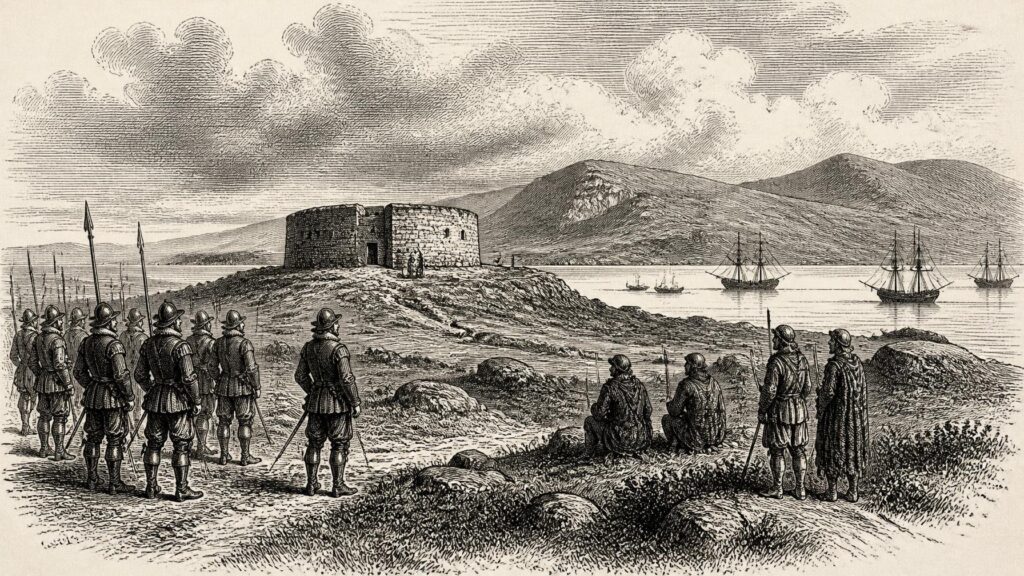
In September, the international dimension became tangible on the Dingle Peninsula. A force of Spanish and Italian soldiers, associated with papal support for the Catholic cause, landed at Smerwick harbour and occupied Dún an Óir, the “Fort of Gold”. The arrival was significant even though the force was small by the standards needed to transform the war. It carried the alarming possibility that Ireland might become a forward theatre in the struggle between Protestant England and Catholic powers. The force also carried expectations created by years of correspondence, clerical diplomacy and appeals for intervention.
Those expectations were soon disappointed. Grey left the Leinster theatre to others, marched south-west with a relatively small body of troops, and joined Ormond’s forces. The government besieged Dún an Óir from 7 November. Artillery made the exposed fort untenable. On 10 November the foreign defenders surrendered. Grey’s own account and other contemporary evidence have long been scrutinised because of the ensuing killings. The broad fact is secure: roughly 500 to 600 Spanish and Italian defenders were put to death after the surrender, with only a small number spared. Whether particular assurances were made, to whom, and through what negotiations has remained contested; Irish memory attached particular force to the phrase “Grey’s word”. What cannot responsibly be softened is that Smerwick ended in the massacre of a surrendered garrison.
The episode was a military victory for the Crown but a moral and political wound. It removed the expedition that rebels had hoped would become the nucleus of larger assistance. It also demonstrated the reach of the Tudor state: ships, artillery, provincial allies and a deputy’s army could be concentrated against a coastal outpost at the far western edge of Munster. At the same time, the slaughter encouraged the image of the war as one fought without reliable mercy, an image reinforced by the harsh campaigning already experienced in the countryside.
Authority, Fear and Aftermath
Grey returned to Dublin late in the year convinced that the Leinster revolt revealed a broader Catholic conspiracy among apparently loyal Old English elites. In December the eleventh earl of Kildare, Gerald FitzGerald, and Christopher Nugent, Baron Delvin, were arrested on suspicion of treason. The evidence against them would later fail to sustain convictions, but the arrests are revealing in themselves. The government’s success at Smerwick did not produce confidence. Rather, it sharpened official suspicion of the men whose co-operation was essential to governing the Pale.
Elsewhere, the reach of violence was equally apparent. In Connacht, Sir Nicholas Malby’s operations in early 1580 included an assault on Donamona Castle in north Mayo in which those inside, including women and children, were killed according to later biographical reconstruction from the record. In Galway, William mac an Iarla Burke and followers were executed outside the town. Such episodes caution against treating 1580 only as a sequence of famous engagements. Government power and rebellion were both experienced through arrests, executions, raids, requisitioning, hostage-taking, fear of betrayal and the movement of armed men through settled country.
By year’s end, Ireland was not pacified. Desmond remained at large; O’Byrne and Baltinglass had not been eliminated; and the social damage of the Munster war would worsen. But the pattern of the conflict had changed. Carrigafoyle had shown that great lordly fortresses could fall to artillery. Glenmalure had shown that government armies could be humiliated in the mountains. Smerwick had shown both the reality and the limits of foreign Catholic intervention—and the ruthless terms on which the Crown was prepared to answer it. In 1580, the struggle for Ireland became at once more international, more regional and more devastating for the people whose homes and fields lay between the rival forces.

Primary Sources
- Grey, Arthur
- Pelham, Sir William
- Eustace, James
- O'Byrne, Fiach MacHugh
- Sander (Sanders), Nicholas
- Fitzgerald, Gerald
- MacMurrough, Muircheartach Óg
- O'Toole, Rose
- O'Toole, Feilim
- Malby, Sir Nicholas
- White, Sir Nicholas
- Annals of the Four Masters
- A Calendar of Manuscript Material Relating to Ireland, 1580–1602
- Calendar of the State Papers Relating to Ireland, 1574–1585
- State Papers Ireland 1509–1782: Government Papers on Irish Affairs
- Book Written by Sir W. Pelham for the Reformation of Munster, 1580
- “Communis Hostis Omnium”: The Smerwick Massacre (1580) and the Law of Nations
- Feagh McHugh O’Byrne
- Site of the Battle of Glenmalure
- Early Modern History: County Limerick
- Hugh O'Neill & Faith and Fatherland
- Campaign Journals