

Armagh’s Besieged Cathedral1561 CE
In 1561, Shane O’Neill’s contest with the Dublin administration over authority in Ulster became Ireland’s principal political crisis. After capturing An Calbhach O’Donnell in May, O’Neill disrupted a planned alliance of Ulster and Scottish opponents. Sussex proclaimed him traitor, marched north, and fortified St Patrick’s Cathedral, Armagh, as a royal garrison. O’Neill’s forces besieged the post and inflicted a reverse on crown troops during their July withdrawal. A September expedition to Lough Foyle also failed to establish control. Negotiations followed, leading to O’Neill’s safeguarded journey to England in December. Coinage proclamations and correspondence revealed wider governmental, economic and diplomatic pressures.
Dateline
A Contest for Ulster
In 1561, the struggle between Seaán mac Cuinn Ó Néill—usually known as Shane O’Neill—and the Dublin administration became the central political crisis in Ireland. The immediate issue was authority in Ulster: whether O’Neill, already the dominant lord in Tír Eoghain, could extend his power over neighbouring lordships, or whether Elizabeth I’s government could contain him through armed intervention, rival claimants and alliances with other Gaelic and Scottish leaders. Yet the year also exposed a larger problem. Tudor government could issue proclamations, recruit an army and occupy a famous ecclesiastical site, but its effective reach beyond the Pale remained uncertain and expensive.
O’Neill was not simply an isolated opponent of the crown. He was engaged in a contest over inheritance, lordship and regional supremacy. He rejected the claim of his nephew Brian, Baron of Dungannon, to succeed to the earldom of Tyrone under the arrangements made with Brian’s grandfather, Conn Bacach O’Neill. At the same time, he expected the deference of lesser Ulster rulers according to Gaelic political practice. The crown, for its part, treated his growing power as a threat to royal peace and used Brian’s claim as a constitutional alternative to O’Neill’s leadership. These incompatible ideas of legitimate authority lay behind the campaigning of 1561.
An Alliance Broken in May
A planned coalition against O’Neill was undone before the government’s main force moved. The most precisely dated turning point came on 14 May, when O’Neill captured An Calbhach O’Donnell, lord of Tír Chonaill, together with An Calbhach’s wife, Catherine MacLean. An Calbhach had been involved in a proposed alignment of the O’Donnells, the MacDonnells of Antrim and Scottish interests associated with the Campbell earls of Argyll. Sussex’s government hoped such a combination would provide allies on O’Neill’s northern and western borders.
The seizure was more than a dramatic kidnapping. It removed O’Neill’s principal Ulster rival from the field, destabilised Tír Chonaill and made a co-ordinated assault on Tír Eoghain far harder. O’Neill then promoted An Calbhach’s half-brother Aodh as ruler in Tír Chonaill. Contemporary and later accounts differ in details of captivity and chronology, so it is safest not to treat every later annalistic statement as an exact record. What is clear is that An Calbhach remained O’Neill’s prisoner beyond 1561, while the political advantage gained in May was immediate.
Further north-east, the MacDonnells remained an important factor. On 20 January an agreement had been concluded concerning Sorley Boy MacDonnell’s participation in a league against O’Neill, conditional on official recognition of the MacDonnell position in the Route and Glens. It did not produce the hoped-for military action. The episode shows how closely Ulster’s politics crossed the North Channel: Scottish kindreds, mercenary connections, marriage alliances, coastal settlements and crown diplomacy all mattered in a contest that cannot be understood as only an English-Irish confrontation.
Proclamation and Advance
On 8 June, the Dublin government formally proclaimed Shane O’Neill a traitor and ordered a general hosting. Thomas Radclyffe, Earl of Sussex and lord lieutenant, had returned to Ireland on 2 June and quickly took the field. The language of treason represented the crown’s view of a subject in rebellion; it did not mean that O’Neill accepted that description. His letters instead insisted that he wished to deal directly with Elizabeth, not to entrust himself to an administration whose protections he considered unreliable.
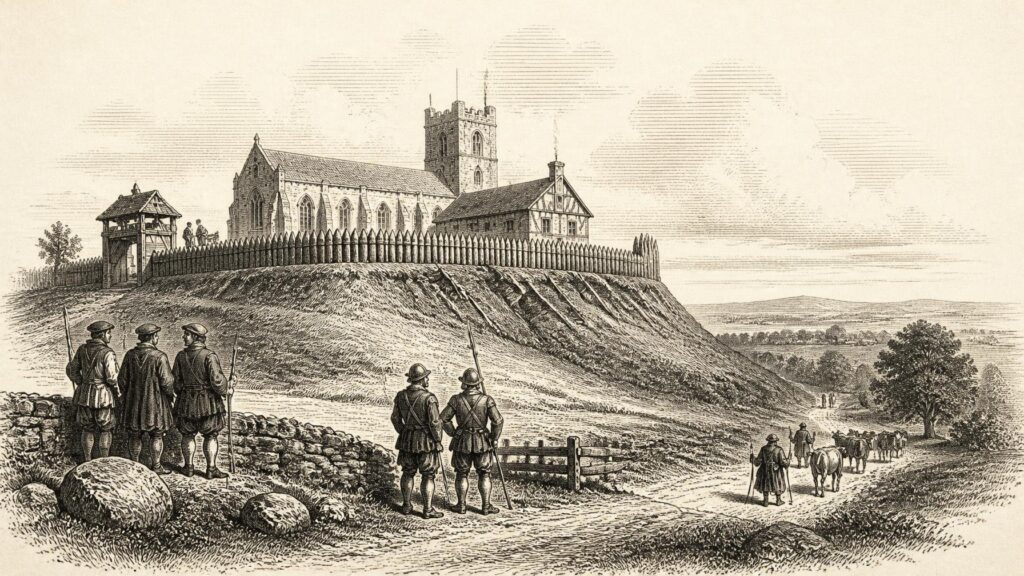
By late June Sussex’s army had reached Armagh. There it fortified the great church of St Patrick, creating a defended garrison at one of Ireland’s most resonant religious centres. The choice was strategic as well as symbolic. Armagh lay within the political orbit of Tír Eoghain, on the route north from the Pale, while its primatial status made it a conspicuous assertion of royal presence. The annals describe earthworks and strong defences around the church; government correspondence confirms that soldiers were stationed there. In a landscape where permanent royal posts were scarce, the fortified cathedral was meant to be a foothold.
It was also an intrusion into a living ecclesiastical and political community. Donat O’Teige, the Roman Catholic archbishop of Armagh, had reached the city in late 1560 under O’Neill’s favour. Before 16 July 1561, according to biographical evidence based on contemporary material, he appeared with O’Neill’s forces during the siege of the garrison and encouraged the attackers. This was not a straightforward clash between a uniformly Protestant state and a uniformly Catholic Gaelic population: religious loyalties, clerical appointments, local lordship and military survival were intertwined. But Armagh plainly became a place where the Reformation settlement promoted by Dublin met a powerful alternative authority.
War Among Cattle and Woods
The summer campaign shows the character of warfare in sixteenth-century Ireland. Sussex could march with professional soldiers, captains and artillery support, but O’Neill avoided offering the pitched battle that an invading army wanted. Livestock were moved away; woodland, bogland and local routes favoured defenders familiar with the country. Raiding, food supply and the ability to carry cattle mattered as much as formal possession of ground. Government forces sought prey in Oriel, while O’Neill’s men watched for an opportunity against columns burdened by animals and provisions.
At the end of July, O’Neill struck the government army during its movement from Armagh. The official correspondence and later narratives disagree on losses and on which encounter deserves emphasis, and the familiar modern label ‘the battle of the Red Sagums’ should not obscure that uncertainty. The basic outcome is secure: the crown’s troops suffered a serious reverse, particularly in their rearward movement, even as government reports claimed heavy losses among O’Neill’s followers. Robert Sexton, a petty captain, was among the English dead. The clash demonstrated that occupation of Armagh had not made the army master of Tír Eoghain.
For ordinary people in the affected districts, military operations brought consequences that the grand language of treason and submission conceals. Armies required food, fodder, transport and guides. Cattle could be driven off by either side, crops and dwellings might be destroyed during marches, and communities faced pressure to supply or conceal men and provisions. Sussex’s later northern march was accompanied by extensive seizure and killing of livestock. O’Neill’s political strength likewise rested partly on his capacity to protect dependants, reward followers and make raids into enemy or crown-aligned territory. The burden fell most heavily on farming households whose animals and stores sustained both local society and war.
Lough Foyle and Negotiation
Sussex did not abandon the effort after July. In September he led a further expedition through Ulster towards Lough Foyle. The Annals of the Four Masters record that five earls—Kildare, Ormond, Desmond, Thomond and Clanrickard—joined the host, an impressive display of aristocratic support for the government. The expedition reached Lough Foyle without a decisive battle. It did not, however, deliver the anticipated strategic result. A victualling fleet expected on the coast failed to arrive, and the army withdrew towards Newry. The episode underlined the logistical frailty of crown campaigning: a force could traverse territory, burn or seize resources, and still fail to establish durable control.
By autumn the emphasis had shifted again towards negotiation. Gerald Fitzgerald, eleventh earl of Kildare, was employed as an intermediary. O’Neill’s position was that a genuine settlement required the removal of soldiers from his country, particularly the Armagh garrison, and secure access to the queen herself. Sussex had reasons to resist concessions that might advertise the failure of his expedition. Yet neither side could easily force a final decision. O’Neill had preserved his lordship and shown his military resilience; Sussex retained an army, formal royal authority and support among some Irish magnates.
Before the year ended, arrangements were made for O’Neill to travel to England under safeguards associated with Kildare and other earls. He crossed in December and appeared before Elizabeth early in January 1562. That famous audience belongs to the following year, not this one. Its origins, however, lay unmistakably in the frustration of 1561: military action had failed to settle Ulster, and direct diplomacy with the queen became the remaining route by which O’Neill sought recognition and the crown sought to limit him.
Money, Government and Communication
Conflict was not the year’s only business. A sequence of proclamations from January through July addressed Ireland’s troubled coinage. The administration sought to restrict the movement of base English coins, prevent particular monetary bargains, keep money within the realm and revise the values at which depreciated issues circulated. On 14 July further base coin was officially decried. A small issue of higher-standard Irish silver belongs to this same monetary intervention. Such measures mattered beyond Dublin’s offices: they affected payments, prices, credit and the purchasing power of soldiers’ wages and landlords’ dues. The surviving evidence reveals official anxiety about currency, though it does not permit a simple calculation of how every household experienced the changes.
The documentary record also preserves O’Neill as an active correspondent rather than merely a commander in the woods. His letters in Irish and Latin to Sussex and to the crown argued his case, demanded that messages be sent to Elizabeth, and presented his complaints in the idiom of honour, protection and justice. That written diplomacy is an important reminder that Gaelic lordship employed both force and political communication. In 1561, the clash at Armagh was therefore fought in several ways: with garrisons, cattle raids and ambushes, but also through proclamations, safe-conducts, petitions and letters carried between Ulster, Dublin and the English court.
By December, no side had gained a final victory. The crown had proved able to mount large expeditions but not to secure lasting obedience in central Ulster. O’Neill had broken an encircling alliance and retained the initiative, but he also faced powerful enemies and the continuing danger of royal intervention. Armagh’s fortified cathedral remained the year’s defining image: an ancient Irish church turned into a military post, surrounded by contested countryside, and emblematic of a kingdom in which authority was asserted far more readily than it was enforced.
Primary Sources
- Annals of the Four Masters, Part 7
- Annals of the Four Masters
- Calendar of State Papers Relating to Ireland, 1509–1573
- Calendar of the State Papers Relating to Ireland: Vol. 1, 1509–1573
- O'Neill, Shane (Seaán)
- O'Donnell (Ó Domhnaill), An Calbhach
- O'Donnell (Ó Domhnaill), Sir Aodh mac Maghnusa
- O'Neill (Ó Néill), Brian
- O'Teige, Donat (Donatus; Donnchadh Ó Taidhg)
- MacDonnell, Sorley Boy
- Radcliffe, Thomas
- Fitzgerald, Gerald
- Statute Law Revision Act 2015
- Statute Law Revision Act 2015, Schedule 2
- The Tudor Coinage for Ireland
- Building History: St Patrick’s Cathedral, Armagh
- Ireland Under the Tudors, Volume II
- Letter of Shane O’Neill to the Earl of Sussex, Viceroy of Ireland, 1561
- Gaelic Lordship and Tudor Conquest: Tír Eoghain, 1541–1603
- Calendar of the Carew Manuscripts, Preserved in the Archiepiscopal Library at Lambeth