

Glentaisie and Affane1565 CE
In 1565, Ireland remained divided among powerful Gaelic and Old English lordships despite Tudor claims. At Affane, Ormond defeated and captured Desmond during a dispute over Déise, prompting concern at magnates waging private war. In Ulster, Shane O’Neill crushed the MacDonnells at Glentaisie, extending influence through garrisons and settlement, and alarming Dublin and London. The Crown advanced surrender and regrant by creating Donal MacCarthy Mór earl of Clancare, while Henry Sidney’s confirmation signalled intervention. Catholic organisation persisted through Jesuit schooling and Miler Magrath’s appointment. The death of scholar Tadhg Cam Ó Cléirigh also demonstrated continuing learned patronage amid political conflict.
Dateline
In 1565, Ireland’s political map was still made and remade by lordships rather than by any uniform public authority. The Tudor administration based in Dublin claimed the island for Elizabeth I, but its effective reach varied sharply. Great Gaelic and Old English dynasties governed extensive territories, raised fighting men, levied food and services, made marriages and alliances, and treated local rights as matters to be defended by force. Two clashes that year, at Affane in Munster and Glentaisie in Ulster, exposed this fragmented order with unusual clarity. Neither was simply a local quarrel. Each altered the calculations of the Dublin government, the queen’s ministers and neighbouring lords.
A Private War at Affane
The year opened amid the breakdown of a precarious peace between the earls of Ormond and Desmond. Thomas Butler, tenth earl of Ormond, dominated a great lordship centred on Kilkenny, while Gerald FitzGerald, fifteenth earl of Desmond, headed the vast Geraldine interest in south-west Munster. Their rivalry concerned land, influence and the right to exercise lordship over border districts. It was also sharpened by the death on 2 January of Joan FitzGerald, a woman whose family connections had helped to restrain hostility between the two houses.
In early February, their dispute erupted at Affane, near the River Finisk in County Waterford. Desmond had entered the Déise to assert claims over the local lord, Maurice FitzGerald of Decies. Decies sought help from Ormond. What followed was a pitched encounter between noble affinities: mounted men, gallowglass infantry and kern drawn from the lordships and their allies. It was not a battle between an English and an Irish side. Both armies joined Old English magnates, Gaelic followers and regional dependants in competing political networks.
Desmond was wounded by Sir Edmund Butler, Ormond’s brother, and taken prisoner; many of Desmond’s followers were killed or captured. The Annals of the Four Masters, written from a later seventeenth-century perspective but preserving a tradition of the event, stressed the Butlers’ gain in prisoners and spoil. It also represented Desmond as caught in an ambush engineered by Decies and Ormond. Other evidence makes clear that the conflict grew from a long-running and escalating contest, rather than from a single act of treachery. The difference matters: contemporary and later accounts did not stand outside the rivalries they described.
Affane was politically alarming because it looked like magnates making war independently of the Crown. The queen’s government could not readily tolerate earls settling jurisdictional disputes through armed action, even when one of them, Ormond, enjoyed Elizabeth’s personal favour. Both earls were required to answer to royal authority in England. The conflict itself did not end in 1565, but the battle established a pattern that would have grave consequences: the Crown would increasingly intervene in Munster not merely as mediator, but as a power claiming to regulate lordship, military exactions and landholding.
Shane O’Neill in the Glens
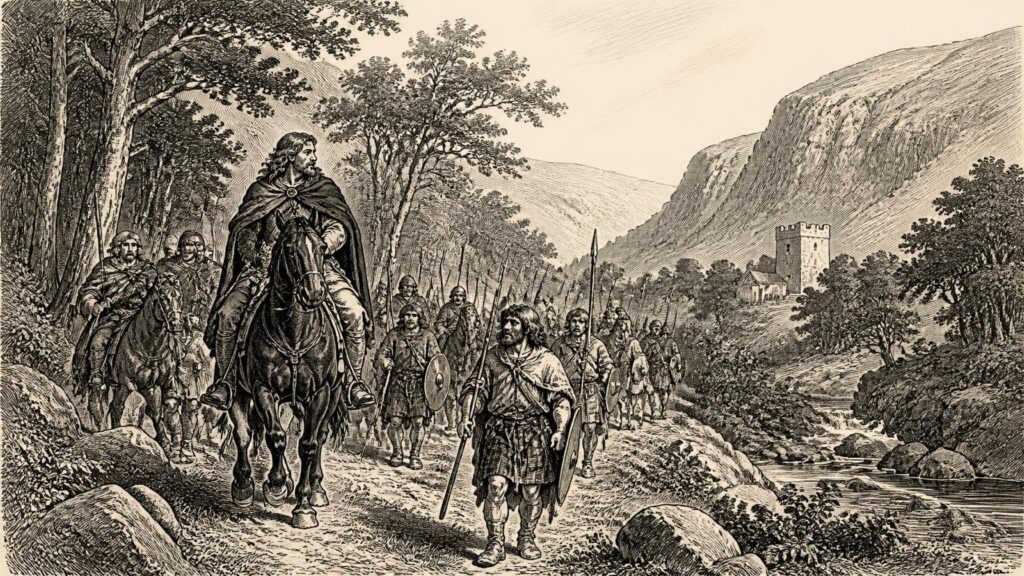
The more dramatic shift occurred in north-east Ulster. Shane O’Neill, leader of the dominant branch of the O’Neill dynasty in Tír Eoghain, had spent years building a regional supremacy that challenged both rival Gaelic lords and the Dublin administration. His chief opponents in Antrim were the MacDonnells, a kindred group whose power connected the north of Ireland to the Hebrides and western Scotland. Sea routes across the North Channel brought kinship, hired soldiers, trade and military assistance; the distinction between an Irish and a Scottish world was therefore much less clear there than later national histories can imply.
On 2 May, O’Neill defeated the MacDonnells at Glentaisie, in the Glens of Antrim near Ballycastle. His advance was carefully planned. According to the account of his career preserved in the Dictionary of Irish Biography, he used local knowledge to move through difficult passes, seized the MacDonnell castles at Red Bay and Ballycastle, and brought the opposing force to battle. The victory was severe. Angus MacDonnell was killed, while James MacDonnell of Dunnyveg and Sorley Boy MacDonnell were captured. James, badly wounded, would die later from his wounds; Sorley Boy survived captivity.
The annalists called Glentaisie a great defeat and dwelt on the stature of James MacDonnell as a generous and warlike lord. Such language is revealing. A chief’s reputation rested not only upon battlefield prowess but upon hospitality, the ability to maintain a household and the capacity to reward followers. The loss was therefore social as well as military, affecting the dependants, fighting retainers and communities sustained by the MacDonnell lordship. O’Neill’s victory likewise depended on more than a day’s fighting. He remained in the Glens through the summer, installed garrisons in captured strongholds and settled his own people there. Military success was being translated into control of land, labour, food supplies and routes along the coast.
For O’Neill, Glentaisie made an already formidable position more dangerous to his rivals. It weakened the MacDonnell counterweight in Antrim, enhanced his influence over neighbouring lordships and demonstrated that he could act swiftly beyond the core of Tír Eoghain. Yet victory did not make him ruler of a settled province. His authority rested on continuing personal leadership, the distribution of protection and plunder, and the coercion or accommodation of lesser lords. Later in the year he again pressed O’Reilly and moved against O’Rourke. These actions alarmed former sympathisers in Dublin and at the English court, who increasingly concluded that agreement with O’Neill had failed.
Titles, Submission and Royal Policy
Elsewhere, the Crown sought to reshape Irish politics by recognising selected lords in English legal forms. Donal MacCarthy Mór travelled to the royal court in spring 1565. He formally surrendered his lands and received them back by royal grant; on 24 June he was created earl of Clancare and baron of Valentia. The arrangement belonged to the Tudor policy usually called surrender and regrant. In theory, it bound a Gaelic lord to the monarch through English tenure, title and inheritance while confirming a place for him within the kingdom of Ireland.
Its limits were plain even at the moment of apparent success. MacCarthy Mór hoped that royal favour would help him revive authority over territories in which his family’s claims had long been contested. His journey also left him in debt, an instructive reminder that lordship did not operate outside material constraints. His own lordship largely functioned through barter, making ready cash difficult to obtain. A new title could confer prestige and legal recognition, but it could not by itself produce money, secure obedience from distant kinsmen or erase the military power of the earls of Desmond and Ormond.
In Thomond, another O’Brien succession dispute reached a temporary settlement during the year, after damaging warfare between Conor O’Brien, third earl of Thomond, and his uncle Donal. The episode, like Affane, showed that the Crown’s titles and the Gaelic principle of choosing a leading man of the ruling kindred could coexist uneasily. The same tension lay behind the wider contest over O’Neill’s authority in Ulster. English law, Gaelic inheritance and older lordly custom were not separate worlds; they were overlapping claims which particular people deployed when useful.
In October, Sir Henry Sidney was finally confirmed as lord deputy. His appointment was a response to this difficult political landscape, above all to the growing assessment that Shane O’Neill could no longer be contained by negotiation. Sidney did not launch the great Ulster campaign of his deputyship in 1565: royal authority for decisive action against O’Neill would follow only in the next year. Nonetheless, his arrival marked a turning point in official direction. Government thinking moved towards stronger military intervention and more systematic remodelling of provincial power.
Faith, Schooling and Learned Life
Religious life did not follow the boundaries of official policy either. The Elizabethan religious settlement was the law of the kingdom, but Catholic worship, clerical networks and older patterns of devotion remained deeply rooted across much of Ireland. David Wolfe, the Limerick-born Jesuit and papal commissary, continued to work discreetly to strengthen Catholic organisation. In Limerick during most of 1565, Edmund Daniel and the English Jesuit William Good conducted what is described as the first Jesuit school in Ireland. They taught Latin and English and formed pupils in Catholic belief and practice.
The school’s vulnerability is as important as its foundation. Financial backing failed, its house was raided and looted, and the teachers were forced to close before moving their work to Kilmallock. The episode should not be mistaken for a settled educational institution or for evidence that one confession had displaced the other. It instead illuminates a contested urban society, in which merchants, clergy, officials and families could navigate divided loyalties while religious education and the celebration of Mass attracted official scrutiny.
In Ulster, the appointment on 12 October of the Franciscan Miler Magrath as Catholic bishop of Down and Connor was another sign of continuing Catholic ecclesiastical organisation. Yet the practical realities were stark: the temporal power of that diocese lay largely within the sphere of Shane O’Neill. Church appointments, like noble titles, depended for their effect on local protection and political circumstance.
The year also recorded the death, on 20 October, of Tadhg Cam Ó Cléirigh, hereditary learned man to the O’Donnells. The annalists praised him as a master of history, poetry and chronology, and as the keeper of a hospitable house for scholars, guests and learners. He was buried with honour at the Franciscan monastery in Donegal. His obituary is a valuable corrective to any image of sixteenth-century Ireland as concerned only with war. Learned families still preserved genealogies, law, historical memory and bardic learning under aristocratic patronage. Their work was woven into lordship itself: knowledge of descent, precedent and reputation could validate political claims as surely as a castle or a fighting force.
A Year of Widening Consequences
Affane and Glentaisie were separate conflicts, fought hundreds of miles apart, but together they made 1565 a year of warning. In Munster, a private war between two great earls revealed the fragility of political order within territories notionally subject to the Crown. In Ulster, O’Neill’s victory over the MacDonnells revealed the capacity of a Gaelic lord to build an autonomous regional supremacy. The promotion of Clancare, the installation of Sidney, the Jesuit school in Limerick and the death of an O’Donnell scholar all belong to the same unsettled Ireland: an island where authority was negotiated through arms, law, religion, learning, kinship and the resources needed to sustain them.
Primary Sources
- Annals of the Four Masters, Part 7: Annal M1565
- Annals of the Four Masters, Irish text: Annal M1565
- Annals of Loch Cé, Part 11
- O'Neill, Shane (Seaán)
- Sidney, Sir Henry
- Butler, Sir Edmund
- Butler, Thomas
- Fitzgerald, Joan
- Fitzgerald, Sir John fitz James
- MacCarthy Mór, Donal
- O'Brien, Conor
- Magrath, Miler (Meiler)
- Wolfe, David
- Gaelic Lordship and Tudor Conquest: Tír Eoghain, 1541–1603
- Irish Jesuit Archives: Edmund Daniel and the Limerick School
- Irish Jesuit Archives: Limerick City
- Why the Reformation Failed in Ireland
- The Sidney State Papers, 1565–1670
- Sidney State Papers
- State Papers Ireland, 1509–1782: Government Papers on Irish Affairs
- Calendar of the State Papers Relating to Ireland, 1509–1573
- The Battle of Affane (1565)
- County Waterford Urban Archaeology Survey
- The Earldom of Desmond
- The Reformation in Ireland: Interpretations Old and New