

Challoner’s Dublin Office1560 CE
In 1560, Elizabeth I’s Irish government strengthened its Dublin machinery by appointing John Challoner secretary and signet keeper, while parliament enacted the Acts of Supremacy and Uniformity. These measures established ecclesiastical authority and prescribed reformed worship, although Latin remained permissible where English was unavailable. Their enforcement was limited by weak institutions, linguistic divisions and restricted Crown power beyond the Pale. Shane O’Neill’s Ulster progress frustrated plans to install Brian O’Neill, while Desmond and Ormond avoided battle in Munster. Raids, maritime disaster, grain controls, military hosting and base coinage revealed an island shaped by regional lordships, insecurity, negotiation and material constraints.
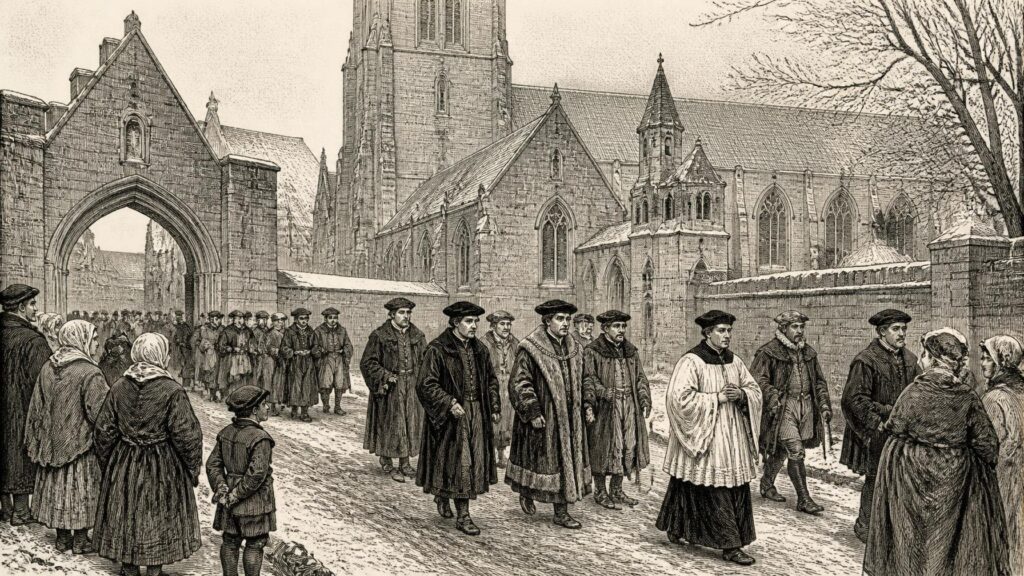
Dateline
In 1560, Ireland’s government acquired a new instrument of rule: John Challoner became secretary of state for Ireland, a post intended to give the administration at Dublin a more continuous centre. The appointment was not, by itself, a conquest of the island. Rather, it exposed the problem confronting Elizabeth I’s government. Statutes could be passed in Dublin, letters and orders could be issued under seal, and officials could be named; yet authority beyond the Pale depended on negotiation, local alliances, food supplies and armed force. During the same year, the Irish parliament enacted Elizabeth’s religious settlement, while Shane O’Neill’s position in Ulster and rival lordships in Munster demonstrated the limits of government direction.
A Brief Parliament, Lasting Consequences
The first parliament of Elizabeth’s Irish reign met in Dublin from 12 January to 1 February 1560. Its most consequential measures were the Act of Supremacy and the Act of Uniformity. The former restored to the Crown jurisdiction in ecclesiastical and spiritual affairs and rejected foreign, meaning papal, authority. The latter prescribed a uniform public service based on the English Book of Common Prayer. Together they made the queen’s religious settlement part of the law of the kingdom of Ireland, not merely an instruction sent from England.
The acts were constitutional statements as well as religious ones. In the Tudor view, allegiance, public office and worship were inseparable. Clergy and officeholders were required to accept the Crown’s ecclesiastical authority; the Uniformity Act also imposed a penalty of twelve pence for absence from the prescribed worship on Sundays and holy days. Such provisions mattered greatly on paper. Their practical reach, however, varied sharply. Parliament represented the political communities that could be summoned and managed by the Dublin government; it was not a gathering that spoke equally for every lordship, parish or language community across Ireland.
The legislation itself acknowledged a conspicuous difficulty. Where a minister or priest lacked English, the Act of Uniformity permitted common and open prayer in Latin, following the form of the authorised book. This was a revealing compromise. English was the official language of the new service, but much of the clergy and laity did not use it. Latin offered continuity in a church culture long shaped by it, yet it was not an Irish-language liturgy. The settlement therefore reached many congregations as a legal command whose words, ministers and institutional support were uncertain. It would be misleading to imagine an immediate, uniform change in what ordinary people heard or practised in parish churches during 1560.
Christ Church and the Limits of Reform
Dublin’s Christ Church Cathedral, where parliament met, was a fitting setting for the tension between statute and practice. The city contained the principal offices of royal administration, civic corporations, courts, merchants and ecclesiastical institutions on which Tudor policy relied. But the government’s Reformation required more than legislation: it needed compliant bishops, trained clergy, books, visitors, local patrons and regular enforcement. Those conditions did not yet exist consistently. Modern scholarship stresses that Elizabeth’s Reformation in Ireland was hindered from the outset by a lack of indigenous support and by the weakness of institutions capable of propagating or enforcing it.
This does not mean that 1560 changed nothing. The statutes supplied a legal framework that later officeholders could invoke, and they marked a renewed connection between royal government and a reformed church after the Marian restoration. But contemporaries and later historians have disputed the parliamentary proceedings, especially the degree of episcopal resistance and the procedures by which the ecclesiastical bills were secured. The safest conclusion is that the Acts were enacted and received royal assent on 1 February, while the exact mechanics of assent and opposition remain less certain than older partisan accounts sometimes suggest.
Challoner and the Paper Government
In May, John Challoner entered office as the new secretary of state for Ireland, as well as secretary of the Irish council and keeper of the signet or privy seal. Challoner was no newcomer to Dublin life. A merchant and civic officeholder, formerly sheriff and mayor, he belonged to a Protestant-leaning circle of urban administrators and entrepreneurs. His appointment was meant to provide the Dublin administration with continuity: a permanent official who could handle correspondence, council business and the authentication of government decisions.
The creation of this office is significant because it shows how Elizabeth’s government intended to rule. Dublin Castle needed more orderly communication with England and a more durable record of policy at home. Yet paperwork could not remove the obstacles facing a relatively small administration. Decisions still depended on the lord lieutenant, Thomas Radclyffe, earl of Sussex; on the Irish privy council; on local magnates; and on military resources that were costly, difficult to supply and often politically counter-productive. Challoner’s office was thus an administrative beginning, not proof that government had suddenly become effective throughout Ireland.
Shane O’Neill’s Summer Progress
The sharpest challenge lay in Ulster. Shane O’Neill had emerged after the death of his father, Conn Bacach O’Neill, as the leading claimant to the O’Neill lordship of Tír Eoghain. His rival was Brian O’Neill, baron of Dungannon, son of Matthew O’Neill, whose status had been elevated under the Crown’s earlier settlement with Conn. The dispute was not merely a family quarrel. It raised opposed ideas of authority: whether the Crown could determine succession and distribute titles at will, or whether the lordship’s own political customs and election of “the O’Neill” carried decisive force.
In August 1560 Elizabeth authorised the subjugation of Shane and the installation of Brian as overlord in Tír Eoghain. It was an ambitious instruction, but events had already revealed the difficulty of implementing it. In July, Shane marched through the southern Ulster lordships. According to the evidence summarised by modern biographical scholarship, the display of force intimidated potential Irish opponents and caused the projected alliance against him to dissolve. Sussex’s moves against Shane during 1560 consequently failed to produce the intended campaign. Shane gained time to organise, while the Crown’s preferred claimant lacked the military strength to displace him.
The Irish annals preserve a smaller but telling indication of the unsettled northern world. They record the death of Art Maol MacMahon in an encounter involving an O’Neill force and Scottish fighters in the Route, the territory associated with the MacQuillans in north-east Ulster. The entry should not be inflated into a major battle whose details are otherwise unknown. It does, however, show that Ulster politics crossed the narrow sea: Gaelic lords, Scottish military migrants and local dynasties all formed part of the strategic landscape in which Shane and the Dublin government operated.
Munster’s Unfought Field
Munster offered a different illustration of divided power. The Annals of the Four Masters, compiled later but drawing on Irish annalistic traditions, place a major confrontation in 1560 between Gerald FitzGerald, earl of Desmond, and Thomas Butler, earl of Ormond. The dispute concerned lands along the Suir and Eóganacht Chaisil. Retinues of English and Gaelic origin gathered from a wide stretch of Munster and Leinster, and the two sides chose a meeting place on the great road near Cnámhchoill and Tioprat Arann. The annalist portrays the armies as ready for battle but says that peace was made before fighting began.
This “battle that never was” deserves notice precisely because no pitched battle occurred. The mobilisation shows the capacity of great aristocratic houses to summon men across extensive territories, independently of the Crown’s declared monopoly of peace. The avoided clash also points to the value of mediation and kinship. Joan FitzGerald, countess of Ormond and wife of Desmond, helped restrain the rival houses in this period. The settlement did not end their competition; it merely postponed open war. In 1560, however, the immediate outcome was averted bloodshed rather than a decisive victory.
Raids, Roads and the Western Sea
Other annalistic notices convey the ordinary insecurity that lay beneath the language of high policy. In Carbery, a Geraldine raiding party was met near the Bandon by forces associated with MacCarthy Reagh and a MacSweeney captain accompanied by hired soldiers. The annalist reports heavy Geraldine losses, including men drowned in the river, and notes that the MacSweeney leader was permanently maimed. In western Connacht, the earl of Thomond campaigned against Murrough na dTuagh O’Flaherty; Galway townsmen defended a ford at Tír Oileáin, though the earl passed through Clanricarde territory.
Sea travel was no less hazardous. The annals tell of Maghnus, son of Toirdhealbhach, returning from the south with hostages and goods when worsening weather struck near Aran. A ship and smaller vessel were torn from their moorings; the larger vessel was driven onto rocks at the mouth of a western Connacht bay. More than a hundred people were said to have drowned, among them Tuathal O’Malley, described as an eminent commander of a long fleet. The precise scale is difficult to test, but the report captures a real condition of sixteenth-century life: maritime routes connected lordships, carried captives and plunder as well as people and goods, and could turn suddenly lethal.
Food, Coin and Defence
Government orders from later in the year underline the material pressures behind politics. On 20 August an order called for a general hosting, and the following day the authorities prohibited the sale of corn from the Pale into the “Irish country”. Such measures linked military preparation to grain supply. They also reveal the frontier assumptions of the Dublin regime, which sought to preserve provisions for the zone it could defend and administer most directly. On 29 October a proclamation continued the circulation in Ireland of England’s base coinage. Currency policy, like grain control, was a reminder that government reached daily exchange as well as warfare and worship.
Thus 1560 was not a year of one all-Ireland event. It was a year in which several forms of authority became unusually visible: parliament legislated religion; Challoner’s appointment strengthened the machinery of Dublin rule; Shane O’Neill exposed the Crown’s military weakness in Ulster; and Munster’s great houses showed how easily regional conflict could eclipse official policy. The laws of February and the new office of May mattered because they set patterns that endured. But the conflicts, accommodations and hazards recorded across the island show why putting those patterns into effect would take far more than a statute or a seal.
Primary Sources
- Annals of the Four Masters, Annal M1560
- Annals of the Four Masters, CELT Edition Introduction
- Challoner (Chaloner, Challyner), John
- O’Neill, Shane (Seaán)
- O’Neill (Ó Néill), Brian
- The Irish Parliament of 1560: The Anglican Reforms Authorised
- Why the Reformation Failed in Ireland
- Pre-Union Irish Statutes Affected: 1560 (2 Eliz.)
- Statute Law Revision Act 2015
- Act of Supremacy (Ireland) 1560
- A New History of the Book of Common Prayer
- The Irish Act of Uniformity and the Latin Prayer Book
- State Papers Ireland 1509–1782: Government Papers on Irish Affairs
- Calendar of the State Papers Relating to Ireland, 1509–1573
- The Fiants of Elizabeth I (1558–1603)
- Butler, Thomas
- Butler, Sir Edmund
- Fitzgerald, Sir John fitz James
- Fitzgerald, James fitz John
- Calendar of Ormond Deeds, Volume V, 1547–1584