

Lixnaw’s Summer Defiance1568 CE
In 1568, Ireland experienced sharpening local conflicts as royal intervention, disputed land rights and absent lords weakened established authority. With the earl of Desmond imprisoned in England, James fitz Maurice unsuccessfully besieged Thomas Fitzmaurice at Lixnaw, where plunder, drought and shortages afflicted civilians and troops. Munster tensions grew through MacCarthy alliances and proposed English settlements. In Leinster, Sir Peter Carew’s successful Idrone claim and Edmund Butler’s estrangement foreshadowed revolt. Sir Henry Sidney pursued limited Ulster agreements, garrisons and transport schemes. Protestant church appointments likewise revealed the gap between crown ambition and practical control, anticipating conflicts in 1569 and subsequent upheavals.
Dateline
In 1568, Ireland’s political map looked unsettled not because one great war had yet engulfed the island, but because several older disputes were beginning to connect. The imprisonment in England of Gerald Fitzgerald, fifteenth earl of Desmond, and of his brother Sir John had left a dangerous vacancy in Munster. In Ulster, the death of Shane O’Neill the previous year had not brought a durable settlement. In Leinster, the crown’s willingness to revive old land claims created fresh alarm among powerful families. The year therefore matters less as the opening of a fully formed rebellion than as a year in which local quarrels, royal reform and fears of dispossession acquired a sharper edge.
Desmond Without Its Earl
Gerald of Desmond and Sir John remained in England throughout 1568. They had been removed from Ireland in December 1567 after years of conflict with Thomas Butler, tenth earl of Ormond, and after official efforts to curb the Desmond affinity. Gerald submitted to the English government in March and again in July 1568, but negotiation over his obligations, his lands and the long-running Butler feud did not secure his release. His confinement was to continue for years. For a great Munster lordship whose cohesion depended on personal lordship, military followings and networks of service, the earl’s absence was a profound practical problem as well as an affront to status.
James fitz Maurice Fitzgerald, the earl’s cousin and captain of the Desmond forces, filled much of that vacuum. His authority was not automatic. An internal challenge from Thomas Roe fitz James, Gerald’s elder but illegitimate half-brother, had been overcome by March. Yet James fitz Maurice commanded men in the earl’s name while lacking the unchallengeable standing of an earl himself. His position depended on proving that the Geraldine lordship could still exact service, rents and obedience. That pressure helps explain the violence that followed in north Kerry.
The Lixnaw Campaign
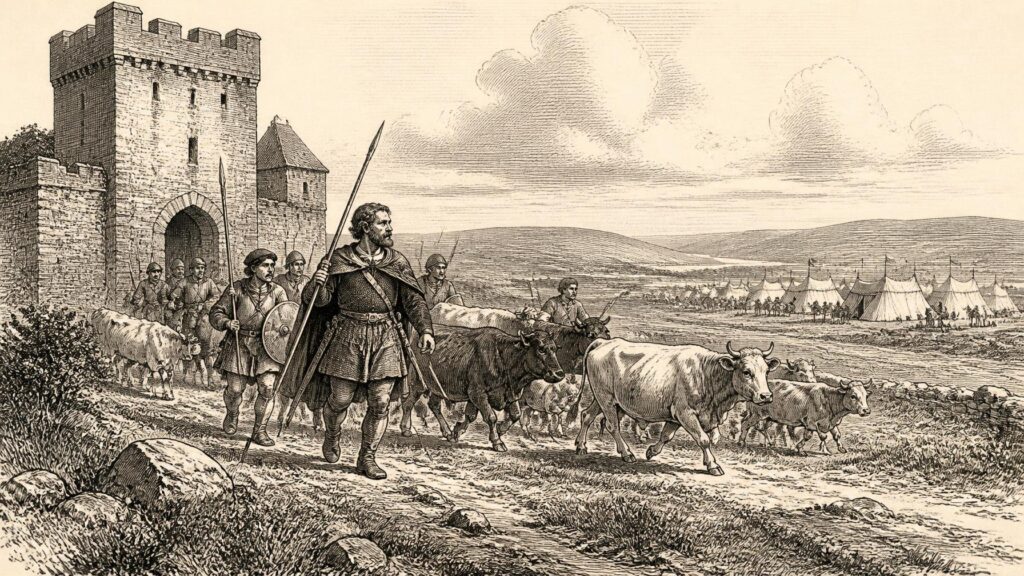
In July, James fitz Maurice led a force into Clanmaurice, the lordship of Thomas Fitzmaurice, sixteenth baron of Kerry and Lixnaw. The barons of Lixnaw were Desmond’s traditional vassals, but they had long resisted that subordination and had sought greater direct protection from the crown. James fitz Maurice plundered their lands, seized cattle as rent or redress, and besieged Thomas in Lixnaw castle. This was not a conflict between neatly opposed national or religious camps. It was a contest within the broad Geraldine world: a captain acting for an absent earl against a powerful collateral lord determined to maintain his autonomy.
The result was a serious reverse for the captain of Desmond. Short of supplies and without relief, Thomas Fitzmaurice attacked the besieging force and won a substantial victory. The episode demonstrated that the captive earl’s deputy could not simply command Munster by inherited authority. It also shows how warfare affected ordinary people. The annalistic account of campaigning around Lammas describes countryside plundered and burned, inhabitants escaping with whatever cattle they could drive to safety, and men enduring oppressive heat and drought. Livestock, grain, water and shelter were not background details: they were the resources on which both armies and households depended.
The Annals of the Four Masters preserve an unusually vivid picture of the campaign’s physical strain. The attackers established large camps around Lec-Snamha, while the defenders were pressed by heat and thirst. The annalists report that people and cattle had to drink brackish river water. Their narrative is written from a later Gaelic learned perspective and should not be mistaken for a neutral military report. Nevertheless, it records the environmental realities that shaped a summer host: moving cattle, consuming crops before harvest, drinking from uncertain water and dispersing local communities. The armed contest was inseparable from a contest for food and mobility.
Munster’s Widening Tension
The Lixnaw expedition did not itself begin the First Desmond Rebellion, which is more securely dated to 1569. It did, however, expose the political conditions from which that rebellion emerged. Late in 1568 Donal MacCarthy Mór, earl of Clancare, was acting aggressively against Lord Roche, was reportedly acquiring arms through Spanish merchants, and was making common cause with the disaffected James fitz Maurice. Across south-western Munster, therefore, the confinement of the Desmond brothers, conflict over lordship, and anxiety about royal intervention were combining.
Plans associated with Sir Warham St Leger and other English adventurers added another source of tension. St Leger had interests around Cork Harbour and was involved late in the year in projected colonial ventures. The proposed leasing and settlement of lands in Kerrycurrihy, a fertile district near Cork, was especially sensitive because James fitz Maurice regarded that barony as part of his family’s inheritance. The colony that would become a central target in 1569 should not be projected backwards as an accomplished fact in 1568. What can safely be said is that land grants, leases and schemes for English settlement were already making local claims to land feel newly precarious.
Idrone and the Butler Breach
A comparable process unfolded in Leinster. Sir Peter Carew, a Devonshire soldier and courtier, came to Ireland in 1568 to press claims derived from medieval Carew grants. These claims ranged widely and threatened Gaelic and Old English landholders alike. The most explosive case concerned Idrone in County Carlow and the adjoining territory known as the Dullough, where Sir Edmund Butler held lands. Carew’s claims were backed by Lord Deputy Sir Henry Sidney, who treated them as an instrument for extending crown authority.
On 7 December 1568, a government decree awarded Idrone and the Dullough to Carew. The decision was profoundly provocative. Edmund Butler believed that the claim to the Dullough was particularly weak, and he had unsuccessfully sought to have the matter determined through the court of chancery rather than by Sidney and the Irish privy council. By then he was already estranged from his brother Ormond, who had agreed in England during the summer to abandon coyne and livery across his territories. That customary exaction had sustained armed lordship by requiring tenants to provide food, lodging and other support to military followers. Its abolition threatened men whose influence rested on maintaining such retinues.
By November, Edmund Butler had recruited extensively, displayed a force reported at about 1,400 men in Wexford, and attacked Shillelagh in County Wicklow. The full Butler revolt lay in the following year, but its roots are unmistakable in 1568: a family rift, disagreement over military maintenance, suspicion of Sidney’s government, and a land judgement that appeared to reward an English adventurer at the expense of an established local lord.
Sidney Returns to Ulster
Sidney had been absent from Ireland from October 1567 until 6 September 1568, while the administration was conducted by the lords justices. He returned to a realm in which the crown’s power remained very uneven. In Ulster, Turlough Luineach O’Neill had emerged after Shane O’Neill’s death. Sidney reopened negotiations with him during the autumn. Turlough accepted, in principle, a limited settlement for the young baron of Dungannon on the south-eastern shore of Lough Neagh and undertook to guarantee his safety; the talks brought little more than this. They did not resolve the underlying struggle over lordship in Tyrone.
Sidney’s response mixed diplomacy with plans for infrastructure and garrisons. He surveyed Clandeboye and the Ards, treated them administratively as part of a proposed shire of Carrickfergus, and sought agreements with Sir Brian MacPhelim O’Neill. Articles dated 8 October included the construction of a carriage bridge across the Laggan at Belfast, the cutting of routes through woodland, and assistance for shipbuilding and repair on Belfast Lough. Such projects were strategic: roads, bridges, ports and fortified places would enable soldiers, officials and supplies to move through districts where crown authority depended heavily on local co-operation.
They also illuminate ordinary exchange. Sidney’s later memoir recalled a twice-weekly market at Carrickfergus supplied from the Pale, Scotland, Man and France. Cattle, eggs, hides and imported wine circulated alongside soldiers and officials. This should not be read as evidence of a peaceful or fully integrated province. Rather, it shows that frontier garrisons and coastal towns relied on regional and cross-channel trade even while government correspondence dwelt on Scottish intervention, uncertain loyalties and the expense of defence.
Church and Authority
Religion formed part of the crown’s programme, though its institutional reach was limited. Thomas Lancaster was nominated protestant archbishop of Armagh on 12 March and reconsecrated at Christ Church Cathedral, Dublin, on 13 June. The appointment reflected Elizabeth I’s determination to sustain the Church of Ireland hierarchy, but the poverty of the see and the weakness of crown control across much of Armagh meant that Lancaster could do little in his nominal province. He spent much of his time in Dublin and within the Pale. The contrast between a formal appointment and limited local power was characteristic of the year.
1568 thus ended with no single settlement. The decisive events were not all battles: a defeated siege at Lixnaw, a land decree in Dublin, negotiations on the Bann, and the continuing detention of Munster’s leading Geraldines mattered as much as any proclamation. They revealed the recurring dilemma of Tudor rule. The crown sought to replace personal lordship with law, tenure, garrisons and institutions; many Irish and Old English elites saw those measures as threats to inherited authority, property and security. The clashes that intensified in 1569 had already acquired their human, political and territorial shape.
Primary Sources
- Annals of the Four Masters, Volume 5 English Translation
- Calendar of State Papers, Ireland, Tudor Period, 1568–1571
- Calendar of State Papers, Ireland, Tudor Period, 1568–1571: Preview
- State Papers Ireland 1509–1782: Government Papers on Irish Affairs
- Fitzgerald, James fitz Maurice
- Fitzmaurice, Thomas, 16th Baron of Kerry and Lixnaw
- Fitzgerald, Gerald fitz James, 15th Earl of Desmond
- Fitzgerald, Sir John fitz James
- Sidney, Sir Henry
- O’Neill, Turlough Luineach
- O’Connor Sligo, Sir Donal
- Carew, Sir Peter
- Butler, Sir Edmund
- Butler, Thomas, 10th Earl of Ormond
- MacCarthy Mór, Donal
- St Leger, Sir Warham
- Lancaster, Thomas, Protestant Archbishop of Armagh
- Ireland Under the Tudors, Volume II
- Sir Henry Sidney’s Memoir of His Government of Ireland, 1583
- A Viceroy’s Vindication?: Sir Henry Sidney’s Memoir of Service in Ireland, 1556–1578
- The Memorandum Book of John Hooker Alias Nowell in 1568 and 1595 While Agent in Ireland to Sir Peter Carew
- The Life and Times of Sir Peter Carew, Knight