

Rathmullan’s Loaded Ship1607 CE
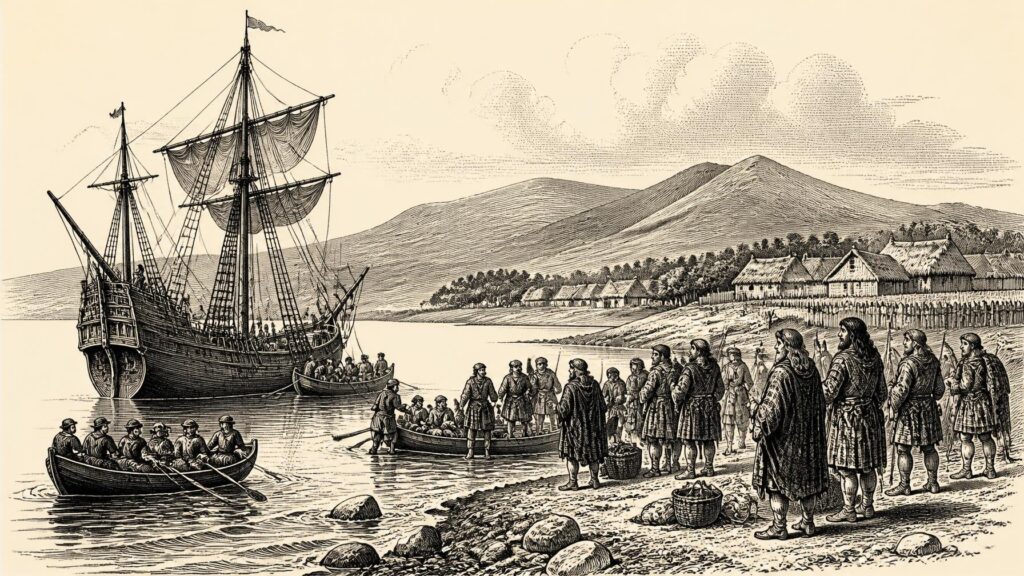
In September 1607, Hugh O’Neill, Ruaidhrí O’Donnell and Cúchonnacht Maguire left Rathmullan with families, followers and clerics, beginning the Flight of the Earls. Their departure reflected insecurity after the Nine Years’ War, as crown law, land investigations and rival Irish claimants undermined Gaelic lordship. Tadhg Ó Cianáin recorded the hazardous voyage: ninety-nine passengers sailed on a French ship, endured storms and shortages, and reached Normandy after twenty-one days. Continental Catholic communities welcomed them, but offered no assured military restoration. Their flight created an opening for stronger crown control in Ulster, preceding, rather than initiating, the later official Plantation of Ulster.
Dateline
In 1607, the most consequential Irish event was neither a battle nor a parliament but a departure. In September, Hugh O’Neill, earl of Tyrone, Ruaidhrí O’Donnell, earl of Tyrconnell, and Cúchonnacht Maguire of Fermanagh left Ulster for continental Europe with members of their families, households and following. Their journey from Rathmullan on Lough Swilly became known as the Flight of the Earls. It was not, however, the instant disappearance of Gaelic Ireland, nor did the later Plantation of Ulster begin that year. Rather, it exposed how precarious the settlement after the Nine Years’ War had become, and created the political opening from which a much more sweeping transformation would follow.
An Unsettled Peace
The earls had made peace with the crown only a few years earlier. Hugh O’Neill’s submission at Mellifont in March 1603 had preserved much of his landed position and title, while Ruaidhrí O’Donnell had been created earl of Tyrconnell later that year. Yet their accommodation with James I rested on very different ideas of authority. The government in Dublin sought sheriffs, common-law courts, fixed land titles and the direct obedience of the king’s subjects. The earls remained great regional magnates whose power had been shaped by Gaelic lordship: kinship, clientship, military service, customary dues and influence over dependent communities.
That difference was felt in ordinary, material matters. After the devastation of the war, O’Neill tried to retain or attract back dispersed tenants, whose labour was essential if Tyrone’s farms and rents were to recover. But crown officials regarded the personal control exercised by the great lords over tenants as an unlawful restraint on free subjects. Sir John Davies, the attorney general, also promoted inquiries into titles and argued that royal law should weaken the authority of chiefs while protecting lesser landholders. Disputes over church property, fisheries, lordship and land were therefore not peripheral legal quarrels: they cut into the foundations of political power and rural livelihood.
In Tyrconnell, Ruaidhrí faced an especially bitter rivalry with Niall Garv O’Donnell, who had assisted the crown during the war and held an estate in east Donegal. In Tyrone, Donnell O’Cahan, O’Neill’s son-in-law, challenged the earl’s dominance and pressed for an independent relationship with the crown. These cases showed that royal government could use divisions within leading Irish families to dismantle older territorial authority. Neither earldom was secure in the form imagined at the peace of 1603.
The Decision to Leave
The immediate reasons for the departure remain uncertain, and responsible history must leave that uncertainty visible. Government circles believed that Tyrconnell’s contacts and loose talk had implicated him in a prospective conspiracy involving Spain. The earls feared arrest and were under pressure from investigations, lawsuits and demands to answer before the authorities. Modern scholarship has not established one final explanation: the decision may have combined fear of prosecution, resentment at the erosion of their power, hopes of Catholic and Spanish assistance, and the conviction that their position in Ireland was becoming untenable. It should not be presented as a proven, carefully prepared plan for an imminent invasion, still less as a simple voluntary abandonment of Ulster.
Tadhg Ó Cianáin, a learned member of a Fermanagh family long associated with the Maguires and a close follower of O’Neill, provides the fullest surviving narrative. His account, written after the journey, is a rare Irish-language diary-like record of the party’s passage. It begins with a letter received by O’Neill on 6 September in the Gregorian calendar, telling him that a French ship awaited the earls near Rathmullan. O’Neill had recently been with Lord Deputy Sir Arthur Chichester; he took his leave and travelled north through Armagh and Dungannon towards Lough Swilly. The speed of this movement, and the secrecy surrounding it, convey a decision made under acute pressure.
Friday at Lough Swilly
On Friday, 14 September 1607 in the Gregorian calendar—the date was 4 September in the English Julian reckoning then used in official documents—the party embarked at Rathmullan. O’Neill arrived to find Tyrconnell, his followers and others loading food and drink aboard the French vessel. Cúchonnacht Maguire, the leading figure from Fermanagh, was among the principal fugitives. The company included women, children, clerics, gentlemen, servants and learned men as well as the political leaders. Ó Cianáin records that there were ninety-nine people aboard when the vessel eventually made landfall in France. That figure describes all aboard, not simply the titled exiles.
The scene was far from ceremonial. Once the ship had moved near the harbour, boats were sent ashore for water and firewood. A party from Fanad, led by the son of Mac Suibhne, confronted them; fighting followed before the boats returned with supplies. The ship then sailed in the night. Such details make clear that this was a household evacuation into danger, dependent on provisions, weather, local loyalties and the skill of a foreign crew—not merely an emblematic crossing by two aristocrats.
The passengers initially intended to reach Spanish territory, probably Corunna, but weather governed the voyage. They passed the north-west coast of Ireland, went far out to sea to avoid the king’s ships believed to be at Galway, and endured violent storms, fog and rain. After twenty-one days at sea, they landed at Quillebeuf in Normandy on 4 October. Ó Cianáin’s inventory of scarcity is striking: when they disembarked, the ship had only five gallons of beer and less than a barrel of water remaining. For families accustomed to large households and landed resources in Ulster, exile began with hunger, exhaustion and a severely depleted stock of necessities.
Exile, Faith and Learning
France allowed the fugitives onward passage but did not provide a direct route to Spain. From Rouen they travelled overland towards the Spanish Netherlands. On 15 October they left Rouen in a mixed convoy of riders, coaches, waggons and people on foot; part of the price of the journey was paid with salt carried in their ship. They reached the Irish College at Douai on 22 October, where the Franciscan Florence Conry and Robert MacArthur met them. The reception by colleges, clergy and civic elites demonstrated that the earls still possessed international Catholic standing, even though they no longer commanded territory in Ireland.
Religion gave the exile a language of purpose. The Irish Franciscan college at Louvain had only recently received papal foundation, in April 1607, and its first friars took up residence in May. The new institutions of Irish Catholic learning on the Continent could preserve clerical training, scholarship and networks when official Protestant structures were being advanced in Ireland. Ó Cianáin’s own account is steeped in Catholic observance, churches, relics, pilgrimage and Franciscan companionship. Yet this should not obscure the worldly realities: the exiles needed passports, horses, money, food, political protection and the favour of rulers whose diplomacy was constrained by peace with England.
By early November they were received with honour in the Habsburg Netherlands. At Binche, Archduke Albert and the Infanta Isabella welcomed O’Neill and Tyrconnell; at Brussels, Spanish, papal, Irish and Flemish representatives joined the reception. These ceremonies were significant, but they did not mean that a foreign army had been promised for Ireland. The hoped-for Spanish destination had already been missed, and continental hospitality was not the same as a commitment to restore the earls by force. They would not reach Rome until April 1608, beyond the limits of this year.
A Vacant Northern Order
Within Ireland, the departure immediately changed calculations of power. Chichester saw a vacuum in Ulster and favoured plantation as the means to secure the region. But it is important not to project later events backwards: the large, official Plantation of Ulster was developed and implemented after 1607, especially following the rising of Sir Cahir O’Doherty in 1608. In 1607, what existed was an opening, a rapidly hardening official response, and great uncertainty among those who had lived under or beside the earls’ lordships.
The loss was not confined to two titles. The ship carried people from networks of service, kinship, religion and learning. Ó Cianáin himself forfeited goods through his participation, though his wife was later assisted in securing them. Others remained behind: rival branches of the O’Neill and O’Donnell families, dependent tenants, clergy, craftsmen and local leaders had to negotiate a landscape in which the crown’s military and legal power now bore down more directly. Sir Toirdhealbhach O’Neill of the Fews, who did not depart, became the largest Catholic landowner in Ulster after the flight—a reminder that authority did not vanish uniformly across the province.
Elsewhere, centralisation also pressed upon civic and economic life. In 1607 Davies initiated proceedings against Waterford as part of a crown challenge to the customs privileges exercised by major Irish port corporations. This was a separate development from the crisis in Ulster, but it belonged to the same wider Jacobean effort to concentrate authority, revenues and legal jurisdiction. Thus the year’s story was not simply of a Gaelic world receding before a new one. It was of the crown testing institutions, claims and communities across Ireland while a ship from Rathmullan carried a displaced northern elite into an uncertain European future.
Primary Sources
- The Flight of the Earls
- Calendar of the State Papers Relating to Ireland, of the Reign of James I: 1606-1608
- O'Neill, Hugh
- O'Donnell (Ó Domhnall), Ruaidhrí
- Chichester, Arthur
- Davies, Sir John
- Ó Cianáin, Tadhg
- Mág Uidhir (Maguire), Cú Chonnacht Óg (‘an Comharba’)
- O'Neill, Sir Toirdhealbhach
- O'Donnell, Caffar
- O'Donnell, Sir Niall Garvach
- Conry, Florence
- O'Loughran, Patrick
- O'Doherty, Rosa
- Annals of the Four Masters: Annal M1605
- Annals of the Four Masters: Annal M1603
- The Flight of the Earls, 1607
- The Flight of the Earls, Historical Irish Corpus
- The Plantation of Ulster
- Taking Flight
- Historical Revision: XVI The Flight of the Earls, 1607
- Settlement > Flight > Plantation
- The Flight of the Earls 1607
- The Route to Rome
- The Flight of the Earls: Imeacht na nIarlaí