Ormond Return1677 CE
In 1677 James Butler, duke of Ormond, resumed the lord lieutenancy, succeeding Essex amid consequences of war, conquest and Restoration land settlement. His authority was constrained by control of revenue through Ranelagh’s undertaking, while his hoped-for parliament did not meet. Government addressed claims of 1649 royalist officers, currency regulation, night watches, local crime, fortifications and property disputes. Honours and ecclesiastical appointments reinforced Protestant authority, while Catholics remained restricted but not yet subject to later repression. Francis O’Molloy published the printed Irish grammar in Rome, exemplifying Catholic scholarship abroad. The deaths of Bellings, Lynch and Taaffe marked a passing political generation.
Dateline
In 1677 Ireland did not witness a fresh war or a meeting of parliament. Its importance lay instead in a change at the summit of government, and in the revealing routine of rule: revenue, land titles, coin, policing and urban order. On 24 August James Butler, first duke of Ormond, was sworn in once more as lord lieutenant. His third period as viceroy began amid the unfinished consequences of the civil wars, Cromwellian conquest and Restoration settlement. For most inhabitants, whether Catholic, Church of Ireland or dissenting, the issues behind official papers could be felt in taxes, property, access to authority and the security of a household or town after dark.
A Viceroy Returns
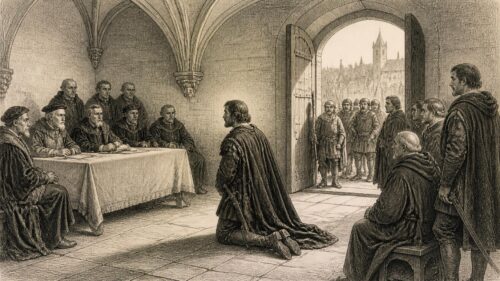
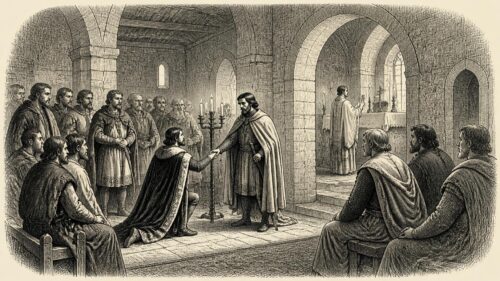
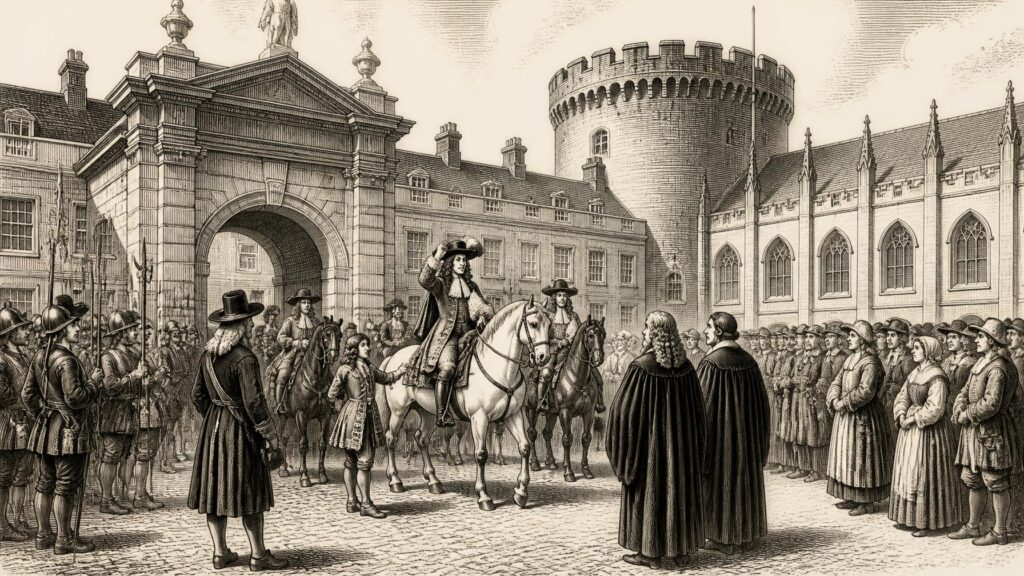
Ormond’s return was neither sudden nor uncomplicated. His reappointment had been announced on 24 May, and royal instructions for him as lieutenant general and general governor were issued on 1 August. At Dublin on 24 August, Arthur Capel, earl of Essex, the outgoing lord lieutenant, personally delivered the sword of office to him. The ceremony marked continuity in royal government, but also the replacement of a viceroy whose relationship with powerful financial interests had become deeply strained.
Ormond was an experienced, elderly and exceptionally well-connected Irish magnate. His Butler inheritance gave him a territorial presence centred on Kilkenny, while his long service to the Stuart monarchy gave him weight at court. Yet the lord lieutenant did not govern with unrestricted command. Charles II’s ministers in England, especially the lord treasurer, the earl of Danby, and Richard Jones, now earl of Ranelagh, expected to retain control over financial arrangements. Ormond’s formal authority therefore sat beside a decisive limitation: the money needed for civil administration and the army was increasingly managed through networks beyond Dublin Castle.
That limitation mattered because Ormond hoped to make his new term an exercise in repair. He wanted a parliament that might strengthen revenue, regularise land titles and support military improvement. He submitted proposals for an Irish parliament to the king on 19 July. Nothing came of them in 1677. This was more than a procedural disappointment. A parliament could have offered a public mechanism for addressing the difficult land questions left by the Acts of Settlement and Explanation. Without one, the administration continued to work through proclamations, claims, certificates, private influence and correspondence between Dublin and London.
Revenue, Land and Credit
Ranelagh’s elevation to an earldom in 1677 symbolised the standing of a man whose ‘undertaking’ had transformed Irish public finance. Under this arrangement, Ranelagh and his partners took responsibility for collecting revenue and meeting charges in return for payments promised to the Crown. It offered Charles II predictable income, but it also made Irish government vulnerable to the priorities of revenue farmers and to opaque accounts. Soldiers in particular had reason to care: arrears and the funding of garrisons were political as well as military questions.
Ormond entered office knowing that he could not avoid the issue. A surviving copy of his letter to Charles II on the state of Irish revenue is dated 24 October 1677. The existence of such an appeal captures a central fact of the year: Dublin’s chief governor was obliged to negotiate over Irish income with the king and his English advisers. Ormond could seek fiscal solvency and argue that Irish taxes should serve Irish needs; he could not simply command the funds.
Land remained equally unsettled in practice, even where legal acts had declared settlements complete. On 16 August a proclamation laid down rules for settling the security allotted to the ‘’49 officers’ – royalist officers associated with service before 1649 who claimed compensation and security after the wars. Their cases overlapped with those of adventurers, Cromwellian soldiers, restored Protestant proprietors and Catholics who had lost estates. The document did not resolve the wider moral or social consequences of confiscation. It shows, rather, that nearly two decades after the Restoration, the state was still processing the property claims generated by the mid-century catastrophe.
Smaller orders expose the same world from below. On 9 April the government declared Dutch ‘new lyon dollars’ not to be legal tender in Ireland. This single measure cannot tell us how widely the coins circulated, but it demonstrates official concern with trustworthy payment in a trading economy linked to the Dutch commercial world. On 19 December the council ordered a night watch in cities and towns. It was a modest but practical response to anxieties about theft, disorder and vulnerability in built-up places. An October order for the arrest of murderers and robbers around Rathdrum, County Wicklow, likewise indicates that government still confronted local violence through sheriffs, justices and proclamations rather than through any modern police force.
Towns, Status and Local Power
The honours granted in 1677 illuminate the social order Ormond was returning to govern. Francis Aungier became earl of Longford, Richard Jones became earl of Ranelagh, and Laurence Parsons of Birr was made a baronet. Such creations were not merely decorative. They recognised service, property and influence, while binding local elites more closely to the Crown. Aungier represented a particularly Restoration type of power: an Anglican landowner, office-holder and Dublin property developer whose estate south of the castle had already produced Aungier Street, one of the capital’s early planned suburban thoroughfares.
Kilkenny provides a more local view of negotiation between great lord and corporation. In 1677 Ormond reached an agreement with the city’s corporation concerning property and rights around the space that would become the Parade. The arrangement belonged to a longer dispute over land and authority within the town. Its significance was concrete: urban improvement, rents, building plots and civic control were inseparable from the power of the duke’s household. Restoration Ireland was not remade only through grand statutes. It was also shaped by such bargains over streets, leases and municipal privilege.
The reconstituted administration brought personnel with it. William Moreton, Ormond’s chaplain, arrived in Ireland with the viceroy and was made dean of Christ Church in December. Simon Digby became dean of Kildare during the year. These appointments reinforced the established Church’s institutional presence. William Robinson, surveyor general of buildings and engineer general, returned to Ireland before year’s end and reported on the condition of Irish fortifications. Although the details of that report are not safely recoverable from its catalogue entry alone, its commissioning fits Ormond’s stated concern for military readiness and the condition of the kingdom’s defensive infrastructure.
Churches and Confessional Boundaries
Religious life in 1677 was defined by unequal legal standing and careful accommodation, not by religious peace in any modern sense. The Church of Ireland was established and its clergy benefited from state patronage. Roman Catholics formed the large majority of the population but sustained their ecclesiastical structures under restrictions. Oliver Plunkett was Catholic archbishop of Armagh and primate of Ireland, while Catholic priests, friars and lay patrons relied on local networks, discretion and continental connections. The later crisis associated with the Popish Plot should not be projected backwards: the proclamation expelling Catholic clergy exercising jurisdiction was issued in October 1678, not in 1677.
That distinction is important. The year’s evidence does not justify portraying 1677 as the beginning of a dramatic nationwide persecution. It does show an Ireland in which Catholic religious and intellectual activity remained precarious, and in which political suspicion could readily be turned against a confessional majority excluded from the commanding institutions of the state.
A Grammar from Rome
The year’s most enduring Irish cultural event occurred outside Ireland. The Franciscan scholar Froinsias Ó Maolmhuaidh, known in Latin as Francis O’Molloy, published Grammatica Latino-Hibernica nunc compendiata at the press of the Congregation de Propaganda Fide in Rome. It was the first printed grammar of the Irish language. Written principally in Latin, it contained twenty-five chapters addressing letters, etymology, contractions, prosody and verse, and used Irish material to explain the language to learned readers.
The book was not a state-sponsored language revival. Its Roman publication instead reveals the reach of Irish Catholic scholarship in exile and the importance of continental religious institutions to Irish learning. Ó Maolmhuaidh, probably from Firceall in present-day Offaly, had entered the Franciscan college of St Isidore’s in Rome in 1632. His grammar connected Latin scholastic learning with a manuscript-based Gaelic intellectual tradition. It also preserved poetic examples and, in an Irish poem placed at the end, lamented neglect of the language. In a century of dispossession, migration and confessional pressure, printing made an Irish linguistic tradition newly portable.
Ó Maolmhuaidh died in 1677, apparently in France while travelling towards Ireland. Two other deaths lend the year a retrospective historical resonance. Richard Bellings, the Old English Catholic lawyer, Confederate official and historian, died peacefully at his estate and was buried at Mulhuddart, County Dublin. John Lynch of Galway, priest and historian writing as Gratianus Lucius, died in Brittany on 30 September. Both had spent much of their lives interpreting, defending or recording the political world broken by the wars of the 1640s. Theobald Taaffe, first earl of Carlingford, Catholic royalist soldier and diplomat, died at Ballymote, County Sligo, on 31 December.
Thus 1677 joined an administrative return to a cultural passing. Ormond’s restoration to Dublin Castle promised moderation and order, but revealed how constrained Irish government had become by finance and unresolved land settlement. Meanwhile, a grammar printed in Rome demonstrated that Irish intellectual life could survive beyond the island’s official institutions. The year was quiet only if measured by battles; in government, property, town life and language, it was a year of consequential adjustment.

Primary Sources
- Butler, James
- Copy of instructions from the King for the Duke of Ormonde appointed Lieutenant General and General Governor of the Kingdom of Ireland, Aug. 1, 1677
- Jones, Richard
- Statute Law Revision Act 2015
- Hearth Money Rolls, etc., 1662–70, 1685, 1770, 1772
- Charles II’s Irish cavaliers: the 1649 Officers and the Restoration land settlement
- Aungier, Francis
- Parsons, Sir Lawrence
- Moreton (Morton), William
- Digby, Simon
- Robinson, Sir William
- The Creation of the Parade: Ormond's Deal with Kilkenny Corporation, 1677
- Ó Maolmhuaidh, Proinsias (Francis O'Molloy)
- Grammatica Latino-Hibernica [electronic resource]
- Grammatica Latino-Hibernica
- Escaping the English: Froinsias Ó Maolmhuaidh’s Grammatica Latino-Hibernica
- Bellings (Bealing), Richard
- Lynch, John
- Taaffe, Theobald
- Bermingham, Francis
- Ormond Papers, Additional Collection: List