Fragmented Authority1331 CE
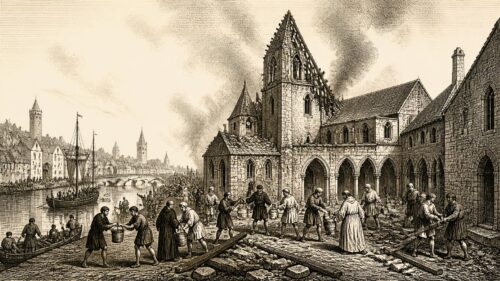
In 1331, authority in Ireland was asserted, evaded and fought over in several very different places at once. At Dublin, Edward III’s government sent a new justiciar and issued ambitious instructions for reform. In Leinster, raiders captured a royal castle and struck at the estates of the archbishop of Dublin. In Connacht, a lord abandoned secular rule for the monastery just as an army burned through his son’s territory. The surviving records do not create a complete national narrative: they are annals, administrative measures and later compilations, each with its own priorities.
Dateline
In 1331, authority in Ireland was asserted, evaded and fought over in several very different places at once. At Dublin, Edward III’s government sent a new justiciar and issued ambitious instructions for reform. In Leinster, raiders captured a royal castle and struck at the estates of the archbishop of Dublin. In Connacht, a lord abandoned secular rule for the monastery just as an army burned through his son’s territory. The surviving records do not create a complete national narrative: they are annals, administrative measures and later compilations, each with its own priorities. Yet together they show a lordship in which royal power remained formidable on paper but insecure beyond the towns, castles and allied lordships that sustained it.
A New Royal Programme
The year opened with political business in Dublin. A parliament had been summoned for January, under the outgoing justiciar Roger Outlaw. Its significance lay less in a settled legislative programme than in the difficulty of getting the great men of the lordship to attend and cooperate. Maurice fitz Thomas FitzGerald, earl of Desmond, did not attend; this was an ominous absence, because his recent accumulation of power in Munster made him a particular concern for the crown.
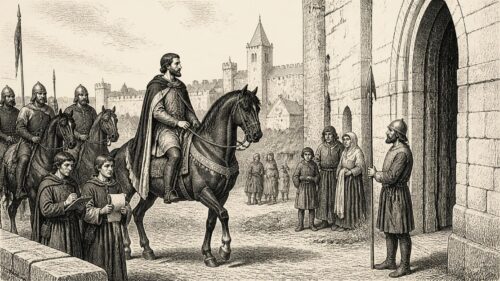
Edward III’s personal rule in England had begun only recently, after the fall of Roger Mortimer’s regime. Ireland was consequently drawn into a wider reassessment of royal grants, loyalties and officials. On 27 February, the king appointed Anthony de Lucy as justiciar. Lucy was a northern English soldier with a reputation for firmness, not a man rooted in Irish political society. He arrived in Ireland on 3 June. On 3 March, William de Burgh, the young earl of Ulster, was made the king’s lieutenant in Ireland. The two appointments were designed to work together: Lucy was to lead royal government, especially in Leinster and Munster, while de Burgh’s great affinity and landed power were expected to preserve peace in Ulster and Connacht.
The programme sent from England was strikingly broad. Among the ordinances of 1331 was a direction that there should be one law for Irish and English people, while preserving the service owed by betaghs and villeins to their lords. It is important not to mistake this for modern legal equality. The exception was fundamental: betaghs were unfree rural tenants, tied by customary obligations to lordship. Nor did the order instantly erase the separate legal practices and political realities of Gaelic Ireland. It nevertheless shows that the crown could imagine a more uniform jurisdiction, even as it acknowledged a deeply unequal social order.
Other measures sought to restrain pardons, recover royal wardships and marriages for the king’s profit, and regulate local office. Most politically dangerous was the resumption of grants made during Mortimer’s ascendancy. To those who had benefited from recent royal favour, the policy threatened lands, liberties and influence already treated as possessions. Its application helped explain why magnates who professed loyalty to the crown could view the new regime with alarm.
Raids Along the Leinster Frontier
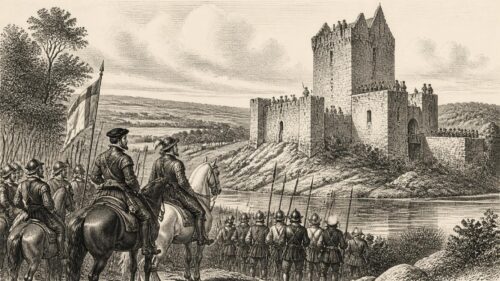
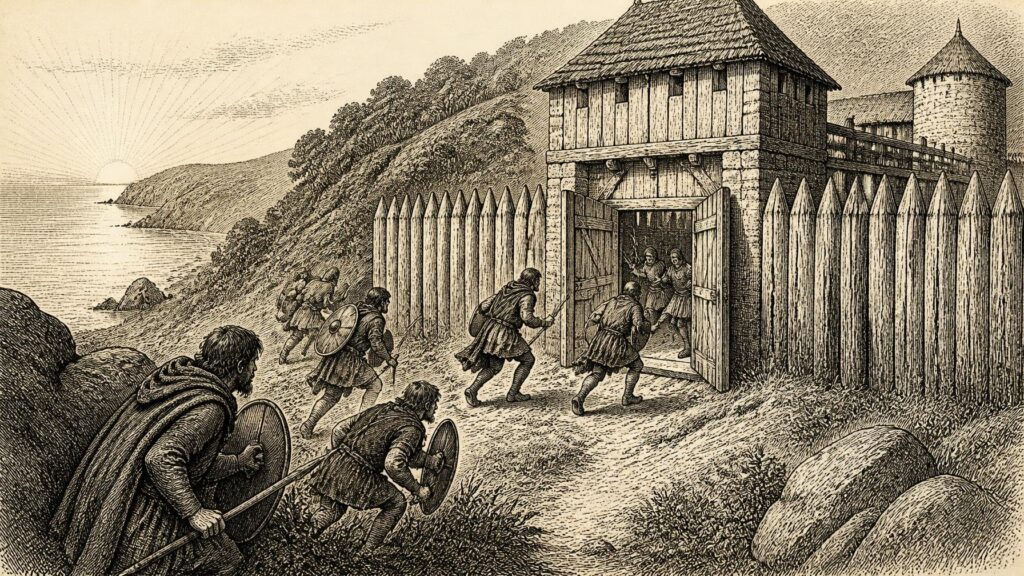
The sharpest evidence of insecurity came in the spring. The Anglo-Irish annals known as Annales Hiberniae record that men described simply as “the Irish” were killed in Hy Kinsella, in south-east Leinster, on 14 April. A week later, on 21 April, raiders took Arklow castle “by stratagem”. That wording offers no detail of the trick, and none should be invented; what matters is that a defended royal or seigneurial strongpoint on the Wicklow coast was lost through surprise rather than reduced by a conventional siege.
The same annal places a raid on Tallaght on 21 April. It attributes the action to the O’Tooles, who drove away 300 sheep belonging to the archbishop of Dublin and killed several men. Sheep were valuable portable wealth: wool, meat, milk and breeding stock made a flock an immediate prize, while its removal damaged the income and provisioning of an estate. The account also reports killings at Cullagh, naming Philip Bret, Raymond Archdeacon, John Chambers, Robert Tirell, two sons of Reginald Barnewall and others connected with the archbishop’s household. Such named casualties reveal that attacks on the approaches to Dublin touched landholders, clerics, tenants and service households, not merely soldiers.
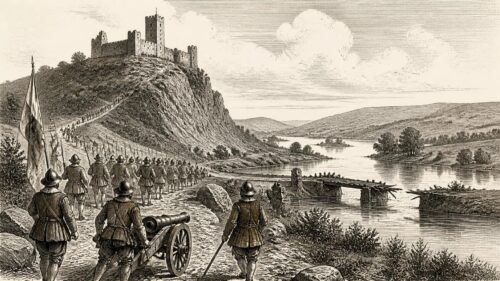
William de Bermingham led an expedition against the raiders, killing some, but the annalist says that he withdrew after deceptive promises. This was a familiar problem of frontier warfare. A mounted force could punish a raid or recover some livestock, yet its opponents knew the uplands, woods and routes of retreat. Garrisons and retaliatory expeditions did not automatically translate into durable control. Arklow’s capture was not permanent—royal forces recovered it in 1332—but its loss in 1331 exposed the weakness of castle-based authority when local alliances and intelligence failed.
Violence continued later in the year in County Wexford. The same source alleges that Leinster Irish burned widely, including churches, and describes the burning of Freynstown church with people inside. Its clerical author presents this as sacrilege and states that excommunication and an interdict followed. The language must be read critically: it is an angry account written from within the colonial church. Still, it preserves the essential point that conflict reached sacred as well as secular places, and that ecclesiastical penalties were deployed as part of the response. An engagement near Ballycarney reportedly ended with about 400 raiders killed and others drowned in the Slaney. Exact numbers in medieval battle narratives require caution, but the entry conveys a serious counterstroke by Wexford’s townsmen and local landholders.
Famine and the Dublin Bay Catch
War was not the only pressure. On 27 June, according to Annales Hiberniae, a great shoal of sea mammals termed thurlpolles entered Dublin Bay between the Conneg and the River Dodder. More than 200 were taken. The annalist explicitly says that this catch relieved an increasing famine. The precise species behind the medieval term is uncertain, so it is safer not to impose a modern identification. The episode matters because it records an emergency food supply drawn directly from the estuary and bay.
Famine did not mean that every district suffered in the same way or that food had vanished altogether. It meant severe strain in access, price and subsistence, especially for households without stores or secure lordly protection. The memory of poor weather was close: the Annals of the Four Masters place an exceptionally wet harvest in 1329, with corn remaining uncut until after Michaelmas. That entry does not prove a simple, uninterrupted national crisis in 1331, but it provides relevant recent context for a Dublin chronicler’s observation that scarcity was worsening. The remarkable catch in the bay was welcomed because ordinary channels of provisioning were failing people.
Parliament, Submission and Arrest
Lucy’s arrival did not produce immediate obedience. A parliament met at Dublin in the summer, but many lords were absent, and it was adjourned to Kilkenny. There, Maurice fitz Thomas and others eventually appeared, made their submissions and were received into the king’s peace. This was negotiation under pressure, not reconciliation between equals. Desmond had strong reasons to fear the resumption of Mortimer-era grants, while Lucy needed to establish that the crown could summon, pardon and discipline the greatest magnates.
The apparent settlement proved fragile. Following further discussions, Desmond was arrested by Lucy at Limerick on 16 August and was taken to Dublin Castle by October. The arrest was a major assertion of royal authority over a man whose political and military following reached across Munster. Lucy subsequently pursued inquiries into accusations against him. Those allegations were shaped by the politics of prosecution and should not be accepted wholesale, but imprisonment itself was unmistakable: the justiciar intended to prevent Desmond from converting local power into open defiance.
Royal action also reached Ulster and the de Burgh family. In September, Henry de Mandeville, former seneschal of the earldom of Ulster, was captured and imprisoned in Dublin Castle. In November, Earl William ordered the seizure of his cousin Walter de Burgh and Walter’s brothers, who were confined in Northburgh Castle in Inishowen. These moves were not simply the crown against “the Irish”. They were contests within the Anglo-Irish aristocracy, involving kinship, regional lordship and rival claims to command armed followings. The consequences would be grave after 1331, but in this year the crucial development was the earl’s successful effort to curb powerful rivals.
Moylurg’s Monastic Succession
Connacht supplies a different but equally revealing story. The Annals of Connacht date 1331 as a common year beginning on a Tuesday. They record that Máelruanaid Mac Diarmata, king of Moylurg in what is now north Roscommon, resigned his kingship and lordship, took the robe of a Grey Monk at Boyle, and died later. His son Tomaltach assumed the kingship on the sixth day after Bealtaine—7 May in the dating used by the Annals of the Four Masters. The transition joined dynastic politics to religious life. Entering a monastery could be a profoundly devotional act, but it also created an orderly transfer of secular authority within a ruling kindred.
The new lord’s position was tested at once. Walter de Burgh, son of William, brought a large army into Moylurg and burned the country, sparing churches, according to the annals. Tomaltach and his followers attacked, but suffered a grievous defeat with losses among the people of the territory. The Four Masters add that peace was then made and Walter departed; the Annals of Connacht emphasise Tomaltach’s determination that the losses should not go unpunished. Rather than force these accounts into a single certainty, they can be read as preserving different aspects of the episode: devastation, defeat and a settlement or pause that did not necessarily end resentment.
For ordinary inhabitants, “burning the country” meant more than a military manoeuvre. It threatened houses, crops, stored food, livestock and the labour needed to restore them. The deliberate protection of churches is also telling. Armed leaders could claim reverence for ecclesiastical sanctuary while devastating the lay population around it. In 1331, then, legal reform from Westminster, famine relief in Dublin Bay, frontier raiding in Leinster and dynastic conflict in Moylurg belonged to the same Irish world: one in which power was constantly proclaimed, contested and renegotiated on the ground.
Source References
Hover over a number to see the source. Select it to open the source.

- [1] Annales Hiberniae
- [2] CELT Project: Annales Hiberniae
- [3] Annála Connacht: Annal 1331
- [4] Annála Connacht
- [5] Annals of the Four Masters: Part 16
- [6] Annals of the Four Masters
- [7] CELT Project: Annals of the Four Masters
- [8] Annala Uladh: Annals of Ulster otherwise Annala Senait, Annals of Senat
- [9] CELT Project: Annals of Ulster otherwise Annala Senait, Annals of Senat
- [10] Annalium Hiberniae Chronicon ad annum MCCCXLIX
- [11] Lucy, Anthony
- [12] Burgh, William de
- [13] Burgh, Walter de
- [14] Mandeville, Henry de
- [15] FitzGerald, Maurice fitz Thomas
- [16] MacDermott (Mac Diarmata), Maolruanaidh (Máelruanaid)
- [17] Burgh, Sir Edmund de
- [18] Fitzrichard, Simon
- [19] Statute Law Revision Act 2007
- [20] CELT: Corpus of Electronic Texts
- [21] Annals of Loch Cé
- [22] CELT Project: Annals of Loch Cé
- [23] Exploring the Irish Annals
- [24] Table of Contents: Annals of the Kingdom of Ireland
Primary Sources
- Annales Hiberniae
- CELT Project: Annales Hiberniae
- Annála Connacht: Annal 1331
- Annála Connacht
- Annals of the Four Masters: Part 16
- Annals of the Four Masters
- CELT Project: Annals of the Four Masters
- Annala Uladh: Annals of Ulster otherwise Annala Senait, Annals of Senat
- CELT Project: Annals of Ulster otherwise Annala Senait, Annals of Senat
- Annalium Hiberniae Chronicon ad annum MCCCXLIX
- Lucy, Anthony
- Burgh, William de
- Burgh, Walter de
- Mandeville, Henry de
- FitzGerald, Maurice fitz Thomas
- MacDermott (Mac Diarmata), Maolruanaidh (Máelruanaid)
- Burgh, Sir Edmund de
- Fitzrichard, Simon
- Statute Law Revision Act 2007
- CELT: Corpus of Electronic Texts
- Annals of Loch Cé
- CELT Project: Annals of Loch Cé
- Exploring the Irish Annals
- Table of Contents: Annals of the Kingdom of Ireland