

Furnival’s Poets and Plunder1415 CE
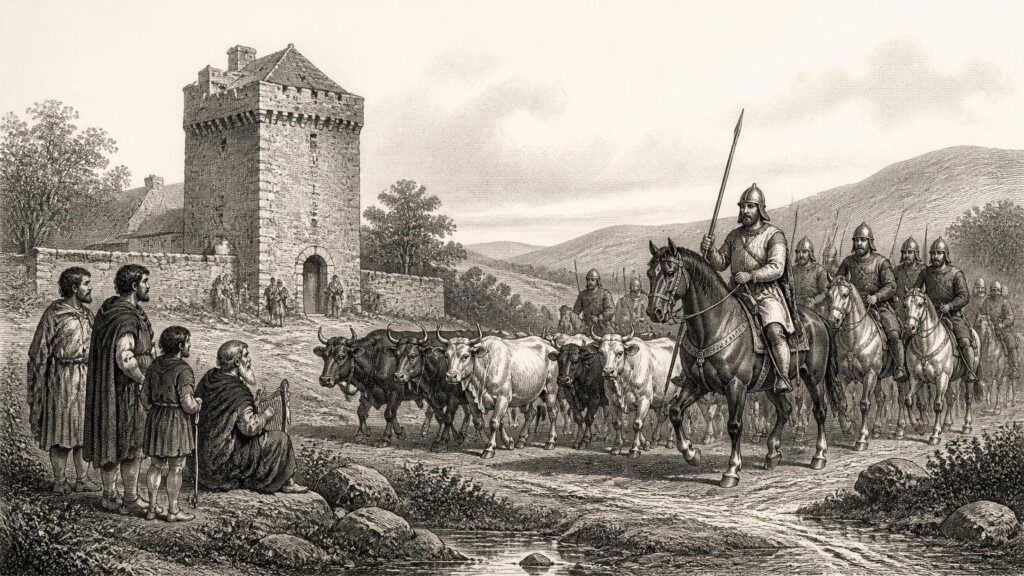
In 1415 Irish annals recorded fragmented connected conflicts across lordship Ireland. John Talbot, Lord Furnival, the king’s lieutenant, campaigned through Leix, Oriel and other districts, seizing a castle, killing or taking livestock, and executing Gerald of Geraldine descent. Chroniclers condemned his plundering of poets and alleged disregard for churches and sanctuaries. In Umhall, rivalry within the O’Malley kindred culminated in Aed O’Malley’s defeat and death, enabling Diarmait to assume the lordship. A January night attack at Cloonshee killed Tomaltach O’Birn and devastated a household. Annals noted clerical deaths, burial, capture, ransom, and cultural commemoration, depicting authority as mobile and coercive.
Dateline
The clearest contemporary-shaped picture of Ireland in 1415 is not of one national event, but of power exercised through movement: a royal lieutenant and his English following campaigning across contested districts; cattle driven away as the tangible profits of war; poets and learned men caught in the path of armed authority; and, on the Atlantic edge, an island lordship changing hands after a destructive family struggle. The year’s annals are terse, partisan and geographically uneven. Yet read carefully, and compared with one another, they reveal a country in which royal government, Gaelic lordship, church institutions and professional learning all mattered, but none was secure from force.
A Year Recorded in Fragments
The Irish annals give 1415 an unusually precise calendrical opening. Annála Connacht places 1 January on a Tuesday and identifies the year as 1415; the Annals of Ulster independently head their entry as AD 1415. Such formulae should not be mistaken for a modern diary. Most events are assigned only to a year, and the chroniclers selected what they considered memorable: deaths of lords and clergy, raids, captures, killings, successions and affronts to churches or learned people. Still, two entries do carry firm dates. Emann Mag Findbairr, prior of Inchmore in Lough Gowna, died a week before May Day, while a night attack at Cloonshee is dated 8 January. The Annals of Ulster also record the death on 11 November of Bean-Midhe, wife of Gilla-Tigernaigh Mac Gilla-Martain.
That pattern matters. Ireland was not administered or experienced as a single political unit. The lordship claimed by Henry V was strongest around the English towns, castles and lordly estates, particularly in the east; beyond and across its margins stood many Gaelic and Gaelicised lordships. Alliances could join people of differing descent and language, while warfare crossed the same boundaries. The sources for 1415 therefore offer connected local histories rather than a simple contest between two fixed nations.
Furnival’s Mobile Lordship
The year’s largest political story was the activity of John Talbot, known in Ireland as Lord Furnival. He had been appointed king’s lieutenant on 24 February 1414 and reached Ireland on 9 November 1414. Thus the annals’ statement that Furnival and many Englishmen “came to Ireland” in 1415 should not be treated as a precise record of his first arrival. It more safely describes the conspicuous presence or renewed operations of his force during the annalists’ year. The distinction is important: the sources firmly place his campaigning in 1415, but they do not warrant assigning every march to a particular day.
Both the Annals of Ulster and Annála Connacht associate him with plundering; the fuller Connacht account maps the campaign’s range. Furnival devastated Leix, territory associated with the Ó Mórdha or O’More lordship, and took a castle belonging to the son of Fachtna Ó Mórdha. He brought away slaughtered cattle, horses and other livestock from Oriel, attacked the descendants of the Bretnachs, and hanged Gerald, son of Thomas Caech, described as being of Geraldine blood. The Annals of the Four Masters preserve substantially the same sequence.
These were not incidental details. Cattle and horses were forms of wealth, sustenance and military capacity. Removing them, or slaughtering them where they stood, punished a district long after a raiding party had departed. Taking a castle signalled an attack on a lord’s capacity to shelter followers, hold goods and dominate a route or locality. Hanging a member of a politically connected family was likewise a public assertion of jurisdiction. But the evidence does not justify imagining a settled conquest of all the places named. The annals record a successful and damaging expedition, not durable incorporation into the lieutenant’s administration.
Furnival’s own position was powerful but constrained. He was the king’s officer, not an independent ruler, and the effectiveness of his office depended on men, money, supplies and local co-operation. His appointment had followed the death of Sir John Stanley; his early Irish career involved campaigning in the midlands and Ulster and obtaining submissions from some Gaelic lords. Later evidence shows that inadequate financial support repeatedly troubled his lieutenancy. In 1415, then, the sharp edge of government was a travelling armed household and its allies rather than an impersonal state operating evenly across the island.
The Poets in the Raid
What made Furnival’s operations especially memorable to Irish chroniclers was their effect on men of learning. The Annals of Ulster say directly that he despoiled many of Ireland’s poets. Annála Connacht names Diarmait Ó Dálaigh of Meath, Aed Óg Mac Raith, Dubthach Mac Eochadha Eolach and Muirgius Ó Dálaigh. In the following summer, it adds, he plundered Fearghal Ó Dálaigh of Corcomroe at Bruiden Dá Choca in Machaire Cuircne. The Four Masters, drawing on related annalistic tradition, gives corresponding names, though forms and identifications vary between editions.
This was more than colourful detail. Learned families such as the Ó Dálaigh maintained hereditary traditions of poetry, genealogy, praise, satire and historical memory. Their work depended upon patrons, households, manuscripts, cattle and protected places in which to teach and compose. An armed raid could therefore damage cultural life materially as well as personally. The annals do not say that books were burnt or that a particular school closed, so such claims should not be added. They do establish, however, that poets were sufficiently prominent for their losses to be recorded alongside the seizure of castles and livestock.
The Connacht annalist sharpened the accusation by declaring that Furnival granted protection to neither saint nor shrine during his time in Ireland. This is an annalist’s moral judgement, not a verifiable itinerary of every church he encountered. Nevertheless, it shows the standard against which power was being measured. A successful lord was expected to recognise ecclesiastical privilege and the claims of holy places, even amid conflict. The chronicler presented the lieutenant’s conduct as a breach of that expectation, making the campaign not merely harsh but disorderly.
Clare Island and the Umhall Succession
In the west, the year brought a decisive change among the Uí Mháille, or O’Malley, of Umhall. According to both the Annals of Ulster and Annála Connacht, Aed Ó Máille made major raids on Diarmait Ó Máille. Diarmait then seized “O’Malley’s island”, generally understood in this context to be Clare Island. Aed pursued him, battle followed, and Aed was defeated and killed. His son Conchobar also died, as did the son of Tomás Ó Máille and Domnall, son of Diarmait. Diarmait subsequently became Ó Máille: in the language of the annals, he assumed the leading lordship of the kindred.
The entry is a compact account of succession by force. It should not be expanded into an invented battle narrative: neither exact site, troop numbers nor the immediate sequence of manoeuvres is supplied. Its essentials are striking enough. An island, valuable for maritime movement, fishing, grazing, shelter and control of sea approaches, had become the focal point of a dispute within a coastal dynasty. Raiding provoked counter-seizure; the confrontation killed men from both sides; and victory altered who could claim the lordship.
The conflict also cautions against treating western Ireland as a passive fringe of events around Dublin. Umhall’s rulers had their own maritime and regional interests. Their contest was separate from Furnival’s recorded eastern and northern plundering, yet it belongs to the same year of fractured authority. Political change could arise from royal military intervention, as in Leix and Oriel, or from competition inside a Gaelic lineage, as in Umhall.
Winter Violence and Vulnerable Households
The most closely dated act of violence in the Connacht annal occurred on Tuesday, 8 January, the Tuesday after Epiphany Sunday. Tomaltach Ó Birn was killed in a night attack by Fergal, son of Diarmait Mag Ragnaill, at Cloonshee in Baile Elli, in the house of Mac an Dondánaigh. Lochlainn Ó hAinlige’s daughter, described as a ward of the household, was burned there. The annalist emphasised the wider destruction: cattle, buildings and corn suffered “immeasurable” damage.
The language is stark, but it also supplies an unusually valuable glimpse of what feud meant beyond the named victim. A house was not simply private shelter; it was a place of dependants, stored crops, livestock and social obligation. A night assault endangered everyone within and converted ordinary productive resources into targets. The notice does not allow us to calculate the scale of loss, yet it makes clear that elite conflict was experienced through ruined food stores, destroyed dwellings and disrupted households.
Church, Lordship and Memory
Religious life appears in 1415 chiefly through institutions and people rather than doctrinal change. The death of Emann Mag Findbairr, prior of Inchmore in Lough Gowna, shortly before 1 May marks the continuing significance of local religious communities. Diarmait Mac Diarmata, killed in the summer by the sons of Ó Conchobair Donn, was buried at Boyle monastery. Such notices show monasteries functioning as recognised places of burial and remembrance for high-status people. They do not tell us the condition of every house or parish, but they demonstrate that ecclesiastical sites remained woven into political and family life.
Other deaths and captures recorded in the annals underline the density of small lordships. Lochlainn Ó hAinlige, chief of Cenél Dobtha, was captured by Uilliam Ó Cellaig at an arranged meeting and compelled to ransom himself for 240 marks. Clasach Ó Cobthaig, praised for poetry and charity, died. These entries preserve a society in which negotiation could turn into seizure, money could secure release, and cultural reputation merited commemoration.
For Ireland, 1415 was therefore a year of coercion without political simplification. Furnival’s campaign projected the king’s authority dramatically, but it did so through devastation and confiscation whose effects were remembered as much for injured poets and affronted sanctuaries as for military success. In Umhall, a separate succession was settled violently around an island. At Cloonshee, a January attack exposed the vulnerability of households and crops. The annals leave no basis for declaring a decisive national turning point. They do preserve something more concrete: a year in which power was repeatedly made visible through cattle, castles, homes, holy places and the people charged with keeping Ireland’s learned memory.
Primary Sources
- Annála Connacht, Annal 1415
- The Annals of Ulster, Year U1415
- Annals of the Four Masters, Annal M1415
- Annals of the Four Masters, Irish Text, Annal M1415
- Annals of the Four Masters, Volume 4: Editorial and Textual Information
- Annála Connacht, CELT Project Record
- Annála Connacht, TEI Header
- The Annals of Ulster, CELT Project Record
- Talbot, John
- MacMurrough Kavanagh (Mac Murchadha Caomhánach), Art Mór
- O'Toole (Ó Tuathail), Feidhlim
- Patent Roll 2 Henry V (1414-1415), Item 141
- Patent Roll 2 Henry V (1414-1415), Item 177
- Patent Roll 2 Henry V (1414-1415), Item 90
- Memoranda Roll, 2 Henry V, Membrane 19, Item 1
- Notarial Registration of Agreement to Arbitrate
- Annals of the Kingdom of Ireland by the Four Masters, Volume 4
- Annals of the Four Masters, Volume 4 Irish Text
- Annals of the Kingdom of Ireland by the Four Masters, Volume 4 (digitised edition)
- Annals of the Kingdom of Ireland, National Library of Ireland Catalogue Record