Wexford’s Hostages, Sligo’s Books1416 CE
In 1416, Ireland remained divided among Gaelic rulers, Anglo-Irish magnates and the Dublin-centred English lordship. Art Mór MacMurrough defeated Wexford’s English settlers, securing booty and hostages in a peace settlement, while alliances involving Talbots and Butlers complicated ethnic divisions. Annals record his death in 1416, though conflicting evidence places it in 1417, creating uncertainty over succession. Raids, feuds and battles affected Connacht, Breifne and Fermanagh. Friar Brian Mac Donnchadha rebuilt Sligo’s Dominican monastery after fire. Another blaze on Church Island destroyed books, precious objects and instruments, illustrating losses to Gaelic learning. Church offices and legal expertise nevertheless endured amid violence.
Dateline
A year of victory and uncertainty
In 1416, Ireland’s political map was made not by a single government but by shifting lordships, alliances and local communities capable of defending themselves. The English crown’s lordship was strongest in and around Dublin and in scattered liberties and towns; elsewhere, Gaelic dynasties, Anglo-Irish magnates and mixed regional powers competed, bargained and raided. The year’s annalistic record is unusually revealing. It preserves a major Leinster victory over the English of Wexford, feuds in Connacht and the north-west, the rebuilding of a Dominican house at Sligo, and the destruction of books and musical instruments on Church Island in Lough Gill.
The dominant figure was Art Mór Mac Murchadha Caomhánach, usually called Art MacMurrough or Art Kavanagh in English-language sources. For decades he had been the foremost Gaelic ruler in Leinster, combining military pressure with alliances that crossed the conventional divide between “Irish” and “English”. Yet 1416 was also the year in which the record places his death. That apparent ending must be handled carefully: the annals do not agree on the date, and a fuller notice is entered under 1417. What can responsibly be said is that 1416 saw both a conspicuous MacMurrough success and the beginning of uncertainty about the succession to his authority.
MacMurrough’s Wexford stroke
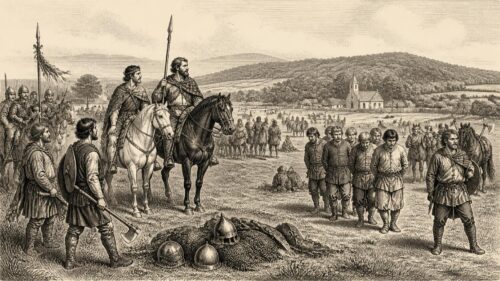
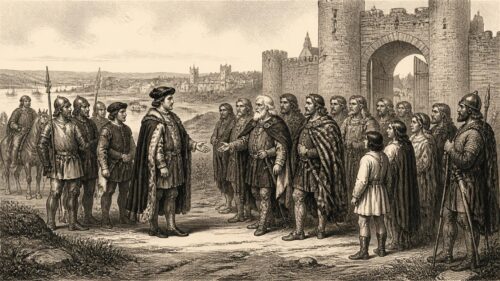
Annála Connacht records that Mac Murchadha won a “great victory” over the Galls, or English settlers, of County Wexford. It puts the loss at seventeen score—340 people killed or captured—and says that the amount of booty could not be reckoned. The Annals of the Four Masters, compiled much later from earlier materials, gives the same figure and adds an important detail: on the following day peace was made and hostages were delivered to MacMurrough. The precise location, date and course of the fighting are not supplied, so it would be wrong to turn the entry into a named battle. Its political meaning, however, is clear enough. A victory of that scale enabled MacMurrough to impose terms upon the Wexford community rather than merely raid it.
The conflict belonged to a wider Leinster contest. Wexford formed part of the Talbot liberty, while John Talbot, Lord Furnival, had been lord lieutenant in Ireland since 1414. Art’s heir, Donnchadh MacMurrough, was connected by marriage to the Butler interest: he married Aveline Butler, half-sister of James Butler, fourth earl of Ormond. The Talbots and Butlers were rivals, and this helps explain why a Gaelic king of Leinster could find common cause with the Butlers against a Talbot possession. It is a useful corrective to a simple picture of two opposed ethnic blocs. Political advantage, kinship, land and local security mattered at least as much as ancestry.
The reported hostages are especially significant. Hostage-giving was a practical guarantee for agreements: selected persons, often of rank, were placed in another lord’s keeping to secure future conduct. The annal does not reveal who they were or how long they remained in custody. Still, their delivery shows that the settlement was intended to bind the defeated side. Captives, horses, arms and livestock were not incidental trophies in such warfare. They were transferable wealth, bargaining tools and visible proof of a lord’s capacity to reward followers.
Another entry, in the Annals of the Four Masters, says that Ó Conchobair Fhailghe inflicted a major defeat on the English of Meath and took prisoners, horses and armour. The same compilation then notes that “many Saxons” came to Ireland. It does not explicitly state that these arrivals were reinforcements for Meath, Wexford, or any particular campaign, and they should not be treated as such. Together, though, the notices show that the frontier between the Dublin-centred lordship and its neighbours remained militarised and unstable.
The disputed death of a Leinster king
Both Annála Connacht and the Four Masters enter Art’s death under 1416. They say he died in his own stronghold after a “victory of repentance”, the conventional religious language used for a penitent Christian death. Annála Connacht calls him the foremost choice of the Gaels of Ireland for generosity and valour; the Four Masters similarly praises his hospitality and prowess. Such phrases are not neutral biography. They reveal the standards by which an Irish lord was remembered: martial effectiveness, open-handed hospitality, patronage and a death reconciled with God.
Yet the following annal-year complicates the chronology. Under 1417, the Four Masters again records Art’s death, placing it a week after Christmas and reporting an alternative story that he and the chief brehon of Leinster, Ó Dóráin, were poisoned at Ros Mic Brióin. Modern scholarship therefore gives his death as 1416 or 1417 rather than claiming a secure day. The 1416 entries are best understood as evidence that news of his death was associated with that year in one annalistic tradition; they do not settle the question conclusively.
Donnchadh succeeded as MacMurrough leader, but his position was less secure than his father’s had been. That later development should not be projected backwards as though it were already decided in 1416. At the close of this year, Art’s Wexford victory still demonstrated formidable power. His death—or the first recording of it—nonetheless removed the man whose personal authority had held together a wide Leinster network of clients, allies and kinsmen.
War among neighbours
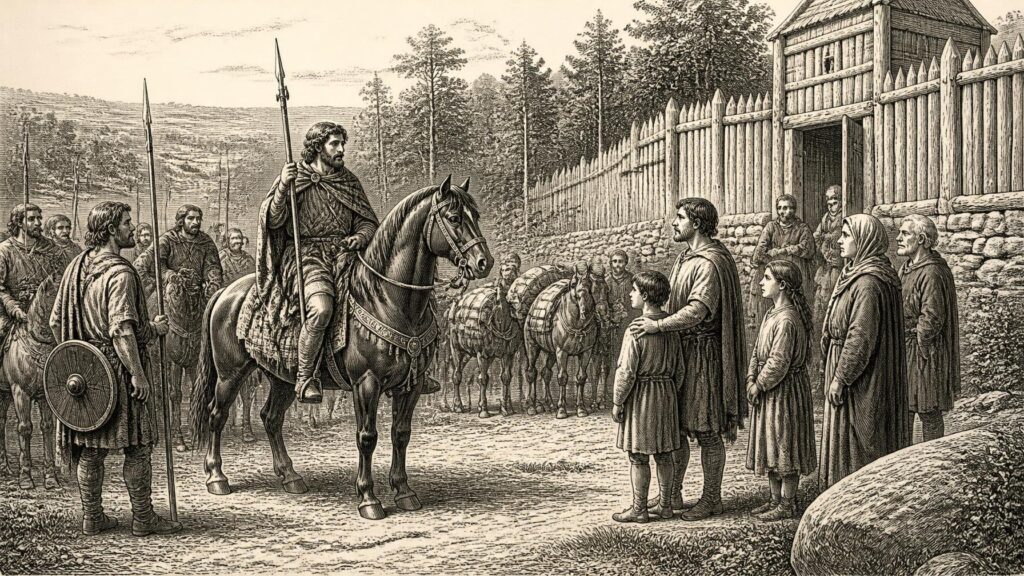
The year’s notices from Connacht, Breifne and Fermanagh show that warfare was not confined to the Pale frontier. Mac Jordan d’Exeter attacked the sons of Seán Ó hEaghra in north Connacht. Ó hEaghra, Turlough Carrach Ó Conchobair and the cavalry of Carbury met the advance party; Ó hEaghra was killed and several men wounded or slain. But the country people then assembled in pursuit, routed Mac Jordan’s force and killed Mac Jordan himself. The sequence captures the uncertain rhythm of a raid: an initial clash, seizure of prey, mobilisation by those affected, and a counterattack.
In the west, Edmund Burke captured Mac Feorais, or Bermingham, another reminder that families of Anglo-Norman origin were thoroughly embedded in regional Irish politics and fought one another as readily as they fought Gaelic neighbours. Among the Clann Donnchadha, raiding between rival branches escalated into the killing of named kinsmen. In Umhall, on the Atlantic coast of modern County Mayo, Tuathal Ó Máille was killed by the sons of his own brother. These are concise entries, but they underline the vulnerability of lordship to internal rivalry.
Further north, Fir Manach and Fir Brefne were at war. Cathal Ó Ruairc supported the Fermanagh side, while Tadhg and Domhnall Ó Ruairc opposed him. One encounter ended in a damaging defeat for followers of Aed Mag Uidhir and Cathal, with horses captured; a later fight at a place rendered as Dogs brought the deaths of two Ó Ruaircs and forty-eight Fermanagh men. The figures should be treated as those reported by the annalist, not as modern battlefield statistics. Even so, the naming of horses, gallowglasses and pursuing parties gives a glimpse of mobile regional warfare centred on cattle, routes, retainers and family claims.
Church, learning and fire
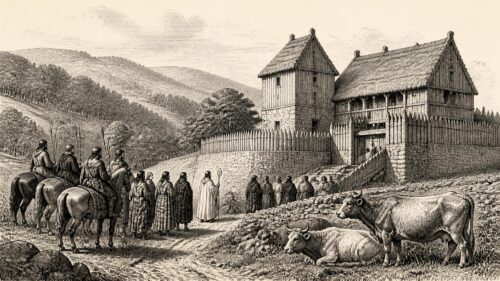
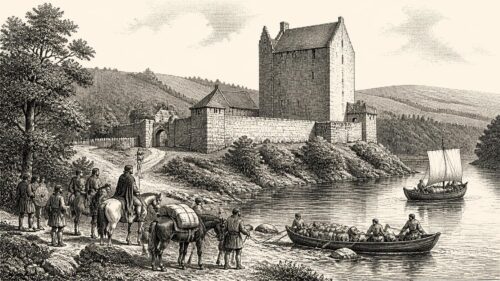
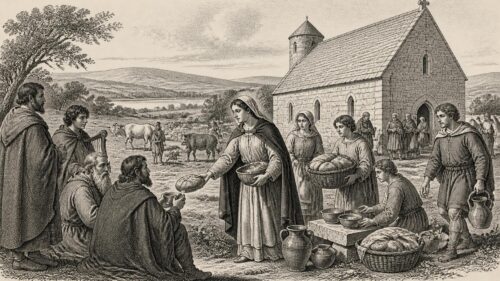
Conflict and accident also affected religious and learned institutions. At Sligo, Friar Brian Mac Donnchadha rebuilt the Dominican monastery, which had been damaged by an accidental candle fire in 1414. The rebuilding is firmly placed in 1416. It demonstrates that friaries were not simply places of worship: they were substantial buildings requiring skilled labour, patronage, materials and organised resources. Sligo’s Dominican house stood in a town with connections across Connacht and the north-west, so its restoration mattered to a wider religious and urban community.
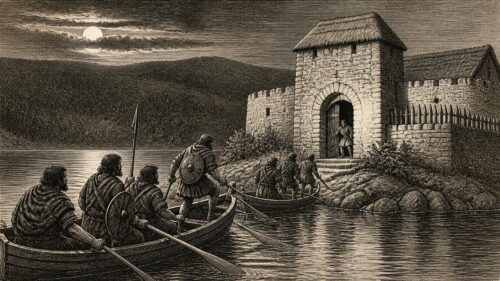
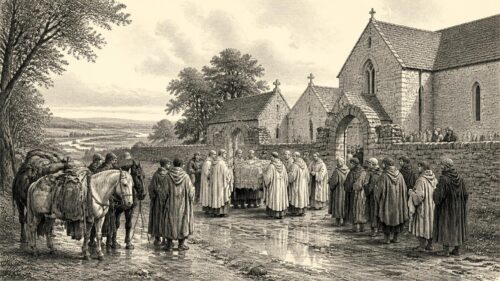
The loss at Church Island on Lough Gill was more intimate and irreplaceable. Annála Connacht says that a church there was burned, destroying Ó Cuirnín’s books, including the Lebar Gerr of the Muintir Cuirnín, together with valued possessions: an ornamental cup, a timp or stringed instrument, and a harp. The entry preserves a rare inventory of the material world of Gaelic learning. Books, liturgical or ceremonial metalwork and musical instruments were all kept in or associated with the church. Their destruction was therefore more than damage to a building; it was a blow to memory, status, performance and inherited learning.
The annals also record the death of Tomás Mac an Óglaigh, erenagh of Killery and chief master of law in Connacht. An erenagh was a hereditary ecclesiastical officeholder, often responsible for church lands and local religious obligations. His description as a leading master of law points to the continuing prestige of learned families and professional legal expertise. Ireland in 1416 possessed no single uniform administration, but it did possess trained interpreters of law, genealogists, poets, clerics and other specialists whose knowledge helped order society.
At Ardagh, the bishop Adam Lexid was burned at Rathaspick in the autumn, according to Annála Connacht. Its sharply hostile description of him as an outsider and an inhospitable friar reflects the annalist’s viewpoint and should not be repeated as fact. What is securely reported is that Conchobar Ó Fearghail was then chosen by the chapter of Ardagh, with the approval attributed to the learned men of Ireland. The episode shows both danger and continuity: a violent death did not prevent the cathedral chapter and regional learned networks from acting to fill the see.
What 1416 reveals
For ordinary people, the year’s raids, burnings and changing allegiances meant immediate risks to crops, stock, houses, churches and travel. The sources chiefly name lords, clerics and learned men, but they also occasionally reveal wider participation: “the people of the whole country” pursued Mac Jordan’s raiders, while booty and prisoners feature repeatedly. These were not distant aristocratic quarrels. They drew upon local food supplies, horses, labour and knowledge of terrain, and their consequences were felt far beyond the leaders named in the annals.
Thus 1416 was not merely the final year attached to Art MacMurrough in one tradition. It was a year in which military authority could still force Wexford into a hostage-backed peace; in which religious communities rebuilt after fire; and in which the destruction of a small island church could erase books, music and precious objects. Ireland’s political landscape remained fragmented, but it was not static. Its connections—through marriage, hostages, learned offices, friaries and contested roads—were active, resilient and often violently tested.
Primary Sources
- Annála Connacht: Annal 1416
- Annála Connacht: Bibliographic and Manuscript Information
- The Annals of Ulster: Year U1416
- Annals of the Four Masters: Annals 1414–1422
- Annals of the Four Masters
- CELT Project: Annals of the Four Masters
- Annals of the Four Masters: Irish Text
- Annals of the Four Masters: Electronic Edition Information
- Annals of the Kingdom of Ireland, Volume IV
- MacMurrough Kavanagh (Mac Murchadha Caomhánach), Art Mór
- O'Byrne (Ó Broin), Donnchadh
- O'Byrne (Ó Broin), Sir John
- Sligo Abbey
- The Gaelic Learned Tradition
- Dominicans in Ireland — History of the Order
- Sligo Abbey Highlights
- Annales Breves Hiberniae
- The Annals of Ireland from A.D. 1171 to A.D. 1616
- Annals of the Four Masters: CELT Edition
- Annala Rioghachta Eireann: Annals of the Kingdom of Ireland