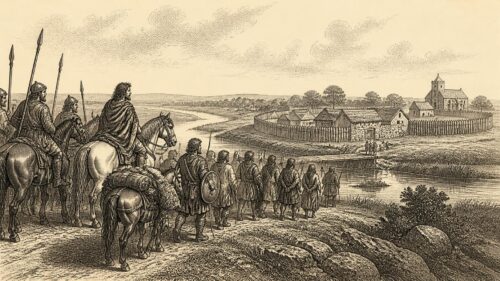
Claregalway’s Broken Parley1335 CE
In 1335, Ireland was divided among competing Gaelic lordships, settler families, church jurisdictions, towns and royal officials. On 4 May, Lysaght Ó Mórdha’s household killed Sir Raymond le Ercedekne, relatives and allies at a meeting near Claregalway, an exceptional blow memorialised at Kilkenny. Connacht suffered raids, plunder and uneasy reconciliation amid de Burgh fragmentation after 1333. Sir John Darcy mobilised Irish ships, nobles and taxation for Edward III’s Scottish war, raiding Arran and Bute. Local warfare, captures and church disputes continued. Heavy spring snow harmed birds throughout Ireland, while devotional practices and hereditary learning, including physician Gilla-na-nAingel Ó Casaide, persisted.

Dateline
In 1335, Ireland’s political landscape was marked less by any single authority than by competing lordships, family alliances and local armed power. The most sharply dated Irish event of the year was a killing at a meeting recorded as taking place at Clar-Goly, generally identified with Claregalway. Elsewhere, Connacht endured destructive conflict among the de Burgh kindred and their allies; the Dublin administration raised men, ships and money for a campaign in Scotland; and churchmen, townspeople, physicians and learned households continued to shape public life. A severe spring snow, remembered for killing small birds across Ireland, offers a rare glimpse of weather entering the record alongside warfare and politics.
A Meeting Turned Deadly
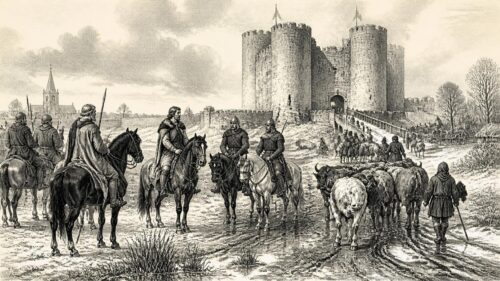
Thursday, 4 May is the clearest date attached to an event in Ireland that year. Friar John Clyn, the Franciscan annalist writing from Kilkenny, states that Sir Raymond le Ercedekne, his sons Patrick and Sylvester, Sir William le Ercedekne and eleven further members of the Archdeacon family were killed by Lysaght Ó Mórdha, his sons and household at a parliamentum at Clar-Goly. Thomas de Bathe, Gerald Bagot and others also died, bringing the reported total to about fifty. The word parliamentum could describe a meeting, conference or parley rather than a formal representative parliament in the later sense. Clyn supplies no secure explanation for the gathering, so it would be unsafe to assign a particular dispute or breach of terms to it.
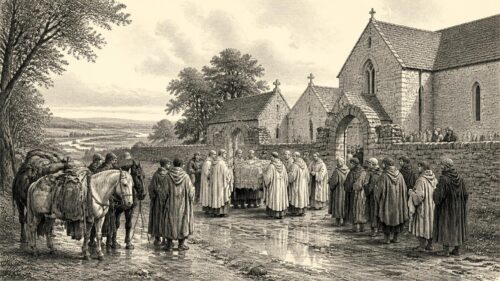
Its consequences, however, were immediately visible in the annalist’s account. Raymond, his two eldest sons, his uncle Sir William and three other Archdeacons were carried through Kilkenny in seven coffins, amid public lamentation, for burial at the Franciscan friary. The procession reveals the reach of elite kinship and religious institutions: a violent encounter in the west was memorialised in one of the leading towns of the English lordship. It also shows why labels such as ‘English’ and ‘Irish’ are too blunt to explain the politics of the period. The victims belonged to a long-established settler family with lands and influence in Leinster, while Ó Mórdha was a powerful Gaelic lord of Laois. Yet each operated through local relatives, retainers, clients and negotiated meetings. Violence did not replace politics; it was often what followed when political dealings failed.
The Claregalway killings were part of a wider atmosphere of insecurity across the lordship’s borderlands. Later developments should not be read backwards as inevitable, but Clyn’s contemporary record makes clear that the destruction of so many members of one affinity in a single encounter was an exceptional shock. It exposed the vulnerability even of armed knights when travelling to negotiations beyond their immediate bases of support.
Connacht Under Pressure
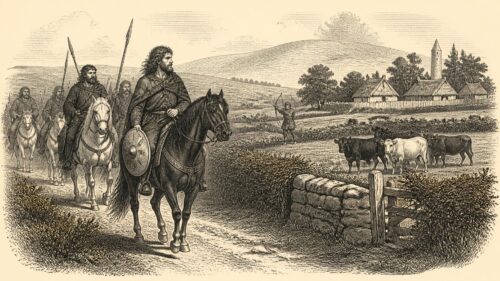
Connacht’s annals show how warfare could be both familial and regional. Findguala, daughter of an Ó Briain and wife of Toirdelbach Ó Conchobair, died during the year: a brief notice, but one that hints at the political importance of marriages linking leading dynasties. Seoán, son of Art Ó hEaghra, was captured by the earl’s son, and much of his people’s property was plundered. Such entries are reminders that captivity, livestock seizure and the taking of movable wealth were routine instruments of power, not incidental disorder.
More extensive damage followed from conflict involving the de Burghs. The sons of Domnall Ó Conchobair raided the descendants of Muiris Sugach FitzGerald and killed Mac Muiris’s son; the Clann-Maurice retaliated. At the same time, the annals report that Edmund Burke devastated western Connacht, carrying out raids, burnings and killings against the earl’s son and the descendants of Richard Burke. A peace was subsequently made. The wording matters. The sources record reconciliation, but not a durable settlement or a final victory.
This struggle belonged to the fractured world left by the murder of William de Burgh, earl of Ulster and lord of Connacht, in 1333. His death had weakened the great comital framework through which Connacht had been governed. By 1335, branches of the de Burgh family, Gaelic dynasties and mixed retinues could make or break local authority. The destruction described in the annals therefore had economic as well as military meaning: raids threatened cattle, grain, dwellings, dependants and the ability to collect rents or food-renders. Even where peace followed, communities had to rebuild stores and relationships.
Drogheda and the Scottish War
While Connacht and Leinster faced their own conflicts, Ireland was drawn into Edward III’s war against Scotland. On 8 May the king sought financial help from Ireland’s clergy, towns and political elites. The justiciar, Sir John Darcy, organised an expedition to support the English campaign. The recruitment demonstrates that the royal administration could still assemble a substantial maritime force, though not that it exercised equal control across the island.
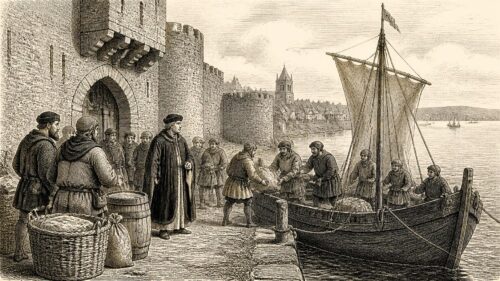
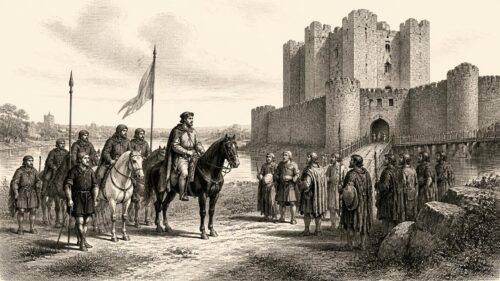
Clyn records that, after the feast of the Assumption of the Virgin on 15 August, Darcy crossed to Scotland with James Butler, earl of Ormond, Maurice fitz Thomas, earl of Desmond, and other Irish nobles in fifty-six ships. Surviving administrative evidence confirms the scale of the preparations: ships had to be found and provisioned, wages arranged, equipment repaired and magnates summoned. Desmond’s contingent was delayed at Drogheda by a shortage of shipping, a practical problem that makes the port’s role especially visible. Drogheda was not simply a market town; it was a point at which royal military planning depended upon sailors, vessels, stores, credit and local labour.
The expedition reached the islands of Arran and Bute. Clyn says that the Irish force plundered, burned and subdued them, took hostages, and returned to Ireland without loss. Other evidence indicates that Rothesay Castle on Bute resisted the assault. It is therefore better to regard the enterprise as a hard, limited maritime operation rather than a decisive conquest. Its importance lay in what it demonstrated: an Irish-based force could be mobilised for war across the North Channel, linking the affairs of the lordship directly to the wider conflict between the English crown and Scotland.
The campaign also imposed a cost at home. Clyn states that two shillings were levied from each ‘peaceful’ carucate, while the clergy gave a tenth of their goods and cities and larger towns provided a subsidy requested by the king. The chronicler carefully notes that this was not to create a precedent or customary charge. That qualification suggests contemporary anxiety about extraordinary taxation. The word ‘peaceful’ is equally revealing: collection was envisaged where royal authority and settlement made it possible, not uniformly throughout Ireland.
Raids, Church Authority and Public Devotion
Violence remained close to everyday government after the Scottish force had departed. In October, James Butler entered the lands of the Ó Broin of Duffry, plundering and burning there. On the same expedition he knighted Fulk de la Freyne, who in turn knighted Gregory de la Launde and Matthew, son of Oliver. Knighthood was not merely ceremonial. It publicly bound men into military status and lordly service in a landscape where armed followings mattered.
In November, Clyn records the capture of Richard de Marreis, Robert Travers and Robert, son of David, by the Ó Cearbhaill, together with the killing of John le Brit and others. Such terse notices do not permit a full reconstruction of the dispute, but they show that hostage-taking and capture remained central features of conflict. A prisoner could be a means of coercion, a source of ransom, or a bargaining counter in negotiations.
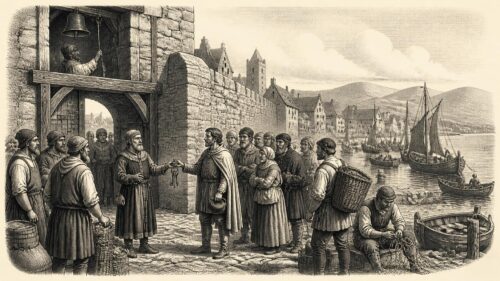
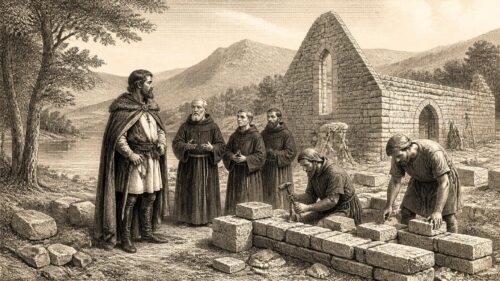
The church was also a field of authority and dispute. On the feast of St Vincent, 22 January, Archbishop Alexander Bicknor of Dublin began a metropolitan visitation of Ossory, which Clyn says had not been visited in this manner for forty years. A visitation allowed an archbishop to inspect clergy, institutions, discipline and revenues. It was an assertion of jurisdiction in a diocese whose bishop, Richard Ledrede, was absent amid a long-running conflict with Bicknor. The event should not be mistaken for quiet religious administration: ecclesiastical rights, income and political influence were deeply connected.
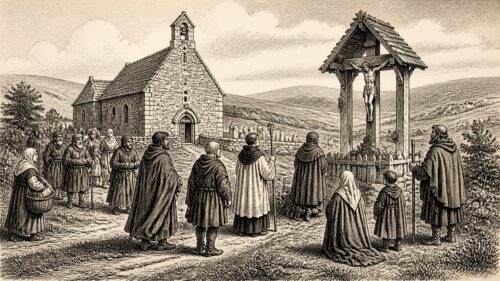
At Kilkenny, a large cross was raised in the middle of the market place on the day after St Lucy’s feast in December. Clyn adds that many people seeking the cross were branded on bare flesh with a hot iron in order to go to the Holy Land. His report is striking but isolated; it does not prove that a substantial Irish crusading expedition actually left in 1335. It does show that crusading devotion and the ideal of pilgrimage remained intelligible and compelling in an Irish town otherwise preoccupied with local war, taxation and lordship.
Snow, Learning and Continuity
Annála Connacht records heavy snow in spring which killed most of the small birds of Ireland. The phrase is plainly broad and cannot be converted into a modern measurement of temperature or mortality. Yet its inclusion suggests an event memorable enough to be understood as island-wide. For rural households, severe late snow could affect grazing, travel, planting and fodder as well as wildlife. In a year already marked by raiding, a difficult spring could sharpen the vulnerability of communities dependent on livestock and seasonal labour.
Learning and specialist service nevertheless endured. The Annals of the Four Masters place in this year the death of Gilla-na-nAingel Ó Casaide, chief physician of Fermanagh. The notice is short, but its terminology is important. A recognised chief physician belonged to a hereditary world of medical expertise attached to powerful households, alongside poets, legal scholars and clerics. Ireland in 1335 was not simply a landscape of castles and raids; it was also sustained by professional knowledge, patronage and the institutions that preserved them.
By the year’s end, the island had experienced a disastrous parley, regional devastation, an overseas campaign and extraordinary fiscal demands. None produced a unified Irish response. Instead, 1335 reveals several political worlds operating at once: Gaelic lordships, settler lineages, church jurisdictions, towns and the crown’s administration. Their connections were real, but so were their limits. Claregalway’s broken meeting and Drogheda’s Scottish muster capture that tension particularly well: authority could travel far, yet it remained precarious wherever trust, ships, money or armed protection failed.
Primary Sources
- Annalium Hiberniae Chronicon ad annum MCCCXLIX
- CELT Project: Annalium Hiberniae Chronicon ad annum MCCCXLIX
- Annála Connacht, Annal 1335
- Annála Connacht (Irish text)
- Annals of the Four Masters, Annal M1335
- Annals of the Four Masters (Irish text)
- The Annals of Ulster, Year U1335
- Annala Uladh: Annals of Ulster otherwise Annala Senait, Annals of Senat
- Materials for the History of the Franciscan Province of Ireland, A.D. 1230–1450
- An Irish Expedition to Scotland in 1335
- Darcy, Sir John
- Bicknor, Alexander
- Clyn, John
- Bermingham, Walter
- Claregalway Franciscan Friary
- Extremes of Weather Recorded in the Annals of Connacht, 1224–1562
- The Crusades to 1291 in the Annals of Medieval Ireland
- The Annals of Ireland by Friar John Clyn: Edited and Translated with an Introduction by Bernadette Williams
- Irish Expeditionary Force, 1335
- The English Armies of Edward III, 1335–1360
- Parchment Conquest, 1171–1307
- Irish Annals Search