Tomaltach’s Tuam1279 CE
In 1279, Ireland’s fragmented political and religious worlds were marked by leadership changes, local violence and expanding lordly authority. Archbishop Tomaltach Ó Conchobair of Tuam died after two decades in office, while killings among Connacht kindreds exposed persistent dynastic rivalry. Robert of Ufford’s administration strengthened castles at Roscommon, Rindown and Athlone, increasing demands upon surrounding communities and anticipating monetary reform. In Thomond, Thomas de Clare pursued settlement and castle-building at Quin amid Ó Briain resistance and continued campaigning. Elsewhere, aristocratic penitential burial, monastic patronage, learned tradition and a Tipperary land lease demonstrate ecclesiastical, cultural and agricultural life alongside conflict daily.
Dateline
A Year Recorded in Several Registers
The evidence for 1279 is unusually revealing precisely because it is uneven. Irish annals preserve a cluster of deaths, killings and ecclesiastical notices in Connacht and the north; a southern chronicle records a final religious act by a Mac Carthaig nobleman; administrative and later narrative material places royal and lordly power in motion from Dublin to Thomond. None yields a single, island-wide story. Together, however, they show an Ireland in which archbishops, regional kings, lordly armies, castle builders, tenants and moneyers inhabited overlapping but very different political worlds.
The firmly dated events of the calendar year should be kept distinct from retrospective narratives and from developments spanning several years. In particular, the killing and destruction associated with Quin appears in annals under 1278 and 1280, while a later Thomond narrative assigns a campaign to 1279. That sequence matters. It is safer to see 1279 as a year in which Thomas de Clare’s effort to establish himself in Thomond was being pressed forward amid active resistance, rather than to attach every remembered clash at Quin to one confidently dated day.
The Death of Archbishop Tomaltach
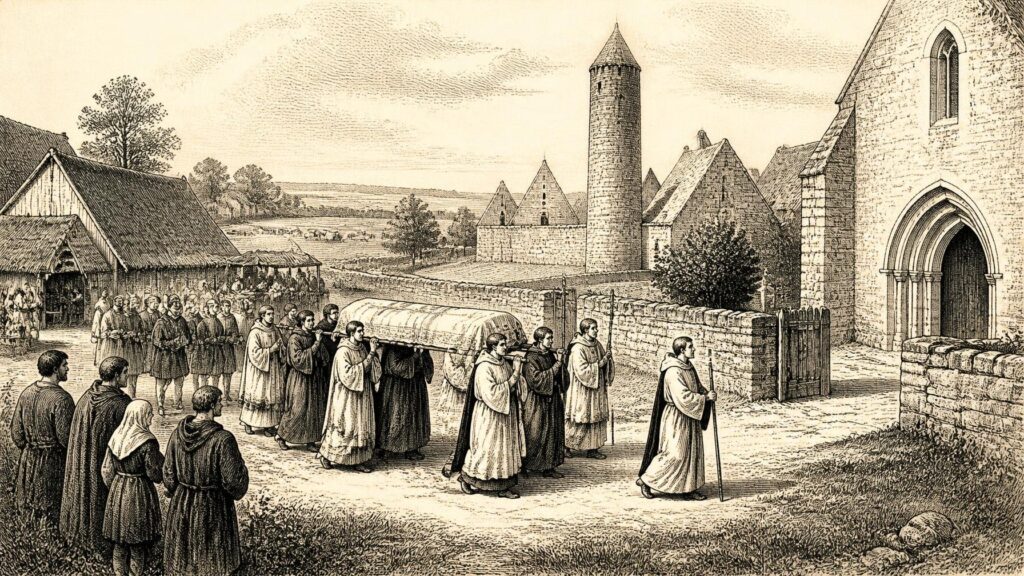
The clearest major event was the death of Tomaltach mac Toirrdelbaig Ó Conchobair, archbishop of Tuam. Annála Connacht enters his death under 1279 and praises him as pre-eminent in Ireland for wisdom, learning, generosity, nobility and the distribution of valuables. The Annals of the Four Masters, compiled much later but drawing on annalistic material, likewise calls him exceptionally distinguished for learning, knowledge and charity. Such formulae are conventional, but their unusually full character signals the standing expected of an archbishop who was both a senior churchman and a member of the dominant Connacht dynasty.
Tomaltach had been archbishop since 1259, after serving as bishop of Elphin. His death therefore removed a figure with two decades of experience in a province where ecclesiastical office, dynastic affinity and political negotiation were closely connected. Tuam was not simply a place of worship. As the metropolitan see of Connacht, it stood within networks of clergy, churches, tenants, tribute and learned personnel, while its archbishop had to maintain authority among powerful secular kindreds. The annalists’ emphasis on hospitality and gifts should not be read as ornamental praise alone: generosity was a public political virtue, creating followers and obligations as well as assisting religious communities and poorer dependants.
There is no securely recorded single national consequence from Tomaltach’s death in 1279, nor should one be invented. But the vacancy was important in Connacht at a moment of recurrent succession disputes and expanding royal intervention. The death of a respected archbishop could alter the balance of influence around Tuam without ending the institutional life of the see.
Violence Within Connacht
The Connacht annals record other losses that make the year feel politically tense. Máel Sechlainn, son of Toirrdelbach Ó Conchobair, was killed, as was Conchobar, son of Diarmait son of Magnus Ó Conchobair. The notices do not explain every motive or identify a single wider campaign. Their value lies partly in showing how readily conflict reached men of the ruling Ó Conchobair kindred. Connacht’s kingship was not transmitted by an automatic rule of primogeniture; competing branches could make plausible claims, and violence, hostage-taking, alliance and negotiated recognition all formed part of political life.
Other entries are more local but no less revealing. Murchad Ó Nechtain was killed by Domnall Ó Nechtain. Robert Ó Nechtain, Murchad’s brother, then challenged Domnall and was himself killed in the resulting encounter. Domnall, son of Gilla Crist Ó Nechtain, was also killed by Áed Ó Conchenainn. These brief entries expose the scale on which lordship was lived: not only through provincial kings and famous castles, but through rival kin-groups defending honour, cattle, land and followers in their own districts.
The death of Gilla in Choimded Ó Cerballáin, bishop of Cenél nÉogain, belongs to the same annalistic year. It is a reminder that the church’s personnel were dispersed through regional societies rather than confined to the great archiepiscopal centres. The record provides no reason to connect his death to the Connacht killings. The responsible conclusion is narrower: 1279 brought changes of leadership in both secular and ecclesiastical communities across a wide geographical range.
Royal Government and Connacht’s Castles
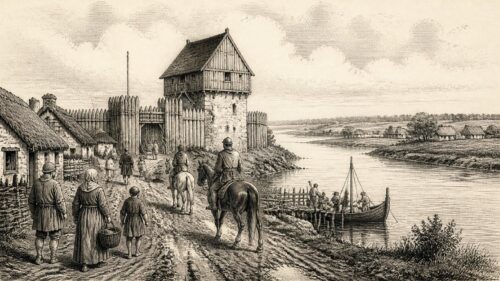
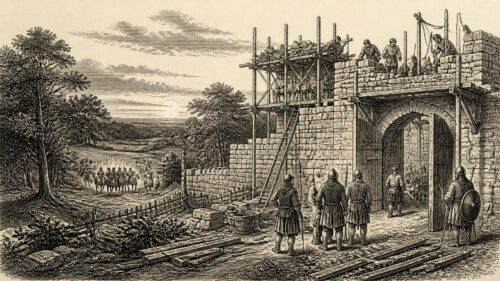
Across the areas under the lordship of the English crown, Robert of Ufford remained justiciar of Ireland. Modern research places much of his activity in Connacht during 1278–79, where royal resources were spent on Roscommon castle and on strengthening the existing fortifications at Rindown and Athlone. These were not passive masonry projects. Castles anchored garrisons, stored supplies, guarded river and road routes, and projected the claims of the Dublin government into contested territories.
For communities living near them, the work had practical consequences. Stone, timber, iron fittings, food, carts, draught animals and labour had to be procured. Roads and waterways became more strategically valuable. The surviving sources do not permit a detailed reconstruction of an individual labourer’s day in 1279, but they make clear that fortification translated political ambition into a material demand on the surrounding countryside.
An English chronicle known as Annales Hiberniae says that Ufford went to England in 1279 and left Friar Robert Fulbourn in his place; it also says, tersely, that “the money is changed”. Both notices must be handled carefully. Ufford’s overall tenure continued until 1281, so the reference may describe a temporary absence or deputisation rather than a final replacement. The monetary notice probably reflects the currency reform being prepared in 1279. The large-scale Irish recoinage itself began in May 1280, and contemporaries soon encountered new coinage through the mints and exchanges of Dublin and Waterford. Thus 1279 belongs to the start of an administrative and financial transition, not securely to the full implementation of it.
Thomas de Clare and the Thomond Frontier
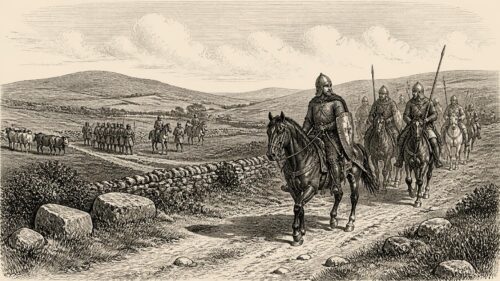
In Thomond, Thomas de Clare’s attempt to convert a royal grant into durable lordship continued to reshape the landscape. De Clare had received Thomond from Edward I in 1276, but its inhabitants were not simply subjects waiting to be governed. The Ó Briain dynasty was divided, rival Gaelic and Anglo-Irish interests crossed one another, and control depended on armed support as much as on royal parchment.
Scholarly biography places the laying of the foundations of de Clare’s large castle at Quin, near Ennis, in 1279, using military service granted after his appeal for assistance in 1278. A castle there was a strategic assertion of power in eastern Thomond. Yet the annalistic sequence demonstrates the insecurity of that assertion. Annála Connacht and the Four Masters place a destructive Ó Briain victory at Quin in 1278, while the Annals of Inisfallen, under 1280, tells of the castle’s construction and a devastating night attack on de Clare’s force. Rather than erase the discrepancy, it is best understood as evidence for repeated activity: a contested place, construction or rebuilding, and continuing war.
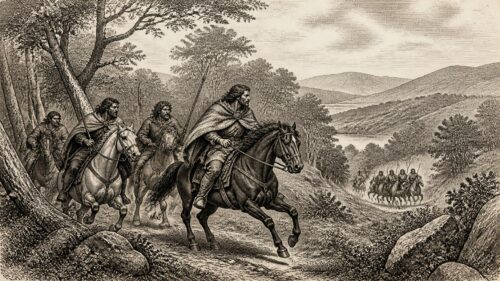
A much later Thomond narrative, Caithréim Thoirdhealbhaigh, specifically labels a 1279 expedition the “Hosting of Fertane”. It portrays de Clare’s cavalry and Donnchad Ó Briain’s infantry marching against Toirdelbach Ó Briain, only for men associated with the mid-Munster English to suffer a setback after moving through woodland. The account is vivid and valuable for preserving local political memory, but it is openly partisan and was written after the events. It can support the broad conclusion that campaigning continued in 1279; it cannot by itself establish exact numbers, a neutral account of tactics, or a comprehensive casualty list.
Religion, Burial and a New Monastery
South-west Munster supplies a very different kind of evidence. Under 1279, the Annals of Inisfallen records the death of Diarmait Mac Carthaig, son of Domnall Cairbrech, at Mag Nisi. Before death he received the monastic habit from Ó hUallacháin, bishop of Ross, and was buried in the newly built monastery at Crecán in Uí Badamna. The annalist describes this as a “victory of repentance”, a phrase used for a Christian death prepared by penitence and religious observance.
This is not a report that Diarmait had abandoned his kin or secular identity earlier in life. It records a final transition, directed by a bishop and marked by burial in a recent religious foundation. Its importance lies in the connection between aristocratic death, episcopal authority and monastic patronage. New or renewed religious houses offered burial, commemoration and spiritual prestige; they also tied local lordly families to particular places and clerical communities.
The year’s intellectual world appears briefly in the later Four Masters, which records the death of Gilla Ísu Mór Mac Fhirbhisigh, described as an ollam, or master, of Tíreragh in history. Although the notice is short, it points to the continued status of learned hereditary specialists. Learning in 1279 was not confined to cathedral schools: genealogical, historical and legal expertise remained embedded in Gaelic aristocratic society.
Land, Rent and Ordinary Exchange
One document dated 2 April 1279 gives a rare glimpse beneath high politics. At Moyaliff in north Tipperary, Robert Blanchard leased a half-carucate of land called Cappanmacer to John Lagheleys and his heirs for sixteen years, beginning at Easter, at an annual rent of two shillings in silver, while reserving common rights. Nearby deeds of about the same date record rents, roads, meadows, mills and parcels measured in acres. Such documents belonged to the legal culture of the Anglo-Irish lordships, but the landscape they describe was thoroughly local: fields lay beside waterways, roads connected mills and settlements, and access to common pasture mattered.
It would be wrong to present one lease as typical of every Irish community. Gaelic lordships often organised rights and exactions differently. Still, the deed shows that, alongside raids and castle-building, 1279 involved long-term agricultural calculation. Landholders expected tenants to pay silver rent, farm usable ground, respect boundaries and share defined resources over many seasons.
No major Irish harvest failure, epidemic or exceptional weather event can be securely assigned to 1279 from the evidence used here. The year should therefore not be made into a crisis of climate or subsistence. Its documented character is political and institutional: the passing of an archbishop, lethal competition among regional kindreds, a contested programme of lordly settlement in Thomond, royal investment in Connacht’s defences, religious burial and the routine business of landholding. Ireland in 1279 was not one kingdom moving to one rhythm. It was a connected island of local powers, churches, towns, lordships and learned communities, each registering the year in its own way.
Primary Sources
- Annals of Inisfallen, Annal AI1279
- Annála Connacht
- Annals of the Four Masters, 1278–1281
- The Annals of Ulster, Year U1279
- Caithréim Thoirdhealbhaigh, Part 1
- Annales Hiberniae
- Clare, Thomas de | Dictionary of Irish Biography
- Ufford (Offord), Sir Robert of | Dictionary of Irish Biography
- Monetary Policies in England, 1272–1307
- Calendar of Ormond Deeds, Volume I, 1172–1350
- The Administration of Ireland, 1172–1377
- Inquisitions and Extents of Medieval Ireland
- Annales Breves Hiberniae
- Annals of Loch Cé
- Annals of Tigernach
- Colonisation and Conquest in Medieval Ireland
- The Normans in Thomond
- The Earthworks and Castle of Bunratty, Co. Clare
- Galway City
- Chartered Towns
- The Great Port of Waterford
- Registrum de Kilmainham