Ballintober and the Meath Fires1362 CE
In 1362, Ireland was divided among competing Gaelic and English authorities. Cathal Óg Ó Conchobair and King Aodh of Connacht captured Ballintober Castle, an important former de Burgh stronghold, then led a major raid into Meath, burning churches and causing extensive damage before returning safely. Meanwhile, Lionel of Antwerp held parliament in Dublin, oversaw administration, including the exchequer’s move to Carlow, and received the title duke of Clarence. Cathal Óg later died of plague at Sligo. Annals also recorded deaths among churchmen and learned families, revealing continuing religious, legal and scholarly institutions amid warfare, epidemic and unstable regional power relations.

Dateline
In 1362, political authority in Ireland was divided, mobile and frequently contested. The king of England’s lieutenant, Lionel of Antwerp, was attempting to strengthen the English lordship from its shrinking eastern and southern centres. Across much of the island, however, Gaelic rulers and lordly kindreds exercised effective power in their own territories. The year’s best-attested events therefore do not form one national story. They are a series of connected local crises: a Connacht royal advance, the seizure of a castle, a destructive expedition into Meath, an outbreak of plague at Sligo, and the continuing business of government and learning in both Gaelic and English political worlds.
The fullest contemporary-style narrative comes from Annála Connacht, whose entries are especially strong for the province. It dates the year carefully, beginning it on Saturday, 1 January. Other annals preserve overlapping but not identical material, and their chronological systems sometimes differ. This matters: events assigned by one compilation to a neighbouring year should not casually be transferred into 1362. Where the evidence is secure, the year shows Connacht’s rulers carrying war eastward at the same time as Lionel’s government held a parliament in Dublin and pursued administrative reform within the lordship.
Ballintober Changes Hands
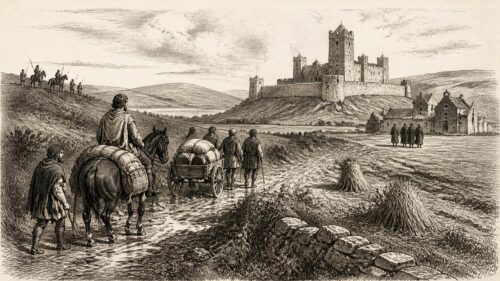
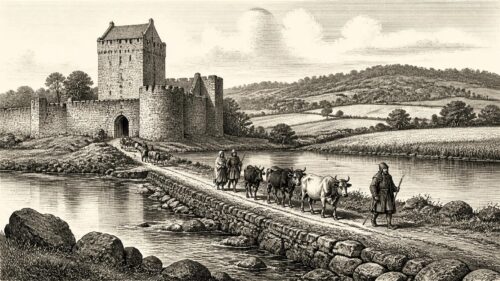
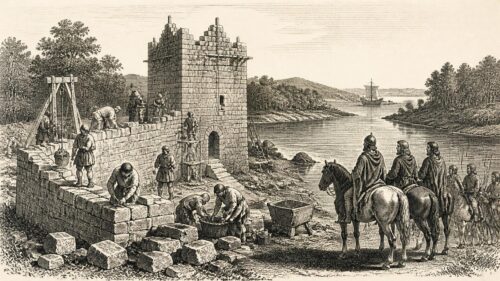
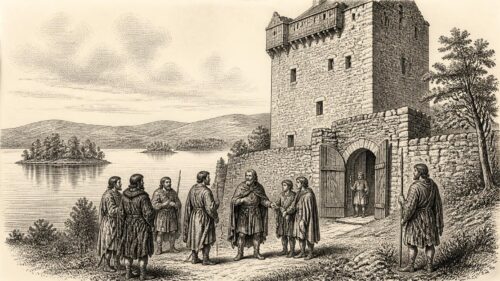
The key Connacht event was the taking of Ballintober Castle by Cathal Óg Ó Conchobair and Aodh, son of Feidhlimidh Ó Conchobair, king of Connacht. The annal gives no date within the year, no account of a siege, and no name for the previous holder. It is consequently unsafe to invent a dramatic assault or identify a particular defeated garrison. Yet the capture was important. Ballintober, in modern County Roscommon, had been a manor and castle associated with the de Burgh lordship; the 1362 notice is the earliest surviving reference to the castle in Gaelic possession.
A castle was more than a fortified residence. It was a focus for rents, agricultural produce, lordly hospitality, storage, servants and armed followers, and it could command routes through its surrounding territory. Its seizure was thus a practical assertion of authority as well as a military success. The episode illuminates the changing balance of power in Connacht after the weakening of the great de Burgh earldom. It does not mean that English influence had vanished from the province, nor that the Ó Conchobairs controlled all Connacht without rivals. Rather, it shows a Gaelic royal family able to appropriate an important stone stronghold and use that position in wider campaigning.
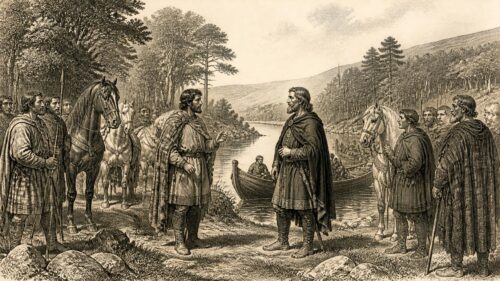
Cathal Óg was a prominent royal kinsman, while Aodh was king of Connacht. Their partnership is itself revealing. Gaelic kingship rested not on a simple rule of eldest-son succession but on a wider ruling lineage in which eligible relatives could be warriors, allies, rivals and potential successors. The annalist praises Cathal’s courage, strength and reputation; such language should be read as praise shaped by aristocratic values, not as a neutral biography. Nevertheless, the record confirms that he was a figure of consequence in the Connacht political world of 1362.
A Hosting into Meath
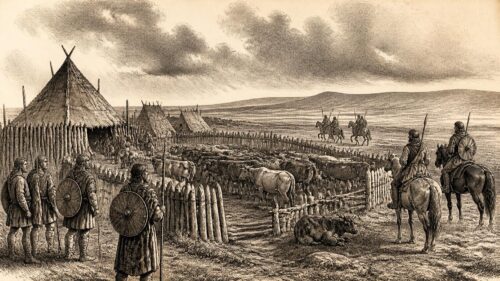
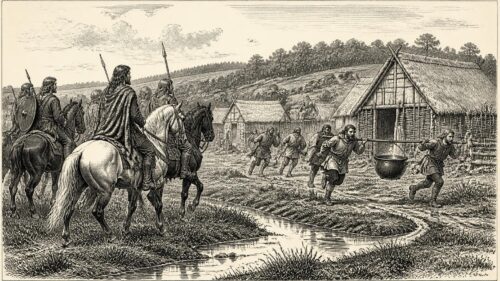
After Ballintober, Cathal Óg and King Aodh led what Annála Connacht calls a great hosting into Meath. A hosting was not merely a battlefield encounter. It was an organised lordly expedition: fighting men travelled with retainers and supplies, and its success was measured in access, destruction, tribute, captives or livestock as much as in a set-piece victory. The Connacht force burned its way as far as Áthais Mide. The annalist says that fourteen churches and Cell Cainnig were burned and that the damage done in Meath was difficult to count. The Annals of the Four Masters, drawing on related tradition, describes the churches as places in which the English had garrisons.
The wording should not be expanded beyond what it can bear. It does not establish the precise locations of all the churches, the size of their garrisons, or the number of people killed. It does, however, make plain that ecclesiastical places could be entangled in warfare. Churches were religious institutions, but they also possessed land, food stores, dependants and legal privileges; in insecure districts some evidently offered defensible sites to armed occupants. Their burning struck at both the material resources and the political presence of opponents. For parishioners, clergy, tenants and households nearby, such an expedition would have meant immediate peril: buildings and stores lost, livestock driven off, and the disruption of cultivation and travel. These consequences are reasonable inferences from the reported burnings, though the annals do not record ordinary people’s individual experiences.
The expedition returned safely to Connacht. That detail was worth recording because a raiding army was vulnerable while withdrawing, laden with plunder and moving through hostile country. Its successful return exposed a serious limitation in the lordship’s reach beyond its stronger settlements and lordships. Cormac Ballach Ó Máel Sechlainn, called king of Meath by the Connacht annalist, died in the same year. The source does not connect his death with the hosting, and no causal link should be assumed. Even so, the coincidence underlines how quickly local political circumstances could shift in a region already damaged by war.
Lionel’s Lordship
These Connacht actions unfolded while Lionel of Antwerp, earl of Ulster and lord lieutenant of Ireland, was trying to restore royal authority. He had arrived in Ireland in September 1361 as the adult son of Edward III, sent with a substantial retinue and an ambitious brief: reform the administration of the lordship and secure its threatened frontiers, particularly in Leinster. In January 1362 he held a parliament in Dublin. The surviving evidence does not justify treating that meeting as a solution to the island’s divisions, but it demonstrates that the institutions of the English lordship remained active.
Lionel’s administration also sought a more defensible and strategically useful centre. The exchequer, the financial arm of government, had been moved from Dublin to Carlow, though not every central institution followed it. This was a practical response to insecurity on the Leinster frontier, not a transfer of an all-Ireland capital. Documentary evidence from 1362 also shows government continuing to issue acts under Lionel’s authority: an October grant concerning forfeited lands in County Waterford was witnessed by him as the king’s lieutenant at Dublin. Administration, patronage and war thus operated together. Royal government rewarded service and managed landed rights even while its capacity to impose authority varied sharply from one region to another.
In November, Edward III created Lionel duke of Clarence. The honour elevated his rank, but it did not by itself provide the men, money or local alliances needed to control Ireland. The contrast with Connacht is instructive. Lionel possessed royal office, a parliament and a fiscal administration. Aodh and Cathal Óg demonstrated power by holding a castle and leading a force across Meath. Neither form of authority was imaginary; each was real within particular networks, territories and constraints.
Plague at Sligo
The year closed with a major loss for Connacht. Cathal Óg Ó Conchobair died of plague at Sligo on the third day after Samain, according to Annála Connacht. Samain began on 1 November in the Gaelic calendar, but it is best to retain the annal’s own wording rather than impose a falsely precise modern date. The death is corroborated by the Annals of the Four Masters, which also calls the cause plague.
“Plague” is an important but limited piece of evidence. It securely indicates that the annalist understood Cathal’s death as part of pestilence; it does not allow a modern diagnosis from this notice alone, nor does it supply mortality totals for Sligo or Connacht. Recent scholarship identifies 1361–62 as a period of renewed epidemic in Ireland, but the surviving Gaelic evidence is selective and concentrates on prominent people. Cathal’s death nevertheless had political weight. A successful commander and royal kinsman disappeared only months after the Ballintober seizure and Meath expedition. In a lineage-based political system, the death of such a man could alter the balance among relatives and allies even where the annal does not narrate an immediate succession dispute.
Church, Learning and Remembered Loss
The annals’ obituary lists offer another view of 1362. They record the deaths of ecclesiastical office-holders, including the coarb of Drumcliff, erenaghs associated with Cill-an-Iomaire and Elphin, an archdeacon of Cill Airid, and a vicar of Imleach. These offices point to the dense local organisation of medieval Irish Christianity. A coarb was the successor or hereditary custodian of a saint’s foundation; erenaghs managed church lands and obligations. Their appearance in the record shows that religious communities remained economic and social institutions, not simply places of worship.
The same notices remember learned families. Auliffe Mac Fir Bhisigh and John Mac Fir Bhisigh were described as intended ollamna, masters or leading scholars, of Tír Fhiachrach; Farrell Mac Aodhagáin was called a learned brehon, a professional judge of Irish law. Their deaths do not prove that schools ceased or law collapsed. On the contrary, the very use of these titles reveals continuing hereditary training in scholarship, legal practice and the preservation of learned tradition. Yet mortality among people being prepared for such offices could be costly for families whose expertise was transmitted through long apprenticeship.
For most inhabitants of Ireland, 1362 survives only indirectly: in the passage of armies, the burning of churches, the running of castles and estates, and the deaths recorded by elite chroniclers. The evidence does not permit a full portrait of harvests, markets or household life that year. It does permit a sharper conclusion. Ireland in 1362 was not a country moving uniformly towards either English reconquest or Gaelic recovery. It was a landscape of overlapping powers, where a royal parliament in Dublin, a relocated exchequer at Carlow, a captured Connacht castle, fires in Meath and disease at Sligo all belonged to the same unsettled year.
Primary Sources
- Annála Connacht: Annal 1362
- Annála Connacht: Annal 1362 (Irish text)
- Annals of the Four Masters: Annal M1362
- The Annals of Ulster: Year U1362
- Annála Connacht
- CELT Project: Annála Connacht
- CELT Project: Annals of the Four Masters
- CELT Project: The Annals of Ulster
- Lionel (‘of Antwerp’)
- Extract from a roll concerning the retinue of Lionel, Earl of Ulster, Lieutenant in Ireland, 36 Edward III
- Annals of the Kingdom of Ireland: National Library of Ireland catalogue record
- Ballintober Castle Survey
- Events: University of Galway
- Lordship and Principality: Colonial Policy in Ireland and Aquitaine in the 1360s
- Calendar of the Patent Rolls: Edward III, A.D. 1361–1364
- Patent Rolls, Edward III (1361 to 1364)
- Close Rolls, Edward III (1330–1363)
- Calendar of Ormond Deeds, Volume II, 1350–1413
- Report of the Deputy Keeper of the Public Records and of the Keeper of the State Papers in Ireland
- Climate, Disease and Society in Late-Medieval Ireland
- The Identification of Some Pestilences Recorded in the Irish Annals
- Crisis and Survival in Late Medieval Ireland: The English of Louth and Their Neighbours, 1330–1450
- Lionel Duke of Clarence