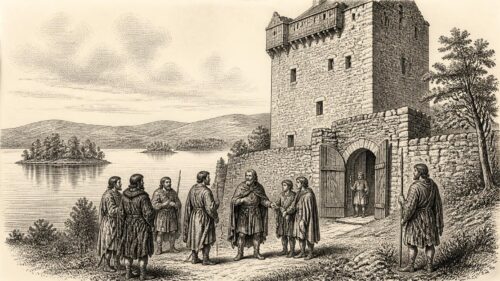
Dublin’s Guildhall Charter1363 CE
In 1363, Ireland comprised overlapping political worlds rather than a unified realm. Lionel of Antwerp, Edward III’s lieutenant, received English money, troops and lordship revenues to sustain royal authority, while regulation of purveyance and weights addressed administrative abuses. Dublin remained crucial: Lionel granted civic liberties on 26 September, confirmed by Edward in November, strengthening the Guildhall’s jurisdiction and commercial governance. Elsewhere, annals recorded deaths of Magnus Ó Domhnaill and Áed Mag Uidir, killings, captivity and inter-kindred conflict in Connacht and neighbouring regions. A severe windstorm damaged churches and houses and sank vessels, disrupting communities, trade and transport networks across waterways.

Dateline
A Year of Uneven Evidence
Ireland in 1363 was not governed, fought over or experienced as a single political unit. The king of England’s lordship was strongest in and around the principal towns and lordly liberties, while Gaelic dynasties exercised authority across much of the island through kinship, clientship, tribute and armed followings. The year’s surviving record reflects that divided landscape. Royal and urban documents illuminate Dublin and the English administration; the Irish annals preserve deaths, killings, a damaging storm and local struggles in Connacht, Fermanagh, Tír Chonaill and Breifne. They should not be made to tell a story of a uniform national crisis. Rather, 1363 shows several political worlds overlapping: a royal lieutenant trying to sustain authority, a chartered city defending its privileges, and regional lordships whose fortunes could change with a death, a captive or an act of violence.
Chronology also requires care. Annála Connacht and the Annals of the Four Masters place a group of deaths, killings and a great wind under 1363. The Annals of Ulster, however, use a dating system whose entries in this period do not always align directly with modern calendar years. This account therefore treats the Connacht annal’s explicitly headed year as the secure framework for events assigned to 1363, while using other annalistic material chiefly to explain the character of politics and warfare in the regions concerned.
Lionel’s Expensive Lordship
The most powerful representative of English royal government in Ireland was Lionel of Antwerp, duke of Clarence, Edward III’s second surviving son. Lionel had arrived in September 1361 as the king’s lieutenant. Through his wife, Elizabeth de Burgh, he was earl of Ulster and claimed a formidable inheritance: the earldom of Ulster, lordship of Connacht and a share of the liberty of Kilkenny. Yet the scale of those titles should not be mistaken for effective control. The de Burgh inheritance had fractured long before Lionel’s arrival, and his administration faced constrained revenue, insecure marches and the political weight of resident Anglo-Irish and Gaelic lordships.
In February 1363, the English crown sent Lionel further money and troops. This was a practical acknowledgement that royal ambitions in Ireland could not be financed simply from Irish receipts. The intervention of 1361–66 was among the largest directed by the English crown towards Ireland since the Bruce era, but it depended heavily on resources drawn from England. Lionel’s earlier attempts to strengthen the government had included campaigning in Leinster and moving the Irish exchequer to Carlow, closer to the vulnerable interior frontier. The wider governmental centre remained Dublin, however, and 1363 shows how important the city remained to royal rule.
November brought a further financial measure: Edward III granted the revenues of the lordship to Lionel for retaining troops among the English of Ireland. The wording and purpose matter. Royal power did not rest on distant proclamations alone. It required paid men, garrisons, supplies, mounts, weapons and co-operation from locally established elites. The grant was intended to make a military presence more sustainable, but it also exposed a persistent dilemma. Resources extracted locally could provoke resentment, especially where officials dealt with provisioning, fees, weights and measures, or compulsory purchases.
That tension is visible in orders sent in November. English legislation enacted in 1362, including provisions concerning purveyance and legal pleading, was conveyed to Ireland. Purveyance was a particularly sensitive issue because it concerned the taking of goods for royal use, supposedly with payment but readily open to abuse. Around the same time the crown restricted the authority of the Irish inspector of weights and measures after reports of extortion. These measures do not prove that all local government was corrupt; they do show that regulation of trade, food, official exactions and justice was a live political question in Lionel’s Ireland.
Dublin and Its Liberties
The clearest firmly dated civic development came in Dublin. On 26 September 1363 Lionel granted the city a charter of liberties, and Edward III confirmed it under the great seal at Westminster on 22 November. The confirmation reaffirmed and enhanced earlier civic privileges. One provision protected Dublin citizens from being sued outside their Guildhall for matters falling within the city’s jurisdiction, apart from specified cases concerning external tenures. The Guildhall on Winetavern Street was therefore more than a meeting place: it was a recognised setting for civic justice, commercial community and municipal authority.
This was meaningful in everyday terms. Dublin’s burgesses, traders, craftspeople, householders and officials lived in a walled port-city whose prosperity relied upon secure exchange, enforceable debts, regulated markets and predictable legal procedure. A privilege limiting where citizens could be impleaded helped preserve the city’s corporate jurisdiction against outside interference. It also tied urban loyalty to the Plantagenet regime. The crown needed Dublin’s money, shipping connections, administrative expertise and defensive reliability; Dublin’s civic leaders needed charters that made their collective rights harder to ignore.
The charter should not be read as evidence that Dublin stood apart from the island’s conflicts. Rather, it was an effort to make one vital node of the lordship more governable at a time when the crown’s reach was uneven. It also preceded, rather than foreshadowed as an accomplished fact, the famous legislation associated with Kilkenny in 1366. In 1363 no Statutes of Kilkenny had yet been enacted. The year’s better evidence concerns finance, administration and municipal privilege, not a completed programme of ethnic separation.
Dynasties, Death and Local Power
Beyond the lordship’s principal towns, the annals record a succession of events whose significance was regional but real. Magnus Eoganach Ó Domhnaill died in 1363. His death concerned the wider ruling family of Tír Chonaill in north-west Ulster, where succession and military reputation were central to political standing. In Fermanagh, Áed Mag Uidir, described by Annála Connacht as king of Fermanagh, also died. The Maguires’ lordship was rooted in the lake-and-river country of the Erne basin, where lordship depended on control of people, territories, routes and alliances rather than on a fixed territorial state.
Deaths of rulers and eligible heirs were not merely private losses. They could reopen rival claims, alter marriage alliances, release hostages, and invite raids by neighbours. The annals do not provide a full narrative of succession in Fermanagh after Áed’s death, so it would be unsafe to invent one. But their attention to his passing indicates the political standing attached to the office. It is equally important that the same sources preserve women’s identities through family and marital connections. Catirfina, daughter of an Ó Fearghail and wife of an Ó Raghallaigh, died in 1363. Such notices reveal how elite women stood at the junction of major kindreds, even when the chroniclers disclose little of their own actions or property.
Violence within and between lordly families continued. Muirchertach Ruad, son of Domnall Irruis Ó Conchobair, was killed by Magnus, son of Cathal Ó Conchobair. Tadc Mac Consnama, chief of Muintir Kenny, was wounded and captured by Cathal, son of Áed Ó Conchobair, and died in captivity. Cathal Mac Donnchada was killed by the people of Moylurg, the territory centred on what is now north Roscommon. These brief reports are stark, but they show the mechanisms of power at close range: kin-based rivalry, raiding, seizure of persons and the vulnerability of sub-regional chiefs.
Captivity in particular was politically consequential. A captured leader might be held for ransom, coerced into agreement, exchanged, or removed from a succession contest. The annal says only that Tadc died in confinement, not why he was seized or what settlement was intended. That limitation is part of the history. Medieval Irish annals were precise about names and outcomes more often than about motives; responsible reconstruction must retain that silence rather than turn every killing into a fully documented campaign.
Wind, Water and Material Loss
The most wide-ranging event recorded for 1363 was environmental. Annála Connacht reports “a great wind” that wrecked churches and houses and sank many ships and boats; the Annals of the Four Masters likewise calls it a very great storm. No exact day or places are supplied, so it cannot responsibly be mapped as an island-wide disaster of measured scale. Nonetheless, the wording indicates a severe windstorm whose effects were felt across built structures and waterways.
For contemporaries, damage to churches carried both material and spiritual weight. Churches were centres of worship, burial, local identity and, in many places, landholding and hospitality. Damage to houses meant lost roofs, stored goods, tools and shelter as winter approached. The loss of ships and boats was equally serious in an island where rivers, loughs and coastal waters linked settlements, fisheries, markets and lordships. Small craft carried people, livestock, food, timber and news; larger vessels connected Irish ports to Britain and continental trade. A storm that sank boats interrupted livelihoods as well as travel.
1363 consequently captures medieval Ireland in miniature: authority was negotiated through charters and armed service, but also tested by local feud, bereavement and weather. Dublin’s Guildhall charter strengthened an urban community within the English lordship. Lionel’s subsidies and revenues demonstrated the crown’s continuing investment and its financial strains. In Connacht and Ulster, annalists recorded leaders, captives and kin groups whose political horizons were not set by Dublin. Above them all came a wind powerful enough to bring down churches, houses and vessels. It was a reminder that neither royal grants nor lordly power could command the elements on which ordinary security depended.
Primary Sources
- Annála Connacht
- Annals of the Four Masters, Part 20
- The Annals of Ulster, Part 166
- CELT Project: Annála Connacht
- CELT Project: Annals of the Four Masters
- Lionel (‘of Antwerp’)
- Burgh, Elizabeth de
- Clare, Elizabeth (de Burgh)
- ‘Hobbes’, ‘Dogs’ and Politics in the Ireland of Lionel of Antwerp, c. 1361–6
- Factionalism and Noble Power in English Ireland, c. 1361–1423
- Negotiating Authority in a Colonial Capital: Dublin and the Windsor Crisis, 1369–78
- Law, Legislation, and Consent in the Plantagenet Empire: Wales and Ireland, 1272–1461
- Lordship and Principality: Colonial Policy in Ireland and Aquitaine in the 1360s
- Ireland
- The Viceroyalty of Lionel, Duke of Clarence, in Ireland, 1361–1367
- The Statutes of Kilkenny Enacted at a Parliament Held under Lionel Duke of Clarence, Son of Edward III
- Municipal Dublin
- Dublin to 1610
- About Our Archive Holdings
- Annales Hiberniae
- Climate, Disease and Society in Late-Medieval Ireland